Do heroes get special mortgage rates? We debunk eight hero home loan myths: GNND, DPA, nurse and teacher loans, overtime income, and commission rebates.
Home Loans for Heroes in Colorado: First Responders, Nurses, Teachers & More
Yes, Colorado heroes have real advantages when buying a home, but those advantages come from three very different places, and they behave very differently: some are published government programs, some are marketing arrangements, and sorting each offer into the right bucket is most of the work.
Home loans for heroes is an umbrella phrase, not a single product. It covers government programs, commercial rebate networks, and a small number of lender-built loans designed around one profession.
This guide maps every path a Colorado first responder, nurse, teacher, physician, or service member can take, and it says plainly which paths move real money and which mainly repackage benefits you may already have.
The three categories of hero home loans

Nearly everything marketed to heroes falls into one of three buckets. Sorting an offer into the right bucket before you shop is the most useful thing you can do.
- Government programs – HUD Good Neighbor Next Door, Colorado Housing and Finance Authority (CHFA) assistance, and the FHA and VA loan baselines.
- Commercial rebate networks – private marketing companies that pair you with participating real estate agents and affiliated providers who rebate part of their compensation at closing.
- Lender products – portfolio loans, most commonly physician mortgages, underwritten around the income pattern of one profession.
| Category | What it actually is | Where the savings come from |
|---|---|---|
| Government programs | Public benefit programs with published rules | A discounted purchase price, assistance funds, or a lower down payment requirement |
| Rebate networks | Private marketing referral networks | A share of the real estate agent commission, plus optional fee credits from affiliated providers |
| Lender products | Portfolio loans held by one individual lender | Flexible down payment and student loan treatment for a named profession |
Whether hero home loans actually save money depends almost entirely on which of the three categories you are looking at.
Every program in all three buckets is laid out line by line in our hero home loan programs compared table.
Why the distinction matters
A rebate network cannot change your interest rate, and a government program cannot pay your real estate agent. They are not competing options; they are separate layers that can often be used in the same transaction.
The one factor that touches every dollar of a 30-year loan is loan pricing itself, and no branded hero label controls it. That is why the comparison at the end of this guide matters more than any single program name.
Category one: government programs Colorado heroes can use
These are the programs with published rules, published eligibility, and no sales incentive behind them. They are also the ones with the most genuine dollars attached.
HUD Good Neighbor Next Door
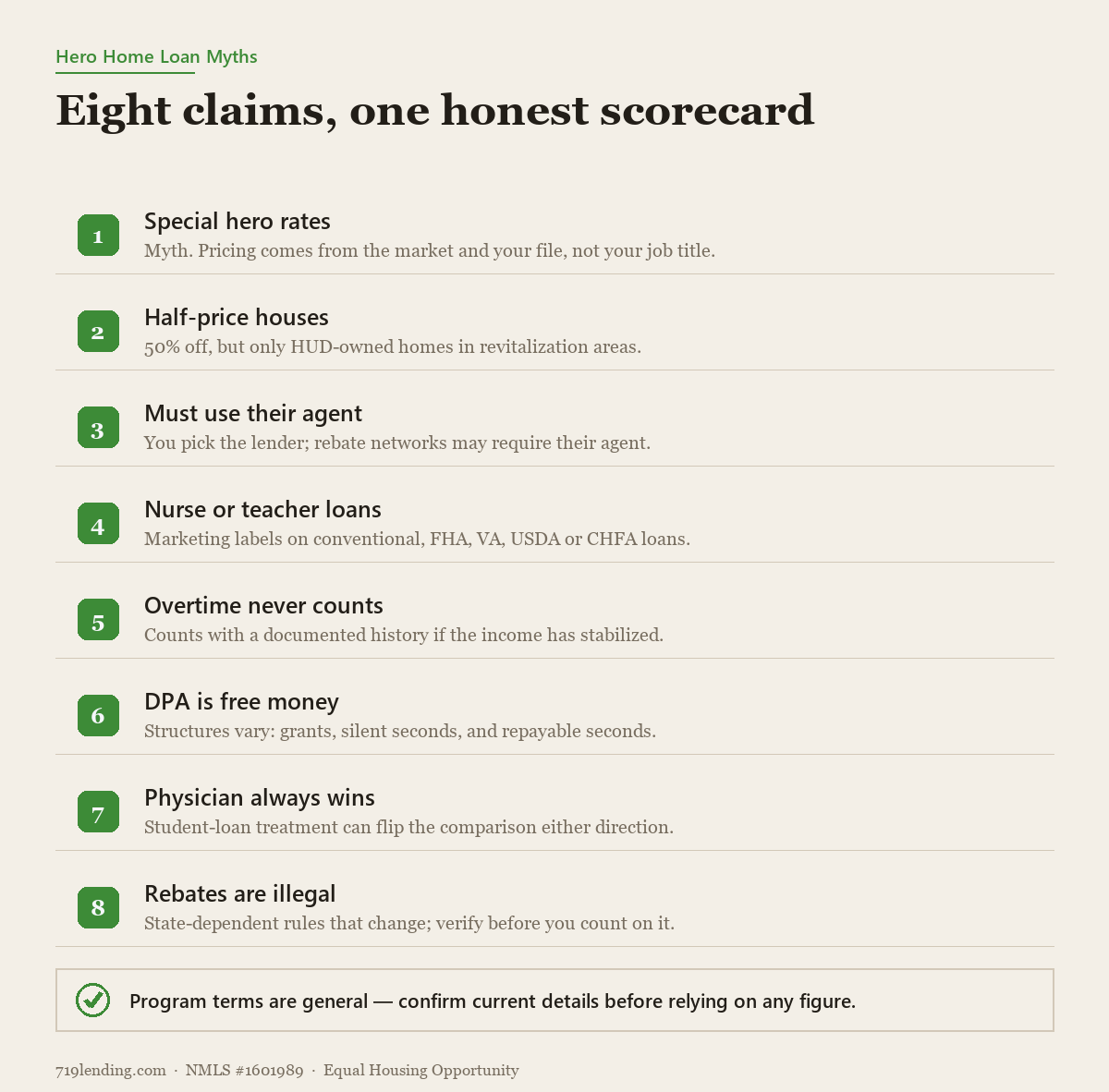
The HUD Good Neighbor Next Door program is the rare hero benefit that is unambiguously large when it applies. HUD offers a 50 percent discount off the list price (figure is general – confirm current with HUD) on certain HUD-owned homes in designated revitalization areas. Eligible buyers are law enforcement officers, pre-K through 12th grade teachers, firefighters, and emergency medical technicians. In exchange, the buyer commits to a 36-month owner-occupancy period secured by a silent second mortgage that carries no interest and no payments when the occupancy requirement is met (program terms are general – confirm current with HUD).
The catch is inventory. Qualifying homes are listed for a short program window, and when more than one eligible buyer submits an offer on the same home, HUD selects the buyer by random lottery rather than by highest bid. Availability in any given Colorado county varies over time, so check current listings rather than assuming a home is waiting. Eligibility rules, current listings, and the selection process are published by HUD, and listings change frequently.
CHFA assistance, which is open to every profession
Colorado Housing and Finance Authority programs are the workhorse of Colorado homebuying assistance. CHFA offers down payment and closing cost help in the form of a grant or a second mortgage, paired with a CHFA first mortgage loan program and subject to income limits, purchase price limits, credit standards, and a homebuyer education requirement (terms are general – confirm current with CHFA).
CHFA assistance is not a hero program, and that is the point. Most Colorado heroes get more mileage from down payment assistance than from any badge-specific discount. The funds are real, repeatable, and available to every profession rather than to a short eligibility list.
CHFA has also offered targeted programs for educators and school employees at various times. Availability and terms change, so ask a CHFA participating lender what is open right now if you work in a Colorado school system.
FHA and VA loan baselines
FHA loans allow a lower minimum down payment and more flexible credit standards than most conventional programs, at the cost of mortgage insurance whose cost and duration depend on your down payment and loan term (general – confirm current).
VA loans carry benefits no other program matches for those who qualify: no required down payment on most purchases, no monthly mortgage insurance, and a funding fee that is waived for borrowers receiving VA compensation for a service-connected disability, among other exemptions (general – confirm current with the VA). The VA publishes its home loan eligibility requirements and certificate of eligibility process directly.
Our take: if you are eligible for a VA loan, it is the first thing to price, and most other hero offers on the table are small by comparison.
Category two: commercial rebate networks and what they really are

This is where most of the confusion in the hero space lives, and where the marketing is loudest.
How the rebate actually reaches you
Rebate networks such as Homes for Heroes are marketing organizations, not lenders. You sign up, the network refers you to a participating real estate agent, and that agent agrees to rebate a portion of the commission they earn back to you at closing. Affiliated lenders, title companies, and inspectors may add their own fee credits.
Nothing about this changes your interest rate, your loan program, or your approval odds. It is a discount on service fees, delivered by companies who participate in the network and who recover that cost through volume.
What to ask before you enroll
- Is the rebate a fixed dollar amount or a percentage of a commission that has not been negotiated yet?
- Am I required to use a specific lender or title company to receive the full credit?
- Would an agent I already trust match or beat the rebate without the network?
- Does the affiliated lender’s pricing offset the credit I am being promised?
Our take on rebate networks
Our take: a rebate you would have received anyway from a good agent is not savings, and a fee credit that arrives alongside higher loan pricing can be a net loss. Rebate networks are legitimate and sometimes genuinely useful, but they belong in the marketing column of your budget, not the mortgage column.
Ask for the credit in writing before you commit to anything, and compare it against a competing offer that has no network attached.
Category three: lender products built around a profession
A handful of lenders write loans that are underwritten to how a specific profession actually earns and owes money. These are portfolio products, meaning the lender keeps the loan rather than selling it, so terms vary widely from lender to lender.
Physician and professional mortgages
Physician mortgage loans are commonly marketed as allowing a very low or zero down payment at higher loan amounts, waiving monthly mortgage insurance, and applying their own treatment of deferred or income-driven student loan payments. Some lenders extend a similar product to dentists, veterinarians, and in some cases nurse practitioners and physician assistants (eligibility and terms vary by lender – confirm current).
It is worth knowing that agency guidelines already offer meaningful student loan flexibility of their own, so the branded product is not automatically the better answer. Pricing on a portfolio product can also differ from a comparable conventional loan, and a physician program that prices well at one lender may not at the next. Price it against a conventional option before assuming it wins.
Where non-agency loans help other heroes
Nurses running a per diem business, paramedics with a side company, and teachers who tutor or coach independently sometimes look self-employed to an underwriter. Bank statement and other alternative documentation loans can solve that when tax returns understate real cash flow, generally at the cost of a larger down payment and different pricing (general – confirm current).
Profession by profession: where Colorado heroes should start
Every profession below has a different first move. The programs overlap, but the sequence does not.
Police officers and sheriff deputies
Colorado first responder home loans are usually a stack of ordinary programs rather than one badge-specific mortgage. Sworn officers are eligible for Good Neighbor Next Door when qualifying homes exist, and departmental shift differential and off-duty detail pay can often be counted as income with the right documentation.
Firefighters and EMS
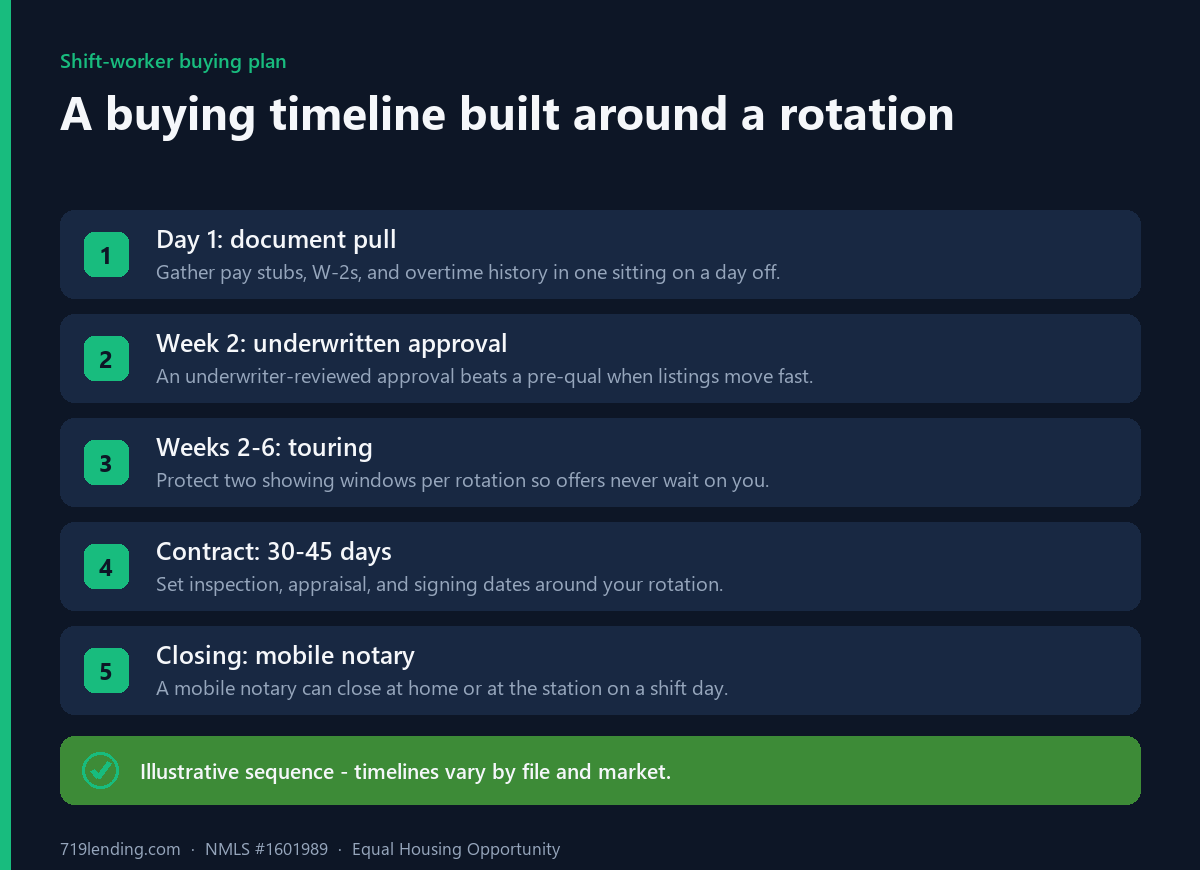
Firefighters and emergency medical technicians share Good Neighbor Next Door eligibility with law enforcement officers and pre-K through 12th grade teachers. The bigger underwriting issue is usually the rotating shift schedule and overtime-heavy pay, which needs a documented history before it counts toward qualifying income.
Nurses and travel nurses
Staff nurses generally qualify with standard documentation, and differential and on-call pay can be added once there is a documented track record. Travel nurses are a different animal: contract-to-contract work, stipends that many lenders will not count as qualifying income, and gaps between assignments all shape which lender can approve the file. How your stipends are treated for tax purposes is a separate question – consult a tax professional.
Teachers and school staff
Teachers have one of the widest menus on this list, because pre-K through 12th grade teachers hold Good Neighbor Next Door eligibility and can also use CHFA assistance. Pay that runs on a school-year calendar is familiar to underwriters and is generally manageable when documented correctly (general – confirm current).
Physicians, residents, and dentists
Residents and fellows with a signed employment contract can sometimes close before the new job starts, depending on the lender and program (general – confirm current). Price the physician loan against a conventional loan with a real down payment before assuming the branded product wins.
Military and veterans
Active duty service members, veterans, and many surviving spouses should start with the VA loan. Basic allowance for housing, basic allowance for subsistence, and other military allowances are commonly counted toward qualifying income, and how a lender treats them changes your qualifying number materially.
How lenders count overtime, shift differential, and per diem
For most Colorado heroes, the qualifying question is not the program. It is whether the pay that funds their household actually counts.
The general rule of thumb
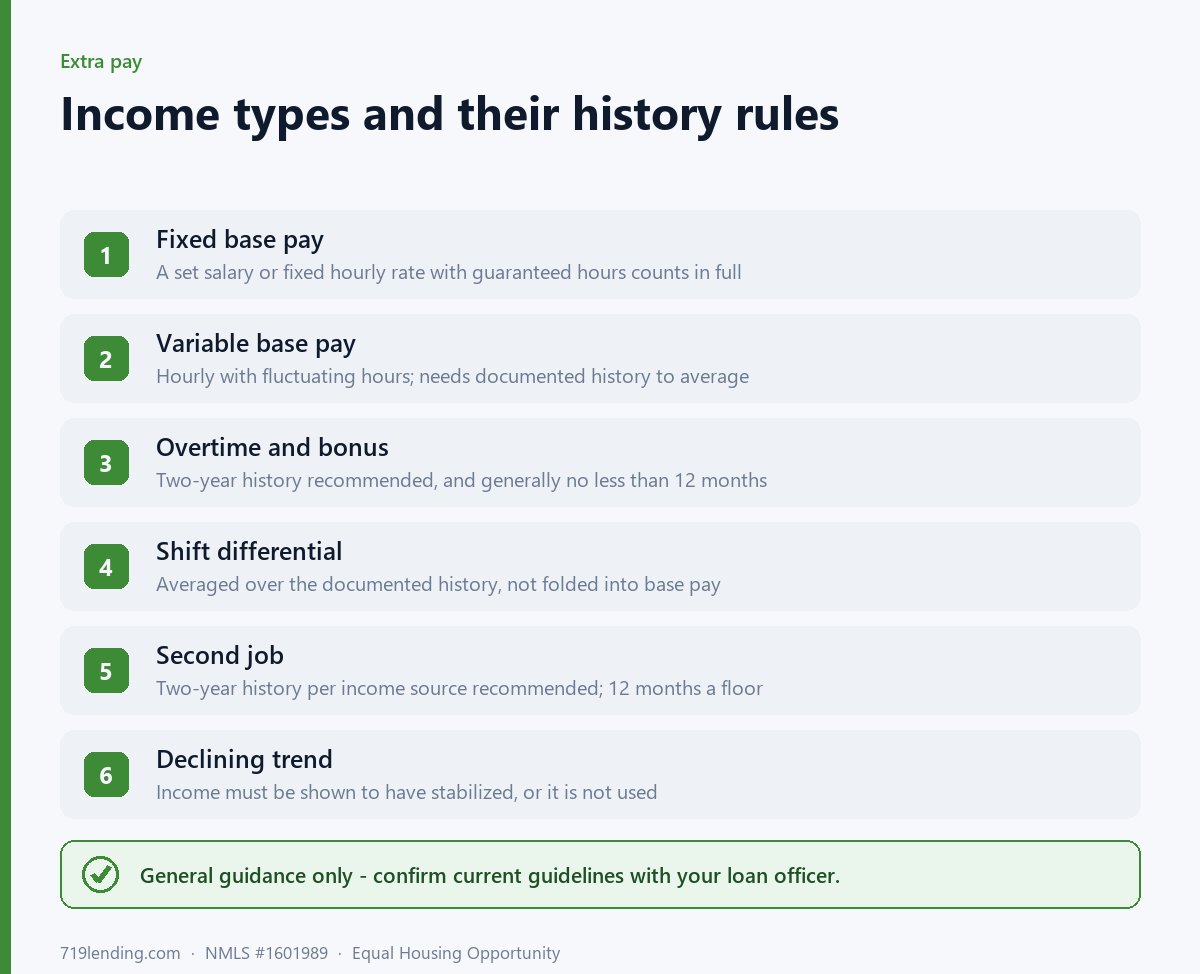
Agency guidelines look for a documented history of variable income plus evidence that it is likely to continue. A two-year history is recommended, but a shorter history of no less than 12 months may be acceptable when positive factors reasonably offset it, so do not assume you are disqualified at the 18-month mark. Lenders then average the income across the documented period. If the income has been declining, the lender must confirm it has stabilized at the lower level before it can be used at all (general – confirm current). Fannie Mae publishes its requirements for bonus, commission, overtime, and tip income.
What to bring to the first conversation
- Your most recent 30 days of pay stubs showing base, overtime, and differential broken out separately.
- Two years of W-2s, plus a year-to-date earnings statement if your employer issues one.
- Documentation of any contract, stipend, or per diem arrangement, including start and end dates.
- A written explanation of any employment gap, deployment, or travel assignment break.
Bringing these to the first call turns a maybe into a number, which is the whole point of a pre-approval.
Colorado Springs is a hero-heavy market
Colorado Springs is home to multiple military installations, a large hospital system, established fire and police departments, and several sizable school districts. In practical terms, that means a meaningful share of every neighborhood tour is competing against other heroes.
What that means for your offer
Sellers in this market respond to certainty, not to the name of your program. A fully underwritten pre-approval, a realistic closing timeline, and a lender who answers the listing agent’s phone call are worth more than any hero branding on your letter.
It also means assistance funds can move quickly. CHFA allocations and any locally administered assistance are finite, so confirm availability at the moment you write the offer rather than at the moment you started looking.
The savings lever most heroes overlook
Across every file we see, the largest recurring variable is not the program. It is the price of the loan itself, and it is the one number heroes are least likely to shop.
Why pricing beats branding
A difference in rate or lender credit compounds across hundreds of payments. A one-time rebate does not. Working with a mortgage broker in Colorado Springs means one application can be priced against many wholesale lenders at once. That is the mechanism that actually produces competition on your behalf.
Stacking without double-counting
The honest sequence for most heroes looks like this:
- Confirm VA eligibility first, because nothing else compares for those who qualify.
- Check whether a Good Neighbor Next Door home exists in your search area right now.
- Layer CHFA or local assistance onto whichever loan program you land on.
- Shop the loan pricing across lenders before you accept any of it.
- Treat rebate credits as a last-mile bonus, negotiated in writing.
How to compare two offers honestly
Put the two written estimates side by side on the same loan amount, same day, and same lock period. The Consumer Financial Protection Bureau explains how to compare Loan Estimates side by side. If one offer includes a hero credit and still costs more over five years, it is not the cheaper offer.
Buying locally? Start with our first responder guide to buying in Colorado Springs, and before you sign up for anything branded, read the hero home loan myths we debunk most often.
Frequently asked questions
What is a hero home loan?
There is no single loan called a hero home loan. The phrase describes three separate things: government programs like HUD Good Neighbor Next Door and CHFA assistance, private rebate networks that return part of a real estate commission, and portfolio loans built for specific professions such as physicians. Sorting an offer into the right category tells you whether it saves real money.
Is there a special mortgage just for first responders in Colorado?
No. Colorado does not have a first-responder-only mortgage product. What first responders do have is eligibility for Good Neighbor Next Door on qualifying HUD homes, access to the same CHFA assistance available to every profession, and underwriting flexibility around overtime and shift differential pay when it is documented.
Do nurses and teachers qualify for Good Neighbor Next Door?
Pre-K through 12th grade teachers qualify. Nurses are not among the program’s eligible occupations, which are law enforcement officers, pre-K through 12th grade teachers, firefighters, and emergency medical technicians (general – confirm current with HUD). Nurses should focus instead on CHFA assistance, VA eligibility if applicable, and lender products that count differential and per diem income.
Are hero rebate programs worth it?
Sometimes. A rebate network can return a meaningful credit at closing, but it is a discount on service fees, not a mortgage benefit, and it does not change your rate. Get the credit quoted in writing, confirm whether you must use an affiliated lender, and compare the total cost against an offer with no network attached before enrolling.
Can I use CHFA down payment assistance with a VA or FHA loan?
CHFA down payment assistance is designed to be paired with a CHFA first mortgage loan program rather than added to any lender’s loan, and the underlying loan types CHFA offers change over time (general – confirm current with CHFA). Because program combinations, allocations, income limits, and purchase price limits change, confirm the exact pairing with a CHFA participating lender before writing an offer.
What credit score do heroes need to buy a house in Colorado Springs?
The same standards apply to heroes as to everyone else. Minimums vary by program and lender, with FHA and VA generally more flexible than conventional financing, and assistance programs sometimes setting a higher floor than the loan itself (general – confirm current). Your score also affects loan pricing, which is why it is worth reviewing months before you shop.
Does overtime count as income for a mortgage?
Often, yes, but not automatically. Agency guidelines recommend a two-year history of the overtime or shift differential and generally accept no less than 12 months when positive factors offset the shorter history, plus evidence the income is likely to continue. Lenders typically use an average rather than your best recent month, and declining income must be shown to have stabilized. Bring pay stubs that break out base, overtime, and differential separately so the number can be calculated correctly.
719 Lending Inc., NMLS #1601989 · Equal Housing Opportunity
719 Lending Inc. is not affiliated with or endorsed by HUD, FHA, VA, CHFA, or any government agency.
Last updated: July 2026

Related Posts