Do heroes get special mortgage rates? We debunk eight hero home loan myths: GNND, DPA, nurse and teacher loans, overtime income, and commission rebates.
Home Loans for Police Officers & Law Enforcement
Yes, there are real home loan options built around law enforcement work, but there is no single “police mortgage” that beats every other product. For most officers the biggest savings levers are loan pricing shopped across multiple wholesale lenders, down payment assistance you may be able to stack, and, for a narrow slice of homes, HUD’s Good Neighbor Next Door program.
This guide covers what genuinely exists for law enforcement buyers in Colorado, how underwriters treat overtime and off-duty detail income, what Colorado assistance can add on top, and how to tell a real program from packaging.
Home loans for police officers: the short answer
Three very different things get marketed to officers under the same “hero” umbrella. Keeping them straight is most of the work.
| What it is | What it actually does |
|---|---|
| Good Neighbor Next Door (HUD) | Large discount on a small, specific set of HUD-owned homes; real money when a home fits |
| State and local assistance (CHFA and county programs) | Down payment or closing cost help layered onto a standard loan |
| Standard loan products (conventional, FHA, VA) | Where pricing is actually won or lost; officers use the same products as everyone else |
| Commercial “hero” rebate networks | Agent commission rebates and affiliated fee credits; marketing arrangements, not loan products |
| Lender portfolio products | Occasionally useful for unusual income or asset profiles; priced accordingly |
Our take: for the majority of officers, loan pricing plus a stackable assistance program moves more money than any badge-branded label. Good Neighbor Next Door is the exception, because when a qualifying home exists, the discount is unusually large.
Officers who already know they want a broad map of hero programs should start with our overview of home loans for heroes in Colorado, then come back here for the law enforcement specifics.
Good Neighbor Next Door: the law enforcement track
Who qualifies as law enforcement
Good Neighbor Next Door is a HUD program, not a lender promotion. HUD’s published criteria center on full-time employment as a law enforcement officer by the federal government, a state, a unit of general local government, or an Indian tribal government, and HUD also describes participants as serving the locality where the home is located.
HUD applies additional conditions that catch officers by surprise. You generally cannot have owned any residential real property within the 12 months before you submit a bid, and you cannot have previously purchased through Good Neighbor Next Door or its predecessor Officer Next Door and Teacher Next Door programs. Part-time, reserve, and civilian agency roles are not treated the same way as full-time officer positions, so confirm your specific role against HUD’s current eligibility criteria before building a plan around it (general – confirm current).
How the discount is structured
Eligible homes are HUD-owned properties in designated revitalization areas, listed on HUD’s marketplace for a short program window of about seven days (general – confirm current program terms).
HUD describes the benefit as a 50 percent discount from the list price of the home (general – confirm current program terms). The discount is not cash. You sign a second mortgage and note for the discount amount, with no interest and no payments, and that silent second is satisfied if you live in the home as your principal residence for the full 36-month occupancy period. HUD requires annual certification that you still live there, and breaking the occupancy commitment makes the second collectible.
HUD publishes the current Good Neighbor Next Door eligibility rules and the live list of eligible homes on its own site. Bids are submitted through a HUD-registered broker, and when more than one eligible buyer bids on the same home, the winner is selected by random lottery.
The realistic catch
Inventory is the constraint, not eligibility. Eligible listings are limited to designated revitalization areas, turn over quickly, and are sold as-is, so availability in any given county, El Paso County included, varies from week to week. Check HUD’s listings directly rather than assuming a home will be there when you are ready.
The mechanics, eligibility windows, and bidding lottery are covered in more depth in our guide to the Good Neighbor Next Door program. Our take: treat it as a standing alert you check monthly, not as the plan your purchase depends on.
How underwriters count a police paycheck

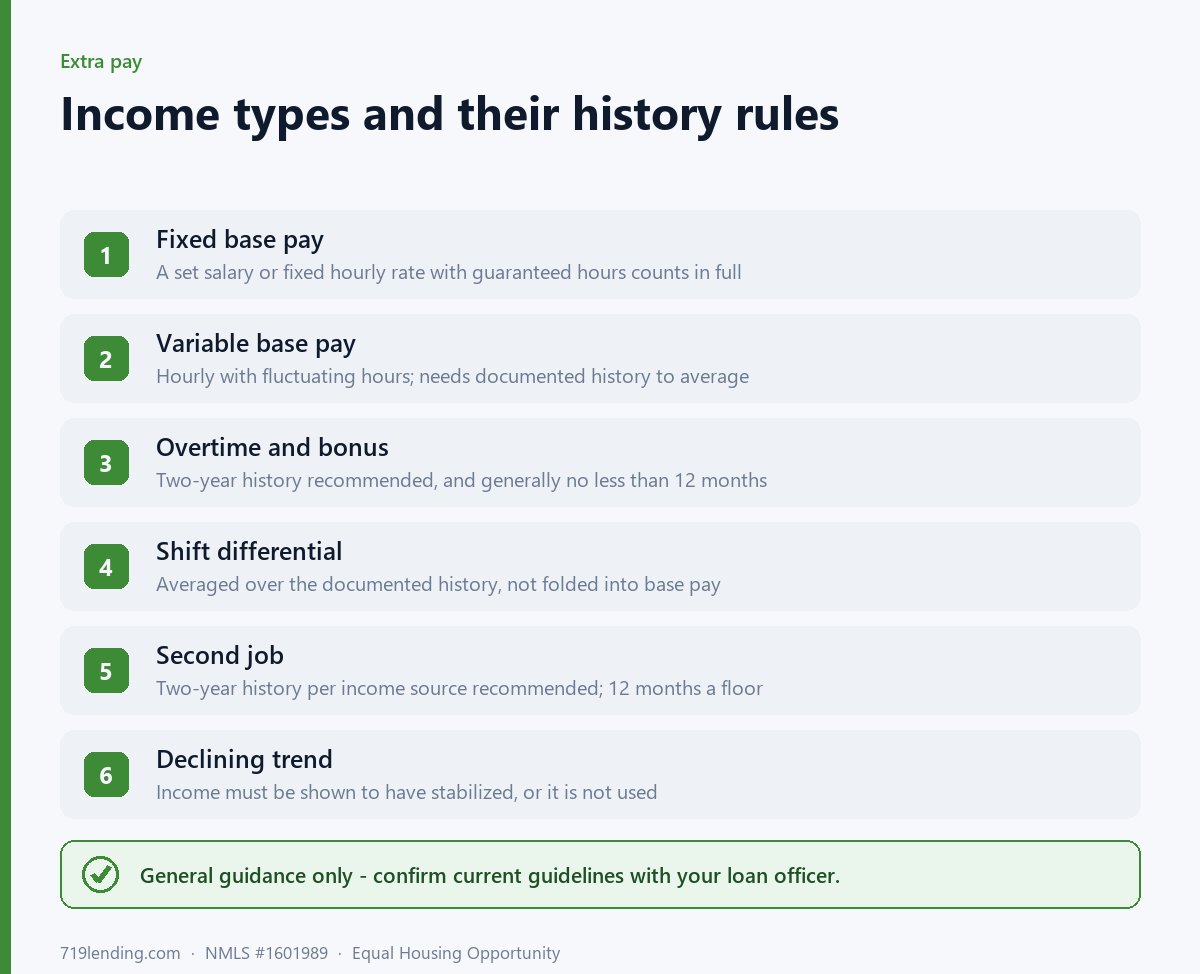
Law enforcement pay is rarely one clean number, and that is the single most common reason an officer’s preapproval comes back lower than expected. Underwriters split the paycheck into steady base pay and variable pay supported by a documented history, generally a minimum of 12 months with a two-year history recommended (general – confirm current investor and lender requirements).
Base pay is the easy part
Salary or contracted hourly base pay is counted in full from a current pay stub and a verification of employment. Step increases and negotiated contract raises are usually counted only once they are in effect and showing on pay stubs.
Overtime and off-duty detail
Overtime, callback pay, and agency-administered off-duty detail are treated as variable income. Fannie Mae’s Selling Guide sets the conventional baseline in its bonus, commission, overtime, and tip income topic (B3-3.3-02), updated in March 2026: a minimum two-year history is recommended, and a shorter history of no less than 12 months may be considered when positive factors reasonably offset it. The monthly figure is an average built from year-to-date and prior-year earnings rather than the highest recent month.
Two details matter more than officers expect. First, a declining trend is not simply averaged down: where variable income is decreasing, the lender must confirm the current income level has stabilized after the decline, and if it has not, that income is not eligible for qualifying. Second, off-duty detail paid directly by a third party rather than through the agency payroll may be treated as self-employment income, with a different documentation path.
Shift differential, holiday, and court pay
Night and swing differential, holiday pay, and court appearance pay are generally handled like overtime: averaged over a documented history, and counted only when the pattern of receipt is consistent and reasonably expected to continue (general – confirm current). Because so much of a police paycheck is variable, the rules for overtime and shift differential income deserve their own read.
What usually gets excluded
Uniform, equipment, and vehicle allowances are frequently excluded unless they appear as ongoing taxable income on the W-2 and can be documented as continuing. One-time hiring or retention bonuses are typically excluded from qualifying income, and any tax treatment of allowances or bonuses is a question to take to a tax professional.
Illustrative qualifying income math for a patrol officer

Here is how the pieces come together. These figures are illustrative only and are not a quote or an approval.
Take an officer with $6,333 per month in base pay (roughly $76,000 annually) plus overtime and detail pay that averages $1,150 per month across a 24-month documented history. The qualifying income used for the debt-to-income calculation is $7,483 per month, not the base pay alone and not the highest recent month.
That $1,150 difference is often the gap between qualifying for the house an officer actually wants and qualifying for something smaller. It is also why officers with heavy overtime should think carefully before applying right after a transfer to a unit that pays less of it, since a fresh downward trend can push that income into the category where a lender must first confirm it has stabilized before any of it can be used.
Our take: bring 24 months of pay history to the first conversation. Most disappointing preapprovals for officers are documentation problems, not credit problems.
Veteran officers and VA loans
A large share of Colorado Springs officers are veterans. Our take: for eligible borrowers the VA loan is frequently the strongest structural option. The VA program does not require a down payment and does not require monthly mortgage insurance, which changes the monthly math meaningfully compared with low-down-payment alternatives.
A VA funding fee applies at closing and varies with the size of the down payment and whether it is a first or subsequent use of the benefit. The VA lists exemptions that include borrowers receiving VA compensation for a service-connected disability, certain surviving spouses receiving Dependency and Indemnity Compensation, and eligible active-duty Purple Heart recipients. Funding fee amounts, the conditions that change them, and the exemption categories are documented directly by the VA (general – confirm current).
Veteran officers should compare their VA loan option in Colorado Springs against conventional and FHA pricing before assuming one wins. Seller credits, property condition, and the size of the down payment you actually want to make all shift the answer.
Colorado down payment assistance police officers can stack
Most officers we work with get more mileage from Colorado down payment assistance through CHFA than from any badge-branded marketing program. CHFA pairs first mortgage products with down payment and closing cost assistance, and programs of this type carry their own conditions, commonly including income limits, purchase price limits, credit minimums, and a homebuyer education requirement (general – confirm current directly with CHFA).
Assistance can be structured as a grant or as a second mortgage depending on the program selected, and amounts and limits are revised periodically, so treat any figure quoted online as out of date until you confirm it with the administering agency. El Paso County and the City of Colorado Springs have also operated their own homebuyer assistance and mortgage programs at various times; availability changes, and which programs are open to new applications should be confirmed before you count on one (general – confirm current).
The important structural point: assistance programs generally attach to the loan, and the loan pricing still gets shopped. An assistance program paired with an uncompetitive first mortgage can cost more over time than a slightly smaller assistance package on better pricing, which is exactly the tradeoff a broker should model in writing.
Colorado Springs and El Paso County specifics
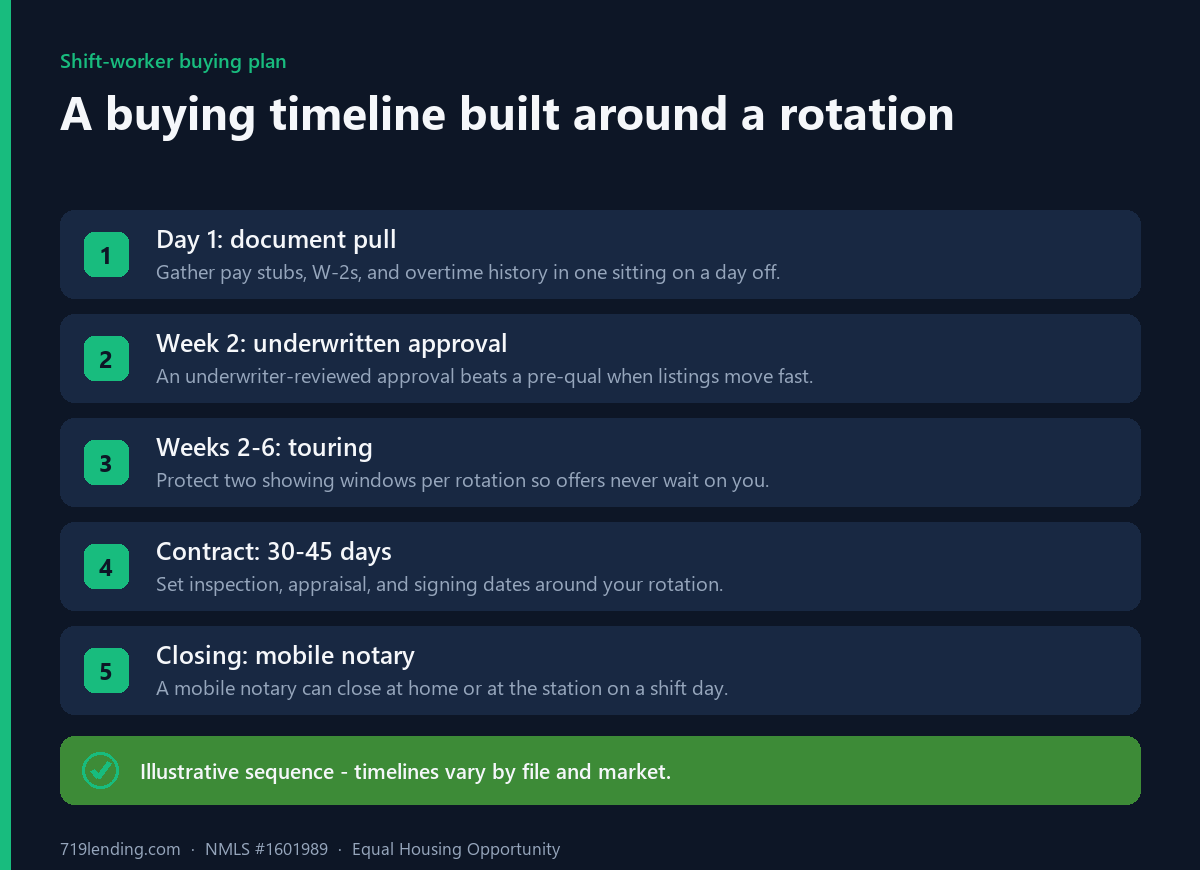
Colorado Springs Police Department and El Paso County Sheriff’s Office schedules produce two recurring mortgage issues: appointment availability and rotating shifts that complicate document turnaround. Building the file before you shop, rather than during a contract, removes most of that friction.
The local market is also unusually military-adjacent, with Fort Carson, Peterson Space Force Base, and Schriever Space Force Base shaping inventory and competition in specific corridors. Officers competing against VA buyers in the same price band benefit from a fully underwritten preapproval rather than a soft prequalification letter.
Union and association benefits are worth asking about directly, since they change from contract to contract. Some agencies and associations have offered relocation or hiring incentives, and any benefit that arrives as taxable compensation should be discussed with a tax professional before you count on it.
Local timing, inspection expectations, and neighborhood tradeoffs are covered in our first responder home buying guide for Colorado Springs.
What “police discounts” from hero networks really are
Several national networks advertise savings for police, fire, EMS, teachers, and medical workers. In nearly every case the mechanism is the same: you agree to use an agent in the network, and a portion of that agent’s commission is rebated to you at or after closing, sometimes alongside credits from affiliated lenders, title companies, or inspectors.
That can be real money. It is also not a loan program, and it is not a discount your lender grants. Terms vary by network and by state, any credit should be disclosed and appear on your closing documents, and eligibility generally depends on using the network’s assigned agent rather than an agent you chose yourself (general – confirm current with the specific network in writing).
Our take: run the numbers side by side rather than assuming. A rebate is worth having when the agent is genuinely the one you would have picked anyway; it is worth less when the network’s agent requirement costs you negotiating leverage on a competitive offer. We are describing these networks generically on purpose and are not endorsing or criticizing any specific company.
Documents to gather before you apply
Officers should assemble a slightly deeper file than a salaried applicant, because the variable pay is what has to be proven.
- Pay stubs covering the most recent 30 days, showing base, overtime, differential, and detail lines separately
- W-2 forms for the most recent two years
- Two years of federal tax returns if you receive any non-agency detail income
- A year-to-date earnings summary from your agency payroll, if available
- Two months of bank statements for the accounts holding your down payment
- Certificate of Eligibility or DD-214 if you are a veteran officer pursuing VA
- Documentation of any employer, union, or association assistance you intend to use
How to compare offers as a law enforcement buyer
Comparison only works when the offers are the same shape. Ask each lender for a Loan Estimate on the same day, for the same loan amount, the same down payment, and the same lock period, then compare the rate, the discount points, and the lender fees as three separate lines.
The Consumer Financial Protection Bureau publishes a plain-language explanation of the Loan Estimate form that makes side-by-side comparison straightforward. The CFPB also notes that multiple mortgage credit checks within a 45-day window are recorded on your credit report as a single inquiry, so shopping does not have to mean repeated credit damage (general – confirm current with your scoring model).
As a broker, our role is to submit one file to multiple wholesale lenders and show you what came back. No lender can promise an approval or a rate in advance, and any figure quoted before underwriting is an estimate.
Frequently asked questions
Is there a special home loan just for police officers?
No. There is no mortgage product restricted to law enforcement. What exists is a HUD purchase discount program with a law enforcement track (Good Neighbor Next Door), state and local down payment assistance officers can qualify for, standard conventional, FHA, and VA loans, and commercial rebate networks that market to officers. The loan itself is the same product available to other buyers.
Does overtime and off-duty detail income count toward qualifying?
Usually yes, if it is documented and stable. Underwriters treat it as variable income and average it from year-to-date and prior-year earnings rather than using your highest recent month. Conventional guidance recommends a two-year history and generally requires no less than 12 months, and if the income has been declining the lender must confirm it has stabilized before it can be used. Detail work paid through your agency payroll is simpler to document than detail paid directly by a third party, which may be treated as self-employment income with additional paperwork (general – confirm current).
How much can a police officer save with Good Neighbor Next Door?
HUD describes the program as a 50 percent discount from the list price of an eligible HUD-owned home (general – confirm current), carried as a silent second mortgage that is satisfied after 36 months of owner occupancy. The practical limit is inventory: eligible homes are limited to designated revitalization areas, are sold as-is, and may not be available in your area in a given month. HUD also restricts participation if you have owned residential property in the prior 12 months or used the program before.
Can police officers use down payment assistance and other programs together?
Sometimes, but stacking has rules. CHFA and local assistance programs each set their own requirements on income, purchase price, credit, occupancy, and which first mortgage they can be paired with, and not every combination is permitted. The workable approach is to identify the assistance you qualify for first, then price the first mortgage options that accept it.
Do veteran police officers get a better deal with a VA loan?
Often, but not automatically. The VA program does not require a down payment and does not require monthly mortgage insurance, which is a structural advantage. A funding fee applies unless you are exempt, and in some scenarios a conventional loan with a larger down payment or a seller-credit structure compares favorably. Compare Loan Estimates rather than assuming.
Are the police discounts advertised by hero home networks real?
The rebates are generally real, but they come from the real estate commission and affiliated service providers, not from the mortgage. You typically must use the network’s assigned agent, and the credit is disclosed through closing. Whether it is worth it depends on whether that agent is one you would have chosen, and on how the total closing package compares with alternatives.
719 Lending Inc., NMLS #1601989 · Equal Housing Opportunity
719 Lending Inc. is not affiliated with or endorsed by HUD, FHA, VA, CHFA, Fannie Mae, or any government agency.
Last updated: July 2026

Related Posts