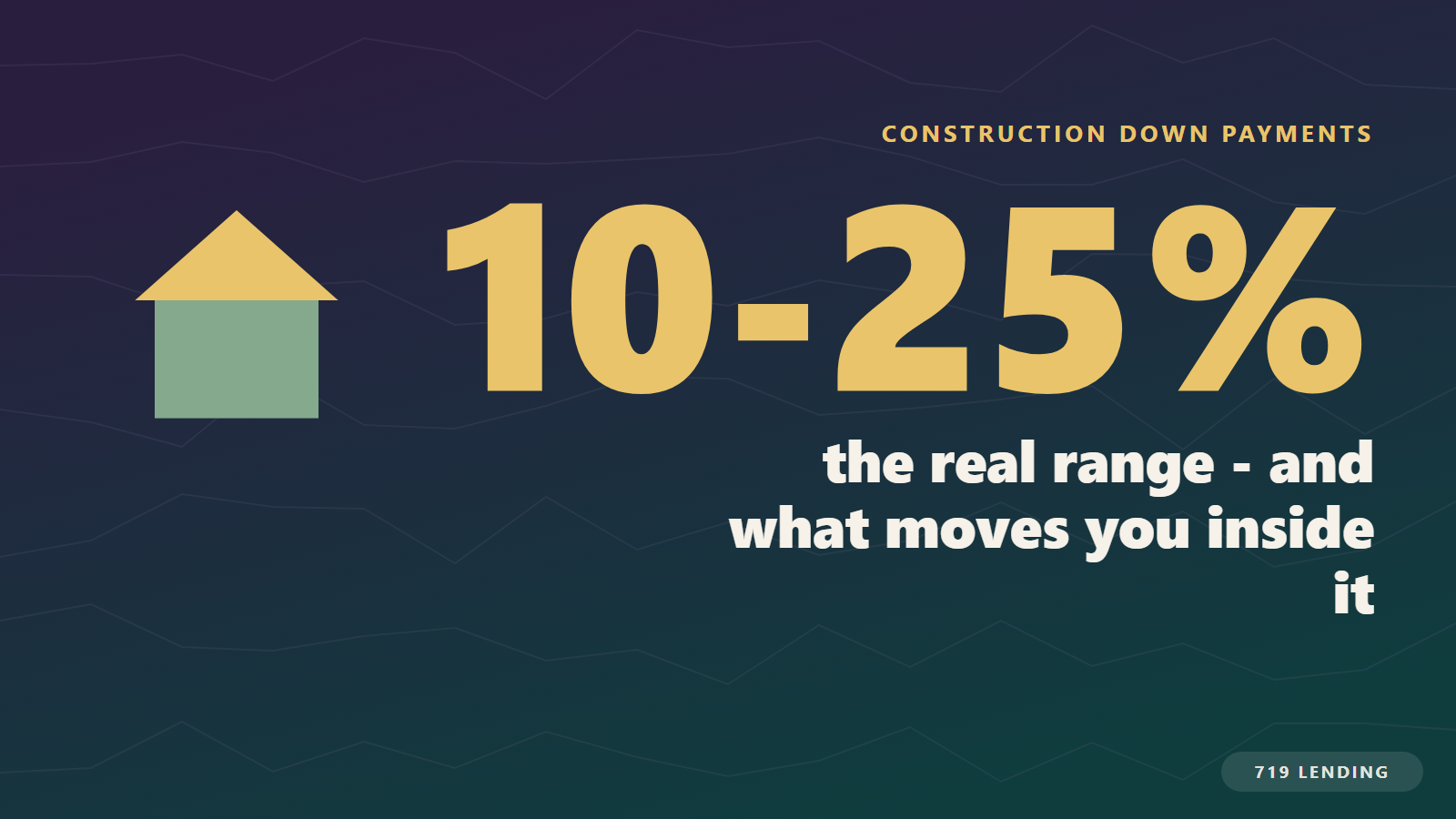
Construction loan down payments usually run higher than a standard purchase mortgage, but the land you already own can do a lot of the heavy lifting. Here is how much you actually need by loan type, and how land equity counts toward it.
Construction Loan Lenders in Colorado: Broker vs Bank
Construction loan lenders in Colorado fall into two camps: portfolio lenders (local banks and credit unions that hold the loan themselves) and wholesale/specialty lenders that a mortgage broker can shop. A single bank offers you one set of terms; a broker compares construction programs across many lenders to match your build, timeline, and credit profile. The right choice depends on how much your scenario varies from “vanilla.”
If you are building in El Paso County or anywhere along the Front Range, the financing question lands before the foundation does. Below is a plain-English breakdown of who funds these loans, what a broker adds over walking into one bank, and the questions that separate a smooth build from a stalled one.

Who actually funds construction loans in Colorado?
Construction loans are funded mostly by portfolio lenders — local and regional banks, plus credit unions — that keep the loan on their own books during the build instead of selling it to Fannie Mae or Freddie Mac. Because the home does not exist yet, there is no finished collateral and no agency to buy the note, so the lender carries the risk directly. That is why construction lending is more specialized and less standardized than a regular purchase mortgage.
You will generally see four sources in Colorado:
| Lender type | How they fund it | Typical fit |
|---|---|---|
| Local / regional bank (portfolio) | Holds the construction note in-house, often refinances to permanent at completion | Borrowers with an existing relationship; straightforward builds |
| Credit union (portfolio) | Member-based portfolio lending, sometimes competitive draw terms | Members with strong deposit history |
| Wholesale / specialty lender (via broker) | Dedicated one-time-close and construction-to-perm programs sold through brokers | Self-employed, jumbo, rural, or non-vanilla scenarios |
| Builder’s preferred lender | Often a national lender tied to a production builder | Production-home buyers (terms tied to the builder) |
A mortgage broker does not fund the loan with its own money. Instead, a broker has access to a panel of wholesale lenders — including several that run dedicated construction and construction-to-permanent programs — and matches your file to the one whose guidelines and pricing fit best.
What is the difference between a broker and a bank for a construction loan?
The core difference is access. A bank can only offer its own construction program; if your scenario falls outside that one box, you are declined or quoted unfavorable terms. A broker shops multiple construction lenders at once, so when one lender’s overlays don’t fit, another might.
Construction loans punish “non-standard” borrowers harder than ordinary mortgages do, because each portfolio lender writes its own rules. That makes shopping matter more here than almost anywhere else in lending.
| Factor | Single bank | Mortgage broker |
|---|---|---|
| Lender options | One construction program | Multiple wholesale construction programs |
| If you’re self-employed | One set of doc rules — pass or fail | Can route to a lender whose guidelines fit |
| One-time vs two-time close | Whatever that bank offers | Compare both structures across lenders |
| Rate & cost shopping | Take it or leave it | Compare pricing across the panel |
| Existing relationship perks | Possible (deposits, fee waivers) | Not relationship-based |
Neither is automatically better. If you have a deep relationship with a local bank and a clean, simple build, that bank may give you a fast, smooth process. If your income is complex, your build is custom, you’re near a county line into rural territory, or you simply want to compare, a broker’s reach is the advantage. (See our overview of working with a Colorado Springs mortgage broker for how that relationship works day to day.)

One-time close vs two-time close: which should you ask about?
This is the single most important structural question in construction lending, and it’s where broker access often pays off. A one-time close (also called construction-to-permanent) uses a single closing and one set of closing costs to cover both the build and the permanent mortgage, then converts to your long-term loan when the home is finished. A two-time close means two separate loans and two closings — the construction loan, then a separate refinance into the permanent mortgage at completion.
| One-time close (C2P) | Two-time close | |
|---|---|---|
| Closings | One | Two |
| Closing costs | Paid once | Paid twice |
| Re-qualification at completion | Not required | Must re-qualify for the permanent loan |
| Rate risk | Rate often set up front | Exposed to market at the second close |
| Flexibility on permanent terms | Locked earlier | Can re-shop the permanent loan |
A one-time close protects you from re-qualifying after months of construction — valuable if your income or rates might shift. A two-time close can be cheaper up front and lets you re-shop the permanent mortgage later. A broker can quote both structures side by side; a single bank may only offer one. Government-backed paths exist too — FHA, VA, and USDA all have one-time-close construction programs, though far fewer lenders run them, so a broker’s panel matters even more for those.
How do construction loans work in El Paso County?
In El Paso County, construction financing follows the same mechanics as the rest of Colorado: the loan funds in draws tied to inspected build milestones (foundation, framing, mechanicals, completion), you typically pay interest only on the funds drawn during the build, and the loan either converts or refinances to a permanent mortgage when the certificate of occupancy is issued.
The local hook that matters here: Colorado Springs and the surrounding county have seen sustained new-build activity, and a meaningful share of buyers are tied to Fort Carson, Peterson, and Schriever — which means VA-eligible borrowers are common. VA offers a true $0-down, no-monthly-mortgage-insurance construction-to-permanent option, but very few lenders actually originate VA one-time-close loans. This is a textbook case where a broker who can reach the handful of lenders running that program may have an edge over a single bank that doesn’t offer it at all.
Lot value also factors in. If you already own your Colorado Springs lot, its equity can often count toward your down payment or required equity on the construction loan — another detail worth confirming with whichever lender you choose. For buyers comparing all their financing options first, our Colorado Springs home buyer guide covers the broader picture.
What questions should I ask a construction loan lender?
Whether you go with a bank or a broker, ask these before you commit. Strong answers separate a lender who does this routinely from one who dabbles.
- Is this a one-time close or two-time close? And which do you recommend for my scenario, and why?
- How are draws scheduled and inspected? Who orders inspections, and how fast do draws fund so the builder isn’t left waiting?
- Do I pay interest only during construction, and on the full loan or only drawn funds?
- What happens if the build runs long or over budget? Is there a contingency reserve, and can the term be extended?
- Does my lot equity count toward down payment or required equity?
- Is the rate locked now, floating, or set at completion?
- Do you offer government one-time-close programs (FHA / VA / USDA) if I’m eligible?
- What are total closing costs — once for a one-time close, or twice for a two-time close?
If you’re also weighing who to call first in town, our roundup of how to evaluate mortgage lenders in Colorado Springs walks through the same vetting mindset for any loan type.
Broker or bank: how to decide
Use a single bank when you have an existing relationship, a clean and conventional build, and you value a familiar process over comparison. Use a broker when your income is complex, your build is custom or rural, you want a VA/FHA/USDA construction path, or you simply want one team to compare multiple construction lenders for you instead of applying at several banks one at a time.
The honest answer for most custom-home and VA-eligible borrowers in El Paso County: shopping helps, and a broker shops for you.
Thinking about building in Colorado Springs or anywhere in El Paso County? Contact 719 Lending and we’ll walk through which construction lenders and structures actually fit your build — one-time close, lot equity, VA, all of it — before you commit to a single program.
719 Lending Inc., NMLS #1601989 · Equal Housing Opportunity · This article is educational only, is not a commitment to lend, and not all applicants will qualify. 719 Lending is not affiliated with or endorsed by any government agency.

Related Posts