First responder home buying in Colorado Springs: shift-friendly timelines, El Paso County neighborhoods, CHFA and GNND reality, and the VA angle.
Hero Home Loan Myths, Debunked
Short answer: almost every one of the common hero home loan myths comes from confusing branding with underwriting. There is no special interest rate reserved for police officers, firefighters, nurses, teachers, or military families, and no program that makes just any house half price.
What is real is a stack of separate things — government programs, commercial rebate networks, and individual lender products — that save meaningful money when they fit your file and save nothing when they do not. This page is the myth-check for our hero home buying cluster. Each myth gets a verdict, a short explanation of what is actually true, and a pointer to the deeper article.
The short answer: three different things wear the same name
“Hero home loan” is not a loan type. It is a marketing umbrella stretched over three categories that behave very differently.
- Government programs — Good Neighbor Next Door, CHFA assistance in Colorado, and the FHA and VA loan baselines. The rules are published, eligibility is strict, and nobody can bend them for you.
- Commercial rebate networks — private companies that arrange a portion of the real estate commission back to the buyer, plus discounts from affiliated vendors. That is marketing, not a mortgage product.
- Lender products — physician-style portfolio loans and similar profession-specific programs. These are genuine loans with genuine underwriting differences, offered by particular lenders.
| Category | Who sets the rules | Where the savings come from |
|---|---|---|
| Government programs | HUD, VA, CHFA, or a local housing authority | Published discounts, grants, or second mortgages |
| Rebate networks | The private company and its affiliated agents | A share of commission plus vendor credits |
| Lender products | The individual lender holding the loan | Underwriting flexibility, not a discounted rate |
Our take: for most buyers in Colorado Springs, the biggest lever is not the badge on the program. It is loan pricing shopped across multiple wholesale lenders, stacked with whatever assistance you genuinely qualify for.
Hero home loan myths at a glance

Eight claims come up in nearly every conversation we have with first responders, nurses, teachers, and service members. All eight are either false or far narrower than the marketing suggests, and they fail for the same underlying reason: hero branding changes packaging, not the pricing math. Even the one genuine headline discount in the list — the 50% write-down under Good Neighbor Next Door — applies only to HUD-owned homes in designated revitalization areas.
Read the summary, then jump to whichever myth is driving your decision. Each section below stands on its own, so you do not need to read the page in order.
One companion to keep open while you read: our honest math on whether hero home loans actually save money.
Myth 1: Heroes get a special interest rate
The verdict and the truth
False. Loan pricing is not set by occupation. Rate quotes are built from bond-market pricing that moves daily, then adjusted for your credit score, loan-to-value, occupancy, property type, loan size, and the lender’s margin that day. Your job title is not one of those inputs.
What actually moves your rate
The variables that move pricing are the same for everyone, and a few of them are inside your control. If you want the full list of inputs, see what actually determines your mortgage rate before you shop.
- Credit score tier and down payment percentage
- Loan program — VA and FHA price differently than conventional
- Discount points paid at closing versus a lender credit taken instead
- Which wholesale lender the broker is pricing that day
The Consumer Financial Protection Bureau publishes a rate explorer showing that offers for the same borrower profile span a range across lenders, and that credit score, down payment, loan term, and loan type are the factors that move the number. Comparing written Loan Estimates, not a job title, is where the money is.
Myth 2: Good Neighbor Next Door makes any house half price
The verdict and the truth
Mostly false — but the part that is true is the single largest discount in this entire category. Good Neighbor Next Door offers eligible law enforcement officers, pre-kindergarten through 12th grade teachers, firefighters, and emergency medical technicians 50% off the list price of eligible HUD-owned single-family homes located in designated revitalization areas (program terms — general, confirm current with HUD). It does not apply to the open market.
What the discount actually costs you
HUD publishes the current Good Neighbor Next Door listings and eligibility rules, and the inventory is limited to homes in designated revitalization areas. HUD states that when more than one person submits an offer on a single home, the buyer is selected by random lottery, and that the discount is carried as a silent second mortgage on which no interest or payments are required provided you meet the occupancy commitment — living in the home as your principal residence for 36 months, or three years.
The program is worth pursuing if a listing appears in your area, and our walkthrough of the Good Neighbor Next Door program explains the lottery, the silent second, and the occupancy note in detail. Our take: check it, but do not build your timeline around inventory that may not exist near you.
Myth 3: You have to use the program’s assigned agent or lender
The verdict and the truth
False, and this is the myth that costs the most quiet money. You always choose your own lender, and no government program assigns you a loan officer. A private rebate network can require that you transact with one of its affiliated agents in order to receive its rebate, but that is a condition of the network’s own benefit, not a mortgage requirement.
Where your shopping rights actually begin and end
Federal disclosure rules also give you a defined shopping right at closing, and it is narrower than most buyers assume. According to the CFPB, you can shop for the closing services listed in section C of page 2 of your Loan Estimate, your lender must give you a written list of closing service providers when it hands you that Loan Estimate, and you may be able to use a provider that is not on the list as long as the lender agrees to work with them. Services outside section C are not shoppable, so read the list rather than assuming everything is negotiable.
What to ask before you enroll
Before you sign anything, read how the Homes for Heroes network actually works so you know exactly who pays whom. Then ask three questions of any branded program.
- Who pays the rebate, and out of which side of the commission?
- Am I locked to a specific agent, lender, or title company to receive it?
- What happens to the benefit if I switch providers mid-transaction?
Our take: a rebate is only a gain if the underlying loan pricing is still competitive. A credit at closing that comes with a costlier loan is a rounding error you pay for over 30 years.
Myth 4: Nurse loans and teacher loans are separate mortgage products
The verdict and the truth
False in almost every case. “Nurse home loan,” “teacher home loan,” and “first responder home loan” are marketing labels wrapped around the same four underlying products everyone else uses: conventional, FHA, VA, and USDA, sometimes paired with state assistance such as CHFA in Colorado.
Why the label still matters a little
The label is not useless. A lender that markets to nurses often understands rotating shift income, per-diem pay, and travel contracts better than a generalist. A broker who works with teachers knows how Colorado Housing and Finance Authority assistance interacts with a conventional loan, and CHFA program availability and terms vary — confirm current details directly with CHFA. That is expertise and workflow, not a separate product with separate pricing.
Our take: judge the loan officer’s familiarity with your income type, not the name on the landing page. Ask them to explain how they will document your last two years of pay before you commit.
Myth 5: Overtime and shift differential never count
The verdict and the truth
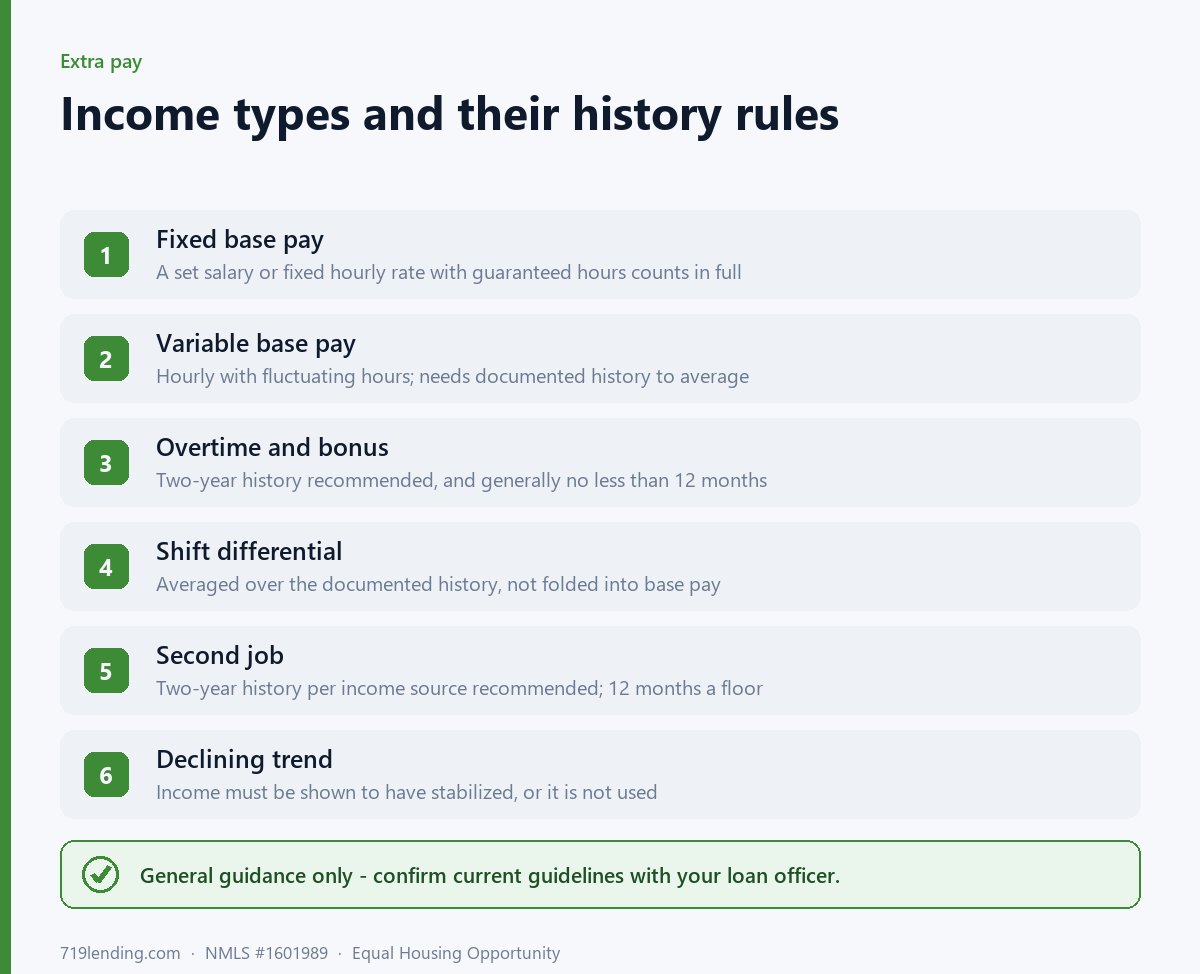
False. Overtime and other variable pay are usable qualifying income when there is a documented history and the amount is stable. This matters enormously for nurses, dispatchers, firefighters on long-cycle shift schedules, and anyone whose base pay understates what they actually earn. Shift differential, holiday pay, and on-call pay are generally evaluated the same way as other variable income, though the exact treatment varies by program and by lender — confirm current requirements against your own file.
How underwriters document it
Documented overtime and shift differential income can be used, and our guide on overtime and shift differential income for mortgages walks through the paperwork underwriters ask for. For conventional loans, the Fannie Mae Selling Guide section on bonus, commission, overtime, and tip income sets the standard, and in general it means:
- A two-year history is recommended, and a shorter history — a minimum of 12 months — may be acceptable when there are positive factors that reasonably offset it
- A completed Request for Verification of Employment, or your most recent paystub plus two years of W-2s
- An average built from year-to-date and prior-year earnings, divided across the months documented
- If the income has declined, the lender must confirm it has stabilized after the decline; if it has not stabilized, that income is not eligible for qualifying
That list is a general summary of the guideline — confirm current requirements with your lender. One common misconception is worth correcting: for conventional loans the lender is not required to verify that variable income will continue unless it has reason to believe it will not. So if your overtime started fourteen months ago, it may still be usable with documentation and offsetting factors. Ask before you assume it is off the table.
Myth 6: Down payment assistance is free money with no strings
The verdict and the truth
Partly true at best. Down payment assistance comes in at least three structures, and only one of them is genuinely a gift. Treating them all as free money is how buyers get surprised at the closing table or at refinance time.
The three structures to ask about
- Grant — no repayment, sometimes with a short occupancy requirement
- Silent or deferred second — no monthly payment, but due on sale, refinance, or after a set term
- Amortizing second — a real second payment that counts against your debt-to-income ratio
Assistance is also frequently paired with a somewhat higher first-mortgage rate, because the funding has to come from somewhere. Terms vary by program, so treat that as a general pattern and confirm current details. The trade can still be worth it if it gets you into a home years earlier, but it should be a decision, not a surprise. Colorado buyers should compare structures side by side using our breakdown of hero down payment assistance in Colorado before assuming any program is free.
Myth 7: A physician loan always beats a conventional loan
The verdict and the truth
False. Physician and dentist portfolio loans can offer real advantages: low or no down payment without mortgage insurance, and student debt treated more leniently than standard agency guidelines allow. Terms differ by lender, and because the lender is holding the risk on its own books the rate is often somewhat higher than a comparable conventional loan (general — confirm current pricing and terms with each lender).
Where the comparison flips
The math usually turns on student loans. Under the Fannie Mae Selling Guide rules for monthly debt obligations, when a borrower is on an income-driven repayment plan the lender may document that the actual monthly payment is $0 and qualify the borrower using that $0 payment, which can put a conventional loan with mortgage insurance ahead of the portfolio product on total cost. When the loan is deferred or in forbearance, the qualifying payment is instead 1% of the outstanding balance or a fully amortizing payment under the documented terms, and that heavier figure is often where the physician loan wins. Those are general guideline summaries — confirm current agency requirements before relying on either path.
Run the numbers both ways, and read our explainer on physician mortgage loans before you assume the doctor product wins. Our take: request a full cost comparison over your realistic holding period — five to seven years is typical, not thirty — and decide from the totals.
Myth 8: Real estate commission rebates are illegal in Colorado
The verdict and the truth
It depends, and it is state-specific. Colorado has generally permitted commission rebates (general — confirm current with your agent and the Colorado Division of Real Estate before counting on one). Some states restrict or prohibit real estate commission rebates paid to buyers, and others regulate how a rebate may be disclosed or paid. The rules in this area do change. Treat any blanket claim — legal everywhere, illegal everywhere — as unverified until you confirm the current position with your agent, your lender, and the Colorado Division of Real Estate.
How to handle it cleanly
Two things are true regardless of state. First, any credit that touches the transaction must be disclosed and approved by the lender — an undisclosed side payment can derail an approval. Second, a rebate paid outside closing may be treated differently than a credit applied at closing; consult a tax professional about how any rebate should be reported.
Our take: ask your agent and lender to confirm the current treatment in writing before you rely on rebate dollars for your cash-to-close.
Myth vs. reality: the highlights

Side by side, the pattern is obvious. All eight myths in this list overstate something real — a 50% discount that exists but reaches only HUD-owned listings, an income source that counts but needs documentation, a product that helps some files and hurts others.
None of that makes hero programs worthless. It makes them specific. The buyers who come out ahead are the ones who test each claim against their own numbers instead of accepting the headline.
How to pressure-test any hero offer in ten minutes
Use this sequence on any program, network, or lender pitch that leads with your profession.
- Ask which of the three categories it is: government program, rebate network, or lender product.
- Ask what the benefit is in dollars, and whether it arrives as a discount, a credit, a grant, or a lien.
- Ask what it requires you to give up — a specific agent, a specific lender, an occupancy term, or a higher rate.
- Get a full loan estimate from at least two sources and compare total cost over five years, not just the monthly payment.
- Confirm any credit or rebate is disclosed to the lender before you count it toward cash to close.
No program promises approval, and no honest quote is final until an underwriter has reviewed your documents. Anything presented as certain before that point is a sales position, not an underwriting decision.
Frequently asked questions
Do heroes get a special mortgage interest rate?
No. Interest rates are priced from market conditions and from your loan file — credit score, down payment, loan program, property type, and the lender’s margin. Occupation is not a pricing input. Profession-focused programs deliver value through discounts, rebates, and down payment assistance instead.
Is Good Neighbor Next Door really 50% off?
Yes, but only on eligible HUD-owned homes in designated revitalization areas, and only for eligible law enforcement officers, pre-kindergarten through 12th grade teachers, firefighters, and emergency medical technicians. HUD carries the discount as a silent second mortgage with no interest or payments required as long as you occupy the home as your principal residence for 36 months, and when more than one eligible buyer bids, the buyer is chosen by random lottery. Program terms are general — confirm current details with HUD.
Do I have to use the agent or lender a hero program assigns?
No. You always choose your own lender, and no government program assigns you a loan officer. Federal disclosure rules also let you shop for the closing services listed in section C of your Loan Estimate, and your lender must give you a written list of providers for those services. A private rebate network may require one of its affiliated agents in order to pay its own rebate, but that is a condition of its benefit, not a mortgage requirement.
Are nurse loans and teacher loans separate mortgage products?
Generally no. They are marketing labels applied to conventional, FHA, VA, or USDA loans, sometimes paired with state assistance. The practical benefit is a lender who understands shift differential, per-diem, or contract income — which is real expertise, not separate pricing.
Does overtime count toward qualifying income?
Yes, with documentation. For conventional loans a two-year history is recommended, and a shorter history of at least 12 months may be acceptable when positive factors reasonably offset it. Expect to provide a verification of employment, or your recent paystub plus two years of W-2s, and expect an average rather than your best month. If the income has declined, the lender must confirm it has stabilized, or it cannot be used to qualify. This is a general summary — confirm current requirements with your lender.
Is down payment assistance free money?
Sometimes, but not always. Assistance arrives as a grant, a deferred silent second, or an amortizing second with a monthly payment. Many programs also pair assistance with a somewhat higher first-mortgage rate. Terms vary by program, so ask which structure applies and what triggers repayment before you accept it.
Are real estate commission rebates allowed in Colorado?
Rebate rules are state-specific and do change, so confirm the current treatment with your agent, your lender, and the Colorado Division of Real Estate before relying on one. In every state, any credit affecting the transaction must be disclosed to and approved by the lender, and it must appear correctly on the settlement statement.
719 Lending Inc., NMLS #1601989 · Equal Housing Opportunity
719 Lending Inc. is not affiliated with or endorsed by HUD, FHA, VA, CHFA, or any government agency.
Last updated: July 2026

Related Posts