Do heroes get special mortgage rates? We debunk eight hero home loan myths: GNND, DPA, nurse and teacher loans, overtime income, and commission rebates.
Teacher Home Loans in Colorado: Good Neighbor Next Door, CHFA & What Actually Works
There is no mortgage product reserved for teachers. What Colorado educators actually get is a short list of real, stackable advantages: HUD’s Good Neighbor Next Door discount, CHFA down payment assistance, and ordinary FHA, VA, USDA, or conventional financing priced across competing wholesale lenders.
So when you search teacher home loans, you are really looking at three unrelated things wearing the same name. This guide keeps them separate, shows what each is worth to a Colorado Springs educator, and explains how underwriters handle nine-month contracts, summer pay, and coaching stipends.
The three things people mean by teacher home loans
Keeping these categories straight is the most useful thing a teacher buyer can do. They come from different places, they are governed by different rules, and none of them cancels out the others.
| Category | Example | What it gives a teacher |
|---|---|---|
| Government program | Good Neighbor Next Door (HUD) | 50 percent off the list price of a specific HUD-owned home |
| State housing finance | CHFA first mortgages, down payment assistance, Schools To Home | Cash toward down payment and closing costs, paired with a first mortgage |
| Commercial rebate network | Teacher-branded and hero-branded referral programs | A share of the real estate commission, sometimes with fee credits |
Only the first two are programs in any regulated sense. The third is a referral arrangement between companies, which can still put money in your pocket but is marketing rather than a loan product.
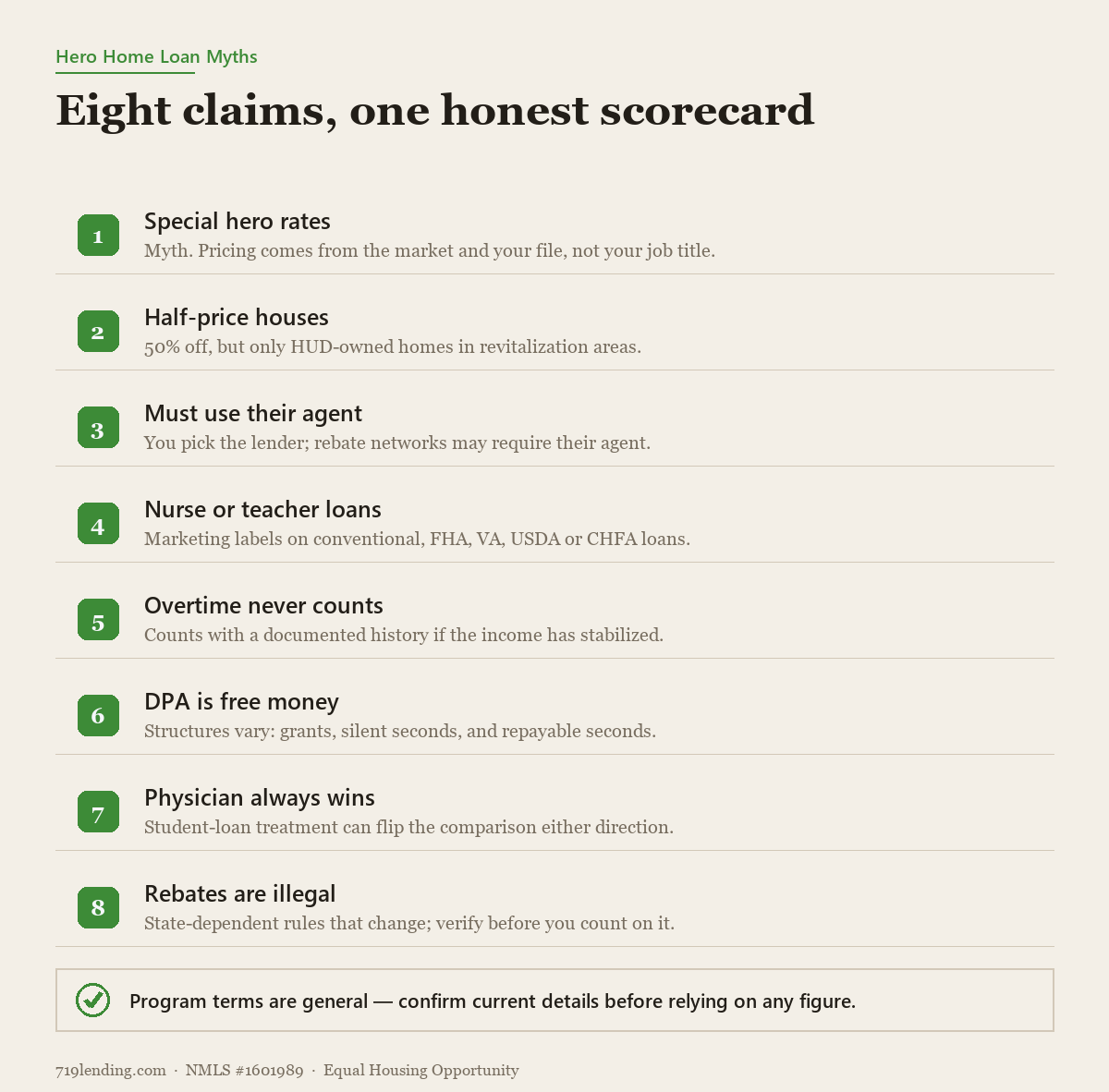
Teachers sit inside a broader set of hero home loan programs in Colorado that includes first responders, nurses, and military buyers, and the same three-category test applies to all of them.
Our take: for most teachers the largest single lever is not a branded program at all. It is the interest rate and the closing costs on the loan itself, which is why comparing pricing from several wholesale lenders usually beats chasing a logo.
Good Neighbor Next Door for teachers: real money, very few houses

Good Neighbor Next Door is the one program on this list that can move six figures. HUD sells eligible homes it already owns to qualifying teachers, law enforcement officers, firefighters, and emergency medical technicians at 50 percent off the list price.
Who counts as a teacher
HUD defines an eligible teacher as someone employed as a full-time teacher by a state-accredited public school or private school that provides direct services to students in grades pre-kindergarten through 12. HUD applies additional conditions, including requirements tied to the area the school serves (confirm the current conditions with HUD). Whether a particular school role qualifies is HUD’s determination, not your lender’s, so confirm your specific position directly with HUD before you plan around the program.
How the 50 percent discount is structured
You do not receive the discount as cash. HUD requires you to sign a second mortgage and note for the discount amount. No interest or payments are required on this silent second provided you fulfill the requirement to live in the property as your principal residence for 36 months.
On an illustrative $300,000 list price, you would finance roughly $150,000 and carry a $150,000 silent second that burns off after three years (illustrative example only, not a quote). FHA financing is commonly used alongside it, and current terms and any required investment should be confirmed with HUD.
The Colorado supply problem
Here is the part the brochures skip. Eligible homes must be HUD-owned properties located in revitalization areas, which are HUD-designated geographic areas authorized by Congress under the National Housing Act. Properties are available for purchase through the program for seven days, and if more than one person submits an offer on a single home, HUD makes the selection by random lottery.
Inventory is the real constraint. In any single Colorado county, including El Paso County, the number of eligible listings at a given moment is limited and can be zero, so check the HUD listing site for current availability rather than assuming a match exists. Our take: treat Good Neighbor Next Door as a ticket you check weekly, not as the plan your home search depends on.
How to actually watch for listings
- Check the HUD listing site on a set day every week rather than once and then forgetting it.
- Get fully underwritten first, because properties are listed through the program for only seven days.
- Work with an agent who has submitted a Good Neighbor Next Door bid before, since the paperwork differs from a normal offer.
- Keep a conventional, FHA, or VA plan running in parallel so your search is never waiting on inventory.
CHFA programs Colorado teachers actually use
CHFA, the Colorado Housing and Finance Authority, is where most Colorado teachers find repeatable help. CHFA is a state authority rather than a marketing company, and its assistance is available statewide instead of on a handful of scattered listings.
Schools To Home
CHFA Schools To Home is a newer, education-specific path for full-time employees of Colorado preK-12 public schools, school districts, charter and institute charter schools, boards of cooperative educational services, and innovation zones. It is worth understanding that the eligibility net is wider than classroom teachers alone.
CHFA describes the program as a fixed-rate first mortgage paired with down payment and closing cost assistance delivered through a deferred second mortgage of up to 25 percent of the first mortgage loan amount, under a shared appreciation model funded by the Public School Permanent Fund (general – confirm current with CHFA). Because it is a shared appreciation structure, repayment of the second plus an agreed share of your home’s appreciation is deferred until the end of the loan term or an earlier trigger such as sale, refinance, payoff of the first mortgage, or the home ceasing to be your primary residence. CHFA also requires a program-specific financial commitment course. Terms, funding availability, and eligible employers can change, so confirm current details with CHFA before you build a budget around it.
Down payment assistance
CHFA’s core benefit for a first-time teacher buyer is help with cash to close, usually structured as a grant or a second mortgage sized as a percentage of the first mortgage amount (general – confirm current). That assistance pairs with a CHFA first mortgage, which can be FHA, VA, USDA, or conventional.
Homebuyer education is typically required, and it is worth doing early rather than the week before closing.
Income limits and price caps
CHFA sets household income limits and purchase price limits that vary by county and household size, and El Paso County has its own figures (general – confirm current). A two-income household with a teacher and a spouse in a higher-paying field can price itself out of eligibility, which surprises people every year.
Where CHFA beats a branded program
CHFA assistance is money at the closing table with published rules and a published application path. A rebate network is a referral arrangement whose payout depends on the commission your agent earns on your specific transaction. Our take: published rules beat variable payouts when you are budgeting a down payment.
Teacher-branded programs and rebate networks: what you are actually being offered
Several national companies market teacher home buying programs, and there are educator-branded programs run by mortgage companies and independent referral networks as well. None of them is a loan product, and understanding that is the entire point of this section.
How the rebate model works
The network signs up real estate agents and lenders who agree to share part of what they earn. When you buy through a matched agent, a portion of that agent’s commission comes back to you at or after closing, sometimes alongside a lender credit toward fees.
The savings are real when they happen, but they are a rebate of someone else’s commission, not a discount on the house and not a better mortgage. Rebate rules vary by state, can be restricted, and carry disclosure requirements at closing, which is why the fine print matters (general – confirm current).
What it can cost you
- You are limited to agents inside the network, which may not include the right agent for your target neighborhood.
- Some programs steer the loan as well, which removes your ability to compare pricing across lenders.
- A rebate of a few thousand dollars can be erased by an eighth of a point in rate over the life of the loan (illustrative).
- Rebate amounts are usually a percentage of a commission that is itself negotiable, so the number is not fixed until closing.
When it is worth taking
If the network agent is genuinely the agent you would have chosen anyway, and the lender side stays open to you, take the rebate. Our take: never trade lender choice for a rebate, because loan pricing is the larger number over any realistic holding period.
Do teacher programs actually save money?
Run the numbers instead of the branding, because the math on hero and teacher programs is usually decided by loan pricing rather than by the rebate. Here is an illustrative comparison on a $400,000 purchase in Colorado Springs (illustrative figures only, not a quote).
- Rebate network: roughly $2,000 to $3,500 back at closing, one time (illustrative).
- CHFA assistance: sized as a percentage of the first mortgage amount, which can be a meaningful five-figure sum on a Schools To Home structure (general – confirm current with CHFA).
- Loan pricing: an eighth to a quarter point difference in rate on a $380,000 loan changes the payment by roughly $30 to $60 per month (illustrative), which is roughly $10,800 to $21,600 across thirty years before any refinance (illustrative).
That last line is the honest thesis of this entire category. A one-time rebate is a nice check. Pricing is the recurring number, and it is the one you control by shopping the loan across wholesale lenders on the same day.
Good Neighbor Next Door is the exception that proves the rule, because a 50 percent list price discount is larger than any realistic pricing difference. It is also the one you are least likely to get, purely because of inventory.
How lenders count teacher income: contracts, summer pay, and stipends

This is where teacher files actually get complicated, and it has nothing to do with branded programs. School employment has features underwriters see rarely, and a loan officer who has not worked many teacher files can misread them.
Nine and ten month contracts
A nine-month or ten-month contract is not a part-year job. Lenders generally qualify a salaried school employee from the annual salary shown on the signed district contract or offer letter, converted to a monthly figure (general – confirm current). Agency guidelines and individual lender overlays differ, so confirm how your contract will be read before you shop.
Bring the current signed contract rather than pay stubs alone, because stubs pulled during summer months can understate annual income. The underwriting principle behind all of this is stability: Fannie Mae requires that income be documented as stable, with a documented history of receipt, and reasonably expected to continue.
The ten-pay versus twelve-pay election
Many Colorado districts let staff spread the same annual salary across ten or twelve checks. Choosing ten does not increase your income and choosing twelve does not reduce it. Your qualifying income comes from the contract, not from the check frequency.
Coaching stipends, extra duty, and summer school
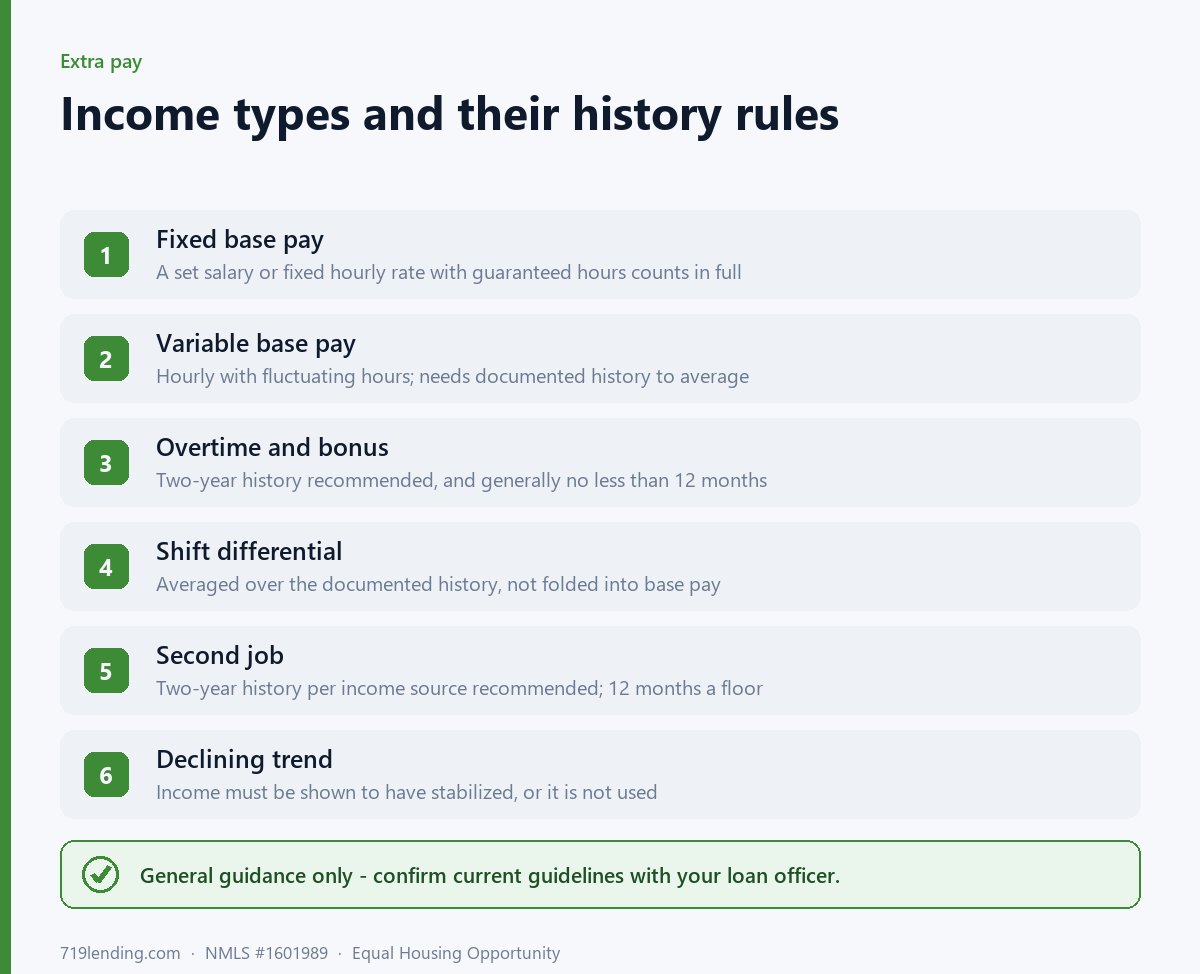
Stipends for coaching, department chair duties, extra duty, and summer school are usually treated as variable income rather than base salary (general – confirm current).
Fannie Mae treats bonus, commission, overtime, and tip income as variable income, and recommends a minimum two-year history while allowing a shorter period of no less than 12 months when positive factors reasonably offset it. So a single year of stipend history is not automatically fatal, though it does invite more scrutiny and a closer look at how the income is averaged. Ask about it during pre-approval rather than discovering it in underwriting.
New teachers and career changers
Fannie Mae’s Selling Guide allows a borrower to qualify on a fully executed offer or employment contract, with the start date falling no earlier than 30 days before the note date and no later than 90 days after it. That option is limited to a purchase of a one-unit principal residence where the borrower qualifies on fixed base income, a verbal verification of employment is still required, and additional reserves can apply when a paystub is not obtained before the loan is delivered. Other loan types and individual lenders apply their own rules (general – confirm current). A career changer moving into education is usually straightforward as well, because a salaried teaching position documents cleanly.
Second jobs and tutoring
Tutoring, curriculum writing, and summer camp work are common among educators and are often self-employed income. That income generally needs a documented history and appears on tax returns, so plan for it to be averaged rather than counted at face value (general – confirm current).
Colorado Springs districts and what they mean for your home search
Teachers in the Pikes Peak region are usually buying inside District 11, District 20, or District 49. We do not rank districts and we do not steer buyers by school assignment, but where you work does change the shape of the search.
What the district actually affects
- Commute, which is a real monthly cost even though it never appears on a loan estimate.
- Price per square foot, which varies widely across the city and the eastern plains.
- Property taxes and any metro district or special district fees attached to newer subdivisions.
- Whether HUD revitalization areas exist nearby, which matters only for Good Neighbor Next Door.
The metro district trap
Newer neighborhoods east and north of the city often sit inside metro districts that add a separate mill levy. That extra amount is part of the monthly payment used to qualify you, so a house that looks affordable on price can fail on payment.
Ask for the actual annual tax figure before you write an offer, and consult a tax professional about anything tax related.
A stacking order that works for most teacher buyers
- Get a full pre-approval with your district contract and any stipend documentation reviewed up front.
- Have your broker price the loan across several wholesale lenders on the same day, since pricing moves daily.
- Check CHFA eligibility against the current income and purchase price limits for El Paso County.
- Check the HUD listing site weekly for Good Neighbor Next Door inventory and treat any match as a bonus.
- Evaluate a rebate network only after the loan side is settled as your own choice.
- Compare total cost over the years you expect to own the home, not just the cash needed at closing.
The Consumer Financial Protection Bureau publishes free tools for comparing loan estimates side by side, including a Loan Estimate explainer and a Closing Disclosure explainer.
Every figure in this article is illustrative or general and must be confirmed against current program terms and current pricing. Nothing here is an offer of credit or an indication that any application will be approved.
Frequently asked questions
Is there a mortgage that only teachers can get?
No. Teachers use the same FHA, VA, USDA, and conventional loans as every other buyer. What is teacher-specific is eligibility for HUD’s Good Neighbor Next Door discount, certain CHFA assistance paths aimed at school employees, and commercial rebate networks that market to educators. None of those is a separate loan type.
Can a Colorado Springs teacher use Good Neighbor Next Door?
Yes, if a qualifying HUD-owned home is listed in a revitalization area and you meet HUD’s eligibility definition. Inventory is the real constraint. In any single Colorado county, including El Paso County, eligible listings are limited and can be zero at a given time, so check the HUD listing site weekly and keep a conventional or FHA plan running alongside it.
How do lenders handle a nine-month teacher contract and summer pay?
Lenders generally qualify you from the annual salary on your signed district contract, converted to a monthly figure, so the summer months are not treated as a gap in employment (general – confirm current). Provide the signed contract, because pay stubs alone can understate annual income if you are paid across ten months. Guidelines and lender overlays vary, so confirm before you shop.
Do coaching stipends and extra duty pay count as income?
Usually yes, as variable income rather than base salary. Fannie Mae recommends a minimum two-year history for variable income such as bonus and overtime, but allows a shorter period of no less than 12 months when positive factors reasonably offset the shorter history. So one year of stipend history is not automatically excluded. Ask before you shop so your maximum price is realistic from the start.
Can I stack CHFA assistance with a teacher rebate program?
Often yes, because they operate at different points in the transaction. CHFA assistance comes through the loan, while a rebate comes out of the real estate commission. Confirm both sets of rules in writing, and confirm the rebate is disclosed on the closing statement the way your lender requires.
Is a teacher-branded program cheaper than shopping the loan?
Usually not on its own. A one-time rebate is a fixed amount, while the interest rate and closing costs affect every payment you make. Compare any branded offer against at least two competing loan quotes obtained on the same day, since pricing changes daily.
How much down payment does a Colorado teacher need?
Less than most educators assume. VA offers a zero down option for eligible buyers, USDA covers some areas outside the city limits, FHA has a low minimum required investment, and CHFA assistance can cover part of the remainder (general – confirm current). Credit profile and debt ratio usually matter more than the down payment itself.
719 Lending Inc., NMLS #1601989 · Equal Housing Opportunity
719 Lending Inc. is not affiliated with or endorsed by HUD, FHA, VA, CHFA, Fannie Mae, or any government agency.
Last updated: July 2026

Related Posts