Do heroes get special mortgage rates? We debunk eight hero home loan myths: GNND, DPA, nurse and teacher loans, overtime income, and commission rebates.
Buying a Home as a First Responder in Colorado Springs
First responder home buying in Colorado Springs: the short answer
If you are a police officer, firefighter, paramedic, EMT, or dispatcher shopping in Colorado Springs, here is the honest answer: there is no single “first responder mortgage” in El Paso County. You buy using the same loan programs every other buyer uses.
What changes your cost is how those programs get priced and stacked — loan pricing shopped across multiple wholesale lenders, down payment assistance you qualify for as a Colorado buyer, and, on a small number of listings, the federal Good Neighbor Next Door discount.
What actually applies locally
- Government programs: FHA, VA, USDA in eligible rural areas (check the USDA eligibility map for your specific address), CHFA assistance, and Good Neighbor Next Door. These are rule-based and verifiable.
- Commercial rebate networks: real-estate commission rebates and vendor fee credits marketed to heroes. Sometimes real money, but marketing programs rather than loan products.
- Lender products: profession-specific portfolio loans, similar in spirit to physician loans. They exist; for most responders they are not the cheapest structure.
- Local reality: shift rotations, Fort Carson-area demand, and commute geography shape your search as much as any program does.
- Our take: compare the all-in cost of two or three real structures instead of chasing a badge-branded label.
The mechanics of first responder home loans are the same statewide; what changes in Colorado Springs is the inventory, the commute, and the competition from military buyers.
How shift work changes the house hunt

Twenty-four-hour shifts, four-on/four-off rotations, and mandatory overtime make the mortgage process harder in one specific way: the process is built around people who can answer a phone at 2 p.m. on a Tuesday. You can beat that, but only by scheduling it.
Front-load the paperwork on a day off
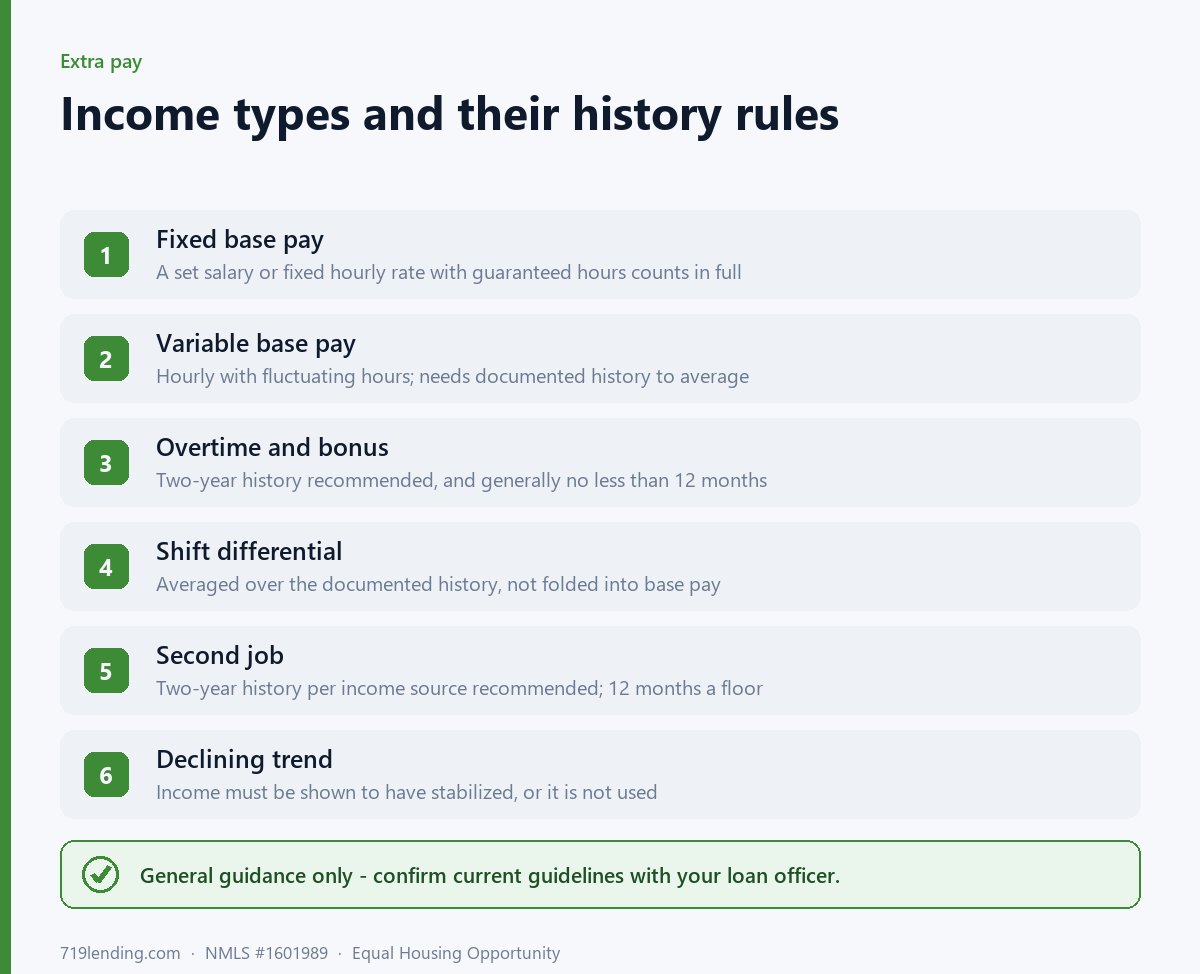
Pull pay stubs, W-2s, and a full overtime and shift-differential history in one sitting on a scheduled day off. Agency guidance for bonus, commission, overtime, and tip income recommends a minimum two-year history, but a shorter history of no less than 12 months may be considered when positive factors reasonably offset it, so the documents you gather early are the documents that decide your qualifying number. Requirements vary by loan program and by lender, so confirm current guidance before you plan around variable pay.
Ask for one consolidated checklist and an e-sign portal up front. Three separate document requests spread across a rotation are what turn a two-week approval into a six-week approval.
Get a real approval, not a quick pre-qual
By roughly week two you want an underwriter-reviewed approval in hand. When a listing can go under contract over a weekend you are working, a stronger approval letter is what lets your agent write an offer immediately instead of waiting for you to wake up.
Protect two touring windows per rotation
Two protected showing windows in each rotation is usually enough to keep pace with El Paso County inventory without burning your recovery day. Give your agent those windows in writing so tours get built around your schedule rather than squeezed into it.
Set contract dates around your rotation
Most local purchase contracts run roughly 30 to 45 days from acceptance (general — confirm current terms with your agent). Inspection, appraisal access, and the signing appointment can all be placed around your shifts if you name the rotation at contract, and a mobile notary can often close you at home or at the station when the signing lands on a work day.
Where first responders buy in El Paso County

Station geography drives this decision more than list price does. A ten-minute difference in drive time matters far more when you are reporting for a 0700 shift after a long night than it does for a nine-to-five commuter, and it compounds every rotation for as long as you own the house.
South: Security-Widefield and Fountain
The southern corridor has historically offered some of the more attainable price points in the metro and sits close to Fort Carson, which matters for households with both a responder and a service member. Trade-offs include a longer drive to stations on the north end and highway-dependent commuting in winter weather.
East: the Powers corridor
The Powers corridor is the county’s newer-inventory spine, with a mix of build years and easier east-side access. It is a common landing spot for buyers who want more square footage per dollar than the central neighborhoods offer, at the cost of a longer trip to downtown-adjacent posts.
North and northeast Colorado Springs
North and northeast Colorado Springs generally price higher and turn over quickly, and they put you closer to the I-25 spine for north-county assignments. Buyers here often stretch on price and make it back on drive time, which is a legitimate trade if the payment still fits comfortably.
The renting-near-the-station tradeoff
Plenty of responders rent close to a station and buy farther out later. Renting near the station buys commute certainty; buying farther out trades drive time for space and equity, and neither answer is automatically right. Ownership also brings property taxes, insurance, and maintenance, and for anything tax-related you should consult a tax professional.
El Paso County price context, in general terms
Price context matters because it sets which programs are even usable, and El Paso County prices move enough that any figure printed in an article is stale before you read it. Pull current county median and neighborhood-level numbers from your agent’s live MLS data at the time you shop, rather than planning around a number from a blog post.
Two practical consequences follow. First, assistance programs with purchase price caps can rule out entire neighborhoods, so check the current cap before you fall in love with a listing. Second, condos and townhomes in the county often sit meaningfully below the single-family median (general — confirm current market data), which is why many first responder buyers start there.
Rates and payments move constantly, and we will not quote a rate or a payment in an article. Federal consumer guidance tells buyers to get official loan offers from more than one lender and compare the offers side by side, which matches what we see in our own files.
Down payment assistance for Colorado Springs first responders
Most of the assistance in play here is not responder-specific at all — it is standard first-time buyer help that responders qualify for like anyone else, layered on top of an FHA, VA, or conventional loan.
CHFA and local layers
Colorado Housing and Finance Authority programs are the workhorse: they pair a first mortgage with down payment assistance, subject to income limits, purchase price limits, a homebuyer education requirement, and credit minimums that change over time. We are not printing those figures here on purpose, because they are revised on CHFA’s own schedule and a stale number is worse than no number — pull the current limits from CHFA or your broker at the time you apply. City and county-level assistance also appears and disappears with funding cycles, so availability is a live question, not a permanent fact.
What to verify before you count on it
- Current income limit for your household size in El Paso County.
- Current purchase price cap against the neighborhoods you are actually touring.
- Whether the assistance is a grant, a silent second, or a repayable second.
- Whether the assistance-paired first mortgage prices competitively against a plain first mortgage without assistance.
That last item is the one buyers skip. Assistance sometimes comes with a higher note rate, and the right comparison is total cost over the years you realistically plan to hold the home.
Good Neighbor Next Door in El Paso County: real money, rare listings
Good Neighbor Next Door is the one federal program built specifically for law enforcement officers, firefighters, and emergency medical technicians — HUD also includes pre-Kindergarten through 12th grade teachers — and it is genuinely significant when it applies. HUD offers eligible single-family homes at a discount of 50 percent off the list price, and in return the buyer commits to living in the property as a principal residence for 36 months, signing a second mortgage and note for the discount amount that carries no interest and no payments as long as that occupancy requirement is fulfilled (program terms — confirm current rules with HUD before relying on them).
The catch is supply. The U.S. Department of Housing and Urban Development lists Good Neighbor Next Door homes only in designated revitalization areas, so local availability depends entirely on what HUD happens to have listed in El Paso County at that moment — check HUD’s listing site yourself rather than assuming inventory exists. When more than one eligible buyer submits an offer on the same home, HUD makes the selection by random lottery.
Our take: set an alert and check it, because the discount is real, but do not build your entire buying plan around a program that may show zero eligible local listings for months. Treat it as an upside case layered on a plan that works without it.
Veteran first responders and the Fort Carson overlap
Colorado Springs has an unusually high overlap between military service and first responder careers, and that overlap is often worth more than any hero-branded program. If you served before you pinned on a badge, a VA loan is often the strongest structure available to you, because of the zero-down-payment option and the absence of monthly mortgage insurance.
The VA publishes the current entitlement, occupancy, and funding fee rules for the VA home loan benefit, and those rules change over time — including funding fee exemptions tied to service-connected disability status. Verify your entitlement and your fee status before you compare programs, because a fee exemption can flip which loan wins on total cost.
Households with one veteran and one civilian responder should price both paths. Sometimes the VA loan wins outright; sometimes a conventional loan with assistance wins because the veteran’s entitlement is tied up in another property.
Branded hero programs and rebate networks
You will see “hero” branded offers marketed heavily in this market. Keeping the categories straight is the whole game: a government program is a rule, a lender product is a loan, and a rebate network is a marketing arrangement.
How rebate networks actually work
Rebate networks typically connect you with a participating real estate agent and lender, then return a portion of the agent’s commission at or after closing, sometimes with small credits from title, inspection, or moving vendors. That can be real money. It is also money that comes out of a commission you may be able to negotiate directly, and participation limits your pool of agents and lenders.
The comparison that settles it
Price the same purchase two ways: the network’s agent-and-lender package including the rebate, versus an agent you chose plus a loan shopped across multiple wholesale lenders. Compare cash to close and total interest, not headline perks. If you want the major hero programs compared side by side rather than described one at a time, start with the comparison before you commit to a lane.
Every one of these threads runs back to the broader map of hero home loan programs in Colorado, which sorts genuine government benefits from packaging.
What to do next as a Colorado Springs first responder
Start with documents, not listings. Overtime and shift-differential history is one of the most common reasons a responder’s approval amount comes in lower than expected, and it is often addressable with the right documentation.
- Gather two years of pay history, including overtime and differentials, on a day off.
- Get an underwriter-reviewed approval, not a pre-qualification.
- Check current CHFA income and price limits against your target neighborhoods.
- Confirm VA entitlement and funding fee status if you served.
- Price at least two loan structures on total cost, then choose.
Because we are a broker rather than a single lender, we submit one file to several wholesale lenders and compare what comes back. A Colorado Springs mortgage broker can shop the same file across multiple wholesale lenders in one pass, which is the practical version of the advice to shop around. First-time buyers should also review the local first-time buyer roadmap before touring, since assistance eligibility is easier to protect than to repair.
Frequently asked questions
Is there a special first responder mortgage in Colorado Springs?
No. There is no separate loan program for first responders in El Paso County. Responders use FHA, VA, conventional, and CHFA-assisted loans like other buyers. The exception is Good Neighbor Next Door, a federal purchase discount limited to specific HUD listings, and rebate networks, which are marketing arrangements rather than loans.
Can overtime and shift differential count toward my qualifying income?
Often yes, but it depends on documentation. Agency guidance for bonus, commission, overtime, and tip income recommends a minimum two-year history, while a shorter history of no less than 12 months may be considered when positive factors reasonably offset it; the lender then averages the earnings across the documented period. Bring pay stubs, W-2s, and, where available, a verification of employment. Requirements vary by loan program and by lender, so confirm the current requirement before you rely on that income.
Does Good Neighbor Next Door actually have listings in El Paso County?
Sometimes, but availability is limited and unpredictable. Eligible homes exist only in HUD-designated revitalization areas, so there may be none listed locally for long stretches — check HUD’s listing site rather than assuming. The discount is 50 percent off HUD’s list price when a listing fits your commute and standards, and it carries a 36-month principal-residence commitment secured by a silent second mortgage (program terms — confirm current rules with HUD). Watch for it, but plan a purchase that works without it.
Can I use CHFA down payment assistance as a first responder?
Yes, if you meet the standard requirements: income limits for your household size, purchase price limits, credit minimums, and homebuyer education. Nothing about the badge changes eligibility either direction. Because limits and terms change, verify current figures rather than relying on last year’s numbers, and compare the assisted loan’s total cost against a loan without assistance.
I served in the military and now work as a firefighter. VA loan or CHFA?
Price both. A VA loan brings a zero-down option and no monthly mortgage insurance, which frequently wins on total cost, especially if you are exempt from the funding fee. CHFA assistance can win when your entitlement is unavailable or when you need help with closing costs. The deciding factor is cash to close plus total interest over your expected hold period.
How do I manage showings, inspections, and closing on a 24/48 schedule?
Schedule the process instead of reacting to it. Block two touring windows per rotation, complete documents on days off, use e-sign, and name your rotation at contract so inspection, appraisal access, and signing dates land on days you are free. Mobile notaries can usually close you at home or at the station when the signing falls on a shift.
719 Lending Inc., NMLS #1601989 · Equal Housing Opportunity
719 Lending Inc. is not affiliated with or endorsed by HUD, FHA, VA, USDA, CHFA, or any government agency.
Last updated: July 2026

Related Posts