Do heroes get special mortgage rates? We debunk eight hero home loan myths: GNND, DPA, nurse and teacher loans, overtime income, and commission rebates.
Firefighter & EMT Home Loans
Firefighter and EMT home loans: the short answer
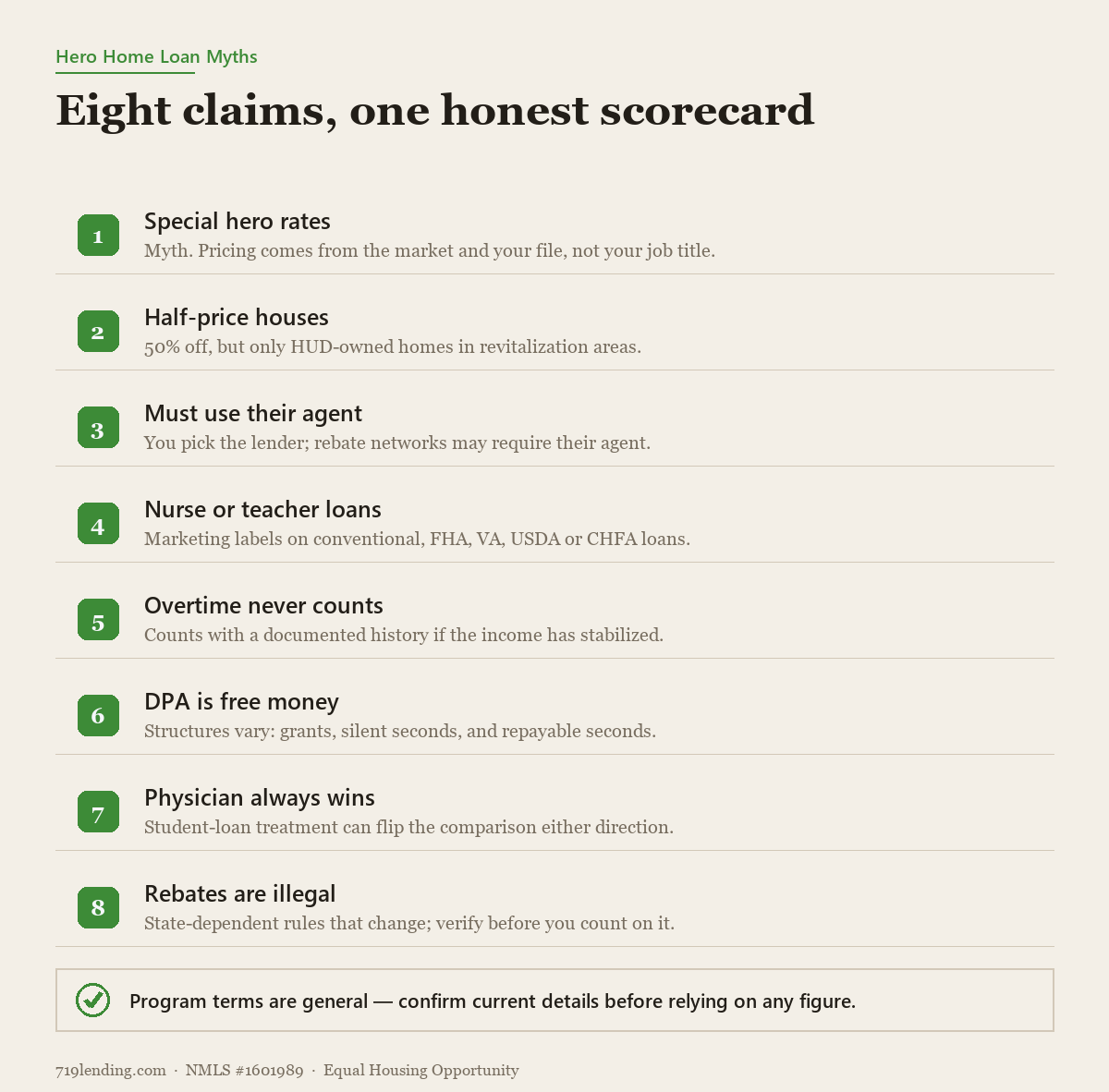
Yes, firefighters, EMTs, and paramedics have real home-buying advantages in Colorado, but “firefighter home loans” is a category name rather than a single mortgage product. No lender prices a loan lower simply because you carry a badge.
What does exist is a stack: one federal program that can cut the list price of specific listed homes for buyers who meet its eligibility rules, state and local down payment assistance, and underwriting rules that count your overtime and shift differential as qualifying income when the history is documented.
The three things people mean by “hero loans”
- Government programs — Good Neighbor Next Door, CHFA assistance, and the FHA and VA baselines. Published rules, published eligibility, real dollars.
- Commercial rebate networks — companies that match you with a partner real estate agent and then rebate part of that agent’s commission or credit certain fees at closing. These are marketing arrangements, not loan products.
- Lender products — profession-specific portfolio loans, such as physician-style programs. Genuinely useful when they fit the file, and priced like any other loan.
Our take: for most firefighters and EMTs the biggest savings lever is loan pricing shopped across wholesale lenders plus stackable assistance. Branded hero programs are sometimes real money and sometimes just packaging.
Quick comparison
| Path | What it really is | Best fit |
|---|---|---|
| Good Neighbor Next Door | HUD discount on specific listed homes | Eligible firefighters and EMTs who can buy where the listings are |
| CHFA assistance | State down payment and closing-cost help | Buyers short on cash who meet income limits |
| VA loan | No-down-payment financing for eligible veterans | Veteran firefighters and EMTs with entitlement |
| FHA loan | Low down payment, flexible credit standards | Buyers with thinner credit files or tighter ratios |
| Rebate networks | Agent commission rebate or fee credit | Buyers without an agent who accept the match |
Program details in this table are general and can change — confirm current terms and eligibility with each program before planning around them.
If you are comparing several of these at once, our overview of home loans for heroes in Colorado lays out how the pieces fit together.
What counts as a firefighter home loan and what does not
Sorting marketing from mechanics saves weeks. Three questions separate them: who publishes the rules, who pays for the benefit, and whether the benefit ever appears on your Loan Estimate.
Programs with published rules
Good Neighbor Next Door, CHFA down payment programs, and the FHA and VA loan programs all publish eligibility criteria and terms you can read before applying. If a benefit is real, you can find the rule that creates it.
Rebate networks and referral programs
Several national networks market savings to first responders by rebating a share of the buyer’s agent commission or crediting certain fees. Those dollars can be genuine, but they come from the real estate side of the transaction rather than from your mortgage, and the amount depends on the agent you get matched with and the price of the home.
One caution: a rebate is only savings if the matched agent is someone you would have hired anyway, and any credit routed through closing must be disclosed to your loan officer at application rather than three days before signing.
Employer, union, and credit union benefits
Some departments, unions, and credit unions offer closing-cost grants, fee waivers, or member pricing. These rarely show up in national marketing, they are often small but stackable, and they are worth one phone call to your local before you shop.
How lenders read 48/96, Kelly days, and 24/48 schedules
Shift work confuses automated income calculators. A firefighter’s paystub can swing significantly between periods because of where the rotation fell, how many holdovers landed in the window, and whether a Kelly day shifted the count.
Salary versus hourly on a rotating schedule
Many Colorado departments pay firefighters on an hourly basis against an annualized schedule, which means your base is predictable over a year but uneven over any two weeks. Underwriters handle this by verifying the annual base with a written verification of employment and year-end W-2s rather than reading a single stub.
Why the average matters more than the last stub
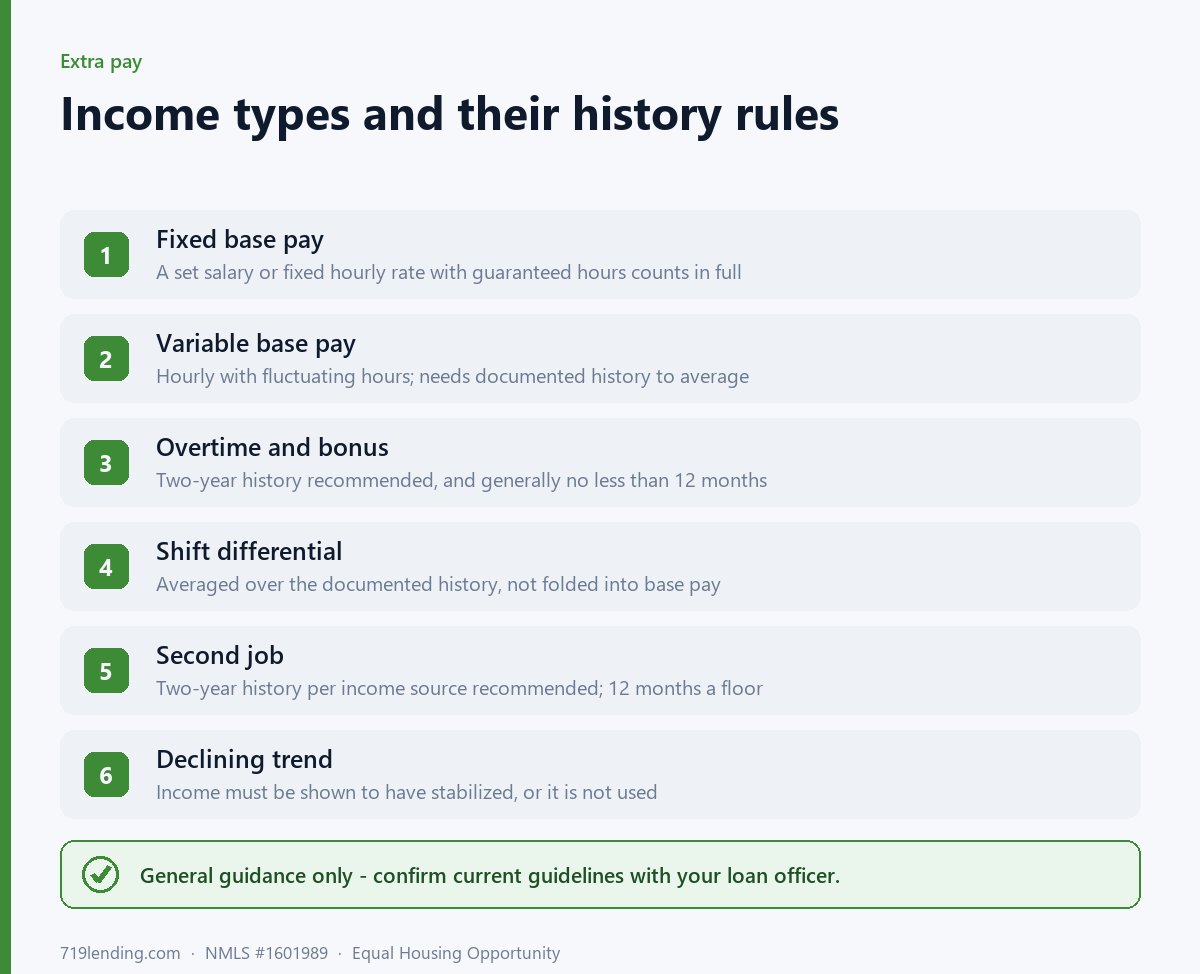
For anything above base pay, lenders average rather than reading your most recent stub. Under conventional guidelines a two-year history of receipt is recommended, a shorter history of no less than 12 months may be considered when positive factors offset the shorter record, and the averaging calculation itself must include at least 12 months of earnings (general — confirm current, since agency and investor overlays differ).
Trend matters as much as the total. Where extra pay is declining rather than stable, the lender generally has to confirm the income has stabilized after the decline; if that cannot be confirmed, the income may not be usable for qualifying at all. That is a stricter rule than most borrowers expect, and it is why one big overtime year rarely rescues a file on its own.
Second jobs on the off days
The 48/96 rotation leaves long stretches off, and plenty of crews use them: construction, private ambulance shifts, teaching EMT or fire academy classes, a landscaping or contracting business. Lenders generally want a two-year history of that second job and evidence it is likely to continue before it counts toward qualifying.
If the side work is self-employment, expect two years of personal and possibly business tax returns, and expect the qualifying figure to be net income after expenses rather than gross receipts.
Overtime, shift differential, and second-job income: the documentation rules

The rules for overtime and shift differential income are the single biggest variable in a firefighter’s file. Two applicants with identical W-2s can qualify for very different loan amounts based purely on how their extra pay is documented and how long it has existed.
The two-year standard and its exceptions
The default expectation is a two-year history of receipt with a reasonable likelihood of continuance. Fannie Mae’s selling guide sets the baseline most lenders follow for bonus, commission, overtime, and tip income, including when a history shorter than two years may still be considered and what documentation the file has to carry. Shorter histories are sometimes acceptable when the income is clearly tied to the position and positive factors offset the shorter record, but that is an underwriting judgment, not a right.
What underwriters actually ask for
- Most recent paystubs showing year-to-date totals broken out by pay type.
- W-2s for the most recent two years, not just a year-end summary from the payroll portal.
- A written verification of employment that separates base pay, overtime, differential, and any stipend.
- For second jobs, a start date, a separate verification, and often the prior year’s tax return.
- For self-employed side work, two years of returns and a year-to-date profit-and-loss statement.
Declining or one-time income
A wildland deployment year, a mandatory-overtime stretch during a staffing shortage, or a one-time incentive payout can spike a W-2 in a way that will not repeat. Underwriters look at trend, and a declining pattern generally has to be shown to have stabilized before the income counts at all.
Bring the full 24 months of documentation to the first conversation so the loan is sized on real qualifying income.
Good Neighbor Next Door for firefighters and EMTs
HUD’s Good Neighbor Next Door program is the one branded benefit in this space that can produce substantial savings on eligible listings. Firefighters and emergency medical technicians are named eligible occupations alongside law enforcement officers and pre-K through 12 teachers.
Who actually qualifies
The occupation alone is not the test. HUD requires that a firefighter or emergency medical technician be employed full time by a government agency, and that the employment directly serve the locality where the home is located. That rules out some private and hospital-based EMS roles, so confirm your employer type against HUD’s published criteria before you build a plan around the program.
How the discount works
HUD lists certain homes in designated revitalization areas at a 50 percent discount, and requires the buyer to live in the home as their principal residence for 36 months (program terms — general, confirm current with HUD). The discount is carried as a silent second mortgage that requires no interest and no payments as long as the occupancy requirement is fulfilled.
The catches
- Inventory is limited, geographically specific, and unpredictable. When more than one eligible buyer bids on the same home, HUD selects by random lottery.
- HUD real-estate-owned homes are generally sold in as-is condition, so confirm condition and repair responsibility for any specific listing. A renovation-friendly loan is often the right pairing.
- You must occupy the home yourself for the full period, which rules it out as a rental strategy.
- Any tax question about the forgiven note belongs with a tax professional, not your lender or your agent.
Program terms are set by HUD and can change, so confirm the current rules on HUD’s Good Neighbor Next Door page before you plan around them.
Colorado inventory reality
Eligible listings in any given Colorado market can be sporadic or absent for long stretches. Our take: treat the program as something to watch for rather than a plan to count on. Get fully pre-approved first, because bids are due inside a short posted window once a listing appears.
Stacking Colorado assistance: CHFA and local programs
Most Colorado buyers who need help with cash to close start with CHFA down payment assistance. It is state-sponsored, it works alongside common first-mortgage types, and it does not care what shift you work.
What the assistance looks like
CHFA has historically offered assistance expressed as a percentage of the first mortgage amount, delivered either as a grant or as a second mortgage, and the assistance is designed to be used with a CHFA first mortgage rather than any lender’s loan (illustrative — programs vary, so confirm current program structure, amounts, and pairing rules directly with CHFA).
Income limits and how shift income counts
Assistance programs use household income limits that vary by program, and in some cases by county and household size. Here is the trap for firefighters: program income calculations can be broader than mortgage qualifying income, so heavy overtime may push you over a limit even when the underwriter is only counting part of it.
Run the limit test early. It changes which door you walk through and it is much cheaper to check before you are under contract.
Layering rules
Assistance, seller concessions, lender credits, and gift funds each have their own caps and sourcing rules, and they interact. Our take: running the full stack at once surfaces conflicts that a single-lender comparison tends to miss.
Veteran firefighters and the VA loan
A large share of Colorado’s fire and EMS workforce served first. A veteran firefighter with entitlement should price a VA loan against the alternatives before deciding, because the down payment and mortgage insurance treatment can change the math substantially (program terms — general, confirm current with the VA).
The VA reports that nearly 90 percent of VA-backed loans are made with no down payment, and VA financing does not carry monthly private mortgage insurance. A VA funding fee may apply, and some borrowers are exempt, so price the fee into any comparison rather than treating the loan as cost-free.
How military and civilian income combine
If you are drilling with the Guard or Reserve while working a fire schedule, both incomes can potentially count, each with its own documentation standard. Reserve pay generally needs a history and evidence of continuance, the same logic applied to civilian overtime.
Confirm the rules at the source
Eligibility, entitlement amounts, and funding fee rules are published by the VA and are updated periodically. Verify your certificate of eligibility early; it is the single most common item that delays a veteran’s file.
Colorado Springs, El Paso County, and the local picture
Colorado Springs Fire Department, the county’s fire protection districts, and the private and hospital-based EMS crews serving the region all draw from the same housing market, and it is not a cheap one.
Commute, districts, and response radius
Some districts have residency or response-time expectations, and even where they do not, a Falcon or Monument station and a home on the far south end is a hard daily combination. Local timing, inspection expectations, and neighborhood inventory shape first responder home buying in Colorado Springs as much as any program does.
Buying around a shift schedule
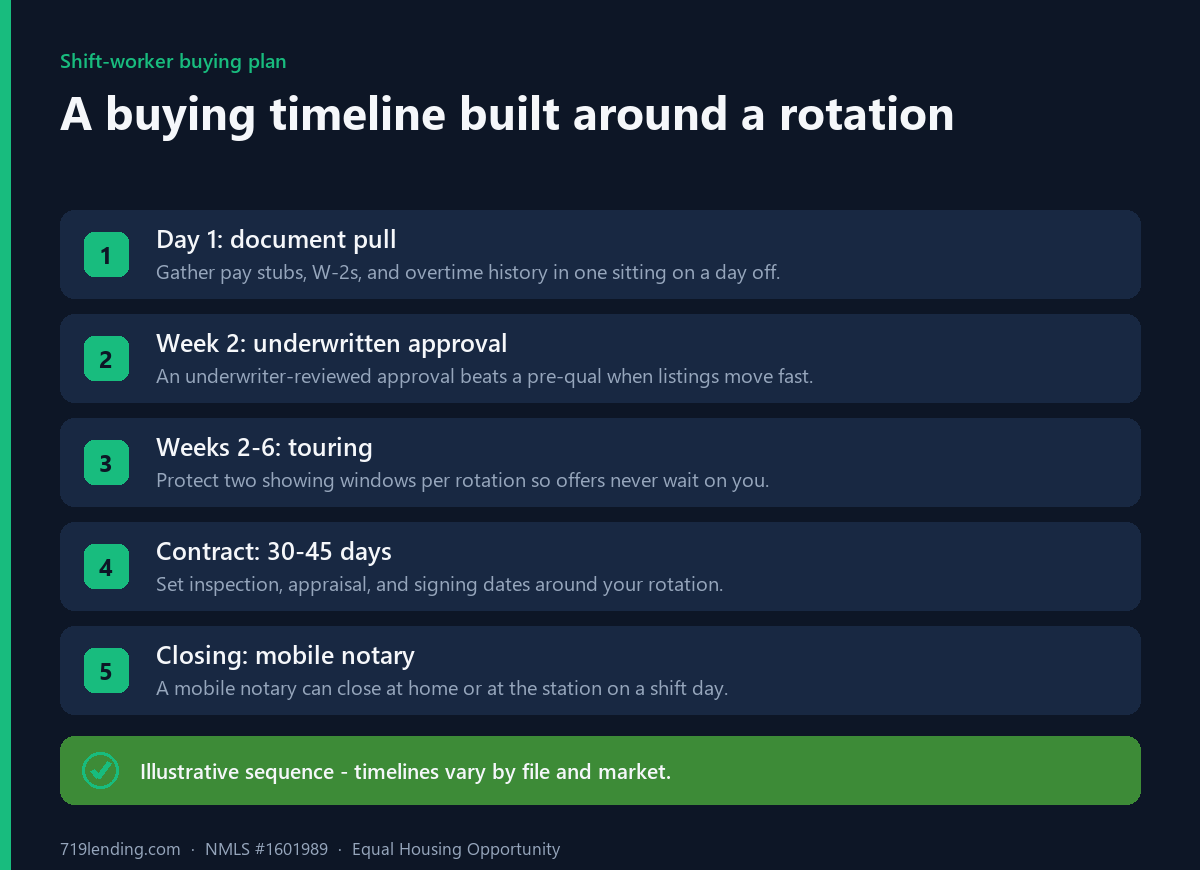
- Line up your pre-approval before you shop; you will not have flexible weekday hours to fix it later.
- Give your agent and lender your rotation so showings, inspections, and signing get scheduled on your days off.
- Ask for a remote or mobile notary closing option in advance rather than the day before.
What moves your pricing locally
Credit profile, down payment, property type, and occupancy drive pricing far more than occupation does. The CFPB’s homebuying guide is a neutral starting point for comparing offers, and comparing several real quotes on the same day is a practical way to see the spread.
Your path to approval as a firefighter or EMT

The sequence below works well for shift workers with variable pay.
- Pull 24 months of paystubs and both W-2s before anyone quotes you a payment.
- Get a written pre-approval that itemizes which income was counted and which was excluded.
- Test your household income against assistance limits in your target county.
- Decide whether GNND is worth watching for, and get pre-approved regardless.
- Compare loan pricing across multiple wholesale lenders on the same day, with the same lock terms.
- Stack assistance, employer or union benefits, and any agent-side credit, disclosed at application.
Do that and the loan gets sized on income that survives underwriting, which is the difference between a clean close and a rewritten pre-approval two weeks before your closing date.
Frequently asked questions
Is there a special mortgage rate for firefighters and EMTs?
No. Rates are set by loan-level pricing factors such as credit profile, loan-to-value, loan amount, occupancy, and property type, not by occupation. Programs and assistance can reduce your cash to close or your purchase price, but the note rate itself is priced the same way it is for any other borrower.
Are firefighters and EMTs eligible for Good Neighbor Next Door?
They can be, but the occupation alone is not enough. HUD requires full-time employment by a government agency as a firefighter or emergency medical technician, and that the employment directly serve the locality where the home is located. Occupancy and other HUD conditions also apply, and inventory in any given area is limited. Confirm current criteria with HUD.
Will my overtime count toward qualifying?
Often, if you can document a consistent history and the employer indicates it is likely to continue. A two-year history is the general expectation, a shorter history of at least 12 months may be considered with offsetting positive factors, and lenders average the history rather than using your best month. Declining overtime generally has to be shown to have stabilized before it counts. Bring 24 months of paystubs and both W-2s to the first conversation.
How do lenders handle a 48/96 or Kelly schedule?
They verify the annualized base through a written verification of employment and W-2s instead of reading a single uneven paystub. The rotation itself is not a problem; an undocumented pay history is. Ask your loan officer to show you which pay types were included in your pre-approval.
Can I use CHFA assistance with an FHA or VA loan?
CHFA assistance is generally designed to be used with a CHFA first mortgage, and CHFA first mortgages have historically included FHA, VA, USDA, and conventional options. Program structure, income limits, and pairing rules change, so confirm current terms with CHFA or your broker before assuming a combination works.
Do first responder rebate programs actually save money?
Sometimes. The credit typically comes from the buyer’s agent commission rather than from the mortgage, so the value depends on the agent match, the home price, and how the credit is applied at closing. Compare it against simply hiring the agent you want and shopping loan pricing independently.
Should a veteran firefighter use VA or FHA?
It depends on entitlement, cash position, credit profile, and how long you plan to hold the home. VA financing generally requires no down payment for eligible borrowers and carries no monthly private mortgage insurance, though a VA funding fee may apply, while FHA can be competitive in specific credit and property scenarios. Price both before choosing.
719 Lending Inc., NMLS #1601989 · Equal Housing Opportunity
719 Lending Inc. is not affiliated with or endorsed by HUD, FHA, VA, CHFA, or any government agency.
Last updated: July 2026

Related Posts