Do heroes get special mortgage rates? We debunk eight hero home loan myths: GNND, DPA, nurse and teacher loans, overtime income, and commission rebates.
Homes for Heroes: How It Works & What You Actually Save
Homes for Heroes is a national referral network, not a mortgage program and not a government benefit. It connects firefighters, EMS crews, law enforcement, military members, healthcare workers and teachers with affiliated real estate agents, lenders and title companies who agree to give back a share of what they earn on the transaction.
That structure explains both its value and its limits. The money is real when the affiliated professionals are people you would have hired anyway, and it is beside the point if the loan itself is priced poorly. This guide walks the mechanics, the illustrative math, and where the larger savings lever usually sits for Colorado hero buyers.
The short answer
Homes for Heroes works by routing you to affiliated professionals who give back part of their compensation on your transaction. There is no application, no underwriting benefit, and no rate advantage built into the network itself.
- What it is: a commercial referral and rebate network.
- What it is not: a loan product, a down payment assistance program, or a government initiative.
- Who it serves: firefighters, EMS, law enforcement, military (active, reserve, veteran), healthcare workers and teachers, as defined by the network.
- When you get paid: at or after closing, depending on your lender’s requirements and the rules that apply in your state.
- What it does not touch: your interest rate, your loan program, or your approval odds.
- Where it applies: the network states its rewards are not available in all states and are limited or restricted in some – confirm current terms directly with the network.
| Savings lever | What it is | Illustrative size |
|---|---|---|
| Homes for Heroes rebate | Affiliated agent gives back part of the commission on the transaction | 0.7% of the purchase price, per the network’s own published materials (illustrative – confirm current) |
| Affiliated lender and title credits | Fee credits applied on the Closing Disclosure by participating partners | A few hundred dollars, illustrative – the network publishes averages near $500 for lender fees and $150 for title |
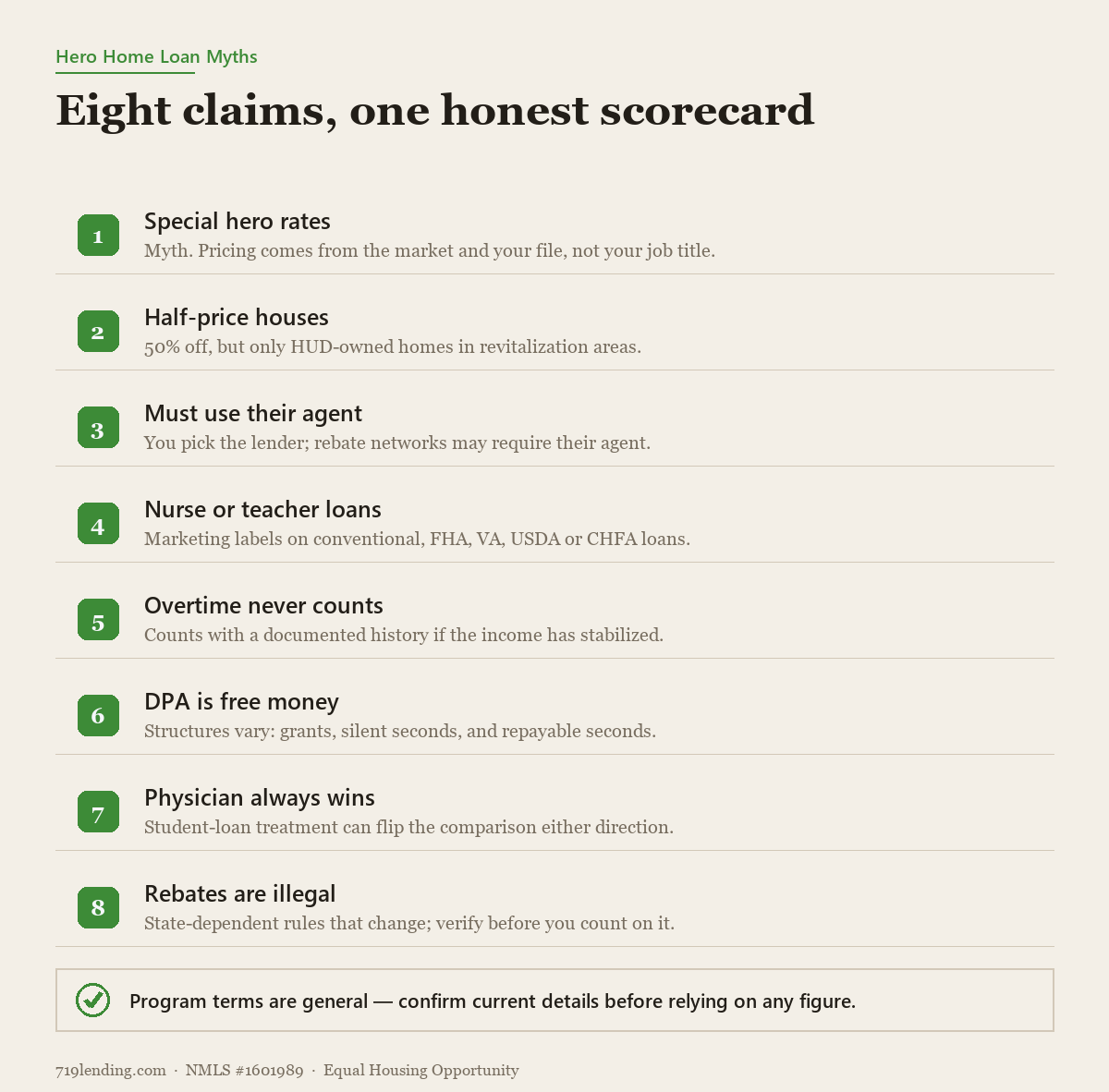
| Good Neighbor Next Door | HUD program offering 50% off the list price of eligible HUD-owned homes in revitalization areas | Large where available, but eligibility is narrow and inventory is very limited |
| CHFA and local assistance | Down payment and closing cost help for qualified Colorado buyers | Varies by program – general, confirm current |
| Loan pricing shopped across wholesale lenders | Rate and points comparison for the same borrower profile | Roughly 0.125% to 0.5% in rate, illustrative – general, confirm current |
If you are just starting, our overview of hero home loan options in Colorado lays out the government programs, lender products and networks side by side.
How Homes for Heroes actually works
The network is a matchmaking layer between hero buyers and professionals who participate under its agreements. Nothing happens automatically – you generally have to enter through the network before you hire anyone.
Step 1: You register through the network
You sign up on the network’s site and are matched with a local affiliate. Registration is free to the hero; the affiliated professionals participate under the network’s own terms and agree to give back part of their compensation. Confirm the current terms directly with the network before relying on any specific figure.
Step 2: You transact with the affiliated professionals
You must use the matched agent, and often the affiliated lender or title company, for the benefit to apply. Signing a buyer agreement with a different agent first generally forfeits the give-back, because it comes out of that specific agent’s commission.
Step 3: How and when the money reaches you
Homes for Heroes describes the agent-side give-back as 0.7% of the home purchase price and publishes an average total reward near $3,000 for heroes using its affiliated partners (the network’s published figure). Those figures are the network’s own published averages, not an independent measurement, and they are illustrative only. The network describes sending a check after closing. Colorado, however, has its own rules about how a commission rebate reaches a financed buyer, which is covered below – so confirm the mechanics in writing with your agent and your loan originator before you count on any particular timing.
What the lender and title side adds
Affiliated lenders and title companies may credit certain fees, such as a portion of processing, underwriting or settlement charges. Those credits appear on the Closing Disclosure and are typically modest relative to the agent give-back. They also do not change the interest rate, which is where most of the long-run money lives.
Who qualifies as a hero
Eligibility here is defined by the network, not by a statute, so the categories are broad and can change.
- Firefighters and EMS personnel
- Law enforcement officers
- Military – active duty, reserves, National Guard and veterans
- Healthcare workers, including nurses and many clinical staff
- Teachers and, in many markets, other school employees
Confirm current eligibility categories and verification requirements directly with the network. Do not assume that qualifying as a hero with a private network means you qualify for any government program – the government programs use their own, narrower definitions.
What the network does not check
Because this is a marketing arrangement rather than an underwriting one, qualifying as a hero here says nothing about qualifying for a mortgage. Credit, income documentation, debt-to-income ratio and assets are evaluated by the lender exactly as they would be for any other borrower. A rebate cannot offset a file that does not qualify, and no one can promise approval.
What the rebate is actually worth: illustrative math

Run the two levers against each other on the same transaction and the ranking becomes clear. All figures below are illustrative and general – confirm current market conditions with a licensed loan originator. Nothing here is a rate quote or an offer of credit.
The rebate side
On a $500,000 purchase, a 0.7% agent give-back is about $3,500, paid once, around closing. That is real money and worth having. It is also a one-time, fixed amount that does not grow, compound or change your monthly payment. This figure is illustrative; the network’s own published average reward is lower than this example.
The loan pricing side
Now the loan. On a $475,000 loan amount, a 0.25% difference in rate is roughly $78 a month in this illustration, and roughly $28,000 in additional interest over 30 years if you keep the loan the full term. A quarter point is a routine spread between two wholesale lenders pricing the same borrower profile on the same day. These are illustrative figures at sample rates, not a quote, and your actual numbers depend on your credit profile, loan program and the day you lock.
Why the comparison is not either-or
Nothing stops you from taking both, provided the affiliated lender is competitive on pricing for your scenario. The failure mode is accepting a more expensive loan in order to protect a one-time $3,500 illustrative rebate. We ran the numbers on whether hero branded programs actually save money for a typical Colorado buyer, and the pattern held: pricing beats packaging over any normal holding period.
Where the savings actually come from

Hero savings are a stack, and the layers are not equal. Ranking them correctly is most of the work.
Order of operations
Start with the loan structure and pricing, because those set the payment for as long as you hold the mortgage. Layer assistance next, because it reduces the cash you need at the table. Treat network rebates as the last layer – a bonus on a decision you were making anyway. Stacking down payment assistance on top of a well priced loan usually moves more money than any rebate check.
Where each layer is decided
Rate and points are decided by the lender you choose and the day you lock. Assistance is decided by program rules and income limits. The rebate is decided by which agent you signed with. Only one of those three follows you for 360 payments.
Homes for Heroes versus government hero programs
The categories get blurred constantly in marketing copy, so keep them separate. Government programs are created by agencies and carry statutory rules and narrow eligibility definitions. Referral networks are private companies. Lender products are portfolio underwriting decisions.
Good Neighbor Next Door
The Good Neighbor Next Door program is the clearest example of real, government-backed money for heroes, offering a 50 percent discount off the list price on eligible HUD-owned homes in designated revitalization areas.
The eligibility list is much narrower than a private network’s. HUD limits this program to law enforcement officers, pre-Kindergarten through 12th grade teachers, firefighters and emergency medical technicians. Healthcare workers and military service members are not eligible categories for this program, even though private hero networks include them. Buyers sign a second mortgage and note for the discount amount; no interest or payments are required on that silent second provided the buyer lives in the home as a principal residence for the full 36-month occupancy period.
The catch is inventory and access: eligible listings are scarce, the list changes weekly, homes are offered through the program for a short listing window, and when multiple qualified offers arrive the buyer is chosen by random lottery. HUD’s published program rules govern who qualifies, how properties are listed and how the silent second mortgage is forgiven.
CHFA and Colorado assistance
Colorado Housing and Finance Authority programs are the practical assistance layer for many Colorado buyers. Program menus, income limits and purchase price limits vary by program and change periodically, so treat any specific figure you read anywhere as general and confirm current terms with CHFA or a participating lender. Eligibility is determined through a participating lender under CHFA’s own program rules, not through any referral network.
VA, FHA and conventional
For military heroes, the loan type itself frequently outperforms every branded benefit. VA-backed loans require no monthly mortgage insurance and, for most eligible borrowers, no down payment, in exchange for a one-time funding fee that certain borrowers – including those receiving VA compensation for a service-connected disability – are exempt from paying. Choosing between VA, FHA and conventional structures changes the down payment requirement, the mortgage insurance treatment and the monthly payment. It helps to compare hero programs side by side before you commit to any one network.
Colorado rules, disclosure and the fine print
Commission rebate rules vary by state — some states restrict or prohibit them, so verify the current rules where you are buying. Colorado permits a brokerage firm to rebate part of an earned commission to a consumer it represents – but Colorado attaches conditions that matter a great deal to a financed buyer, and they are the opposite of the “just wait for a check” assumption many hero marketing pages create.
The Colorado condition most buyers miss
Under the Colorado Real Estate Commission’s published position on rebating a portion of an earned commission, a rebate to a buyer who is obtaining financing is expected to be disclosed to the lender, reflected on the settlement statement, and approved by the lender. The Commission’s position also directs that a rebate should not be paid outside of closing, and warns that money rebated to a buyer without lender disclosure and approval may constitute loan fraud. Brokers are advised to put the rebate terms in writing, including whether it is paid as cash or applied to closing costs and the fact that the lender may disallow part or all of it. Rules change – confirm current Colorado Real Estate Commission guidance and your brokerage’s policy before relying on any specific mechanic.
Practical translation: if you are financing in Colorado, do not plan around a quiet post-closing check. Plan on telling your loan originator about the rebate early so it can be disclosed and approved properly.
Rebates versus lender credits
An agent commission rebate is not the same thing as a lender credit. Lender credits are disclosed on the Loan Estimate and Closing Disclosure and are tied to your loan pricing. Agent rebates are a reduction of the brokerage’s earned commission and are governed by real estate licensing rules plus your loan program’s rules on interested party contributions. Fannie Mae’s selling guide treats agent or broker rebates that are not credited toward the transaction as sales concessions, which are deducted from the sales price for loan-to-value purposes. That is one more reason the rebate needs to be on the table early rather than handled quietly on the side.
Documentation and lender approval
Loan programs set their own limits on what interested parties – including the real estate agent – may contribute toward your closing costs, and those limits vary by occupancy and loan-to-value. Tell your loan originator about any commission credit as early as possible. Retrofitting it days before funding is how deals get delayed, repriced, or lose the credit entirely.
Taxes
Rebates may have tax consequences depending on how they are structured and reported. We do not give tax advice and make no claim about deductibility or taxability; consult a tax professional about your specific situation before assuming any particular treatment.
How to use Homes for Heroes without leaving money behind
Used correctly, the network is a small, free add-on. Used incorrectly, it becomes the reason someone accepts an expensive loan.
- Register before you sign a buyer agency agreement with any agent – after is usually too late.
- Interview the matched agent on merit. A rebate does not fix weak local representation.
- Get pricing from the affiliated lender and from at least one independent broker on the same day.
- Compare total cost, not just rate: points, lender fees and mortgage insurance all move the number.
- Confirm in writing how and when the rebate is paid, and tell your lender about it up front so it can be disclosed and approved.
- Ask which assistance programs you qualify for before locking a rate.
- Verify the network’s current terms and state availability yourself rather than relying on any published average.
The CFPB explains how to compare Loan Estimates from more than one lender so the pricing differences are visible in writing. A Colorado Springs mortgage broker can price the same borrower profile across multiple wholesale lenders in one conversation, which is a direct way to test whether the affiliated lender is genuinely competitive.
Our take
Our take: Homes for Heroes is a legitimate, openly commercial referral network, and it is worth registering for if you have not yet chosen an agent. Take the give-back when it comes attached to professionals you would have hired regardless.
Our take: the branded benefit is the smallest lever on the table. The roughly $28,000 illustrative difference that a quarter point makes over 30 years is the number that deserves the shopping effort, and it is decided by loan pricing and structure – not by which network sent you the agent.
Our take: in Colorado specifically, the rebate mechanic deserves a conversation with your loan originator on day one. A benefit that has to be disclosed and approved is not a benefit you want discovering itself a week before closing.
Frequently asked questions
Is Homes for Heroes a government program?
No. It is a private, for-profit referral network. Affiliated agents, lenders and title companies participate under its agreements and give back part of their compensation. Government hero benefits are separate and include HUD’s Good Neighbor Next Door program and state programs such as CHFA assistance.
Who qualifies as a hero?
The network defines eligibility broadly: firefighters, EMS personnel, law enforcement, military members including veterans, healthcare workers, and teachers. Because eligibility is set by the company rather than by statute, categories, state availability and verification requirements can change – confirm current terms directly with the network.
How much does Homes for Heroes actually save?
The network’s own published materials describe the agent-side give-back as 0.7% of the home purchase price and an average total reward near $3,000 for heroes using its affiliated partners (the network’s published figure). On a $500,000 home, 0.7% is about $3,500 (illustrative; figures attributed to the network – confirm current). Actual amounts vary by market, price point and which affiliated partners you use.
Do I have to use their lender to get the rebate?
The agent give-back depends on using the affiliated agent. Lender and title fee credits require using those affiliated partners. You can generally take the agent give-back while financing elsewhere, but confirm the specific terms in writing before you sign anything.
Are real estate commission rebates legal in Colorado?
Colorado permits a brokerage firm to rebate part of an earned commission to a consumer it represents, and the Colorado Real Estate Commission’s published position states this does not by itself violate license law or RESPA. For a financed buyer, that position also expects the rebate to be disclosed to the lender, shown on the settlement statement and approved by the lender, and directs that it not be paid outside of closing. Confirm current guidance and your brokerage’s policy.
Can I combine it with CHFA, VA or FHA financing?
Generally yes, but not silently. Loan program rules on interested party contributions govern how a credit can be applied at closing, and a rebate that is not credited toward the transaction can be treated as a sales concession that reduces the sales price used for loan-to-value. Disclose the arrangement to your loan originator early rather than at the end.
Is the rebate taxable income?
Treatment depends on how the payment is structured and reported, and we do not provide tax advice. Consult a tax professional about your specific circumstances before assuming any particular outcome.
719 Lending Inc., NMLS #1601989 · Equal Housing Opportunity
719 Lending Inc. is not affiliated with or endorsed by HUD, FHA, VA, CHFA, Homes for Heroes, or any government agency. All rates, figures and dollar amounts in this article are illustrative and general – confirm current terms with a licensed loan originator.
Last updated: July 2026

Related Posts