Do heroes get special mortgage rates? We debunk eight hero home loan myths: GNND, DPA, nurse and teacher loans, overtime income, and commission rebates.
Hero Home Loan Programs Compared: What Each One Actually Gives You
Hero home loan programs compared at a glance

If you teach, patrol, fight fires, run calls, treat patients, or serve in uniform and you want to know which hero home loan programs actually put money in your pocket, the direct answer is that a small number do and most do not. The loudest marketing rarely attaches to the largest dollar value.
The honest hierarchy looks like this: one federal program offers a genuine 50% discount but almost no inventory, state down payment assistance offers real dollars based on income rather than occupation, and the loan itself — how it is priced and structured across wholesale lenders — is where most heroes find their biggest savings.
Every profession-specific path below ties back to the broader guide to home loans for heroes in Colorado.
| Program | What you actually get | Who qualifies | The catch |
|---|---|---|---|
| Good Neighbor Next Door (HUD) | 50% off the list price of an eligible HUD-owned home | Teachers pre-K through 12th grade, law enforcement officers, firefighters, emergency medical technicians | Very few eligible homes; random lottery when multiple offers arrive; 36-month occupancy commitment |
| CHFA down payment assistance | Down payment and closing cost help, structured as a grant or a second mortgage | Colorado buyers within CHFA income limits using a CHFA first mortgage loan | Must pair with a CHFA first mortgage; limits vary by county; homebuyer education required |
| VA loan | No required down payment and no monthly mortgage insurance | Eligible veterans, active duty, Guard, Reserve, and some surviving spouses | Funding fee applies unless exempt; occupancy rules |
| FHA loan | 3.5% minimum down payment with more flexible credit guidelines | Any buyer meeting agency guidelines | Mortgage insurance is required on all FHA loans; how long it lasts varies |
| Conventional low-down-payment options | As little as 3% down on some programs (program-dependent — confirm current), and conventional mortgage insurance can be cancelled under certain conditions | Buyers meeting credit and, for some versions, income limits | Pricing is sensitive to credit score and down payment |
| Commercial rebate networks | A share of the buyer agent’s commission plus assorted vendor fee credits | Members who use the network’s affiliated agents and partners | Not a loan product; you generally must use their agent |
| Physician and professional loans | Low or zero down with no monthly mortgage insurance | Physicians, dentists, and sometimes other licensed professionals | Portfolio pricing can exceed a well-shopped conventional loan |
Every dollar figure, percentage, and program term in this article is illustrative and general — confirm current terms before relying on any of them. Program rules change, and each lender and agency publishes its own.
Three categories people constantly mix up
Sort every hero program you encounter into one of three buckets before you compare anything. They are not interchangeable, and most confusion comes from treating them as if they were.
- Government programs: HUD’s Good Neighbor Next Door, CHFA assistance, and the FHA, VA, and USDA loan baselines. These have published rules and statutory backing.
- Commercial rebate networks: private marketing companies that route you to affiliated agents and lenders in exchange for a share of the commissions and fees generated.
- Lender products: portfolio loans a bank designs around a profession, such as physician mortgages. These are underwriting flexibility, not discounts.
How to read this comparison
Two questions separate a real benefit from packaging. First, does the program change the price of the house or the cost of the money? Second, does it require you to give up your choice of agent, lender, or property?
Anything that fails both tests is branding. Anything that clearly passes the first deserves a serious look, even if it is inconvenient.
Good Neighbor Next Door: the largest real discount, and the hardest to use
Good Neighbor Next Door is the one program on this list that hands over a discount large enough to change a household’s balance sheet. HUD offers certain single family properties in designated revitalization areas to qualifying public servants at 50 percent off the list price.
What HUD actually gives you
The discount is not a check. HUD requires you to sign a second mortgage and note for the discount amount, and no interest or payments are required on that silent second as long as you fulfill the occupancy requirement. In return, an eligible buyer must commit to live in the property for 36 months as a principal residence.
Financing is a separate step. You still need an FHA, VA, conventional, or cash purchase to cover the half you are actually paying.
Who qualifies for the HUD program
- Teachers covering pre-Kindergarten through 12th grade
- Law enforcement officers
- Firefighters and emergency medical technicians
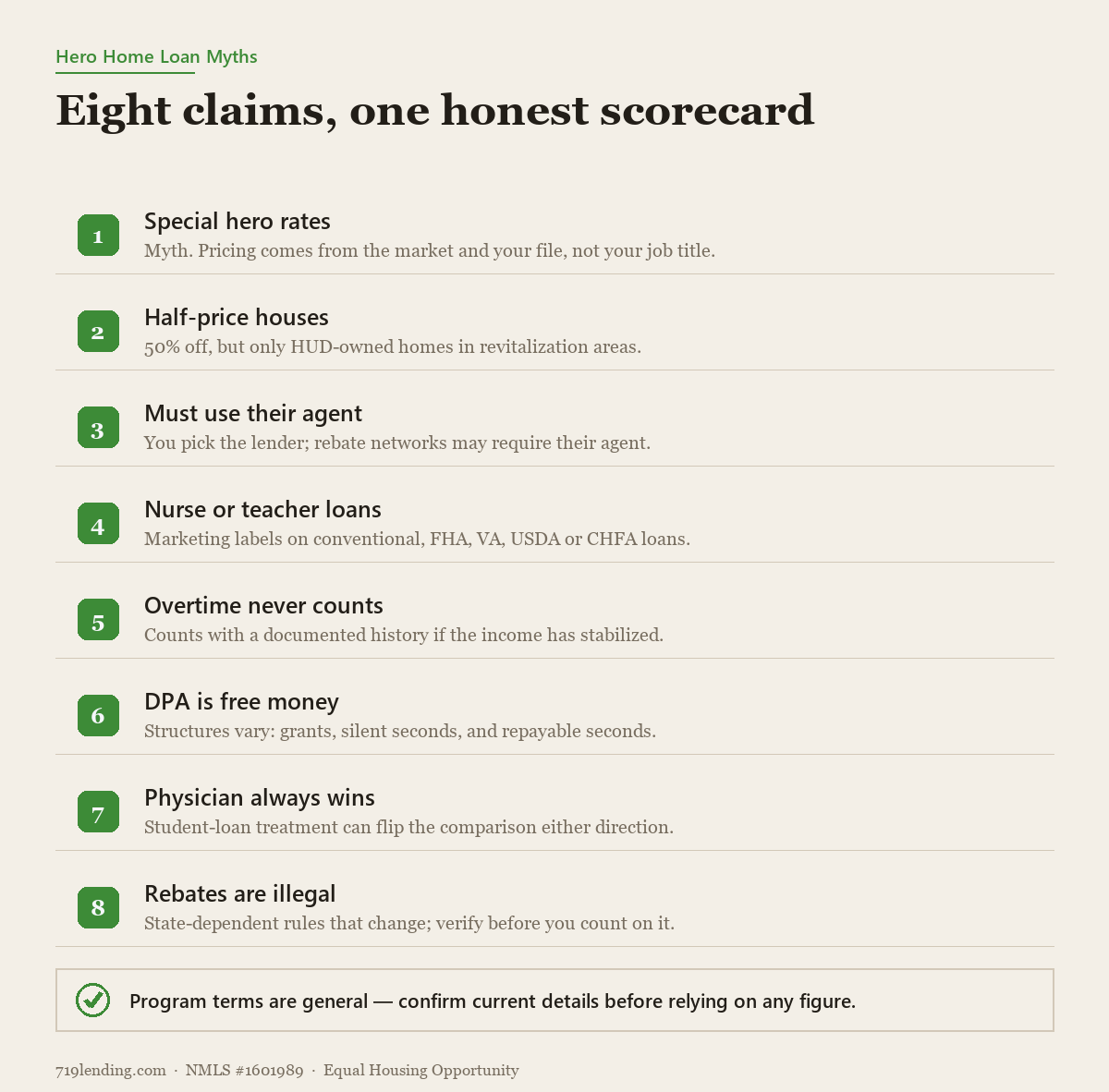
HUD publishes detailed employment and service-area conditions for each category, so confirm current eligibility requirements directly before you plan around them. Nurses, physicians, and military members are not on HUD’s occupation list for this particular program, which surprises people who assume the word hero means the same thing in every program.
The catches worth knowing before you get attached
Inventory is the wall. HUD lists eligible Good Neighbor Next Door properties on its own site, and the listings turn over quickly. Properties are available for purchase through the program for seven days, and in a given month an entire metro area may have zero eligible homes, or one that needs significant repair work.
Selection is also random. When more than one person submits an offer on a single home, HUD makes the selection by random lottery rather than by offer price, so a stronger offer does not improve your odds. Our take: treat this program as a standing weekly alert, not as your home buying plan.
CHFA down payment assistance: Colorado’s income-based money
Colorado Housing and Finance Authority down payment assistance is the workhorse of hero home buying in this state, because it does not care what you do for a living.
What CHFA provides
CHFA offers help toward down payment and closing costs either as a grant that does not require repayment or as a second mortgage loan, and each option must be paired with a CHFA first mortgage loan. You choose one or the other — CHFA does not allow both alongside the same first mortgage. The structures and amounts are revised periodically, so treat any specific figure as general and confirm current terms with your lender.
Who qualifies for CHFA assistance
- Buyers within CHFA’s income limits, which vary by household size, county, targeted or non-targeted area, and loan program
- Buyers using an eligible CHFA first mortgage loan program
- Borrowers who complete a CHFA-approved homebuyer education class before closing
- Buyers who meet the credit and debt-to-income guidelines of the underlying loan
Because the limits are set county by county, El Paso County figures differ from Denver metro figures, and CHFA updates the tables periodically. Pull the current limits for your county and household size rather than working from a number you read months ago.
Why CHFA works well for heroes
Eligibility attaches to income and the loan rather than the occupation, so a teacher, a paramedic, and a warehouse manager with the same income are treated the same way. That is exactly what makes it valuable: it adds dollars without asking what your badge says.
FHA, VA, and conventional loans: the baselines doing the heavy lifting
Most heroes end up in one of three ordinary loan types, and the choice among them usually moves more money than any branded program on the internet.
VA loans
For eligible service members and veterans, the VA loan is hard to match: the VA home loan program does not require a down payment or monthly mortgage insurance, and underwriting treats military pay realistically. A one-time funding fee applies unless you are exempt, and some borrowers — including those receiving compensation for a service-connected disability — are. The VA publishes its own eligibility and entitlement rules, and they are worth reading before you assume you do or do not qualify.
FHA loans
FHA allows for down payments as low as 3.5 percent and permits lower credit scores than most conventional loans, which matters for buyers rebuilding after a rough stretch. The trade-off is that mortgage insurance is required on all FHA loans, and how long the annual premium stays on the loan depends on your down payment and loan term — on many current FHA loans with smaller down payments it can remain for the life of the loan (general — confirm current with HUD). Confirm current FHA mortgage insurance terms for your specific scenario.
Conventional loans
Conventional financing with 3% to 5% down can outperform FHA when credit is strong, because conventional mortgage insurance can be cancelled under certain conditions and is priced to your profile. Income-limited conventional options may also offer reduced mortgage insurance for qualifying buyers — general, and worth pricing against a standard conventional loan rather than assuming.
The CFPB’s loan options resource is a neutral starting point for understanding how the major loan types differ before anyone tries to sell you one. The CFPB’s explainer on mortgage insurance is the companion piece, covering how FHA premiums, conventional PMI, and the VA structure differ from one another.
Commercial rebate networks: marketing, not a mortgage product
Rebate networks are marketing cooperatives, not mortgage programs, and the distinction matters when you compare offers.
What they actually pay
The core benefit is a rebate of part of the buyer agent’s commission at closing, sometimes bundled with small credits from affiliated title, inspection, or lending partners. On an illustrative $450,000 purchase with an illustrative 2.5% buyer agent commission — commission rates are negotiable and vary by agreement — a network returning a quarter of that commission would pay roughly $2,800. That is real money, and roughly the size of a single round of loan pricing. Treat all three figures as illustrative and confirm current terms.
What they do not do
- They do not create special mortgage rates; the loan is whatever the affiliated lender is offering that day
- They do not change agency guidelines, mortgage insurance, or down payment requirements
- They do not always let you keep an agent you already know and trust
- Rebate mechanics differ by state and by loan type, and some closings handle them differently
When a rebate network is worth it
Our take: if you do not already have an agent and the network’s agent is genuinely strong, the rebate is genuine savings you should take. If joining means abandoning a great agent or accepting an uncompetitive loan, the rebate can quietly cost more than it pays.
Physician and professional loan products: flexibility, not a discount
Physician and professional loan programs are portfolio products, which means the bank keeps the loan and can write its own rules.
What lenders flex
- Low or zero down payment at loan sizes where conventional financing would require far more cash
- No monthly mortgage insurance, which is often the single largest line-item difference in the payment
- Student loan debt sometimes counted on terms the bank sets rather than the agency calculation
- An employment contract accepted before the first paycheck, within defined limits
Worth knowing before you assume the portfolio product wins on student debt alone: agency guidelines already allow a documented income-driven payment of $0 to be used in some cases, and otherwise permit a calculation based on a percentage of the outstanding balance or a fully amortizing payment. Ask both sides to show you the actual qualifying payment they would use.
The trade-off nobody advertises
Portfolio flexibility is not free. The note rate on a physician-style loan is frequently higher than a well-priced conventional loan, and the break-even depends on how long you actually keep the financing. Run both side by side with real numbers rather than assuming the professional product wins on name alone.
What actually saves most heroes the most money

The honest question is whether a branded hero program beats a well-shopped ordinary loan, and often it does not.
Loan pricing is the biggest lever
The same borrower file, submitted to several wholesale lenders on the same morning, comes back with meaningfully different pricing. An eighth to a quarter of a percent in rate on a $450,000 loan is roughly $35 to $75 a month, every month, for as long as you keep it (illustrative — confirm current). That difference compounds far past any one-time rebate.
This is the structural argument for working through a broker rather than a single retail lender: one application, several lenders competing, one honest comparison.
Income documentation is the second lever
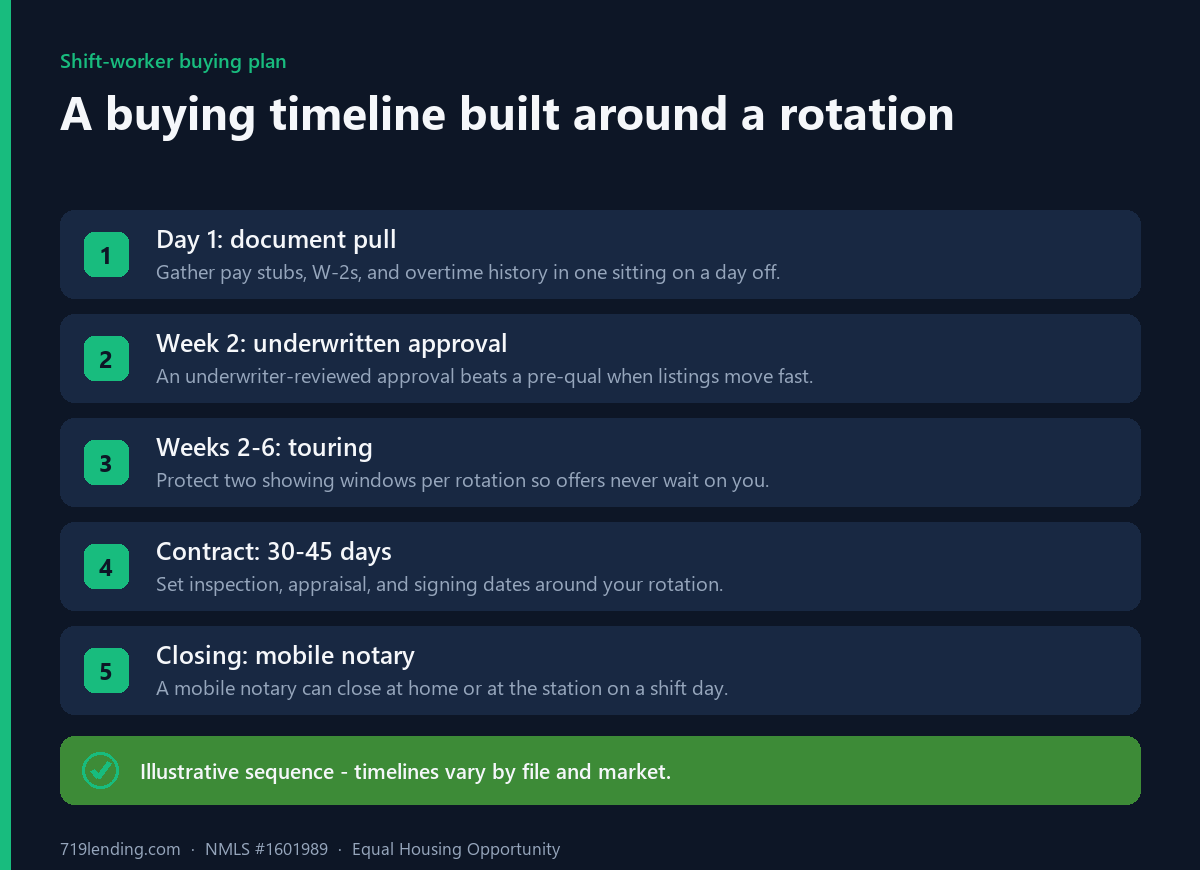
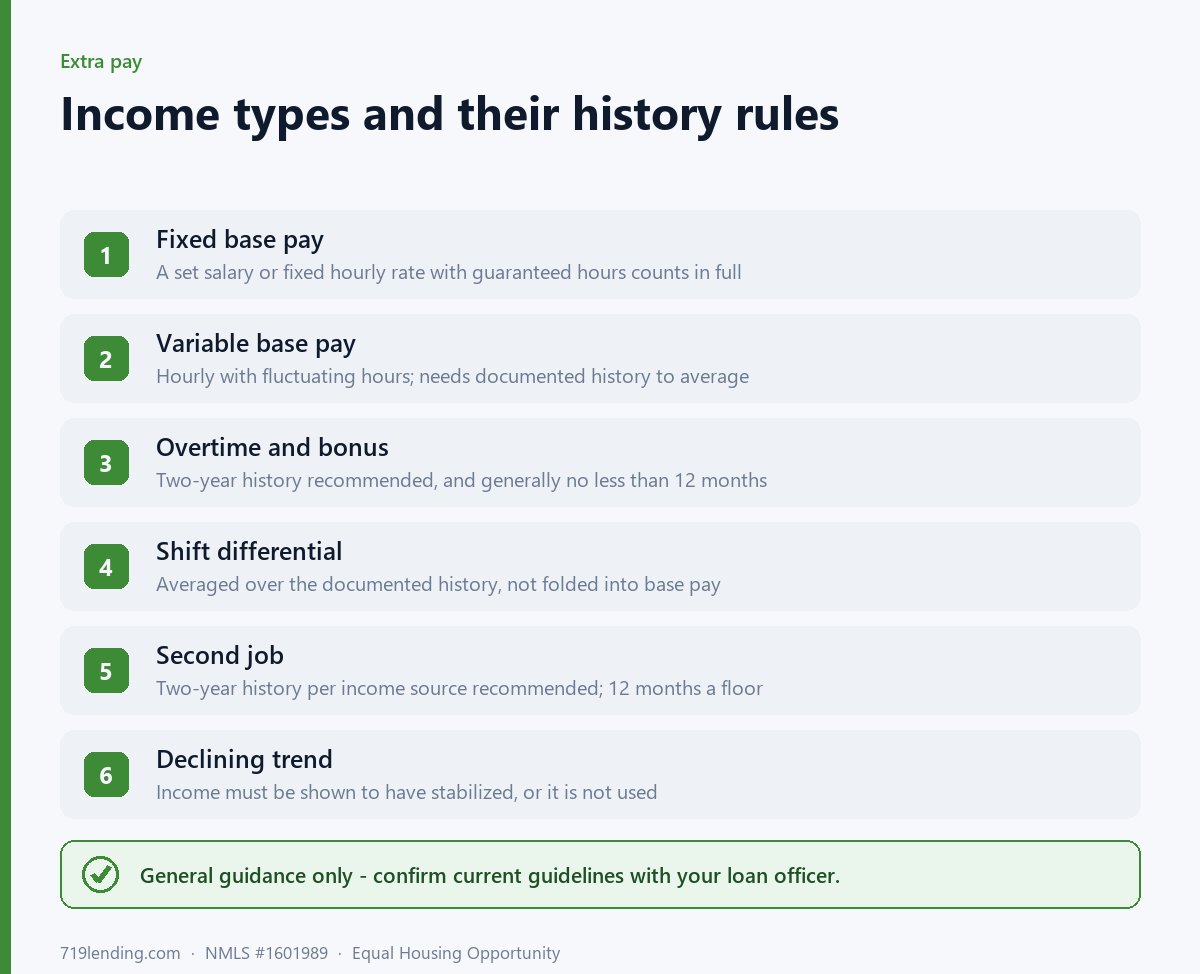
Heroes are disproportionately paid in ways automated underwriting handles badly — overtime, shift differential, per diem, contract assignments, moonlighting, and second jobs. How that income is documented decides how much house you qualify for, and it is frequently worth more than any program discount.
Our take on the hierarchy
- Shop the loan pricing first, because it applies to every month you own the home
- Layer assistance next, because it reduces the cash you bring to closing
- Pursue Good Neighbor Next Door only if eligible inventory genuinely exists near you
- Treat rebate networks as a bonus, never as a reason to change agents or lenders
How hero programs stack, and where they collide
Stacking is where the real money shows up, and also where the rules bite hardest. The combinations below are typical, not universal, and every one of them has to be confirmed against current program documents.
What usually stacks
- CHFA assistance with a CHFA first mortgage loan, which CHFA offers in more than one loan type
- State assistance with local city or county programs, subject to each program’s own rules
- Seller-paid closing cost credits with most assistance programs, up to agency interested-party limits
- Lender credits paired with a slightly higher rate, when you expect to move or refinance sooner
What usually collides
- Two down payment assistance programs both claiming second lien position
- Good Neighbor Next Door alongside programs with conflicting resale or occupancy restrictions
- Portfolio physician loans with agency assistance programs, since the bank writes its own overlay
- Rebate networks with lenders that require their own affiliated agent or vendor
None of this is discoverable from a marketing page. It comes from asking a lender to model the actual combination in writing before you make an offer.
Colorado Springs: how this plays out locally
El Paso County carries a large military, first responder, medical, and education workforce, so nearly every category above is in play here simultaneously. Fort Carson, Peterson Space Force Base, Schriever Space Force Base, and the Air Force Academy make VA eligibility common, and the region’s hospital systems make shift-differential income a routine underwriting conversation rather than an exception.
What is realistically available here
HUD-owned inventory in designated revitalization areas is thin in this market, which is why Good Neighbor Next Door functions better as a patient alert than as a strategy. CHFA assistance, by contrast, is used in this market constantly and pairs with the CHFA first mortgage programs local buyers already use.
Our take: in Colorado Springs, the winning combination for most heroes is an aggressively shopped VA or conventional loan, or a CHFA first mortgage with assistance attached, with any commission rebate treated as a bonus at the very end.
A one-afternoon plan for choosing
You do not need weeks to sort this out. You need one focused afternoon and a lender willing to show their work.
- Confirm your loan eligibility first — VA entitlement, credit profile, and how your income documents
- Check whether any eligible HUD homes exist in your area this week
- Ask a broker to price your file with several wholesale lenders on the same day
- Model CHFA and local assistance against that pricing, including the second lien terms
- Only then decide whether a rebate network or a professional loan product adds anything real
If a program cannot survive that sequence, it was packaging rather than a benefit.
Frequently asked questions
Which hero home loan program saves the most money?
For a buyer who can find an eligible property, Good Neighbor Next Door is by far the largest single benefit, because 50 percent off the list price of a HUD-owned home dwarfs everything else on the list. For everyone else, which is most heroes, the largest savings come from shopping loan pricing across wholesale lenders and layering CHFA down payment assistance. Figures are illustrative and general — confirm current program terms.
Do teachers, nurses, and first responders get special mortgage rates?
No program on this list sets interest rates by occupation. Rate offers are driven by credit profile, loan type, down payment, property type, and the pricing each wholesale lender publishes on a given day. Programs marketed as hero discounts generally deliver credits, rebates, or assistance rather than a reduced rate.
Can Good Neighbor Next Door be combined with other assistance?
Sometimes, but it depends on the specific programs involved. HUD requires a second mortgage and note for the discounted portion, and some down payment assistance programs require a lien position that conflicts with it. Ask your lender to confirm lien position and program compatibility in writing before you submit a bid.
Are commission rebate networks real money or just marketing?
Real money, with conditions attached. The rebate comes out of the buyer agent’s commission, so it exists only if you use the network’s affiliated agent, and the amount varies by network and market. Treat it as a closing credit worth a few thousand dollars on a typical purchase (illustrative — confirm current), not as a mortgage benefit.
What credit score do hero home loan programs require?
The program does not set the score; the underlying loan does. FHA permits lower credit scores than most conventional loans, and conventional pricing rewards higher scores. Assistance programs typically layer their own minimum on top of the loan’s requirement, so confirm both numbers before you shop for a house.
Can travel nurses and first responders with heavy overtime use all of that income?
Often yes, but documentation drives the answer. Agency guidelines generally look for a documented history of the income — commonly around two years, though a shorter history of at least 12 months can be acceptable with positive compensating factors — and then average it. Travel contract income is evaluated differently than staff income. This is one of the most common places heroes hear no from an automated system and yes from a lender who knows the guidelines.
Do hero programs help if I already own a home?
Some do and some do not. Down payment assistance and first-time buyer programs commonly define a first-time buyer as someone who has not owned a primary residence for a set look-back period, with exceptions in certain targeted areas and for some qualifying veterans. Definitions vary by program, so confirm the current rule with the specific agency. Refinance pricing, by contrast, is shoppable for anyone, and that is where existing homeowners usually find savings.
719 Lending Inc., NMLS #1601989 · Equal Housing Opportunity
719 Lending Inc. is not affiliated with or endorsed by HUD, FHA, VA, CHFA, the CFPB, or any government agency.
Last updated: July 2026

Related Posts