Do heroes get special mortgage rates? We debunk eight hero home loan myths: GNND, DPA, nurse and teacher loans, overtime income, and commission rebates.
Home Loans for Nurses: Programs Plus How Lenders Count Your Income
There is no federal home loan program built only for nurses, so most advertising for “nurse home loans” is packaging wrapped around ordinary mortgage products. What nurses can actually use is the standard menu — conventional, FHA, VA and USDA — plus Colorado down payment assistance, a few commercial rebate networks, and the underwriting rules that decide how overtime, shift differential, per diem shifts and bonus pay count as qualifying income.
That last item is usually the one that moves a nurse’s approval the most. A staff RN whose differential and overtime are documented and counted correctly can qualify for a meaningfully larger loan than the same nurse whose file shows base pay alone.
The short version for nurses buying a home
If you read nothing else, these are the points that decide most nurse files.
- No nurse-only mortgage exists. Nurses use the same loan programs everyone else uses; the profession does not unlock a separate product.
- Assistance is real and stackable. Colorado Housing and Finance Authority (CHFA) programs, local down payment assistance and employer help can combine with a conventional or FHA loan.
- Rebate networks are marketing, not loans. They route you to participating agents and lenders in exchange for a credit at closing, which may or may not beat what you would get shopping on your own.
- Variable pay is the real lever. Overtime, differential, PRN and bonus income generally need a documented history and a reasonable expectation of continuance.
- Pricing is the controllable variable. Points, lender credits and mortgage insurance structure move the total cost, and they are worth comparing across several lenders.
Our take: treat the profession-branded marketing as a tiebreaker, not a strategy, and spend your energy on income documentation and loan pricing.
Is there a special mortgage program just for nurses?
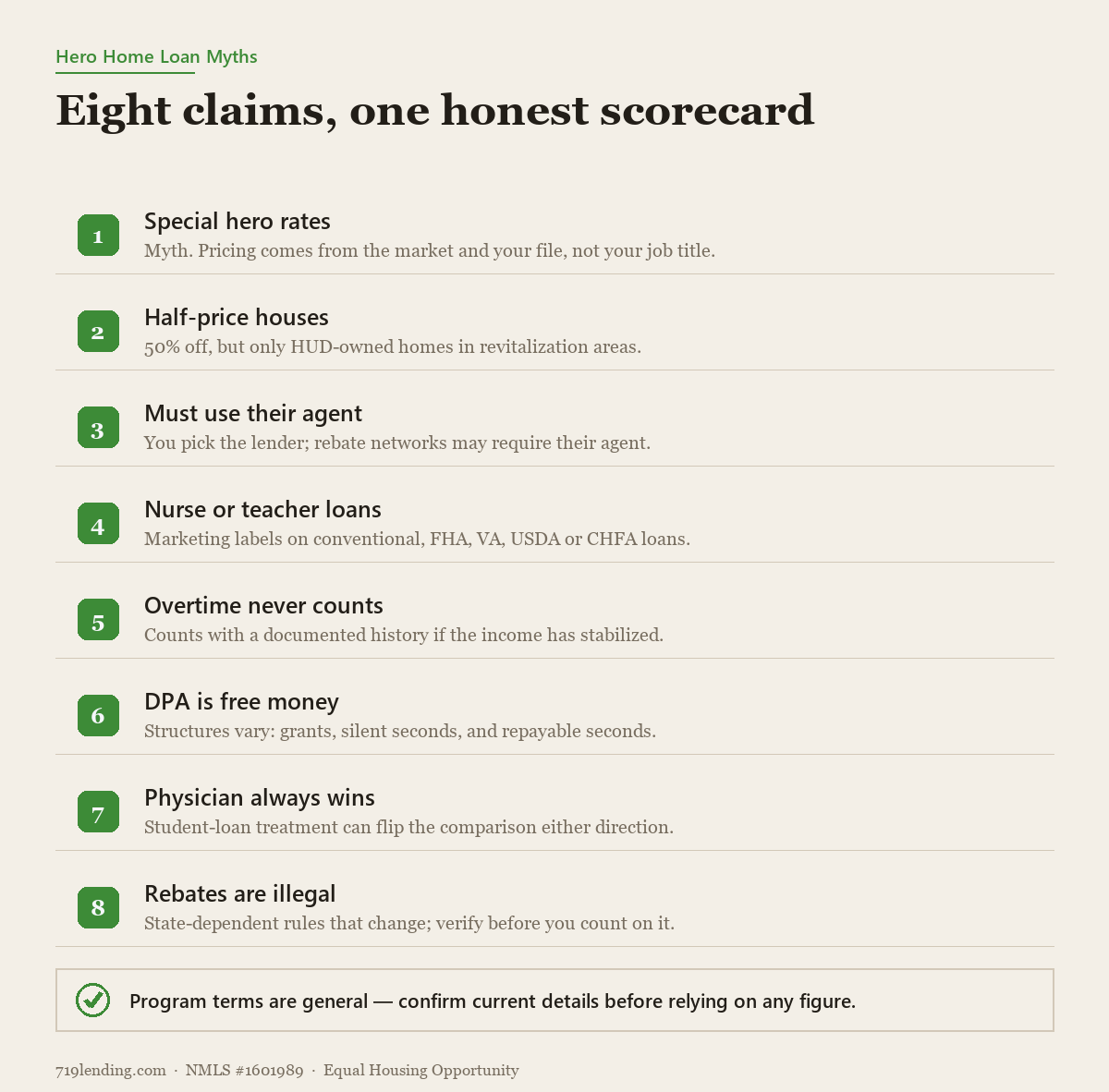
No. There is no HUD, VA or CHFA loan reserved for registered nurses, LPNs, CNAs or nurse practitioners, and no agency underwriting box that loosens because of an RN license.
The closest thing to a profession-based federal benefit is a home sales discount rather than a loan, and it does not cover nursing. HUD’s Good Neighbor Next Door program is limited to law enforcement officers, pre-Kindergarten through 12th grade teachers, firefighters and emergency medical technicians, so nurses are not on that list. A nurse who separately holds an EMT certification would need to qualify through that role rather than through the nursing license.
What the “nurse home loan” label usually means
In practice the phrase points to one of three different things, and keeping them separate protects you from bad comparisons.
- Government programs that nurses may qualify for like anyone else — FHA, VA if you are an eligible service member, veteran or surviving spouse, USDA in eligible rural areas, and state assistance through CHFA.
- Commercial rebate or discount networks that market to healthcare workers and pay a portion of the real estate commission or credit lender fees at closing.
- Lender portfolio products — the physician-style loans some banks extend to nurse practitioners, CRNAs and other advanced practice clinicians, which are individual lender programs, not a national nurse benefit.
Where the real money usually is
Nurses are usually grouped with other hero professions in marketing, but the underwriting rules are the same ones every borrower gets. The savings that actually show up on a Closing Disclosure come from loan pricing, mortgage insurance structure and assistance funds — not from the label on the landing page.
Our take: branded hero programs are sometimes real money and sometimes just packaging, so ask for the number in writing before you commit.
Programs Colorado nurses can actually use
Nothing below is nurse-specific, which is exactly the point: these are the tools that carry real dollars.
CHFA and local down payment assistance
CHFA offers first mortgages paired with down payment assistance in the form of a grant or a second mortgage, depending on the program (programs and terms change — confirm current with CHFA). CHFA sets income and purchase price caps that vary by county and household size, and they change periodically (general — confirm current).
El Paso County and City of Colorado Springs programs come and go with funding cycles, so availability should be confirmed at the time you apply rather than assumed from an older article.
FHA, VA, USDA and conventional
FHA tends to be forgiving on credit and debt ratios. Conventional loans with as little as 3% down (general — confirm current program terms) can be cheaper when credit is strong, because conventional mortgage insurance is risk-based and can generally be cancelled once equity requirements are met, while FHA mortgage insurance follows different cancellation rules.
VA-backed loans are limited to eligible service members, veterans and certain surviving spouses, and most are made with no down payment. Eligibility rests on service history and duty status, so the spouse of a living veteran is not independently eligible; surviving spouses qualify only in defined situations, such as eligibility for VA Dependency and Indemnity Compensation or being the spouse of a service member missing in action or held as a prisoner of war.
Employer and hospital assistance
Some Colorado health systems and staffing employers offer relocation packages, sign-on money or housing stipends. Those funds can affect both your down payment and your qualifying income, and underwriting will want the offer letter or policy document rather than a verbal description.
How lenders count nurse income

This is the section that decides most nurse files. Fannie Mae and Freddie Mac publish the standards that govern how each pay type is treated — Fannie Mae across its income assessment chapter, and Freddie Mac in Guide Chapter 5303, Employed Income — and lenders apply them to your pay stubs, W-2s and employment verification. Both agencies restructured or refreshed this guidance recently, so an older summary you find online may no longer match the current rule.
Base pay counts immediately
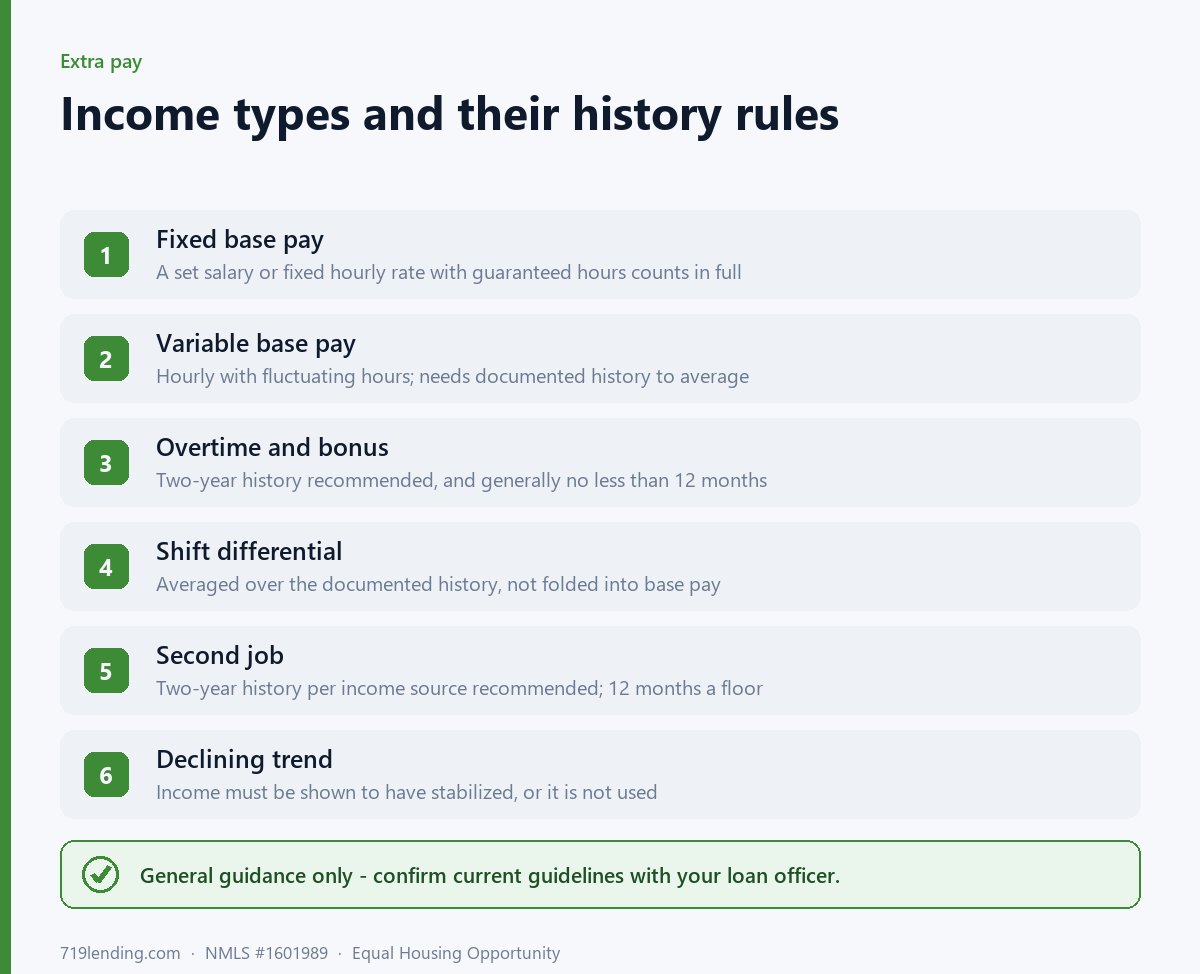
Salaried and hourly base pay is verified from recent pay stubs, prior-year W-2s and a verification of employment. Hourly nurses should expect the lender to use a documented average of hours rather than assuming a full-time schedule.
Overtime and shift differential need history
Overtime and shift differential are averaged, not taken at face value. Fannie Mae’s bonus, commission, overtime and tip income section recommends a two-year history and treats 12 months as the floor when positive factors reasonably offset the shorter record. Stubs that break the premium pay out clearly help enormously.
PRN, per diem and second nursing jobs
PRN and per diem earnings are variable income, so they need a documented history and evidence the pay is likely to continue. A second nursing job is treated much the same way: a two-year history for each income source is recommended, while a shorter record of no less than 12 months may still be acceptable when other positive factors offset it (general — confirm current).
Sign-on, retention and bonus pay
A one-time sign-on bonus generally does not count as monthly income, though it may be used for down payment funds if it is sourced and seasoned. Recurring, documented annual bonuses can often be averaged in when history supports them.
Declining income invites questions
If your overtime dropped sharply from last year to this year, expect the underwriter to identify the point at which the income stabilized and calculate forward from there, or to set the income aside entirely. A written explanation — unit staffing changes, a move off nights, a schedule change after a license upgrade — is worth providing before you are asked.
W-2 staff nurse vs. PRN and per diem: two different files

The same person, same hospital and same annual earnings can produce two very different loan applications depending on how the pay arrives.
The staff nurse file
A benefited W-2 staff nurse usually qualifies on base pay alone, with overtime and differential as upside. Documentation is comparatively light: recent pay stubs, two years of W-2s and a verification of employment.
The PRN or per diem file
A PRN nurse’s income is variable by design, so the lender builds an average across a longer window and looks for stability. Gaps between assignments, a recent switch from staff to PRN, or a short track record can reduce the usable income even when the deposits look strong.
What to do about it
If you are considering a move from staff to PRN and also planning to buy, sequence matters. Getting the loan closed before the employment structure changes is often the simpler path, and it is a conversation worth having before you give notice.
New-grad RNs and offer letters
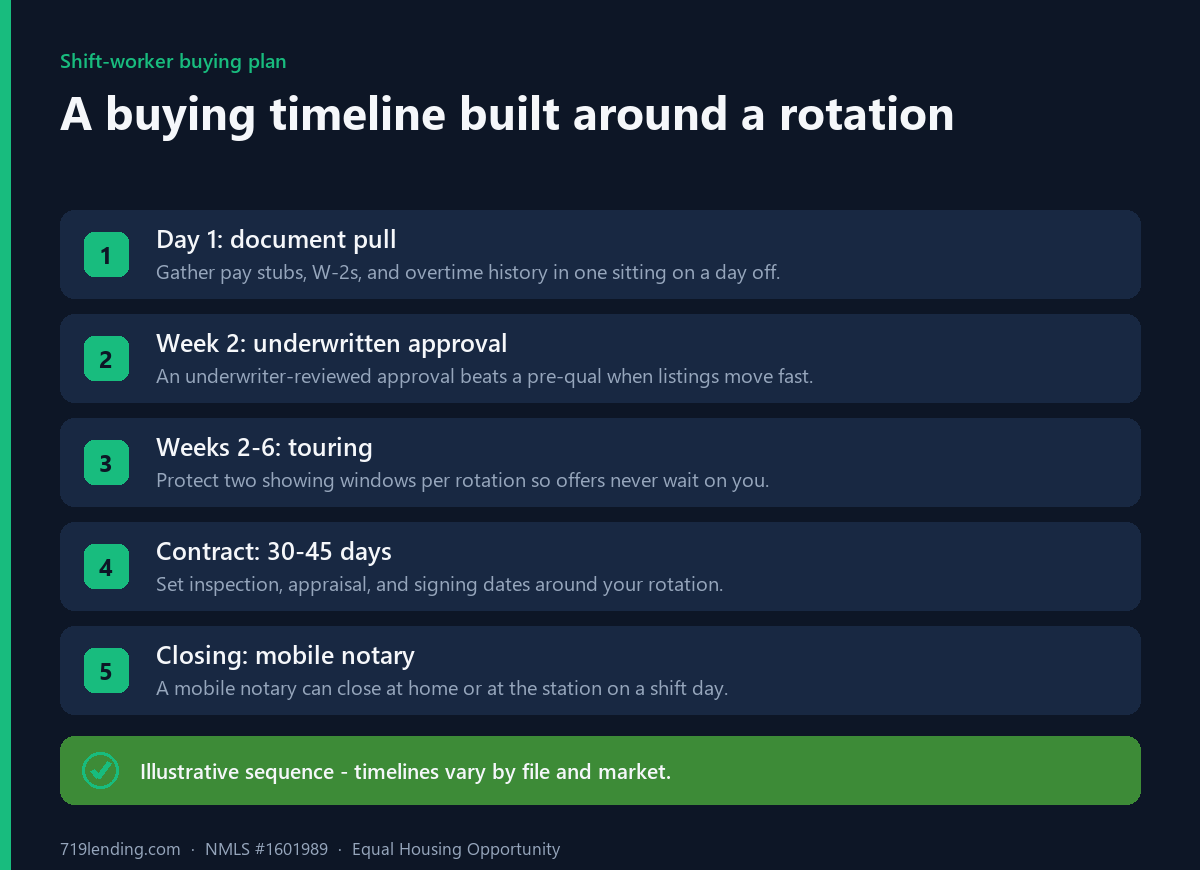
New graduates can frequently buy before their first shift. Fannie Mae’s employment offers or contracts section allows a start date no earlier than 30 days before the note date and no later than 90 days after it, provided the offer is fully executed and non-contingent (general — confirm current).
The practical requirements look like this.
- A signed offer letter identifying the employer, the borrower, the position, the pay type or rate, and the start date.
- No contingencies left outstanding — background check, licensure and health screening should be cleared.
- Reserves in the bank. Agency guidance points to roughly six months of principal, interest, taxes, insurance and association dues, or enough to cover the monthly obligations counted in your debt ratio for the months between the note date and the start date plus one (general — confirm current).
- Evidence of the license itself, since a pending NCLEX result is generally treated as an outstanding contingency by an underwriter.
Not every lender allows offer-letter qualifying, and the ones that do apply different reserve requirements. This is one of the clearest cases where shopping the file across wholesale lenders can change the answer from no to yes.
Travel nurses and contract assignments
Travel nurses face a different underwriting conversation than staff nurses, because contract assignments end by design. The lender is trying to establish that the pattern of contracts, not any single contract, will continue.
Two details cause most of the friction.
- Stipends and per diem reimbursements. Non-taxable housing and meal stipends may not be counted the same way as taxable wages, which can shrink usable income sharply.
- Gaps between contracts. Normal time off between assignments is expected, but agency guidance is strict here: when the work history spans different employers, a gap of more than one month within the most recent 12-month period is generally a problem unless the employment is treated as seasonal (general — confirm current).
If most of your compensation arrives as stipends, plan for a longer documentation history and a conservative qualifying figure.
Buying near Colorado Springs hospitals
Commute matters more than usual when your shift starts at 6:45 a.m. and winter weather is a factor. The larger nursing employers in the area include UCHealth Memorial Hospital Central and UCHealth Memorial Hospital North, the CommonSpirit-affiliated Penrose Hospital and St. Francis Medical Center, the Children’s Hospital Colorado campus in Colorado Springs, and the Army hospital at Fort Carson. Health system branding and facility names change periodically, so confirm current names before you plan a commute around them.
We name these neutrally — none of them endorses or is affiliated with us, and none has a preferred-lender arrangement here.
Practical geography
Neighborhoods north of downtown and along Powers Boulevard put you within a reasonable drive of the north-side campuses, while the west and southwest sides serve the central and Penrose campuses better. Nurses working rotating campuses should weigh a central location over the shortest single commute.
Night shift and neighborhood fit
If you sleep days, ask about arterial road noise, flight paths and school bus routes before you fall in love with a house. It is a small diligence step that a listing photo will never tell you.
How to shop the loan itself
Our take: for most nurse buyers, the loan pricing moves the total cost more than any profession-branded credit does. A broker can price the same file across multiple wholesale lenders in one sitting, which is the comparison most nurse borrowers never run.
Compare on the same day
Mortgage pricing moves daily, so quotes gathered a week apart are not comparable. Ask each lender for a Loan Estimate on the same day, for the same loan amount, down payment and lock period.
Read the whole page, not the rate
Points, lender credits, mortgage insurance and title choices can swing the total cost more than a small rate difference. The Consumer Financial Protection Bureau publishes plain-language guides on comparing Loan Estimates side by side.
Ask the rebate question directly
If a healthcare rebate network is in the picture, ask what the credit is in dollars, who pays it, and whether using their agent is required. Then compare that number against what a freely chosen agent and a separately shopped lender produce. Any figures quoted by those networks are illustrative and should be confirmed in writing.
Documents to gather before you apply
Having these ready shortens the process and prevents the income-averaging surprises described above.
- Most recent 30 days of pay stubs, including any that show differential and overtime line items separately.
- W-2 forms for the past two years, plus tax returns if you have PRN 1099 work or a side business.
- Two months of bank statements for every account used for down payment or reserves.
- Your offer letter or contract if you are new, changing employers or traveling.
- Documentation of any employer relocation, sign-on or housing assistance.
- An explanation letter for any employment gap, unit change or drop in overtime.
Frequently asked questions
Is there a special home loan program for nurses?
No. There is no federal or Colorado state loan reserved for nurses. Nurses qualify for the same conventional, FHA, VA and USDA programs as other buyers, and may layer state or local down payment assistance on top. Even HUD’s profession-based Good Neighbor Next Door discount covers law enforcement, teachers, firefighters and emergency medical technicians rather than nurses.
Will lenders count my overtime and shift differential?
Usually yes, if you can document it. Agency guidance recommends a two-year history for overtime and similar variable pay, treats 12 months as the floor when positive factors offset the shorter record, and looks for evidence the pay is likely to continue. Pay stubs that itemize the premium pay make this far easier than stubs showing only a lump gross figure.
Does PRN or per diem income count toward a mortgage?
Often, yes. PRN and per diem pay is variable income, so it needs a documented history and a reasonable expectation of continuance. A two-year history is recommended, a shorter record may still work when other positive factors offset it, and declining PRN hours can lead the underwriter to use a reduced figure (general — confirm current).
Can a new-grad RN buy a home before starting the job?
Frequently, yes. Agency guidance allows qualifying on a fully executed, non-contingent offer letter when the start date falls no earlier than 30 days before the note date and no later than 90 days after it, and you hold enough reserves to bridge the gap until income begins. Lender overlays vary, so this is worth shopping.
Do nurses qualify for down payment assistance in Colorado?
Nurses qualify on the same terms as anyone else, based on income limits, purchase price caps and credit rather than occupation. CHFA is the primary statewide source, and local programs appear and pause with funding cycles (general — confirm current).
Are healthcare rebate or discount programs worth using?
Sometimes. The credit is real when the network’s participating agent and lender are also competitive on price. Get the dollar amount in writing, then compare the full package against an agent and lender you choose independently before you enroll.
What credit score do nurses need to buy a house?
The same thresholds that apply to any borrower apply here, with FHA generally reaching lower scores than conventional and pricing improving as scores rise. Score affects both eligibility and cost, so it is worth checking early rather than at contract.
All figures, ranges and timeframes above are general and illustrative, not an offer, an approval or a quote of terms; confirm current agency, state and lender requirements before relying on them.
We do not provide tax advice. Please consult a tax professional about how any part of a home purchase affects your situation.
719 Lending Inc., NMLS #1601989 · Equal Housing Opportunity
719 Lending Inc. is not affiliated with or endorsed by HUD, FHA, VA, USDA, CHFA, or any government agency.
Last updated: July 2026

Related Posts