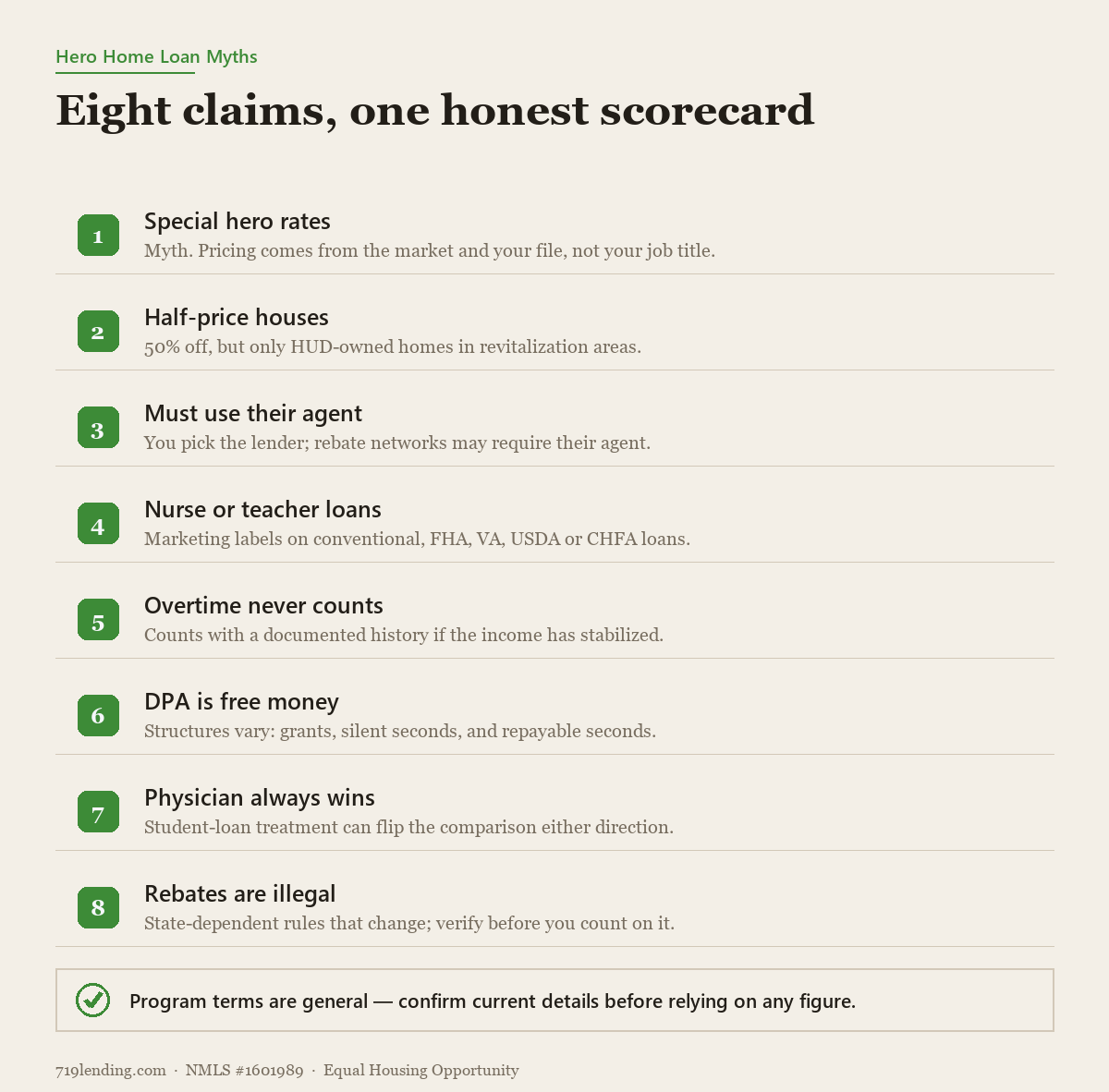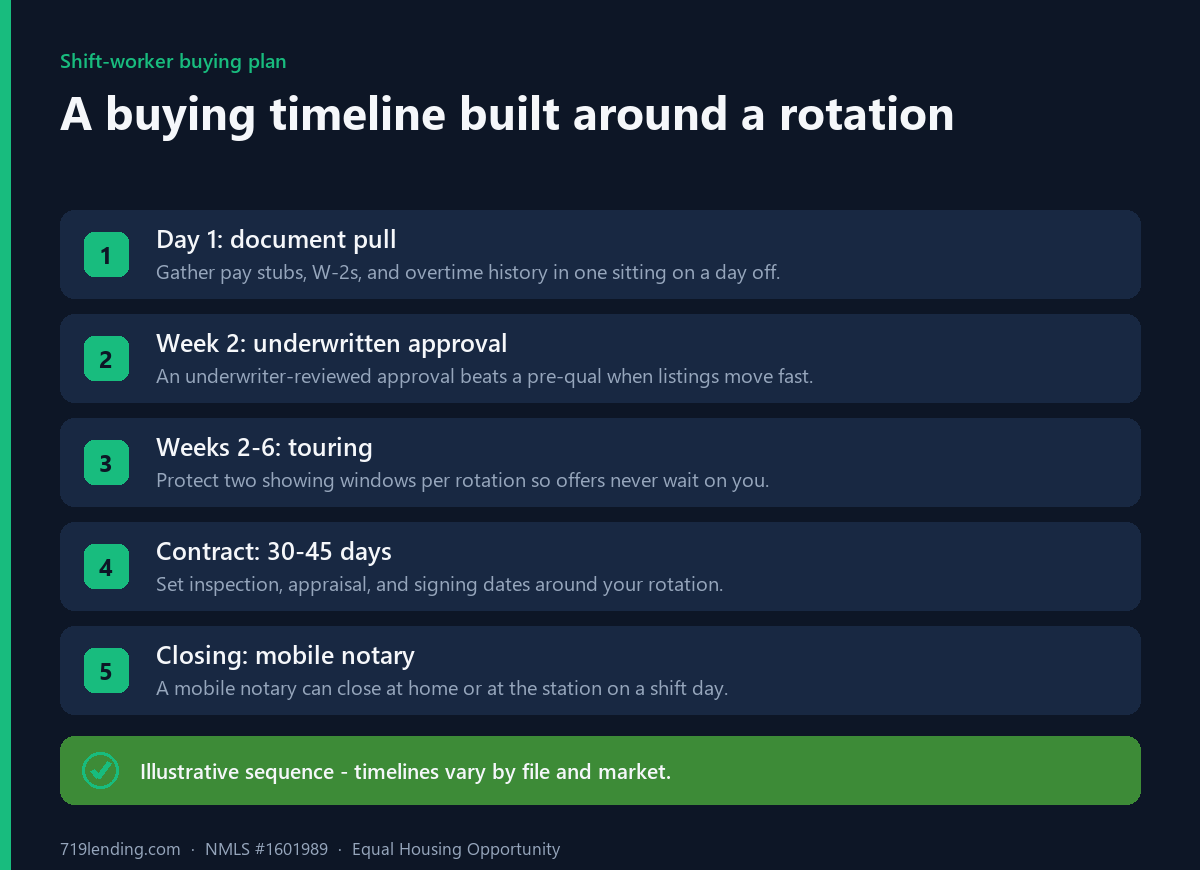
Do heroes get special mortgage rates? We debunk eight hero home loan myths: GNND, DPA, nurse and teacher loans, overtime income, and commission rebates.
How Lenders Count Overtime, Shift Differentials & Second Jobs
Yes, lenders can count overtime, shift differentials, second jobs, bonuses and on-call pay toward a mortgage. The catch is history: most extra pay has to show a documented track record, generally at least 12 months and preferably 24, before an underwriter will average it into your qualifying income.
That single rule decides more hero-profession outcomes than any branded home-buying program does. If a large share of your gross pay arrives outside your base wage, how a lender reads those lines determines whether the file works.
The short version: what counts, what waits
- Fixed base pay — a set salary, or a fixed hourly rate with guaranteed hours, is generally counted in full.
- Variable base pay — hourly work with fluctuating hours is treated as variable base income and needs a documented history to average.
- Overtime and shift differential — averaged over a documented history; a two-year record is recommended and generally no less than 12 months.
- Second job — a two-year history for each income source is recommended, with 12 months a common floor.
- Bonus and on-call pay — same treatment; averaged over the documented period, not annualized off one large check.
- Declining pattern — if the extra pay is trending down, the lender has to confirm it stabilized, or it is not used.
- Paperwork — paystubs with year-to-date breakouts, W-2s (how many years varies by income type and program), and often a written verification of employment.
Colorado Springs is a shift-work town, and the hero professions we serve most — nurses, police officers, firefighters, paramedics and military members — are exactly the ones whose paystubs are complicated.
How each type of extra income is treated

How the agencies actually categorize extra pay
“Variable income” is industry shorthand rather than a current guideline heading. Fannie Mae’s Selling Guide addresses bonus, commission, overtime and tip income in one dedicated section, and treats hourly base pay with fluctuating hours separately as variable base income. Either way the underwriter asks the same questions: is the income stable, is it reasonably expected to continue, and does the recent trend support using it.
Freddie Mac’s Single-Family Seller/Servicer Guide sets comparable expectations in its employed-income chapter, with the same emphasis on documented history, continuance and trend. Guideline sections get renumbered and rewritten periodically — Fannie Mae restructured its income assessment chapter in 2026 — so confirm the current text and the requirements for your specific loan type before relying on any figure.
How the averaging actually works
The math is usually plain arithmetic. Fannie Mae directs lenders to average year-to-date and prior-year earnings across the number of months those documents cover, and the calculation must include at least 12 months of income.
A nurse with $9,600 of overtime across 24 months (illustrative figures only) is credited roughly $400 a month — not the $1,100 that showed up in one heavy holiday month. That is why a single enormous month rarely rescues a file, and why a steady eight to ten extra hours a week is worth more at the underwriting desk than a feast-or-famine pattern.
Why the 24-month look-back is usually your friend
A minimum two-year history is what Fannie Mae recommends. A shorter record — but generally no less than 12 months — may still be acceptable when positive factors in the file reasonably offset it. Two years is preferred because a longer window smooths seasonality, absorbs a slow quarter, and makes the continuation argument easier to write.
If your extra pay has grown, the two-year average will read lower than your current run rate — but it is far more likely to be accepted without conditions. Our take: a slightly smaller number you can actually use beats a larger number that triggers a fight.
Counts now versus needs more history

The practical question is not whether overtime counts, but whether your overtime counts today. An eight-month overtime record usually does not clear the bar yet; a 24-month record usually does. A second job you started six months ago generally has to keep building toward that 12- to 24-month window.
The declining-trend problem
If this year’s extra pay is materially below last year’s, an underwriter will not simply average the two. Under Fannie Mae’s current standard the lender must confirm the income level has stabilized after the decline; if it has not, the income is not eligible for qualifying.
A documented reason helps — a unit that cut mandatory overtime, a department that filled vacancies, a medical leave — but the explanation has to be in writing and consistent with the paystubs, and it does not replace evidence that the income has leveled off.
Job changes reset less than you fear
Lenders evaluate whether your work history reflects a reliable pattern of employment over the most recent two years, and a shorter history can still qualify when the overall profile offsets it. Our take: changing employers inside the same field at the same or higher pay usually does not erase your history, while changing careers, moving from full-time to per-diem, or switching from an overtime-heavy role to a salaried one is far more likely to restart the clock on the extra pay. Treatment varies by lender and program — confirm current requirements rather than assuming either outcome.
Shift differentials, on-call and callback pay
Nights, weekends and the hospital schedule
Shift differential is generally averaged over its documented history rather than counted as part of base pay, even when you work the same night rotation every week. Differentials commonly run somewhere in the range of one to several dollars per hour depending on employer, shift and unit (general illustrative range — confirm current figures with your employer).
Twelve-hour rotations, night and weekend differentials, mandatory overtime and per-diem shifts are routine in hospital scheduling, which is why nurse income deserves its own walkthrough before you shop for a house.
Public-safety pay codes
Sworn officers and firefighters frequently carry court pay, callback pay, holdover pay and extra-duty details on top of a base salary, and an underwriter reviews each line separately. Some of those codes are steady enough to average; others are episodic and get set aside.
The fix is mechanical: get a paystub that itemizes each code with year-to-date totals, so the file shows what recurs rather than one lump labeled “other.”
Second jobs and multiple employers
What underwriters look for
When you qualify using more than one job, each income source has to meet the requirements for its own income type. Fannie Mae recommends a two-year history for each income source, and income received for a shorter period — but no less than 12 months — may be considered acceptable when positive factors reasonably offset the shorter history.
Continuity matters as much as the raw month count. Employment gaps during the most recent 12 months can make a borrower look unstable on paper, so be ready to explain them in writing.
Gaps, per diem and PRN work
Per-diem and PRN work is not disqualified, but irregular gaps make the continuity argument harder. If you pick up shifts at a second facility, keep them consistent for the year before you apply rather than clustering them in bursts.
Self-employed side income follows a different track entirely, with tax returns and profit-and-loss documentation instead of paystubs. That is a separate conversation from W-2 overtime, and it should be scoped early.
Bonus, holiday and hazard pay
Bonus income is averaged over its documented history the same way overtime is, and the calculation has to cover at least 12 months. An annual bonus with a two-year record is generally divided across those 24 months; a first-time bonus with no prior-year history rarely counts at all.
Hazard pay, incentive pay and retention stipends are handled case by case. The key question is whether the pay is tied to an ongoing role or to a temporary event. A staffing-crisis premium that has already been announced as ending is unlikely to be used.
Veterans and military borrowers: residual income matters too
Active-duty and veteran borrowers also have a distinct set of rules for how service pay and allowances are treated. VA-backed home loan requirements are set by the Department of Veterans Affairs, which describes the program as residual-income driven: on top of the usual debt-to-income review, a monthly dollar cushion has to remain after the mortgage payment, other debts and certain living expenses are covered.
Residual income figures vary by household size, region and loan amount — general guidance only, confirm current requirements. That test rewards steady, documented pay and is less forgiving of income you cannot evidence. For veteran first responders working overtime on a civilian department, both frameworks apply at once: the history rules decide what counts, and residual income decides whether what counts is enough.
What to gather before you apply
- Your most recent 30 days of paystubs, showing year-to-date totals broken out by pay code.
- W-2s from every employer, including the second job — how many years are required varies by income type and program, and requirements evolve, so confirm what your lender needs.
- A prior-year December paystub if it captures the full year-end totals for each code.
- Contact information for HR or payroll, since lenders commonly request a written verification of employment on files with extra pay.
- A short written explanation for any gap, leave, transfer or drop in hours.
- Documentation of any raise, promotion or new differential that started recently.
The Consumer Financial Protection Bureau publishes plain-language guidance on the paperwork to gather before you apply, which is a useful sanity check if a request feels unusual.
Mistakes that quietly cost heroes qualifying income
- Applying two months after switching from an overtime-heavy unit to a salaried role, then wondering why the income dropped.
- Submitting a summary paystub with no year-to-date breakout, so recurring differentials get lumped into an unusable “other” line.
- Dropping the second job right before underwriting because the process felt stressful.
- Assuming a raise replaces the history requirement — the new base rate counts, but the extra pay tied to it still needs a record.
- Letting one lender’s underwriting read stand as the final word on whether a pay code counts.
Our take: where the real savings live
Our take: for most hero borrowers, the biggest dollars are not in a branded program name. They are in two places — getting every legitimate dollar of extra pay counted, and shopping the loan pricing itself.
Once your qualifying income is settled, the next lever is pricing, because the same file can be priced differently from one wholesale lender to the next. Stackable down payment assistance and program-specific benefits sit on top of that, and a genuine government program such as the HUD Good Neighbor Next Door program can be real money for those who qualify.
That HUD program is open to law enforcement officers, pre-Kindergarten through 12th grade teachers, firefighters and emergency medical technicians buying an eligible listed home in a revitalization area, with a 50% discount from the list price and a 36-month owner-occupancy commitment (general program terms — confirm current details and availability with HUD). Nurses and military service members are not on HUD’s eligibility list for that particular program, though other paths may fit.
Underwriting judgment on extra pay is not perfectly uniform across investors. A broker can compare how several wholesale underwriting desks would read the same paystub before you commit to one lender, which matters most for exactly the borrowers whose income arrives in six different pay codes.
Pricing, program availability and approval outcomes depend on your full profile, the lender and market conditions; nothing here is an offer, a rate quote or a promise of approval. All figures, ranges and percentages above are general and illustrative — confirm current numbers for your situation. Nothing here is tax advice; consult a tax professional about how any of this affects your taxes.
Frequently asked questions
Does overtime count toward mortgage qualifying income?
Usually yes, when you can document a history of it. Overtime is averaged over the documented period rather than counted at your current run rate. Fannie Mae recommends a minimum two-year history, and a shorter record — generally no less than 12 months — may be acceptable when other factors offset it.
How many months of overtime history do lenders want?
Twelve months is generally the floor and a two-year history is what Fannie Mae recommends. A two-year record also smooths out slow stretches, which usually produces a more defensible average than a single strong year. Requirements vary by program and lender, so confirm current guidelines.
What happens if my overtime is going down?
A declining trend is treated conservatively. Under Fannie Mae’s current standard the lender must confirm the income level has stabilized after the decline; if it has not, the income is not eligible for qualifying. A written explanation consistent with your paystubs helps, but it does not replace evidence that the income leveled off.
Do shift differentials count as income?
Shift differentials are generally averaged over their documented history rather than folded into base pay. Make sure your paystub itemizes the differential with year-to-date totals so it can be identified and averaged.
Can I use a second job to qualify?
Often yes, if the history is long enough. Fannie Mae recommends a two-year history for each income source, and a shorter period — generally no less than 12 months — may be acceptable when positive factors reasonably offset it. Do not drop the second job during the loan process.
What documents prove overtime and extra pay?
Paystubs with year-to-date breakouts by pay code, W-2s from every employer, and frequently a written verification of employment from HR or payroll. How many years of W-2s are required varies by income type and program, and requirements evolve, so confirm what your lender needs. Explanations for gaps, leaves or transfers should be in writing.
Do the rules change on a VA or FHA loan?
The core idea is consistent across programs: extra pay needs documented history, stability and a supportable trend, though the specific documentation and the way remaining income is tested vary by program. VA adds a residual income test on top of the debt-to-income review. Confirm current requirements for your specific loan type before you rely on any figure.
719 Lending Inc., NMLS #1601989 · Equal Housing Opportunity
719 Lending Inc. is not affiliated with or endorsed by HUD, FHA, VA, CHFA, Fannie Mae, Freddie Mac, the Consumer Financial Protection Bureau, or any government agency.
Last updated: July 2026

Related Posts