Do heroes get special mortgage rates? We debunk eight hero home loan myths: GNND, DPA, nurse and teacher loans, overtime income, and commission rebates.
First Responder Home Loans: Programs, Discounts & How to Actually Save
What “first responder home loans” actually are
“First responder home loans” is a category label, not a single mortgage product. In almost every case it means an ordinary conventional, FHA, VA, or CHFA mortgage combined with a discount program, down payment assistance, a lender or seller credit, or — occasionally — a true niche portfolio product.
Police officers, firefighters, paramedics, EMTs, 911 dispatchers, and corrections officers are underwritten under the same agency rules as everyone else. What changes is what can be stacked on top of the loan.
The short version
- The loan itself is usually standard; the savings come from what gets layered on it.
- One government program — Good Neighbor Next Door — is a genuinely large discount, but it applies to a narrow list of homes.
- Colorado’s CHFA programs and local Colorado Springs assistance are usually the most reliable help for a first responder buying here.
- Commercial “hero” rebate networks are marketing arrangements, not loan products, and their value depends on rules you should read before you sign anything.
- Getting overtime and shift-differential income counted correctly often moves the needle more than any branded discount.
Our take: for most first responders, loan pricing shopped across many wholesale lenders plus stackable assistance beats any hero badge printed on a website.
The three categories first responders should keep straight
Nearly every confusing “hero” offer falls into one of three buckets. Sorting an offer into the right bucket tells you who is paying, when the money shows up, and what you give up to get it.
1. Government programs
These are run by HUD, by state housing finance agencies such as Colorado Housing and Finance Authority (CHFA), or through federal loan programs like FHA and VA. The rules are published, eligibility is defined in writing, and no salesperson can quietly change the terms on you.
2. Commercial rebate networks
These are private marketing companies that match buyers with participating real estate agents and lenders, then return part of the agent’s commission as a rebate or a closing credit. Homes for Heroes is the best-known example. The concept is legitimate and the money can be real, but it is a referral arrangement, not a mortgage.
3. Lender products
A small number of banks and portfolio lenders offer profession-specific loans; physician mortgages are the classic case. Loans written specifically for first responders are marketed by some lenders and credit unions, but availability, membership requirements, and terms vary by institution and region — programs vary, so confirm current offerings directly with the lender.
If a program cannot be placed cleanly into one of those three buckets, that is your signal to ask more questions before you commit to an agent, a lender, or a contract.
Good Neighbor Next Door: the one true discount
Good Neighbor Next Door (GNND) is HUD’s program that sells eligible HUD-owned homes in designated revitalization areas at 50% off the list price to full-time law enforcement officers, firefighters, emergency medical technicians, and pre-K through 12th grade teachers. It is the largest first responder housing discount that actually exists, and it is a government program rather than a marketing perk.
How eligibility works
- You must be employed full time in a qualifying role — sworn law enforcement officer, firefighter, or EMT — and intend in good faith to remain in that profession for 12 months after closing.
- A firefighter or EMT must buy within his or her service area, and a law enforcement officer must be sworn to uphold, and make arrests for violations of, federal, state, tribal, county, township, or municipal laws.
- Neither you nor your spouse may own other residential real property at the time the offer is submitted, or in the 12 months before it.
- The home must be a HUD-owned property listed in the GNND program at the time you bid, and a HUD-registered real estate broker must help you find it and submit the offer to HUD.
- You must live in the home as your principal residence for 36 months after move-in.
- Properties are listed through the program for seven days, and if more than one qualified buyer submits an offer, HUD selects by random lottery.
You may use FHA, VA, or conventional financing, or pay cash. Under HUD’s published program terms, if you choose FHA-insured financing the down payment is $100 and closing costs may be financed into the loan (general — confirm current program terms).
How the 50% discount is carried
You do not simply pay half price and walk away. You sign a second mortgage and note for the discounted amount, with no interest and no payments required as long as you fulfill the 36-month occupancy requirement. If you vacate, rent, or sell the home during those 36 months, HUD requires repayment of the discounted amount on a prorated schedule. HUD recertifies occupancy annually and may spot check residency at any time.
Two details worth knowing. If you leave the employment that made you eligible, HUD does not demand repayment at that point, but you must still complete the full 36-month occupancy period. And at the end of that period, HUD releases its second mortgage, after which no further HUD obligations or restrictions apply.
The honest catch
Inventory. GNND homes are HUD-owned properties in HUD-designated revitalization areas, they are sold “as is” with no seller contribution for repairs, and each one is listed through the program for only seven days. That combination means eligible listings near any given Colorado community can be scarce for long stretches. GNND is worth checking regularly while you shop, but it is not a plan you can build a timeline around. You can review HUD’s official Good Neighbor Next Door program rules before you rely on any third-party summary.
Colorado assistance: CHFA and Colorado Springs help
For a first responder buying in El Paso County, state and local assistance is usually the most dependable savings, because it is available on ordinary listings rather than a short list of HUD-owned homes.
What CHFA generally offers
- Down payment and closing cost assistance delivered as a grant or a second mortgage (general — programs vary, confirm current terms directly with CHFA).
- Fixed-rate first mortgages paired with FHA, VA, USDA, or conventional underwriting (general — confirm current).
- Homebuyer education requirements that are straightforward but must be completed before closing (general — confirm current).
Income and price limits are the gate
CHFA assistance is generally limited by household income and by purchase price, and those limits change periodically and vary by area (general — confirm current limits with CHFA). A dual-income household with two public safety salaries and heavy overtime can land above the limit, so this is worth checking early rather than after you are under contract.
Local layers
Colorado Springs and El Paso County have periodically funded their own down payment programs, and some employers and unions offer housing benefits that stack. These come and go with funding cycles, so treat any list you find online — including ours — as a starting point to verify, not a guarantee. Worth noting on the federal side: HUD states that additional assistance from state or local government sources may be used in conjunction with GNND.
VA loans for first responders who also served
A large share of Colorado Springs first responders are veterans, and that overlap is frequently the most valuable thing on the table. A VA loan requires no down payment in most cases and charges no monthly mortgage insurance, which is often a stronger deal than any hero-branded conventional offer (general — confirm current eligibility and terms).
Why it usually wins on cost
Removing monthly mortgage insurance from a payment is a permanent monthly savings, not a one-time credit. Compare that against a one-time rebate and the math frequently favors the VA loan, even when the rebate looks larger on a flyer. The tradeoff is a one-time VA funding fee, which most borrowers pay and some are exempt from.
What to confirm first
- Your Certificate of Eligibility and remaining entitlement.
- Whether a funding fee exemption applies to you — the VA lists exemptions including borrowers receiving compensation for a service-connected disability.
- How drill pay, retirement pay, or disability compensation will be counted alongside your first responder salary.
Eligibility, entitlement, and funding fee details are published by the VA, and it is worth reading the primary source rather than a lender’s summary page.
Rebate networks and hero branding, explained honestly
This is where most of the confusion in this category lives, so here is the plain mechanic: a rebate network signs up real estate agents, sends them buyers, and the agent agrees to return a portion of the commission earned on the transaction to the buyer as a credit or a check.
What that means for you
- The savings come out of the real estate commission, not out of the mortgage.
- You generally must use the network’s assigned agent and sometimes its assigned lender to qualify.
- The credit typically appears at closing or shortly after, subject to lender and program rules.
- Rebate amounts are usually quoted as a share of the sales price, often in the neighborhood of 0.5%-1% (illustrative — confirm the actual program’s terms).
The questions worth asking before you enroll
- Am I locked into one agent, and is that agent the right one for my price range and neighborhood?
- Is the affiliated lender’s pricing competitive, or does the rebate simply return money I overpaid on the loan?
- Can the credit be applied to closing costs, and will the lender allow it on my loan type?
- How is the rebate reported? Rebate treatment can carry tax consequences — consult a tax professional.
Our take: a rebate is real money and worth having when the agent is genuinely good and the loan pricing is independently competitive. It becomes a bad trade when it steers you into a single lender you never priced against anyone else.
Overtime, shift differential, and how your income actually gets counted
This is the quiet part of first responder lending, and it decides more approvals than any discount program. Public safety pay is rarely a clean salary line — it is base pay plus overtime, holiday pay, shift differential, callback, standby, and sometimes a second job.
The general standard
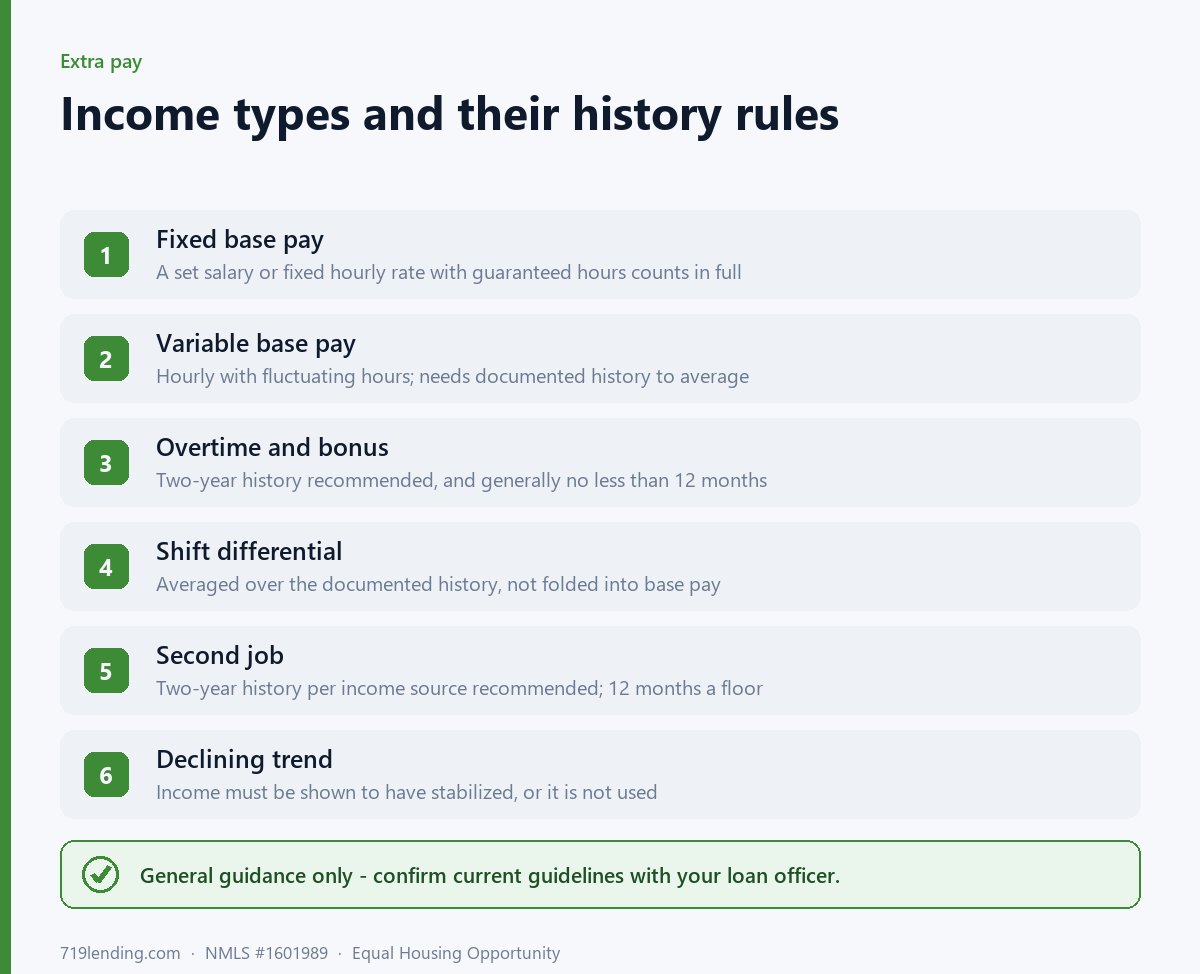
The requirement is shorter than most people assume. Under Fannie Mae’s current Selling Guide, variable base income such as fluctuating hourly earnings and shift differential requires a minimum 12-month history of receipt. For overtime and bonus income, a two-year history is recommended, but income received for a shorter period of no less than 12 months may be considered acceptable. The income is then averaged, commonly using year-to-date earnings together with the previous year (general — confirm current agency and investor guidelines, which vary by loan type). If the income is trending down, the lender must confirm the current level has stabilized before it can be used at all.
Fannie Mae’s Selling Guide sets out how bonus, commission, overtime, and tip income must be documented and calculated, and it is the primary source most underwriters work from. FHA, VA, and individual investor overlays can be stricter, so the safe assumption is the longer history rather than the minimum.
Where files go wrong
- Less than 12 months of documented history, which generally cannot be used as qualifying variable income at all.
- Recent promotions that changed the pay structure and reset the history.
- Agency overtime that dropped during a staffing change, which triggers the stabilization test rather than a simple average.
- Paystubs that lump differential into a single line the underwriter cannot decompose.
- A Verification of Employment that raises doubt about whether the variable income will continue.
The fix is preparation: pull two years of W-2s and a full year-to-date paystub before you apply, and let your loan officer structure the income calculation up front rather than defending it during underwriting.
Five real ways first responders save

Strip away the branding and the levers are short and specific. A 0.25% rate gap on a $400,000 loan is roughly $60 a month, or a bit over $21,000 across a 30-year term (illustrative only — your figures will differ).
- Shop pricing wide. Wholesale lenders price the same borrower differently on the same day.
- Stack real assistance. CHFA and local Colorado Springs programs can help with down payment and closing costs (general — confirm current).
- Use GNND if a home fits. HUD discounts eligible listed homes 50% off list price for qualifying buyers.
- Document overtime correctly. A documented history — 12 months minimum, two years preferred — can raise qualifying income.
- Negotiate credits, not badges. Seller and lender credits reduce cash to close directly.
Notice that four of the five have nothing to do with a hero-branded program. That is the honest thesis of this whole category.
Branded hero program versus a shopped broker loan

These are not competing products — you can sometimes have both — but they save money in completely different ways, and only one of them shows up in every monthly payment for the life of the loan.
Reading the comparison
A rebate near 0.5%-1% of the purchase price is a one-time event at closing. A 0.25% difference in rate is roughly $60 a month on a $400,000 loan, every month, for as long as you keep the mortgage (both figures illustrative). Working with a mortgage broker in Colorado Springs means one application gets priced against many wholesale lenders instead of one bank’s rate sheet.
How to compare them fairly
Put both on paper. Get a Loan Estimate from the network’s affiliated lender and at least one independent quote on the same day, for the same loan amount and lock period, and compare the rate, the lender fees, and the cash to close side by side. The Consumer Financial Protection Bureau’s Loan Estimate guide shows exactly which boxes to compare.
An illustrative example: a Colorado Springs paramedic
The following is a simplified illustration, not a quote, and not an offer of credit. Figures are made up to show the mechanics.
| Item | Illustrative figure |
|---|---|
| Purchase price | $425,000 |
| Base salary | $68,000 |
| Overtime and differential, 2-year average | $16,000 |
| Qualifying income used | $84,000 |
| Down payment assistance (illustrative) | $12,750 |
| Rate difference between two lenders | 0.25% |
| Monthly effect of that rate difference | About $60 |
Two things drive this file. First, the overtime average adds $16,000 of qualifying income, which is often the difference between qualifying for this price point and not qualifying at all. Second, the 0.25% pricing gap costs about $60 a month if nobody shops it — which over ten years of ownership exceeds a typical one-time rebate.
A hero rebate on this purchase might return somewhere around $2,000-$4,000 at closing (illustrative). That is genuinely useful money. It is simply not the largest lever in the file.
How to shop this without wasting three months
A sequence that works, in order:
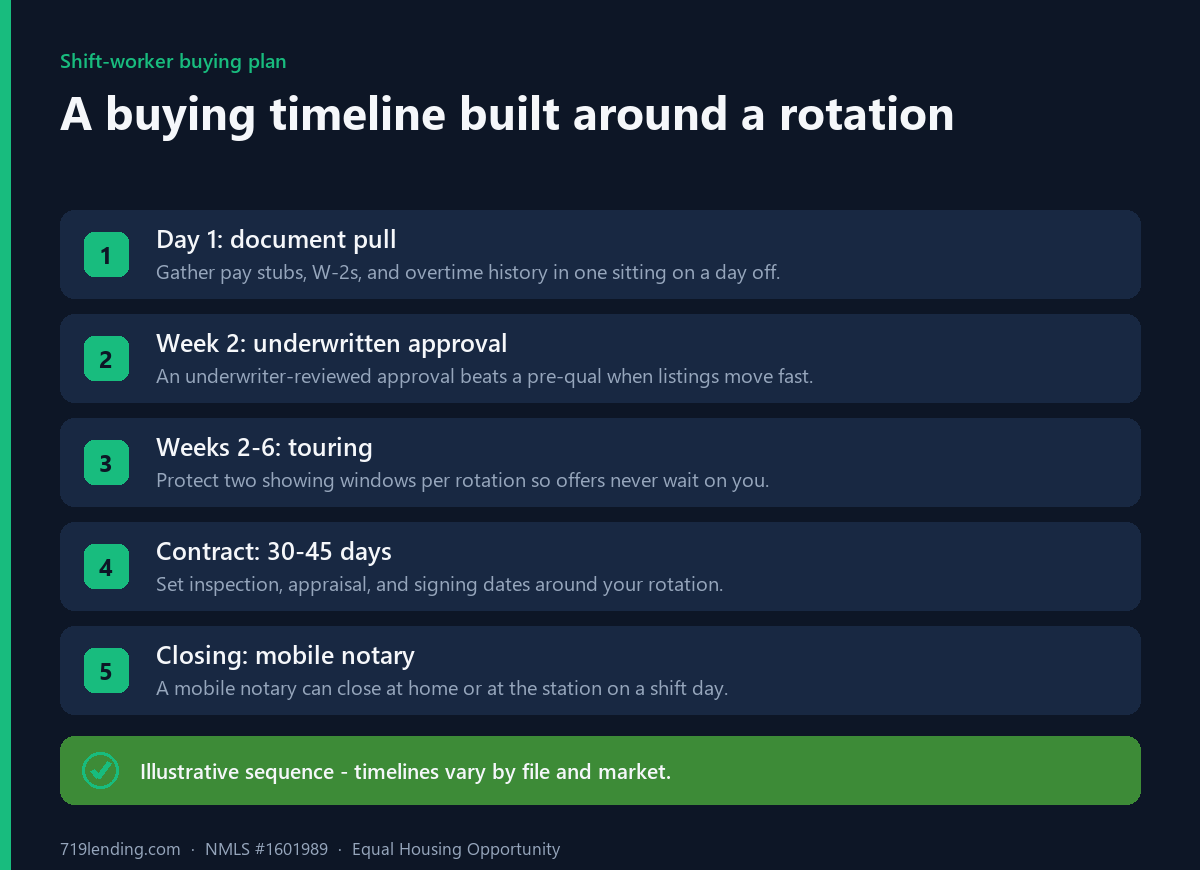
- Pull two years of W-2s and a current year-to-date paystub before you talk to anyone.
- Get your income structured and pre-approved with the overtime calculation documented in writing.
- Check CHFA and local assistance eligibility against your actual qualifying income, not your gross pay.
- Check current GNND listings, and keep checking regularly while you shop.
- If you served, price a VA loan against every alternative before deciding.
- Evaluate any rebate network with the affiliated lender’s Loan Estimate in hand, next to an independent one.
- Choose based on total cost over the years you expect to keep the loan, not on which offer has the best name.
If you want the wider view of every hero-adjacent program available in this state, start with the Colorado hero home loan overview and work down to your profession.
Frequently asked questions
Is there a special mortgage just for first responders?
Rarely. Most first responder home loans are ordinary conventional, FHA, VA, or CHFA mortgages with discounts, assistance, or credits layered on. Some lenders and credit unions market profession-specific products, but availability and eligibility rules vary by institution and region, so confirm current offerings directly.
Who qualifies as a first responder for these programs?
It depends entirely on the program. HUD’s Good Neighbor Next Door defines eligibility narrowly — full-time sworn law enforcement officers, firefighters, and emergency medical technicians, plus pre-K through 12th grade teachers. Commercial rebate networks usually define it more broadly, sometimes including dispatchers, nurses, and military members. Always read the specific program’s definition.
Can I combine a hero rebate with down payment assistance?
Sometimes, but not automatically. HUD does state that additional assistance from state or local government sources may be used in conjunction with Good Neighbor Next Door. Commercial rebates are a separate question: assistance programs and lenders each have rules about how outside credits are applied and how much total credit a loan can absorb. Get both programs reviewed together before you go under contract rather than discovering a conflict during underwriting.
Will my overtime count toward qualifying for a mortgage?
Often yes, if it is documented. Fannie Mae’s guide requires a minimum 12-month history for variable base income such as shift differential, and for overtime it recommends a two-year history while allowing no less than 12 months, then averages the income (general — confirm current guidelines, which vary by loan type). Bring two years of W-2s and a year-to-date paystub so the calculation can be built correctly from the start.
Do first responders get lower interest rates?
Not automatically because of the profession. Pricing is driven by credit score, down payment, loan type, property type, and market conditions on the day you lock. The practical way to improve your rate is to shop the same file across multiple wholesale lenders and to strengthen the inputs that pricing actually reads.
Is Good Neighbor Next Door available in Colorado Springs?
Availability depends on whether HUD currently owns eligible homes in designated revitalization areas near you, and each eligible home is listed through the program for only seven days. Check HUD’s listings regularly while you shop, and treat GNND as an opportunity to watch for rather than a plan to depend on.
Should I use the lender a hero program refers me to?
Only after you compare. Get that lender’s Loan Estimate and at least one independent quote for the same loan on the same day, then compare rate, lender fees, and cash to close. If the referred lender is competitive, the rebate is pure upside; if it is not, the rebate may simply be returning money you overpaid on the loan.
719 Lending Inc., NMLS #1601989 · Equal Housing Opportunity
719 Lending Inc. is not affiliated with or endorsed by HUD, FHA, VA, CHFA, Fannie Mae, or any government agency. Program rules and figures cited are general and subject to change — confirm current terms with the administering agency.
Last updated: July 2026

Related Posts