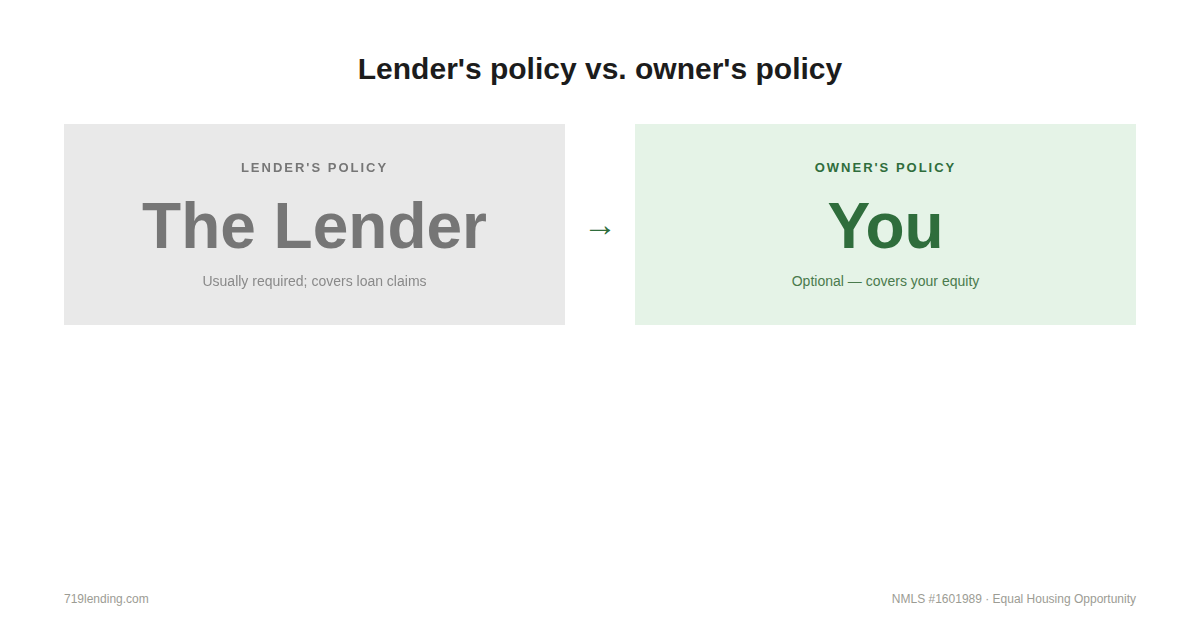
Colorado buyers can decline the owner's title insurance policy, but most lenders require a lender's policy to close the loan. This guide explains what each policy protects, who decides, who typically pays, and what you give up if you skip the owner's coverage.
What Makes a Mortgage a Jumbo Loan? Colorado Guide
What makes a mortgage a jumbo loan comes down to one number: the loan amount. If the loan amount is above the conforming loan limit the Federal Housing Finance Agency (FHFA) publishes for your county, the mortgage is a jumbo loan. This guide explains how that line is drawn, why it moves every year, and what actually changes when a home loan crosses it — written for Colorado buyers weighing conventional loans against jumbo mortgages.
Here are the key facts up front:
- A jumbo loan is any mortgage above the FHFA conforming loan limit for the county where the property sits.
- Fannie Mae and Freddie Mac are restricted by law to purchasing loans at or below that limit.
- The loan limit is higher in certain high-cost counties and for properties with up to four units.
- Because no government-sponsored enterprise stands behind a jumbo loan, each lender sets its own borrower qualifications, and the CFPB notes the cost of obtaining a jumbo mortgage may be higher than a conforming one.
What makes a mortgage a jumbo loan?
A jumbo loan is defined entirely by the loan amount relative to the conforming loan limit. There is no separate application, no special property type, no different loan officer — just a threshold.
Conforming loans are mortgages that Fannie Mae or Freddie Mac can guarantee and purchase from lenders. By law, those two companies — the government-sponsored enterprises, or GSEs — are only allowed to guarantee loans up to a certain amount.
Any conventional mortgage originated above that amount is a jumbo loan. The house can be identical, the borrower can be identical, and the classification still flips the moment the loan amount crosses the line.
So the real question becomes: who draws that line, and where?
Who sets the conforming loan limit?
The Federal Housing Finance Agency and the HERA formula
The Federal Housing Finance Agency (FHFA) regulates Fannie Mae and Freddie Mac and sets the conforming loan limit values each year. A permanent formula for calculating the limits was established under the Housing and Economic Recovery Act of 2008 (HERA).
Before HERA, the limits were adjusted through various legislative acts, some of which set temporary values for loans originated in specific windows. The HERA formula replaced that patchwork with an annual, formula-driven update.
Why the loan limit changes every year
Because the FHFA recalculates conforming loan limits annually, the dividing line between conforming loans and jumbo loans moves. A loan amount that would have been a jumbo loan one year can fall inside the conforming loan limits the next.
That is why a loan officer always confirms the current limit for your county at application, rather than relying on last year’s figure. Timing can genuinely change how a purchase is structured.
Next: why lenders care so much about which side of the line a loan lands on.
Why the conforming line matters: Fannie Mae and Freddie Mac
Conforming loans work the way they do because of what happens after closing. Lenders can sell conforming loans to Fannie Mae and Freddie Mac, which guarantee them and keep money flowing back to lenders to fund the next mortgage.
Jumbo loans sit outside that system. Fannie Mae and Freddie Mac are restricted by law to purchasing single-family mortgages with origination balances below the conforming loan limit, so a jumbo loan cannot be sold to the GSEs.
That single fact drives everything else about how jumbo loans work. Without a GSE guarantee, the lender carries more risk on the loan, and each lender decides for itself what borrower qualifications it will accept.
It also explains why jumbo underwriting varies so much from one lender to the next — which we cover below.
When does the loan limit go higher?
High-cost counties and conforming jumbo loans
The conforming loan limit is not one national number applied everywhere. In counties where home prices are particularly high, the FHFA sets higher limits, up to a ceiling loan limit for the highest-cost areas.
Loans that fall between the standard limit and a high-cost county’s higher limit are sometimes called conforming jumbo loans: they are part of the conforming program, but the loan limit is higher. Alaska, Hawaii, Guam, and the U.S. Virgin Islands are statutorily designated high-cost areas with meaningfully higher limit values.
Multi-unit properties
Loan limits are also higher when you purchase a property with multiple units — for example, a duplex where you plan to live in one unit and rent out the other.
The building must have no more than four units, and you must purchase the entire building for the higher limits to apply. Buying a single condo unit inside a larger building falls under the regular one-family limit.
Knowing which limit applies to your exact property is a lookup, not a guess — here is how to do it.
How to find the loan limit for your county
The Consumer Financial Protection Bureau points borrowers to the Department of Housing and Urban Development (HUD) loan limit tool to check the conforming loan limit for any county:
- Choose your state from the drop-down menu.
- Type in your county and set the “Limit Type” filter to “Fannie/Freddie.”
- Leave the other inputs alone and click send.
- The number in the “One-Family” column is the conforming loan limit for a single-family home or condo in that county.
For a multi-unit purchase, look at the column matching the number of units (labeled “families”) you plan to buy. The FHFA also publishes the full list of conforming loan limit values for all counties each year.
Knowing the loan limit is useful when shopping for homes and negotiating with sellers, because you can tell whether a particular home might require a larger down payment to stay conforming — or a jumbo loan instead. Once you know which side of the line you are on, here is what actually changes.
What changes when a loan crosses into jumbo territory
Underwriting becomes lender-by-lender
On conforming loans, Fannie Mae and Freddie Mac guidelines create a broadly shared rulebook. On jumbo mortgages there is no GSE rulebook, so each lender writes its own.
That is why borrower qualifications for a jumbo mortgage loan — the minimum credit score a lender will accept, the down payment it wants, the debt-to-income ratio it allows, how much it wants to see in cash reserves, and how it documents stable income — differ from one lender to the next. There is no single national standard to quote.
Practically, that means the same borrower can get different answers from different mortgage lenders on the same jumbo loan request. A broker who works with multiple lenders can shop those differing standards rather than being locked into one lender’s box.
Costs and pricing can differ
The CFPB states plainly that the cost of obtaining a jumbo mortgage may be higher than the cost of obtaining a conforming mortgage. Interest rates, closing costs, and whether items like private mortgage insurance apply are all set by the individual lender on a jumbo loan, so comparing loan terms across lenders matters more here than almost anywhere else.
Questions about mortgage interest deductions or other tax benefits of a large mortgage are for a tax professional — tax treatment varies by situation, and a lender should not be your tax advisor.

Here is the whole comparison at a glance.
Jumbo loan vs conforming loan at a glance
| Feature | Conforming loan | Jumbo loan |
|---|---|---|
| Loan amount | At or below the FHFA conforming loan limit for the county | Above the county’s conforming loan limit |
| Who can buy the loan | Fannie Mae or Freddie Mac (the government-sponsored enterprises) | Not eligible for GSE purchase |
| Who sets the limit | FHFA, annually, under the HERA formula | No upper limit set by the GSEs |
| Underwriting standards | Broadly shared GSE guidelines | Set individually by each lender |
| Cost to obtain | Baseline | May be higher, per the CFPB |
With the mechanics clear, here is how this plays out locally.
What this means for Colorado Springs buyers
Conforming loan limits are county-specific, so the number that matters for a Colorado Springs purchase is the current limit for El Paso County — and for Monument, Woodland Park, or Pueblo, the limit for those counties. Your loan officer confirms the current figure before structuring the loan.
For buyers near the price threshold, structure is a real lever. A larger down payment can bring the loan amount under the conforming loan limit, and buying a multi-unit property shifts you to a higher limit column entirely.
This is a heavily military market, and service members PCSing into Fort Carson, Peterson, or Schriever sometimes ask about a VA jumbo loan for higher-priced homes. VA financing follows its own set of rules, so that conversation is worth having directly with a loan officer who works VA files daily before assuming a conventional jumbo is the only path.
Either way, the classification question is answered the same way: check the county limit, compare it to the loan amount you need, and plan from there.
Next step: run your numbers against the current limit
If you are shopping in a price range where the jumbo question is live, the concrete next step is a short conversation: bring the target price range and planned down payment, and a loan officer can tell you whether the loan amount lands conforming or jumbo under the current county limit — and what each path would look like for your monthly payment and closing costs.
Reach out to 719 Lending to walk through the current conforming loan limit for your county and compare jumbo and conforming structures side by side.
Frequently asked questions
What makes a mortgage a jumbo loan?
A mortgage is a jumbo loan when the loan amount exceeds the conforming loan limit the Federal Housing Finance Agency (FHFA) sets for the property’s county. Loans at or below the limit can be guaranteed and purchased by Fannie Mae or Freddie Mac; loans above it cannot, which makes them jumbo.
Who decides the jumbo loan limits each year?
The FHFA sets conforming loan limit values annually using a permanent formula established under the Housing and Economic Recovery Act of 2008 (HERA). Anything above the applicable county limit is a jumbo loan, so the jumbo threshold moves whenever the FHFA updates the limits.
Is the conforming loan limit the same in every county?
No. There is a standard limit in most counties, but counties with particularly high home prices get higher limits up to a ceiling, and Alaska, Hawaii, Guam, and the U.S. Virgin Islands have statutorily higher limit values. Limits are also higher for properties with up to four units when you buy the whole building.
How do I find the conforming loan limit for my Colorado county?
Use HUD’s loan limit lookup tool: select Colorado, type in your county, set the Limit Type to “Fannie/Freddie,” and read the One-Family column for a single-family home or condo. The FHFA also publishes the full county-by-county list each year, and a loan officer can confirm the current figure.
Are jumbo loans harder to qualify for than conforming loans?
Jumbo loans have no shared GSE rulebook, so each lender sets its own standards for credit score, down payment, debt-to-income ratio, cash reserves, and income documentation. Requirements vary lender to lender, and the CFPB notes the cost of obtaining a jumbo mortgage may be higher than a conforming one.
Can I avoid a jumbo loan by making a larger down payment?
Often, yes. The jumbo classification depends only on the loan amount, not the purchase price. If a larger down payment brings the loan amount at or below your county’s conforming loan limit, the mortgage is a conforming loan rather than a jumbo loan.
719 Lending Inc., NMLS #1601989 · Equal Housing Opportunity
719 Lending Inc. is not affiliated with or endorsed by HUD, FHA, VA, USDA, CHFA, the CFPB, or any government agency.
Last updated: August 2026

Related Posts