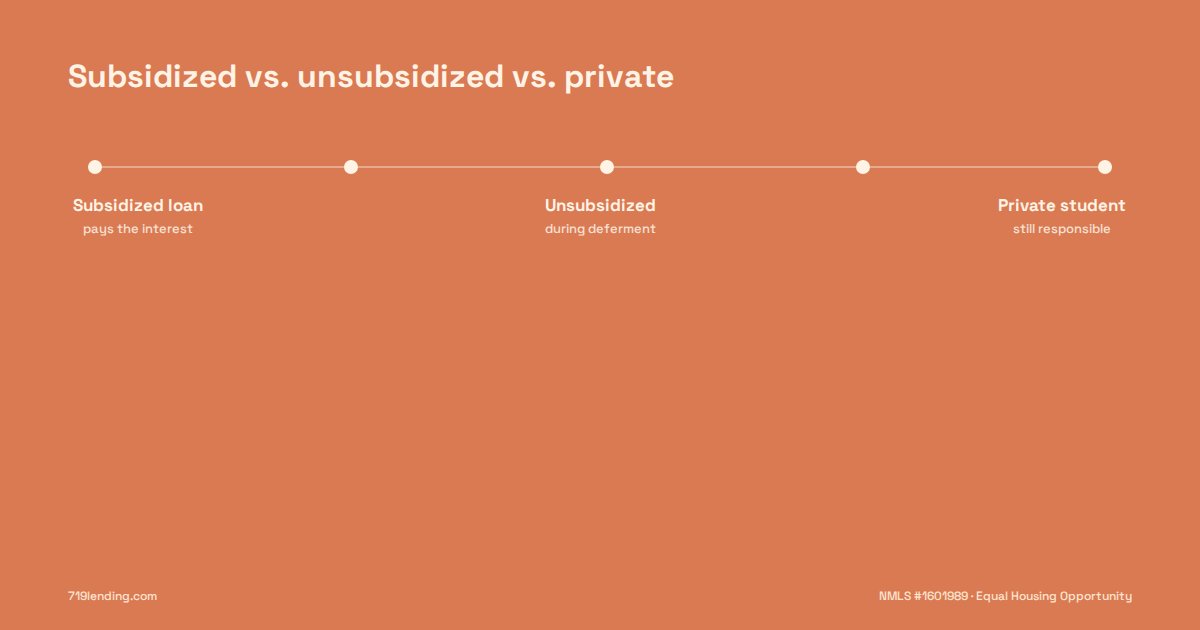
If you have a federal subsidized student loan, you do not have to pay interest on it during an approved deferment — the U.S. Department of Education covers it. Unsubsidized and private student loans work differently, and the gap matters, especially for service members around Colorado Springs weighing deferment during active duty.
How Does an Adjustable Rate Mortgage Adjust After the Fixed Period?
How does an adjustable rate mortgage adjust after the fixed period ends? The short answer: on each scheduled adjustment date, the interest rate resets to the current value of a market index plus a fixed margin, limited by any interest rate caps written into the loan contract. This guide explains each of those moving parts for Colorado borrowers who already hold an ARM or are weighing one against a fixed rate mortgage.
Before the deep dive, here is the whole mechanism in one list:
- Index: a broader measure of interest rates that moves with the market. The loan does not control it.
- Margin: a set number of percentage points the lender adds to the index. It is fixed at closing and does not change.
- Caps: limits on how much the rate can move at the first change, at each later change, and over the life of the loan.
- Adjustment period: the schedule in the note that says how often the rate resets after the introductory period.
How does an adjustable rate mortgage adjust after the fixed period ends?
Every adjustable rate mortgage (ARM) starts with an initial interest rate that stays the same for a defined stretch — months, one year, or a few years, depending on the note. Many ARMs start at a lower initial interest rate than a comparable fixed rate mortgage.
When that introductory period is over, the interest rate changes on a regular interval spelled out in the loan agreement. The Consumer Financial Protection Bureau (CFPB) describes the reset formula plainly: the actual rate at each change is based on the new index value plus a set margin, subject to any caps.

So the adjustment is not a negotiation and not a judgment call by the servicer. It is arithmetic performed on a schedule the borrower agreed to at closing. The next three subsections break down each input.
The index: the part that moves
Part of the interest rate on an ARM is tied to a broader measure of interest rates called an index. The index reflects conditions in the wider market, so it rises and falls over time.
When the index of interest rates increases, the payment goes up at the next adjustment. When interest rates decline, the payment may go down — but the CFPB is careful to note that is not true for all ARMs, because caps and floors can get in the way.
The margin: the part that never moves
The margin is a number of percentage points the lender adds to the index to set the interest rate on the loan. It is fixed in the note when the loan closes.
Two borrowers with the same index can end up with different reset rates because their margins differ. That is why comparing margins matters when shopping an adjustable rate mortgage, not just the teaser rate.
The caps: the guardrails
Some ARMs set a cap on how high the interest rate can increase at any single adjustment or over the life of the loan. Some also limit how much the rate may decrease at any time or over the life of the loan.
Importantly, the caps may be different for the initial change than for the subsequent regular interval changes. With the formula established, the next question is what actually happens on the first reset date.
What happens on the first adjustment date
On the first adjustment date after the fixed rate period, the servicer looks up the current index value defined in the note, adds the margin, and checks the result against the initial adjustment cap. The capped result becomes the new interest rate on the loan.
The monthly payment is then recalculated so the loan stays on its repayment schedule. If the index has risen since closing, the amount of the payment is likely to go up.
Why the first adjustment gets the most attention
The first reset often produces the largest single change, because the initial rate may have been lower than what the index-plus-margin formula produces, and the cap that governs the first change can differ from the caps on later changes.
That is exactly why the CFPB tells borrowers to know how the ARM adjusts before signing — including how soon the payment could go up and how high it could go. After the first reset, the loan settles into its ongoing rhythm, covered next.
How often does the rate adjust after the first reset?
After the introductory period, the interest rate changes on a regular interval defined in the loan contract. The note — not the servicer’s preference and not market drama — controls the schedule.
Each adjustment repeats the same process: current index value, plus the fixed margin, checked against the periodic cap and the lifetime limits. The recalculated monthly payment takes effect for the next adjustment period.
Because the schedule is contractual, a borrower can map out every future adjustment date the day the loan closes. The table below summarizes who controls each piece of the formula.
| Component | What it does | Can it change? |
|---|---|---|
| Index | Broader measure of interest rates the loan is tied to | Yes — moves with the market |
| Margin | Percentage points the lender adds to the index | No — fixed in the note at closing |
| Adjustment caps | Limit each rate change, up and sometimes down | No — fixed in the note |
| Lifetime cap | Limits how high the rate can go over the life of the loan | No — fixed in the note |
| Adjustment period | How often the rate resets after the fixed period | No — set by the loan agreement |
With the schedule clear, it helps to understand how each layer of caps interacts on a given reset date.
How interest rate caps shape each adjustment
Interest rate caps are the reason the index-plus-margin math does not always land where the raw formula says. The note can contain several distinct limits.
Initial adjustment cap versus subsequent caps
The cap on the very first change after the fixed rate period may be different from the cap that applies to each later regular interval change. Reading the note is the only way to know which structure a specific loan uses.
Lifetime cap
Some ARMs set a ceiling on how high the interest rate can increase over the life of the loan. No matter what the index does, the rate cannot exceed that lifetime cap.
Limits on decreases
Some ARMs also limit how much the interest rate may decrease, either at any single adjustment or over the life of the loan. That is one reason the CFPB notes that a falling index does not always translate into a lower monthly payment. Caps set the boundaries; the next section covers what the reset means for the payment itself.
What the adjustment means for the monthly payment
Each time the interest rate resets, the monthly payment is recalculated. If the index rose, the monthly mortgage payment is likely to go up; if the index fell, the payment may go down, subject to any floor in the note.
Budgeting for an ARM means budgeting for the range, not the current number. The CFPB’s core affordability question is blunt: will you still be able to afford the loan if the rate and payment go up to the maximums allowed under the loan contract?
Remember too that the mortgage payment is only part of the monthly cost of owning a home — property taxes and homeowners insurance move on their own schedules, independent of the ARM formula. Knowing the mechanics is one thing; finding the specific terms for a specific loan is the next step.
Where to find the adjustment rules for a specific loan
The CFPB lists three reliable ways to confirm whether a loan is fixed or adjustable and to locate its adjustment terms.
Call the servicer
The servicer is the company that receives the monthly payments.
Check the closing disclosures
For mortgage applications made after October 3, 2015, the loan type is listed at the top of page one of the Closing Disclosure. For older loans, the Truth in Lending Disclosure statement will contain language such as: “Your loan contains a variable-rate feature. Disclosures about the variable-rate feature have been provided to you earlier.”
Read the promissory note
The paper signed at closing labeled “Promissory Note” or “Note” may carry the words “Adjustable Rate Note” and language like “The interest rate I will pay will change in accordance with Section __ of this Note.” That section holds the index, margin, caps, and adjustment schedule. Once you have those terms in hand, run through the CFPB’s checklist below.
Questions to answer before the fixed rate period ends
The CFPB says every ARM borrower should be able to answer these before — ideally long before — the first adjustment:
- How high or low the interest rate and monthly payments can go with each adjustment
- How frequently the interest rate will adjust
- How soon the payment could go up
- Whether there is a cap on how high the interest rate could go
- Whether there is a limit on how low the interest rate could go
- Whether the loan remains affordable if the rate and payment reach the contract maximums
If any answer is unclear, pull the note and the disclosures, or have a loan officer walk through them with you. Answering these questions early also leaves time to act, which is the subject of the next section.
What are the options before the loan adjusts?
Some borrowers plan to sell the home or refinance into a fixed rate mortgage before the introductory period ends. The CFPB offers a direct caution here: don’t assume you’ll be able to sell or refinance before the rate changes, because the value of the property could decline or your financial condition could change.
That warning is worth taking seriously in a military market like Colorado Springs, where a Permanent Change of Station (PCS) can arrive on the Army’s timeline rather than the housing market’s. Reviewing refinance options well ahead of the first adjustment date leaves room to compare paths instead of reacting under a deadline.
And if the numbers at the contract maximums do not work on today’s income, the CFPB’s guidance is to consider another loan — a conversation worth having across the full menu of loan programs rather than in isolation. Which brings us to the practical next step.
Next step for Colorado ARM borrowers
Pull the promissory note and find the adjustable rate section. Write down the index, the margin, each cap, and the next change date, then stress-test the household budget against the maximums the contract allows.
If you would rather not decode the note alone, talk with a 719 Lending loan officer in Colorado Springs. We can read the adjustment terms with you, compare the ARM’s possible range against a fixed rate mortgage, and map out the timeline before the first reset — with plenty of room to spare for a PCS or a life change.
Frequently asked questions
What determines the new rate when an ARM adjusts?
On each adjustment date, the new interest rate is based on the current value of the index named in the note, plus a set margin added by the lender, subject to any interest rate caps in the loan contract.
Does the payment always go up when an ARM adjusts?
No. The payment goes up when the index of interest rates increases, and it may go down when interest rates decline — but the CFPB notes that is not true for all ARMs, because some notes limit how much the rate can decrease.
How often does an adjustable rate mortgage adjust after the fixed period?
The rate changes on a regular interval defined in the loan agreement. The promissory note spells out the adjustment period, the index, the margin, and the caps, so the full schedule is knowable from day one.
Can the margin on an ARM change over time?
No. The margin is a set number of percentage points the lender adds to the index, and it is fixed in the note. Only the index portion of the formula moves with the market.
How do I find out if my mortgage is adjustable?
Call the servicer listed on the monthly statement, check the top of page one of the Closing Disclosure for loans applied for after October 3, 2015, review the Truth in Lending Disclosure for older loans, or look for ‘Adjustable Rate Note’ language in the promissory note.
Should I count on refinancing before my ARM adjusts?
The CFPB cautions against assuming a sale or refinance will be possible before the rate changes, since property values and personal finances can shift. Review the contract maximums and confirm the payment would still be affordable.
719 Lending Inc., NMLS #1601989 · Equal Housing Opportunity
719 Lending Inc. is not affiliated with or endorsed by HUD, FHA, VA, USDA, CHFA, the CFPB, or any government agency.
Last updated: August 2026

Related Posts