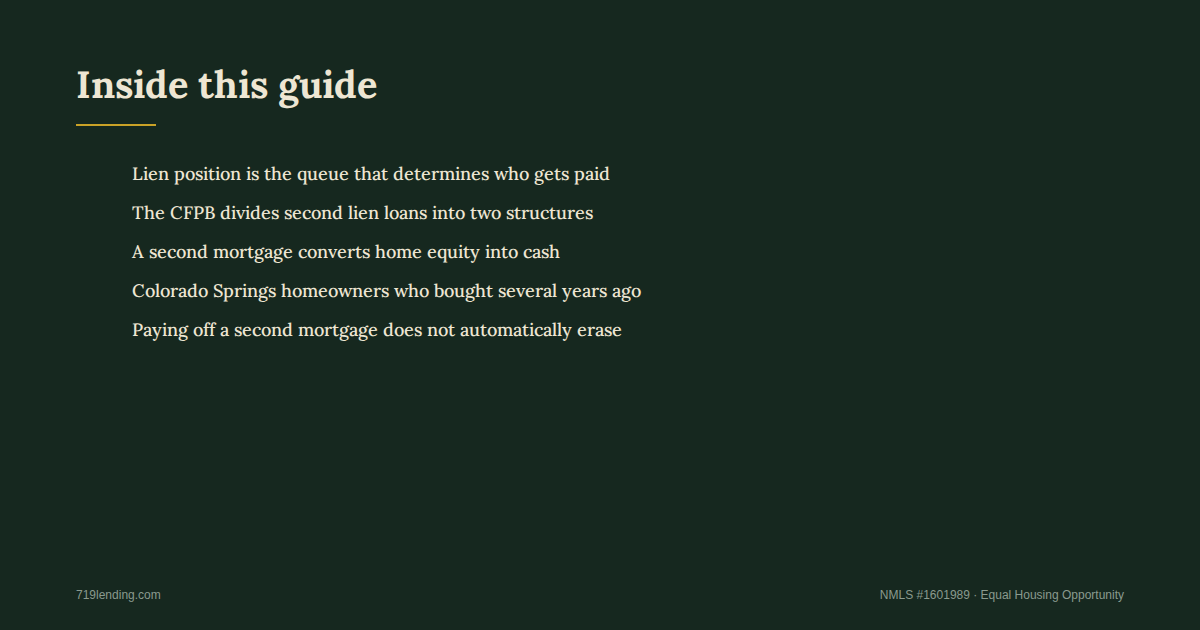
A 2nd lien mortgage sits behind your first mortgage in repayment priority. Here is how second lien loans like home equity loans and HELOCs actually work, why lien position matters, and what Colorado Springs borrowers should weigh before using home equity as collateral.
How to Compare Your Closing Disclosure to Your Loan Estimate
If you are asking how do I compare my closing disclosure to my loan estimate, the short answer is: line by line, side by side, starting the moment the Closing Disclosure arrives. This guide walks Colorado buyers through every section the Consumer Financial Protection Bureau says to check, what is allowed to change, and how to push back when something looks off.
The stakes are real. The Closing Disclosure is the final statement of the loan terms and closing costs, and it is the document your signing appointment is built on.
Why the closing disclosure exists and when you get it
The Closing Disclosure is the final version of the Loan Estimate you received when you applied. The Loan Estimate told you what the lender expected the loan to look like; the Closing Disclosure tells you what it actually looks like.
Lenders are required to provide the Closing Disclosure three business days before your scheduled closing. That window exists specifically so you can compare the two forms and resolve problems before you are sitting at the closing table.
Use those days wisely. If something looks different from what you expected, ask why — that is the whole point of the waiting period. Next, here is the fast checklist before we go section by section.
The quick side-by-side checklist
Pull out your most recent Loan Estimate — not the first one you received, but the latest revision — and confirm each item below matches the Closing Disclosure.
| Item to compare | What to verify |
|---|---|
| Your name and contact info | Spelling is exact; even minor misspellings can cause problems later |
| Loan term, purpose, product, loan type | Identical to the most recent Loan Estimate |
| Loan amount | Matches; if it increased, ask whether closing costs were rolled into the loan |
| Interest rate | Matches what you locked; a locked rate can change only in limited circumstances |
| Estimated total monthly payment | Matches, and you can comfortably afford it |
| Closing costs | Similar to the estimate; significant changes need an explanation |
| Cash to close | Matches the Loan Estimate; this is what your cashier’s check or wire must cover |

Everything else in this article expands on those rows, starting with the loan terms themselves.
How do I compare my closing disclosure to my loan estimate, page by page
Page one: loan terms
The Closing Disclosure opens with the same core terms the Loan Estimate did: loan amount, interest rate, loan term, product, and loan type — conventional, FHA (Federal Housing Administration), VA, or USDA. These items are very important, and they should match your most recent Loan Estimate exactly.
If the loan amount has increased, one possible reason is that closing costs were rolled into the loan. That reduces your upfront cost at closing but raises the overall cost of the loan because of added interest, so make sure it was a choice you actually made.
If you locked the interest rate, the lender is only allowed to change it under limited circumstances. A rate that does not match what you were expecting is a call-the-lender-immediately item.
Page one: projected payments
Next, check that the estimated total monthly payment matches the Loan Estimate. This figure combines monthly principal and interest, mortgage insurance if the loan requires it, and estimated escrow for property taxes and homeowners insurance.
Also look at the estimated taxes, insurance, and assessments line. If any items there are not in escrow, you will pay them directly, often in lump sums — confirm you have budgeted for that. Homeowners association dues, common in many Colorado Springs neighborhoods, are often not escrowed.
With the terms verified, the next battleground is the cost detail on page two.
Comparing closing costs line by line
Origination charges and points
Origination charges are the upfront fees the lender charges for making the loan. Compare this section to the same section of the Loan Estimate; the totals should line up.
Points are an upfront fee paid to the lender in exchange for a lower interest rate than you would otherwise pay. If points appear on the Closing Disclosure that were not on the Loan Estimate — or the reverse — ask the lender to walk you through the change before you sign.
Services you could not shop for
The section labeled “Services Borrower Did Not Shop For” lists third-party services the lender required and selected. Compare it with Section B, “Services You Cannot Shop For,” and Section C, “Services You Can Shop For,” on page two of the Loan Estimate.
The costs here should be similar, though they may differ somewhat from the estimate. What you are really scanning for is new services that never appeared on the Loan Estimate at all — those deserve a direct question.
On government-backed loans, the upfront mortgage insurance premium or the VA funding fee appears in this area, and those charges are set by the government program rather than the lender. That matters for military buyers using a VA loan in Colorado Springs, where the funding fee is a program rule, not a negotiable lender fee.
Services you shopped for
The “Services Borrower Did Shop For” section covers providers you chose yourself, such as certain closing services. The prices should match what you agreed to pay.
If a company appears here that you did not choose, or a charge you do not recognize, ask the lender what the charge is for and how the company was selected.
Taxes, prepaids, and initial escrow
Taxes and other government fees cover transferring the property to you and recording the mortgage with the county — in El Paso County, that recording happens at the county records office like anywhere else.
Prepaids include interest on the loan between closing day and the end of that month, and it is common to pay the first year’s homeowners insurance premium in advance at closing. The initial escrow payment at closing establishes the starting balance in your escrow account.
Property taxes are set by your local government, not the lender, and the homeowners insurance premium is set by the insurance company you chose. Verify the lender’s estimates against your actual tax authority and policy so the escrow math holds up.
Once the itemized costs check out, move to page three and the money question.
Cash to close: verify it last, verify it hard
Cash to close is the actual amount you must pay at closing, in addition to any money you have already paid. You will typically need a cashier’s check or wire transfer for this amount, and your closing agent — sometimes called a settlement agent, escrow agent, or closing attorney — can tell you how to make the payment.
Compare it directly against the estimated cash to close on the Loan Estimate. If the number does not match, ask the lender to explain why before closing day, not at the table.
Seller credits and lender credits
Check that the seller credit reflects what you negotiated. If the seller agreed to pay specific costs rather than a general amount, those may show up as “Seller Paid” line items on page two instead of one credit line.
Lender credits are a rebate from the lender that offsets some of your closing costs, typically provided in exchange for a higher interest rate than you would have paid otherwise. Confirm any lender credit you discussed actually appears — and that no credit quietly disappeared between the Loan Estimate and the Closing Disclosure.
The remaining pages cover loan features you should read even though they rarely change.
Loan disclosures worth reading twice
Escrow account details
The Closing Disclosure states whether you will have an escrow account, which homeownership expenses it covers, and the estimated costs. An escrow account lets you pay homeowners insurance and property taxes monthly as part of the mortgage payment instead of in large lump sums.
If the form shows no escrow account but you wanted one, talk to the lender. Also check whether you are being charged an escrow waiver fee for skipping escrow — some lenders charge one, and it should be a choice you made deliberately.
Prepayment penalties, balloon payments, and other features
Two features the Consumer Financial Protection Bureau flags as risky: a prepayment penalty, which lets the lender charge a fee if you pay off the mortgage early, and a balloon payment, where the final payment is a lump sum much larger than the regular monthly payments. If either appears, ask the lender about other options.
Also review the assumption line — if the loan allows assumptions, a future buyer of your home may be able to take over the loan on the same terms. Check the late-payment fee disclosure, whether the lender accepts partial payments, and the demand feature and negative amortization lines. Most loans do not have negative amortization or a demand feature, so their presence deserves a question.
The comparison numbers on the final page
The last section discloses the total of payments over the life of the loan, the finance charge, the amount financed, the annual percentage rate, and the total interest percentage. These are the numbers that let you see the full lifetime cost of the loan, not just the monthly payment.
Finally, read the note and the security instrument — the mortgage or deed of trust — carefully. The security interest is what allows the lender to foreclose if the loan is not repaid, so know what you are signing.
If any of this review turns up a mismatch, here is the play.
What to do if something does not match
Call the lender immediately and ask why the item changed. Some closing costs are allowed to shift between the Loan Estimate and closing, but the core terms — loan amount, rate if locked, term, product, and type — should not move without an explanation you understand and agreed to.
Do this on day one of the three-business-day window, not the night before closing. That window is your leverage: problems found early can be corrected on paper; problems found at the table create pressure to sign anyway.
Keep every version of the Loan Estimate you received. Always compare against the most recent one, because revised estimates during underwriting supersede the original.
A note for Colorado Springs and military buyers
Military buyers around Fort Carson, Peterson, and Schriever often close on a PCS timeline, which makes the three-day review window feel tight. Build the review into your move plan the same way you build in the household-goods delivery.
If you are using a VA loan, remember the funding fee sits with the government-program charges, not the lender fees, when you compare the forms. First-time buyers using Colorado Housing and Finance Authority (CHFA) down payment assistance should confirm the assistance appears correctly in the cash-to-close math — a Colorado first-time buyer program credit that goes missing on the Closing Disclosure changes the check you bring.
Whatever the program, the comparison process is identical: most recent Loan Estimate on the left, Closing Disclosure on the right.
Your next step
The moment the Closing Disclosure lands in your inbox, print it, print the most recent Loan Estimate, and go through the checklist in this article with a pen. Flag anything that changed and ask the lender to explain each flag the same day.
If you are still shopping or want a second set of eyes on your disclosures, the team at 719 Lending in Colorado Springs reviews these documents with borrowers every week and can walk you through exactly what changed and why.
Frequently asked questions
When do I get my Closing Disclosure?
Lenders are required to provide the Closing Disclosure three business days before your scheduled closing. Use those days to compare it against your most recent Loan Estimate and resolve any problems before closing day.
Which Loan Estimate should I compare my Closing Disclosure to?
Always compare against your most recent Loan Estimate, not the first one you received. Revised estimates issued during the loan process supersede earlier versions, so the latest revision is the benchmark.
What should match exactly between the Loan Estimate and Closing Disclosure?
The loan term, purpose, product, loan type, and loan amount should match your most recent Loan Estimate, and a locked interest rate can only change under limited circumstances. If any of these differ, call the lender immediately and ask why.
Why is my cash to close different from my Loan Estimate?
Cash to close reflects your down payment and closing costs minus your deposit, seller credits, lender credits, and other adjustments. If it does not match the Loan Estimate, ask the lender to explain the difference — common causes include changed credits, updated prepaids, or costs rolled into the loan.
What can change between the Loan Estimate and the Closing Disclosure?
Costs for lender-required third-party services may be somewhat different from the estimate, and prepaids and escrow figures can shift as actual tax and insurance amounts are confirmed. What you should question are new services that never appeared on the Loan Estimate and significant changes to closing costs or core loan terms.
What do I do if my Closing Disclosure has an error?
Contact the lender right away and ask them to correct it — even a misspelled name can cause problems later. The three-business-day review window exists so errors can be fixed on paper before you sign.
719 Lending Inc., NMLS #1601989 · Equal Housing Opportunity
719 Lending Inc. is not affiliated with or endorsed by HUD, FHA, VA, USDA, CHFA, the CFPB, or any government agency.
Last updated: August 2026

Related Posts