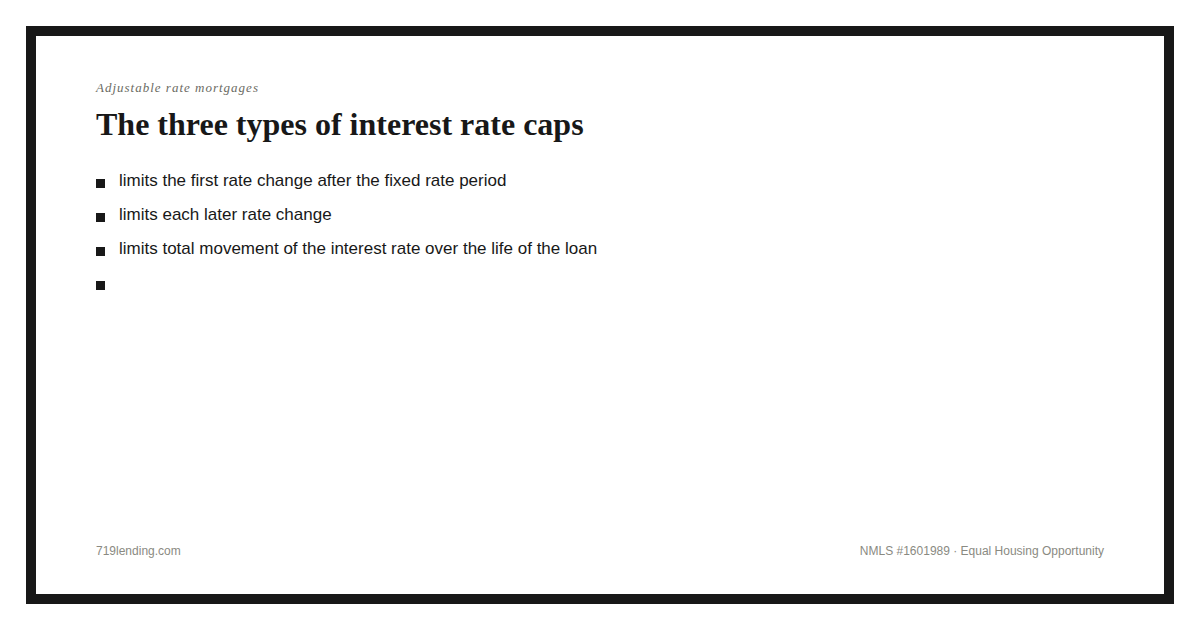
Rate caps are the built-in guardrails of an adjustable-rate mortgage. They limit how far the interest rate can move at the first adjustment, at each later adjustment, and in total over the life of the loan. Here is what each cap does, where to find them in the loan documents, and the questions to ask before you sign.
What Is a Second Mortgage or Junior-Lien? A Plain Guide
What is a second mortgage or junior-lien? It is a loan you take out using your house as collateral while you still have another loan secured by that same house. That is the Consumer Financial Protection Bureau’s definition, and it covers the two products most homeowners actually encounter: home equity loans and home equity lines of credit (HELOCs).
This guide is for Colorado homeowners who are weighing a second mortgage loan for a remodel, debt consolidation, or another goal, and who want to understand how lien position, repayment structure, and risk actually work before they sign anything.
What is a second mortgage or junior lien, exactly?
A second mortgage is any loan secured by your home that sits behind an existing loan on the same property. The existing loan is the first mortgage, sometimes called the primary mortgage or original mortgage.
The word “second” refers to payoff order, not to the size of the loan or when you happen to sign the paperwork. If you can no longer pay your mortgages and the home is sold to pay off the debts, the second mortgage loan is paid off second, after the first mortgage lender is satisfied.
“Junior-lien” is simply the legal way of saying the same thing. The first mortgage holds the senior lien position; every mortgage recorded after it holds a junior position. In principle a homeowner could even have a third or fourth mortgage, each one further back in line.
With the definition settled, the next question is why payoff order changes how these loans are priced.
Why lien position matters to you and the lender
Lien position determines who gets paid first when a home is sold to satisfy the debts against it. If there is not enough equity to pay off both loans completely, the second mortgage lender may not get the full amount it is owed.
That extra risk is why second mortgages often carry higher interest rates than first mortgage loans. The second lender knows it stands behind the first mortgage lender in every scenario that ends badly.
For the borrower, the practical takeaway is simple: a second mortgage loan is real mortgage debt, secured by your house, with foreclosure as the ultimate consequence of non-payment. It is not a lighter-weight version of a home loan just because it comes second.
Understanding that risk framework makes it easier to compare the two main forms a second mortgage takes.
The two common types: home equity loan and HELOC
Home equity loans and home equity lines of credit are the most common examples of second mortgages. Both borrow against home equity, but they deliver the money in very different ways.
Home equity loan: closed-end, lump sum
A home equity loan (sometimes called a HEL) lets you borrow money using the equity in your home as collateral. Equity is the amount your property is currently worth, minus the amount of any existing mortgage on your property.
You receive the money from a home equity loan as a lump sum payment, and a home equity loan usually has a fixed interest rate — one that will not change. Because you get the entire loan amount upfront and cannot redraw after that, this structure is called closed-end.
The CFPB also cautions that home equity loans may have upfront fees and costs, so compare more than just the monthly payments when shopping around. Closing costs and origination fees on a second mortgage deserve the same scrutiny you gave the first mortgage.
Home equity line of credit: open-end, revolving
A home equity line of credit works more like a revolving line. An open-end second mortgage means you can continue to take cash out up to the maximum credit amount, and as you pay down the loan balance, you can draw again up to the same limit.
That borrowing phase is what makes an equity line of credit flexible for projects with uncertain costs. But flexibility cuts both ways: it is easier to keep adding to your overall debt burden when the credit remains available.
Here is how the two structures compare side by side.
| Feature | Home equity loan | Home equity line of credit (HELOC) |
|---|---|---|
| Structure | Closed-end | Open-end |
| How you receive funds | Entire loan amount upfront as a lump sum | Draw as needed up to the maximum credit amount |
| Can you re-borrow? | No — you cannot redraw after funding | Yes — as you pay down the balance, you can draw again up to the same limit |
| Interest rate | Usually a fixed interest rate | Structure varies; confirm the terms with the lender |
| Lien position | Junior to the first mortgage | Junior to the first mortgage |
| Collateral | Your home | Your home |

Both products share one non-negotiable feature: the collateral. That leads directly to the risk conversation.
What are the risks of a second mortgage?
The major risk with home equity loans and home equity lines of credit is straightforward: if you cannot repay the loan, you could potentially lose your home, because you are using the equity in your home as collateral.
You are adding to your total debt burden
By taking out a second mortgage, you are adding to your overall debt burden. Anytime you add to your debt burden, you make yourself more vulnerable if you later experience financial difficulties that affect your ability to repay your debts.
Two mortgage payments every month means two obligations that must be met even when income drops, a job changes, or an unexpected expense lands. Existing loans do not pause because a new one was added.
Default on the second can trigger foreclosure
When a borrower defaults on a second mortgage, the mortgage holder can sometimes start foreclosure even if the borrower is current on the first mortgage. Staying current on the primary mortgage does not shield the home from the second lender’s remedies.
These risks matter most in one specific scenario: using home equity to pay off other debts.
Should you use a second mortgage for debt consolidation?
The CFPB’s warning is blunt: be careful using home equity to consolidate higher-interest debts. When you use home equity to pay off other debts, you really aren’t paying them off — you are merely taking out one loan to repay another.
Why the lower rate is not free
The interest rates on a second mortgage may be lower than the rates on the debts being consolidated, but that is only because you are using your home as collateral. Debts that were previously unsecured — like unsecured personal loans or credit card balances — become debt that can cost you the house.
Trading short-term debt for long-term debt
There is also a term-length trap. The CFPB’s example: taking out a mortgage to pay off a five-year car loan may have you making payments and paying additional interest for ten, fifteen, or even thirty years.
Be careful about trading short-term debt for long-term debt at a higher total cost to you. A longer loan term can shrink the monthly payments while stretching the repayment period far beyond the life of the thing you bought.
Before borrowing against home equity to consolidate debts, the CFPB suggests talking to a qualified credit counselor. That advice is worth a section of its own.
Talk to a credit counselor before pledging your home
If you are considering a home equity loan to pay off debts, explore alternatives with a credit counselor that do not potentially put your home at risk of a forced sale.
Look for a non-profit credit counseling organization that can advise you on managing money and debts, help you develop a budget, and give you free educational materials or workshops. The CFPB points to the National Foundation for Credit Counseling as a starting point.
Avoid firms that ask for big fees up-front or make unrealistic promises, like restoring your credit or settling your debts for pennies on the dollar. Once you have identified counselors, check with your local Better Business Bureau or the state attorney general’s office for any history of complaints.
One more risk deserves attention, because it has resurfaced for homeowners across the country: the so-called zombie second mortgage.
What is a zombie second mortgage?
“Zombie” mortgages are mortgage debts you might have thought were forgiven or satisfied long ago but that still exist. Because they seem to reappear after being considered dead for years, they are called zombie second mortgages.
How second mortgages went dormant
Before the Great Recession in 2008, mortgage lenders sometimes gave borrowers two mortgages on the same property instead of one — a primary mortgage recorded at the courthouse first, and a second mortgage recorded after it covering the remainder of the purchase price. Sometimes the second mortgage was taken out as a home equity loan after the purchase.
When home values shrank and borrowers defaulted, some second mortgage holders charged off their loans as uncollectible and stopped communicating. Some sold the loans to debt buyers without telling the borrower.
Why they are coming back now
Borrowers who received no notices or periodic statements for years assumed the second mortgage had been modified, discharged in bankruptcy, or forgiven. Now, as property values rise and first mortgages get paid down, companies claiming to own these dormant second mortgages are demanding the outstanding balance plus fees and interest, and some threaten foreclosure.
The lesson for any second mortgage borrower: keep your records, and never assume a loan that went quiet has gone away. Now let’s connect all of this to the local picture.
Second mortgages for Colorado Springs homeowners
Colorado Springs is a heavily military market, and second mortgages come up often here. A homeowner facing a PCS move may want to tap equity before relocating, or a family that bought years ago may have watched home equity grow substantially as property values climbed along the Front Range.
The mechanics are the same in Colorado as anywhere: the first mortgage keeps its senior lien position, the new loan records behind it as a junior lien, and both are secured by the same property.
What changes borrower to borrower is how the numbers pencil out — how much equity exists, what the interest rate on the loan would be, what the closing costs look like, and whether the household budget comfortably absorbs two mortgage payments. Those are questions to work through with a loan officer using your actual credit report, income, and property value.
Where to read the official source
The definitions in this article come from the Consumer Financial Protection Bureau, the federal agency that implements and enforces consumer financial law. Three pages are worth reading directly:
- What is a second mortgage loan or junior-lien? — the core definition, open-end versus closed-end structures, and payoff order.
- What is a home equity loan? — how equity is calculated and why HELs usually carry a fixed interest rate.
- What is a zombie second mortgage? — how dormant second mortgage debt can resurface years later.
The CFPB notes its content is general consumer information, not legal advice. If tax questions come up around home equity borrowing, tax treatment varies, so talk to a tax professional.
Your next step
If you are considering a second mortgage in Colorado Springs or anywhere along the Front Range, start with two things: an honest look at your budget with both mortgage payments in it, and a conversation with a licensed loan officer who can compare a home equity loan, a home equity line of credit, and other mortgage options against your actual situation.
Bring your current mortgage statement, an idea of what the home is worth, and a clear purpose for the funds. From there, a loan officer at 719 Lending can walk you through the loan amount, loan term, and cost details in writing so you can decide with the full picture in front of you.
Frequently asked questions
What is the difference between a second mortgage and a home equity loan?
A home equity loan is one type of second mortgage. “Second mortgage” or “junior-lien” describes any loan secured by your home while another loan is already secured by the same property. Home equity loans and home equity lines of credit (HELOCs) are the two most common examples.
Why do second mortgages often carry higher interest rates than first mortgages?
Because of payoff order. If the home is sold to pay off the debts, the second mortgage is paid off second. If there is not enough equity to pay off both loans completely, the second mortgage lender may not get the full amount it is owed, so it prices that risk into the interest rate.
Can I lose my house over a second mortgage?
Yes. The major risk with home equity loans and HELOCs is that you are using the equity in your home as collateral, so if you cannot repay the loan, you could potentially lose your home. A second mortgage holder can sometimes start foreclosure even if you are current on the first mortgage.
What does open-end versus closed-end mean for a second mortgage?
An open-end second mortgage, like a HELOC, lets you take cash out up to the maximum credit amount and draw again as you pay down the balance. A closed-end second mortgage, like a typical home equity loan, gives you the entire loan amount upfront as a lump sum with no redraws afterward.
Is using a second mortgage to consolidate debt a good idea?
The CFPB urges caution. Using home equity to pay off other debts doesn’t really pay them off — you are taking out one loan to repay another, secured by your house. You may also trade short-term debt for long-term debt, paying interest over a much longer repayment period. Talk to a qualified non-profit credit counselor first.
What is a zombie second mortgage?
A zombie second mortgage is old second mortgage debt you thought was forgiven or satisfied that resurfaces years later. Some lenders charged off defaulted second mortgages, stopped sending statements, and sold the debt to collectors, who later demand the balance plus fees and interest — sometimes threatening foreclosure.
719 Lending Inc., NMLS #1601989 · Equal Housing Opportunity
719 Lending Inc. is not affiliated with or endorsed by HUD, FHA, VA, USDA, CHFA, the CFPB, or any government agency.
Last updated: September 2026

Related Posts