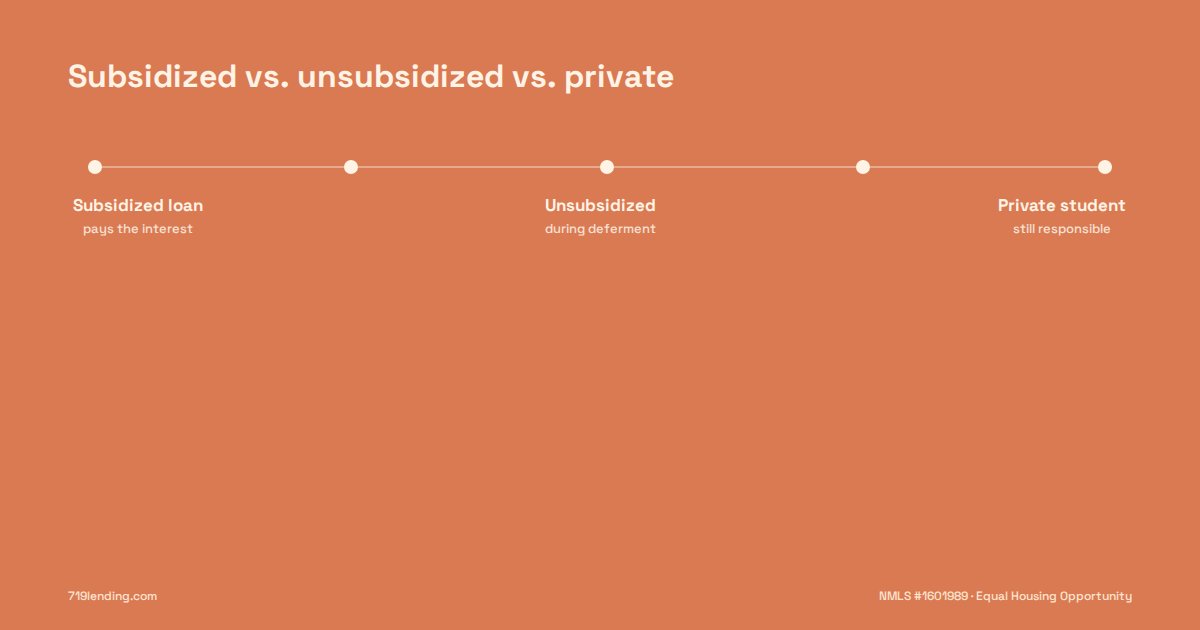
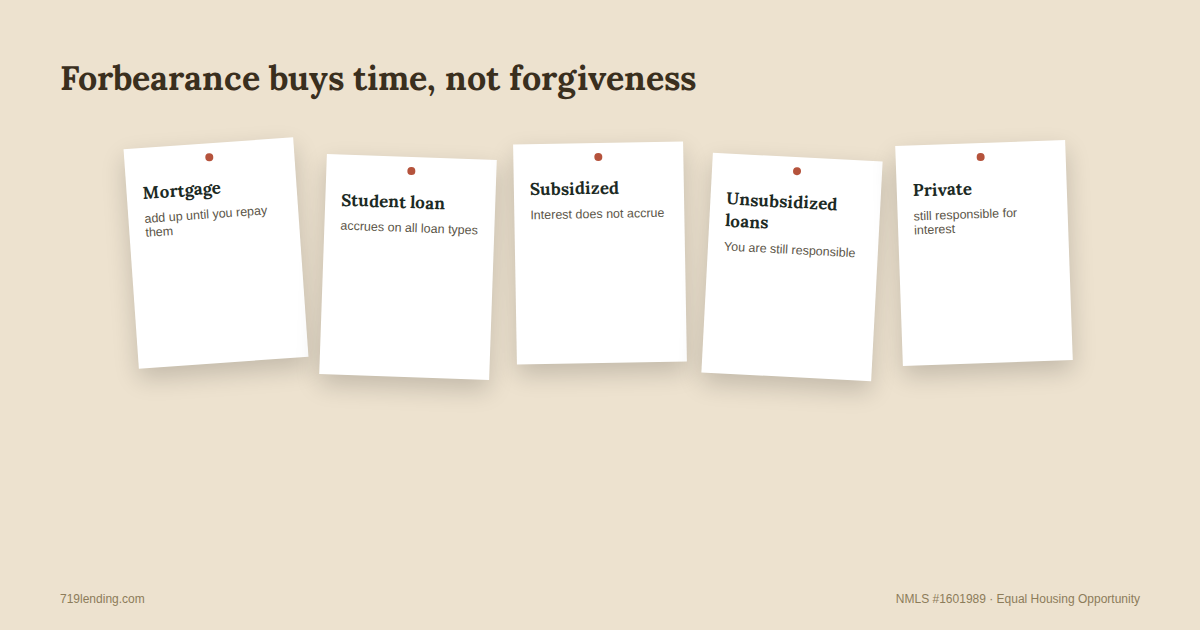
If you have a federal subsidized student loan, you do not have to pay interest on it during an approved deferment — the U.S. Department of Education covers it. Unsubsidized and private student loans work differently, and the gap matters, especially for service members around Colorado Springs weighing deferment during active duty.
What Are Common Examples of Second Mortgages? | 719 Lending
If you are asking what are common examples of second mortgages, the direct answer from the Consumer Financial Protection Bureau (CFPB) is home equity loans and home equity lines of credit, often shortened to HELOCs. This guide is for Colorado homeowners — including the many military families around Colorado Springs — who want to understand how each type of second mortgage works before borrowing against home equity.
We will cover what a second mortgage actually is, the difference between closed-end and open-end structures, why second mortgage interest rates tend to run higher than first mortgage rates, and the risks the CFPB wants borrowers to weigh.
What are common examples of second mortgages?

The CFPB names two common examples of second mortgages: the home equity loan and the home equity line of credit (HELOC). Both are loans secured by your house while your primary mortgage is still in place.
- Home equity loan: a closed-end second mortgage — you receive the entire loan amount upfront as a lump sum and cannot redraw after that. It usually carries a fixed interest rate.
- Home equity line of credit (HELOC): an open-end second mortgage — a credit line you can draw against up to the maximum credit amount, pay down, and draw again up to the same limit.
- Purchase-money second mortgages: historically, some lenders paired a primary mortgage covering most of a purchase price with a second mortgage covering the remainder at closing.
Each of these is a junior lien, and that lien position drives almost everything else about how a second mortgage behaves. Let’s start with the definition itself.
What is a second mortgage or junior lien?
A second mortgage — the CFPB also calls it a junior lien — is a loan you take out using your house as collateral while you still have another loan secured by the same house. Your existing mortgage stays in first position, and the additional loan sits behind it.
The word “second” refers to payoff order, not importance. If you can no longer make your mortgage payments and the home is sold to pay off the debts, the first mortgage is paid off first and the second mortgage loan is paid off second.
Why lien position matters
If the sale does not produce enough home equity to pay off both loans completely, the second mortgage lender may not get the full amount it is owed. Because the lender in second position takes on that extra risk, second mortgage loans often carry higher interest rates than first mortgage loans.
Open-end versus closed-end second mortgages
The CFPB draws one more useful line between the types of second mortgages. An open-end second mortgage lets you continue to take cash out up to the maximum credit amount and, as you pay down the balance, draw again up to the same credit limit.
A closed-end second mortgage delivers the entire loan amount upfront, and you cannot redraw after that. With those two structures in mind, the two common examples make more sense.
Home equity loan: the closed-end second mortgage
A home equity loan (sometimes called a HEL) allows you to borrow money using the equity in your home as collateral. Equity is what your property is currently worth minus the amount of any existing mortgage on the property.
You receive the money from a home equity loan as a lump sum payment. That single-disbursement structure is why a home equity loan is the classic closed-end second mortgage.
How the home equity loan is structured
A home equity loan usually has a fixed interest rate — one that will not change over the life of the loan. Many borrowers value that structure because it produces a predictable monthly payment alongside the payment on the primary mortgage.
The trade-off is flexibility. Once the lump sum is disbursed, you cannot go back and borrow more against that same loan the way you could with a credit line.
What the CFPB says to watch
Home equity loans may have upfront fees and costs, so the CFPB advises comparing more than just the monthly payments when shopping around. Closing costs and closing fees vary by lender, and they belong in any side-by-side comparison before loan approval.
And the core risk is blunt: if you cannot pay back the home equity loan, the lender could foreclose on your home. The open-end alternative carries the same collateral risk in a different wrapper.
HELOC: the open-end second mortgage
A home equity line of credit is the open-end example of a second mortgage. Instead of a lump sum, the lender approves a maximum credit amount, and you draw against that credit line as needed.
As you pay the balance down, the available credit replenishes, and you can draw again up to the same credit limit. That revolving structure is what separates an equity line of credit from a home equity loan.
Draw period and repayment period
Lenders commonly structure a HELOC with a draw period, when you can access the credit line, followed by a repayment period after the draw period ends. The exact terms — how long each phase lasts, whether the interest rate is fixed or a variable interest rate, how monthly payments change — differ by lender, so confirm the specifics in writing before signing.
Because a HELOC is still a second mortgage secured by home equity, the same foundational risk applies: fall behind, and the collateral is your house. That risk is worth a section of its own.
Purchase-money seconds: a second mortgage at the closing table
Not every second mortgage is taken out years after buying a home. The CFPB notes that before the Great Recession, mortgage lenders sometimes gave borrowers two mortgages on the same property instead of one.
In that structure, a primary mortgage — recorded at the courthouse first — covered most of the purchase price, and a second mortgage, recorded after the first mortgage, covered the remaining portion. In other cases, the second mortgage was taken out as a home equity loan after the house was purchased.
Recording order at the courthouse is what fixes which loan is the first mortgage and which is the junior lien. That history also explains one of the stranger risks in this corner of personal finance: the zombie second mortgage.
Zombie second mortgages: when an old loan comes back
A zombie second mortgage is a mortgage debt you might have thought was forgiven or satisfied long ago but that still exists. The CFPB explains that old debts can be written off by the lender and sold for pennies on the dollar to debt collectors.
Sometimes the mortgage company simply goes silent — no statements, no communication. Years later, a debt collector reaches out to collect on the dormant second mortgage.
Why zombie seconds happen
When home values shrank during the Great Recession, some borrowers had trouble making mortgage payments. Some holders of defaulted second mortgages charged the loans off as uncollectible, stopped communicating, or sold the loans to debt buyers without telling the borrower.
Borrowers who received no notices for years assumed the second mortgage had been modified with the first, discharged in bankruptcy, or forgiven. Now, as borrowers pay down their first mortgages and property values rise, collectors are demanding the outstanding balance plus fees and interest — and some threaten foreclosure.
The lesson for anyone with an old home loan in the file: get written confirmation of a second mortgage’s status, and keep it. Next, why the pricing on a junior lien looks the way it does.
Why second mortgage interest rates run higher
Second mortgage rates reflect payoff order. If a foreclosure sale does not cover both loans, the primary mortgage lender is paid first and the second mortgage lender may absorb the shortfall.
That is why, as the CFPB puts it, second mortgage loans often carry higher interest rates than first mortgage loans. It is a structural feature of the junior lien, not a reflection of any one borrower’s credit history.
Overall mortgage rates and mortgage interest rates still move with the broader market, and the interest rate on any specific second mortgage depends on the loan, the property, and the borrower. Pricing is only half the analysis, though — the risks deserve equal weight.
The risks the CFPB flags with any second mortgage
Taking out a second mortgage adds to your overall debt burden. Any time you add debt, you make yourself more vulnerable if financial difficulties later affect your ability to repay.
The major risk with a home equity loan or home equity line of credit is direct: because you are using home equity as collateral, you could potentially lose your home if you cannot repay such a loan.
Be careful with debt consolidation
Many homeowners consider a second mortgage for debt consolidation of high interest debt — credit cards, medical bills, personal loans. The CFPB’s caution: when you use home equity to pay off other debts, you are not really paying them off, you are taking out one loan to repay another.
Interest rates may look lower in the short term, but only because your home now secures the debt. The CFPB also warns against trading short-term debt for long-term debt at a higher total cost — stretching a car loan’s balance across decades of mortgage payments means paying additional interest for far longer.
Before using a second mortgage to consolidate debt, the CFPB suggests talking with a qualified nonprofit credit counselor who can help you weigh options that do not put the home at risk. The National Foundation for Credit Counseling is the starting point the bureau names.
Be careful borrowing to invest
The CFPB is equally direct about borrowing against your home as part of an investment strategy: there is no such thing as a risk-free or guaranteed investment. All investments can lose value, and that could put your home at risk if you cannot repay the loan later on.
Understood alongside the alternatives, though, a second mortgage is simply one tool among several.
Second mortgage or cash out refinance?
Which path fits depends on the terms of the existing mortgage, current interest rates, loan to value, closing costs on each option, and your financial goals.
For Colorado Springs military families, timing matters too — a PCS move on the horizon changes how long you will carry any new loan. A conversation about refinance options versus a second mortgage is the practical way to run both scenarios side by side.
Whichever direction you lean, the primary source is worth reading yourself.
What the official source says and where to read it
The definitions in this article come from the Consumer Financial Protection Bureau’s Ask CFPB library — specifically its pages on second mortgage loans and junior liens, home equity loans, and zombie second mortgages. The CFPB is the federal agency that implements and enforces federal consumer financial law.
Those pages are plain-English and free at consumerfinance.gov. Reading them before you apply anywhere puts you in a stronger position with any mortgage lender.
Next steps for Colorado homeowners
Start by estimating your home equity: what the property is worth today minus the existing mortgage balance. Then decide whether a lump sum or a reusable credit line matches the goal — home improvements, consolidating debt, or another purpose.
Gather your questions about upfront costs, the repayment period, and how the additional monthly payment fits your budget alongside the first mortgage. Then talk it through with a licensed professional.
719 Lending works with homeowners across Colorado Springs and the Front Range every day. Reach out to a 719 Lending loan officer to compare a home equity loan, a HELOC, and a full menu of loan options, or start an application when you are ready to see real terms on paper.
Frequently asked questions
What are the two most common types of second mortgages?
According to the Consumer Financial Protection Bureau, home equity loans and home equity lines of credit (HELOCs) are the common examples of second mortgages. A home equity loan is closed-end — a lump sum you cannot redraw — while a HELOC is open-end, letting you draw, repay, and draw again up to the credit limit.
Is a HELOC considered a second mortgage?
Yes. A home equity line of credit is a loan secured by your house while your first mortgage is still in place, which makes it a second mortgage, or junior lien. It is the open-end type: you can take cash out up to the maximum credit amount and redraw as you pay the balance down.
Why do second mortgages have higher interest rates than first mortgages?
If the home is sold to pay off the debts, the second mortgage is paid off second. If there is not enough equity to cover both loans, the second mortgage lender may not receive the full amount owed. Because of that added risk, second mortgage loans often carry higher interest rates than first mortgage loans.
Can I lose my home over a second mortgage?
Yes. The CFPB notes that a major risk with home equity loans and HELOCs is foreclosure, because you are using the equity in your home as collateral. If you cannot repay the second mortgage, the lender could foreclose even though the loan sits behind your primary mortgage.
What is a zombie second mortgage?
A zombie second mortgage is an old second-mortgage debt you thought was forgiven or satisfied but that still exists. Lenders sometimes charged off these loans, stopped communicating, or sold them to debt buyers. Years later, collectors resurface demanding the balance plus fees and interest, and some threaten foreclosure.
Is a home equity loan a good way to consolidate debt?
The CFPB urges caution. Using home equity to pay off other debts does not eliminate them — you are taking out one loan to repay another, now secured by your home. The bureau recommends talking with a qualified nonprofit credit counselor before using a second mortgage for debt consolidation.
719 Lending Inc., NMLS #1601989 · Equal Housing Opportunity
719 Lending Inc. is not affiliated with or endorsed by HUD, FHA, VA, USDA, CHFA, the CFPB, or any government agency.
Last updated: September 2026

Related Posts