Personal lines of credit are offered by banks and credit unions, and most require you to hold a checking account at the same institution. This guide explains how a personal line of credit works, why the checking account requirement matters, how it differs from a credit card or HELOC, and what to confirm before you sign.
Do Banks Have Different Policies for Stopping Payment on Checks?
Do different banks have different policies for stopping payment on checks? Yes — the Consumer Financial Protection Bureau (CFPB) says plainly that the process of stopping payment on a check varies between financial institutions, and so does how long the stop payment lasts. This article explains what is consistent everywhere, what changes from bank to bank, and exactly what to do, whether you bank with a national institution or a credit union here in Colorado Springs.
The short answer: yes, stop payment policies vary by institution
Every bank or credit union lets an account holder request a stop payment on a check. That part is universal.
What varies is the stop payment process itself: how you submit the request, whether it must be in writing, what the bank charges, and how long the stop payment order stays in force.
Key takeaways before the detail:
- Contact your bank or credit union right away — speed matters more than anything else.
- Banks and credit unions may charge a fee for a stop payment request.
- The process and the duration of the stop payment vary between financial institutions, so ask about your bank’s policy directly.
- Under most state laws, a written stop payment request made before the check is completely processed means the check can’t be cashed for six months.
- In some cases the stop payment expires after one year, and you can renew it when it lapses.
Next, let’s look at what stays the same no matter where you bank.
What is the same at every bank or credit union
The core mechanics of a stop payment order don’t change. A stop payment order is an instruction to your bank or credit union telling them not to pay a specific item from your account.
The CFPB’s first instruction is universal: contact your bank or credit union right away if you want to stop payment on a check. A stop payment only works if the bank receives it before the check has been completely processed.
It is also true almost everywhere that stop payment fees exist. The CFPB notes that your bank or credit union may charge you a fee when you request to stop payment on a check, and that banks and credit unions generally charge fees for stop payment orders.

With the common ground covered, here is where financial institutions diverge.
Where the stop payment process differs between banks
How you make the stop payment request
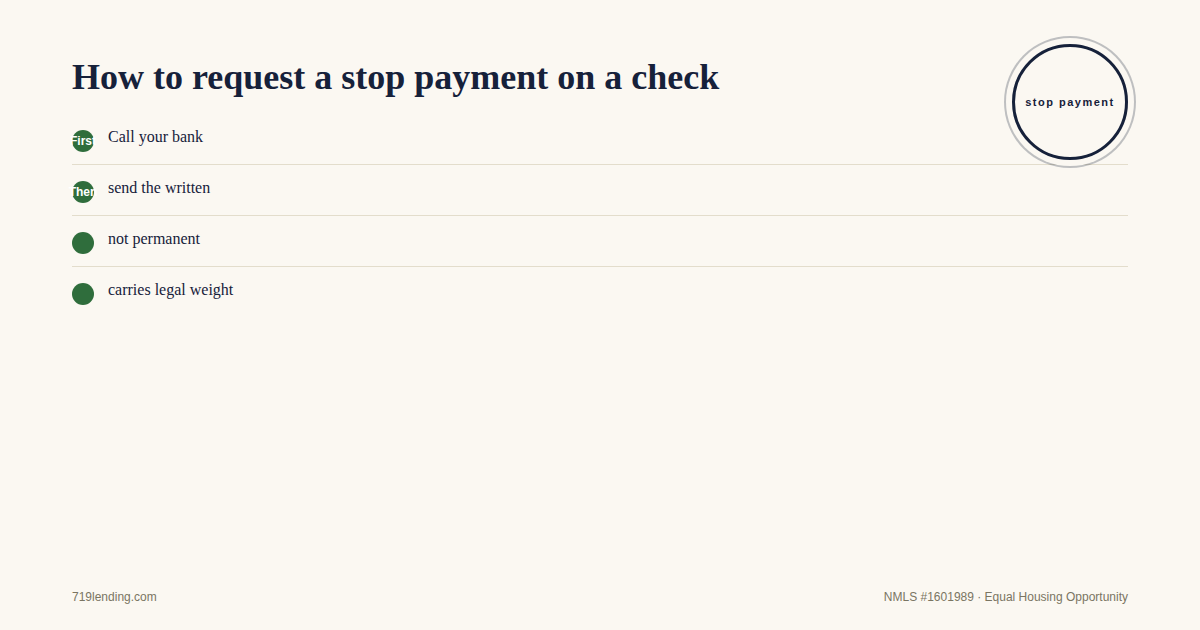
Some financial institutions take a stop payment request by phone, some through online banking, and some want a written follow-up. The CFPB’s advice is to talk to someone at your bank or credit union to learn about their policies, because the stop payment process genuinely varies.
A practical tip regardless of the bank’s policy: put the request in writing anyway. The strongest legal protection under most state laws attaches to a written stop payment request.
How long the stop payment order lasts
Duration is the other big difference. Most states have laws that say if you make the stop payment request in writing before the check has been completely processed, the check can’t be cashed for six months.
In some cases, the stop payment expires after one year instead. After the stop payment request expires, the bank or credit union may pay out the check if someone presents it.
Stop payment fees
The fee itself is set by each institution, which is part of why the account holder experience differs from one bank to the next. Confirm the fee when you call, and ask whether the bank’s policy requires written confirmation to keep the stop payment in force.
These differences matter most after the stop payment expires — so let’s cover that scenario.
What happens when a stop payment order expires
A stop payment order is not permanent. Once it expires — after six months under most state laws, or after one year in some cases — the bank pay decision resets, and the bank or credit union may honor the check if the payee or anyone else presents it.
You have two options at that point. You can make another stop payment order when the first one expires, or, if you want to permanently stop the payment from going through, the CFPB suggests considering closing the account and opening a new one.
Monitoring your bank statements after the stop payment request is smart either way, so you can confirm nothing was cashed against the old check. Stopping a recurring electronic payment works differently, which is worth understanding too.
Stopping automatic payments is a different process
Stopping payment on a paper check and stopping automatic payments from your account are related but separate processes. For automatic payments, the CFPB says you have the right to stop a company from taking automatic payments from your account, even if you previously allowed them.
The sequence there: call and write the company to revoke authorization, then call and write your bank or credit union to say you have revoked it. Some banks or credit unions might recommend you send them a stop payment order as well.
Two cautions from the CFPB apply here. Cancelling an automatic payment does not cancel what you owe — if you stop an automatic payment on a loan, you still have to make payments by another method. And you should notify your bank right away if a payment goes through after you revoked authorization, because federal law gives you the right to dispute unauthorized transfers if you tell your bank in time.
So who actually ends up needing a stop payment? More people than you’d think.
When Colorado borrowers typically use stop payments
A check that is lost or stolen is the classic reason an account holder decides to issue a stop payment. Writing a replacement check without stopping the first one risks both getting cashed.
Military households around Fort Carson, Peterson, and Schriever see this during PCS moves, when paper checks for deposits or services can go missing in the shuffle. Homebuyers sometimes face it too — a misdirected earnest money or due-diligence check is stressful, and a quick stop payment request is the standard fix.
If you suspect fraud rather than a simple lost check, say so when you contact the bank; a fraud dispute may involve more than a stop payment, and closing the account can be the cleaner path.
Everything above traces back to one official source, which is worth reading yourself.
What the CFPB says, in its own words
The Consumer Financial Protection Bureau’s guidance, “How do I stop payment on a check?”, is the authority here. It states: contact your bank or credit union right away; the bank may charge a fee; the process varies between financial institutions, as does how long the stop payment lasts; and under most state laws a written request made before the check is completely processed means the check can’t be cashed for six months, with some stop payments expiring after one year.
You can read it directly at consumerfinance.gov under “Ask CFPB.” The CFPB notes its content is general consumer information, not legal advice.
Here’s how to turn all of that into action today.
Your next step
Call your bank or credit union now — before the check is processed. Have the check number, the check date, the amount, and the payee ready so the bank can identify the exact item.
Ask three questions: what the stop payment fee is, whether the request must be in writing to get the six-month protection, and when the stop payment order expires under the bank’s policy. Then put the request in writing, note the date, and watch your bank statements to verify nothing slips through.
If the stop payment touches a home purchase — a lost earnest money check, a payment tied to closing — loop in your loan officer so nothing on the mortgage side gets delayed. The team at 719 Lending in Colorado Springs is happy to help you sort out how a banking hiccup affects your closing timeline.
Frequently asked questions
Do all banks charge the same stop payment fee?
No. The CFPB says banks and credit unions generally charge fees for stop payment orders, but each institution sets its own fee and process. Ask your bank or credit union directly what they charge and whether the request must be in writing.
How long does a stop payment on a check last?
It varies by institution and state law. Under most state laws, a written stop payment request made before the check is completely processed means the check can’t be cashed for six months. In some cases the stop payment expires after one year. You can renew the stop payment order when it expires.
What happens if someone cashes the check after my stop payment expires?
After a stop payment request expires, the bank or credit union may pay out the check if someone presents it. To prevent that, place a new stop payment order before the old one lapses, or consider closing the account and opening a new one to permanently stop the payment.
Does a verbal stop payment request work, or does it have to be in writing?
The process varies between financial institutions, so some may accept a phone request. But the six-month protection under most state laws applies to stop payment requests made in writing before the check is fully processed, so following up in writing is the safer move.
Can I stop an automatic payment the same way I stop a check?
It’s a different process. For automatic payments, you revoke authorization by calling and writing both the company and your bank or credit union. Some banks also recommend a stop payment order. Note that cancelling the payment does not cancel what you owe on the underlying bill or loan.
719 Lending Inc., NMLS #1601989 · Equal Housing Opportunity
719 Lending Inc. is not affiliated with or endorsed by HUD, FHA, VA, USDA, CHFA, the CFPB, or any government agency.
Last updated: November 2026

Related Posts