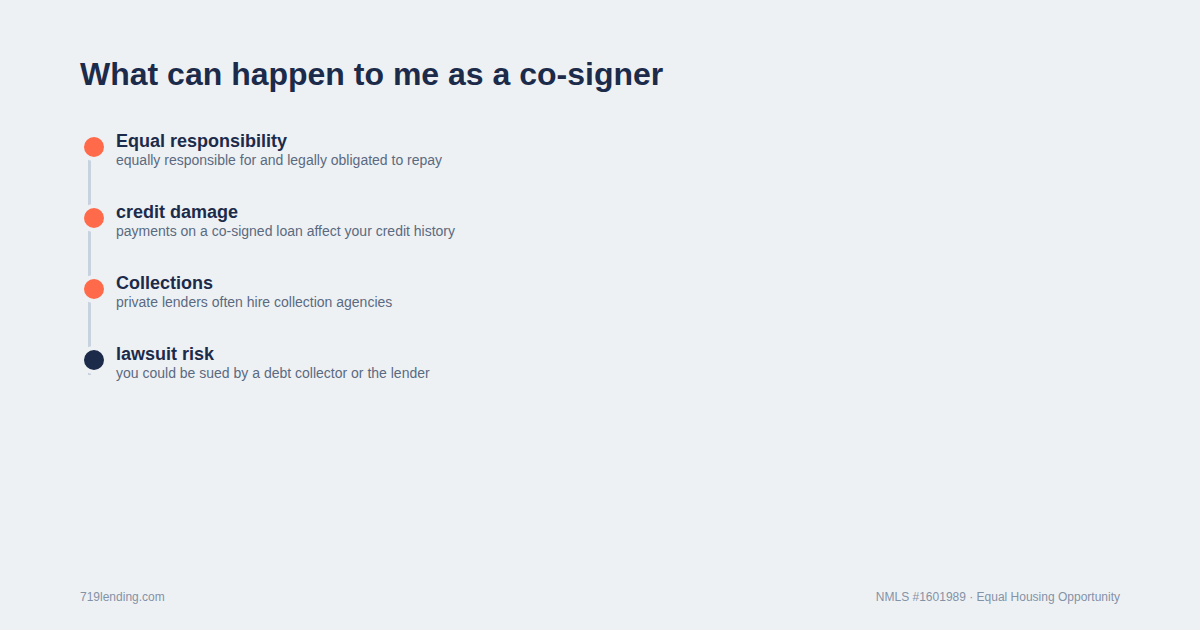
Cosigning a loan means you are equally responsible for the debt. If the primary borrower defaults, the lender can report the missed payments on your credit, send a collection agency after you, and even sue you. Here is exactly what can happen, what the Consumer Financial Protection Bureau says, and what to do before things get that far.
Points vs. Lender Credits on a Mortgage: The Difference
The difference between using points versus lender credits on a mortgage comes down to when you want to pay: more at the closing table for a lower interest rate, or less at the closing table in exchange for a higher interest rate. This guide explains how discount points and lender credits work, where each shows up on the Loan Estimate and Closing Disclosure, and how to think through the tradeoff — written for Colorado Springs buyers, including the many military families here whose timelines are shaped by PCS moves.
Points vs lender credits: the direct answer
Points — also called discount points or mortgage points — lower the interest rate on the loan in exchange for paying more at closing. Paying points lowers the monthly payment and means you pay less interest over time.
Lender credits are the mirror image. The lender gives you money to offset closing costs, and in exchange you accept a higher interest rate on the loan. You pay less up front, but more over the life of the loan.
Here is the tradeoff at a glance:
| Choice | At closing | Over time | Tends to fit |
|---|---|---|---|
| Pay discount points | Higher upfront costs | Lower interest rate and lower monthly payments | Keeping the loan a long time, with cash to spare |
| Zero points, zero credits | Standard closing costs | The market rate the lender offers with no adjustment | Easiest to understand and compare between lenders |
| Take lender credits | Lower closing costs | Higher interest rate and a higher monthly payment | Keeping cash for the down payment, moving expenses, or reserves |

With the summary in place, let’s look at each side of the tradeoff in detail, starting with points.
What are mortgage points (discount points)?
Discount points let you make a tradeoff between upfront costs and the monthly mortgage payment. By paying points, you pay more at closing, but you receive a lower interest rate and therefore pay less over time.
Points can be a reasonable choice if you plan to keep the loan for a long time, because the monthly savings have more time to add up against what you paid up front.
How points are calculated
A point is calculated as a share of the loan amount, so a larger loan amount means each point costs more in dollars. Points don’t have to be round numbers either — lenders quote fractional points, and the exact amount is spelled out in your loan paperwork.
Paying points lowers the interest rate compared to the rate you could get on a zero-point loan at the same lender. The same kind of loan with the same lender should carry a progressively lower interest rate as you pay more points.
How much the interest rate drops for each point paid is not fixed. It depends on the specific lender, the kind of loan, and overall mortgage market conditions — sometimes each point buys a relatively large reduction, other times a smaller one.
Where points appear on the Loan Estimate
Points are paid at closing and are added to your closing costs. They are listed on the Loan Estimate and on the Closing Disclosure on page two, in Section A.
By law, points listed in those documents must be connected to a discounted interest rate. If a lender charges an upfront fee it calls points without lowering the rate, ask exactly what you are getting for it.
Points cover one direction of the tradeoff. Lender credits handle the other, so let’s flip the arrangement around.
How do lender credits work?
Lender credits work the same way as points, in reverse. You accept a higher interest rate on the loan, and the lender gives you money to offset your closing costs.
When you use lender credits, you pay less up front, but you pay more over time because the interest rate is higher. The more lender credits you receive, the higher the rate will be.
Why lender credits are called negative points
On a lender’s worksheet, lender credits might be described as negative points, because they are calculated the same way points are — as a share of the loan amount — just flowing in the opposite direction.
That framing is useful: points and lender credits are the same dial, turned in different directions around the zero-point market rate.
Where lender credits appear on your documents
Lender credits appear as a negative number on the Lender Credits line item on page two, Section J, of the Loan Estimate or Closing Disclosure. That negative number reduces the amount you pay at closing.
In exchange for the lender credit, the rate on the loan is higher than what the same lender would have offered on the same kind of loan without credits.
Now that the mechanics are clear on both sides, the real question is which direction of the tradeoff fits your situation.
Which tradeoff fits your situation?
There is no universally correct answer — the choice between paying points and taking lender credits depends on your cash position and how long you expect to keep the loan.
When paying points can be worth considering
Paying points fits a borrower who plans to keep the mortgage for a long time and can afford to pay more cash at closing without draining savings.
The upfront cost buys a lower interest rate, and the longer you hold the loan, the more months of lower payments you collect against that cost.
Buying points is less compelling if paying them would leave you with no cushion for property taxes, homeowners insurance, repairs, or other expenses in the first year of a home purchase.
When lender credits can be worth considering
Lender credits fit a borrower who doesn’t want to pay a lot of cash up front and can afford a larger mortgage payment each month.
Buyers often use lender credits when they want to preserve cash for the down payment amount, moving expenses, or reserves after closing. The lender credit covers some or all of the closing costs, and the cost is spread across the life of the loan through the higher interest rate.
Note that lender credits come from the lending institution and are separate from seller concessions, which you would negotiate with the seller — ask your loan officer how the two interact on your specific loan application.
When zero points may be the cleanest choice
If you don’t know how long you’ll stay in the home or when you’ll want to refinance — and you have enough cash for closing costs and savings — you might not want to pay points or take a higher interest rate to receive credits.
The Consumer Financial Protection Bureau notes that with no adjustments in either direction, a zero-point loan is easier to understand and easier to compare between mortgage lenders.
Time horizon is the deciding variable in all three scenarios, and in this market it deserves its own section.
Why your timeline matters — especially for military borrowers
Points are a bet that you will keep the loan long enough for the monthly savings to outweigh the upfront cost. Lender credits are the opposite bet: that keeping cash now matters more than the higher monthly payment later.
In Colorado Springs, that timeline question is not hypothetical. Service members stationed at the local installations often face PCS moves on a schedule they don’t control, which can shorten how long they actually keep a home loan.
A borrower who may sell or refinance within a few years should be cautious about paying points, since there may not be enough time for the lower monthly payments to pay back the upfront fee. A borrower who expects to stay put for many years has more time for paying points to work in their favor.
If you are unsure, the CFPB suggests a practical exercise: ask a loan officer to show you two different options — with and without points or credits — and to calculate the total costs over a few different possible timeframes. Choose the shortest amount of time, the longest amount of time, and the most likely amount of time you can see yourself keeping the loan.
Timeline settles the direction; comparing lenders settles the price. Here’s how to shop without comparing apples to oranges.
How to compare offers from different lenders
When you compare loans from different lenders, they can have different pricing structures. Some lenders are more or less expensive overall than others, whether or not you receive lender credits or pay points.
That’s why it pays to shop around for a mortgage — and why comparing offers correctly matters as much as collecting them.
Ask for matching quotes
When comparing offers, ask for the same amount of points or credits from each lender. A quote with points against a quote with lender credits tells you almost nothing about which lender prices the loan better.
Zero-point quotes from each lender are often the simplest baseline, because there are no adjustments in either direction to untangle.
Read the Loan Estimate line by line
The Loan Estimate puts every lender’s mortgage and closing costs in the same standardized format. Points sit in Section A; lender credits sit in Section J as a negative number.
Comparing those sections across quotes shows you exactly what each lending institution is charging in lender fees and what any lender credit is actually offsetting.
Shopping smart also means knowing when the words “points” and “credits” are being used loosely — which brings us to a few things to watch for.
Watch-outs: when the words don’t mean what you expect
Some lenders use the word “points” to refer to any upfront fee calculated as a share of the loan amount, whether or not you receive a lower interest rate in return.
Some lenders may also offer lender credits that are unconnected to the interest rate — for example, as a temporary offer or to compensate for a problem on the file.
The rule of thumb from the CFPB: if you pay fees, points, or discount points connected to the initial interest rate, you should expect a lower rate in return. If you’re considering paying points or receiving lender credits, always ask the lender to clarify exactly what the impact on the interest rate will be.
One more note: tax treatment of points varies by situation, so talk to a tax professional rather than assuming anything is deductible.
What the official source says
This article draws on the Consumer Financial Protection Bureau’s consumer guidance on discount points and lender credits, available at consumerfinance.gov under “How should I use lender credits and points?”
The CFPB also recommends reviewing your options with a HUD-certified housing counselor if you want independent guidance before choosing between paying points, taking lender credits, or keeping the loan at zero points.
Reading the source is worthwhile; the last step is turning the decision into actual side-by-side quotes.
What to do next
Decide roughly how long you expect to keep the home — and if you’re active duty, factor in the realistic PCS window. Then request quotes structured three ways: with points, with lender credits, and with neither.
Compare the total cost of each option over your shortest, longest, and most likely timeframes, using the Loan Estimate to see the exact amount of points or credits on each version.
719 Lending is a mortgage broker in Colorado Springs, which means we shop multiple lenders on your behalf rather than lending our own money. If you’d like to see the same loan priced with points, with lender credits, and with zero points side by side, reach out and a loan officer can walk you through the tradeoffs for your timeline.
Frequently asked questions
What is the difference between points and lender credits?
Points are an upfront fee paid at closing in exchange for a lower interest rate on the loan, so you pay more now and less over time. Lender credits are the reverse: the lender pays money toward your closing costs, and you accept a higher interest rate, so you pay less now and more over the life of the loan.
Are lender credits the same as negative points?
Effectively, yes. Lender credits are calculated the same way as points and may appear as negative points on a lender’s worksheet. They show up as a negative number on the Lender Credits line in Section J of the Loan Estimate and Closing Disclosure, reducing what you pay at closing.
When does paying discount points make sense?
Paying points tends to fit borrowers who plan to keep the loan for a long time and can afford more cash at closing. The longer you hold the mortgage, the more time the lower monthly payment has to offset the upfront cost. If a sale or refinance may come soon — such as before a PCS move — the payback window may be too short.
Do lender credits cover all closing costs?
Not necessarily. A lender credit can offset some or all of your closing costs depending on how much credit you take, and the more lender credits you receive, the higher the interest rate on the loan will be. Your Loan Estimate shows the exact credit amount against your itemized closing costs.
Where do points and lender credits show up on the Loan Estimate?
Points appear on page two, Section A, of the Loan Estimate and Closing Disclosure, and by law they must be connected to a discounted interest rate. Lender credits appear as a negative number on the Lender Credits line in Section J, lowering the amount you pay at closing.
How do I compare lenders when one offers credits and another charges points?
Ask each lender for quotes with the same amount of points or credits — zero-point quotes are the simplest baseline. Lenders have different overall pricing, so matching the structure is the only way to see which one is actually less expensive for the same kind of loan.
719 Lending Inc., NMLS #1601989 · Equal Housing Opportunity
719 Lending Inc. is not affiliated with or endorsed by HUD, FHA, VA, USDA, CHFA, the CFPB, or any government agency.
Last updated: September 2026

Related Posts