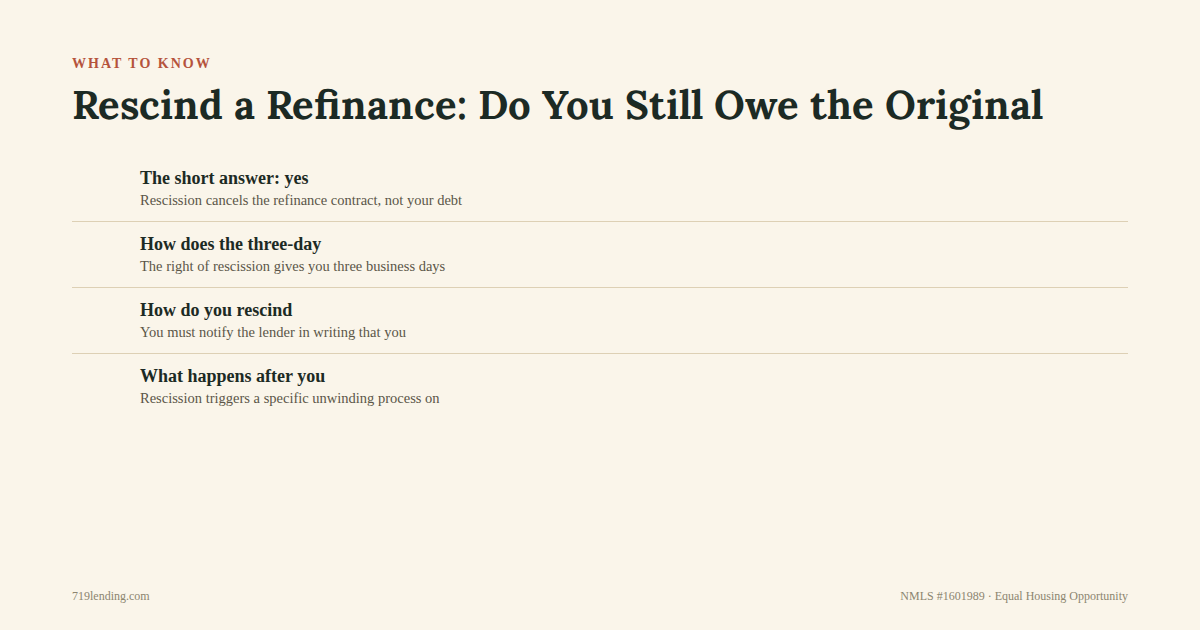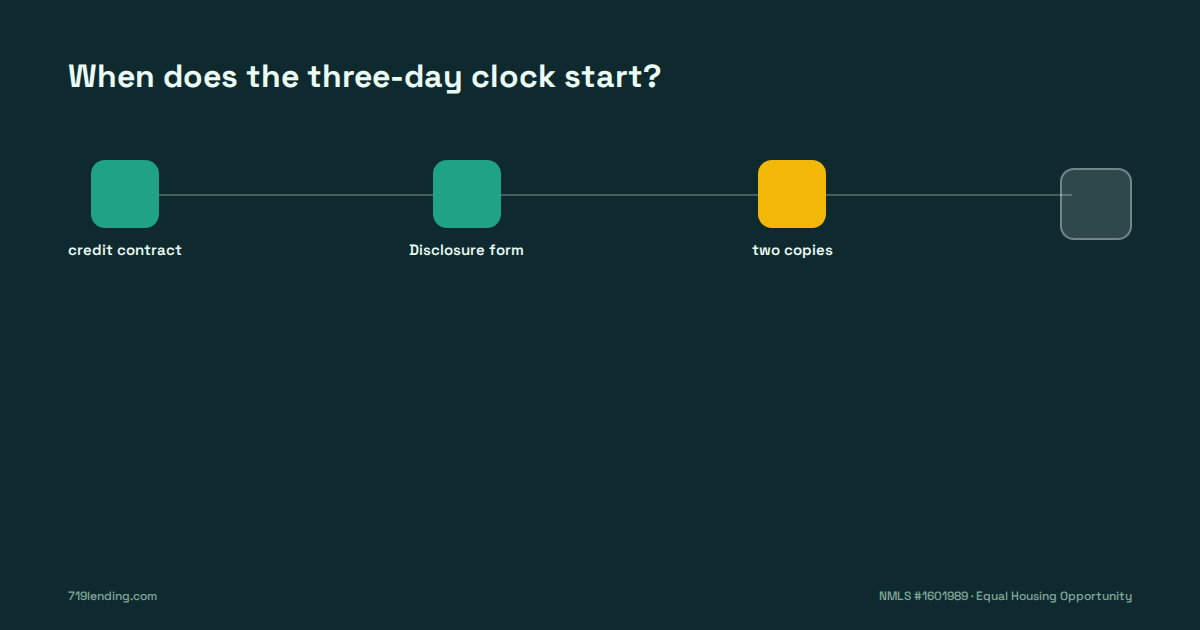
Canceling a refinance during the three-day right of rescission window unwinds the new loan, not your existing mortgage. Here is exactly what the rescission rules say, how the clock works, and what Colorado homeowners should do before and after they cancel.
Do You Need HELOC Lender Permission to Refinance?
Do I need permission from my HELOC lender to refinance my first mortgage? In many cases, yes — the Consumer Financial Protection Bureau (CFPB) says that once you take out a home equity line of credit, you may have to get approval from your HELOC lender before you can refinance your first mortgage, and the HELOC lender can refuse.
This article explains why that approval exists, what happens when the HELOC lender says no, and what Colorado homeowners — including military families around Colorado Springs — should do before starting a refinance with a home equity line of credit already on the house.
- A HELOC is a second mortgage, or junior lien, secured by your home.
- Refinancing the first mortgage may require the HELOC lender’s approval.
- The HELOC lender is allowed to refuse that approval.
- If it refuses, you may need to pay off the HELOC to complete the refinance.
- The safest move is to contact the HELOC lender early and ask about its process.
Do I need permission from my HELOC lender to refinance my first mortgage?

The direct answer from the CFPB: taking out a HELOC can affect your ability to refinance. You may need approval from the HELOC lender to refinance the first mortgage loan.
That surprises a lot of homeowners. The home equity line of credit feels like a separate account, so it seems like the first mortgage should be its own transaction.
It is not. Both loans are secured by the same house, so a change to the primary mortgage affects the position of the home equity line behind it.
That is why the HELOC lender gets a say — and why the next section on lien position matters.
Why a HELOC sits behind your first mortgage
A HELOC is a second mortgage, which the CFPB also calls a junior lien. It is a loan you take out using your house as collateral while you still have another loan secured by the same house.
Home equity loans and home equity lines of credit are the two common examples of second mortgages.
What “second” actually means
The term “second” describes payoff order. If you can no longer pay your mortgages and the home is sold to pay off the debts, the second mortgage is paid off after the first.
If there is not enough home equity to pay off both loans completely, the second mortgage lender may not get the full amount it is owed.
Because of that risk, the CFPB notes that second mortgage loans often carry higher interest rates than first mortgage loans.
Open-end versus closed-end second mortgages
Some second mortgages are open-end: you can continue to take cash out up to the maximum credit amount, and as you pay down the balance you can draw again up to the same limit. A home equity line of credit works this way.
Other second mortgages are closed-end: you receive the entire loan amount upfront as a lump sum and cannot redraw after that. A traditional home equity loan is the common example, and it usually has a fixed interest rate.
Either way, the lender in second position has a real stake in what happens to the loan ahead of it — which brings us to the approval itself.
What happens when you ask the HELOC lender for approval
When a homeowner refinances the first mortgage, the existing mortgage is paid off and replaced by a new loan. The HELOC stays on the property, so the HELOC lender may need to agree to the change.
There are essentially three outcomes.
The HELOC lender approves
The HELOC lender can agree to let the refinance proceed with the home equity line of credit remaining in place behind the new mortgage. Ask the HELOC lender directly what its process, paperwork, and timeline look like, because each lender — bank, credit union, or otherwise — handles this its own way.
The HELOC lender refuses
The CFPB is blunt on this point: HELOC lenders can refuse to allow you to refinance your first mortgage loan. The decision belongs to the HELOC lender, not to you and not to the lender handling the new loan.
You pay off the HELOC instead
If the HELOC lender refuses, the CFPB says you may need to pay off the HELOC in order to refinance. That can mean paying the loan balance from savings, or discussing with your loan officer whether the new loan can be structured to pay off the home equity line — for example, through a cash out refinance, if the amount of home equity and the guidelines of the new loan allow it.
Knowing these outcomes in advance shapes how you plan the whole transaction, which is where the official guidance comes in.
What the CFPB says and where to read it
The Consumer Financial Protection Bureau is the federal agency that implements and enforces federal consumer financial law. Its Ask CFPB library answers this exact question in plain language.
The relevant page is titled “Does a HELOC affect my ability to refinance my first mortgage loan?” on consumerfinance.gov. It confirms the three points above: approval may be required, the HELOC lender can refuse, and a refusal may mean paying off the HELOC.
The CFPB also publishes companion pages defining second mortgages and home equity loans, which are worth reading before you sign anything secured by your home.
With the rules clear, the practical question becomes what to do when the answer is no.
Your options if the HELOC lender says no
A refusal is frustrating, but it does not automatically end the refinance. Homeowners in this spot generally weigh a few paths with their loan officer.
Pay off the home equity line of credit
Paying off the HELOC removes the junior lien, so there is no second lender whose approval is needed. Ask the HELOC lender for an exact payoff figure and whether closing the credit line requires anything beyond paying the balance.
If the plan is to roll the HELOC payoff into the new mortgage, discuss it with the loan officer early. Whether the home equity supports it, and whether the loan guidelines permit it, are questions to confirm before you commit to anything.
Replace the HELOC after the refinance
Some homeowners pay off the existing HELOC, complete the refinance, and then apply for a new HELOC afterward. Whether a new home equity line makes sense depends on the interest rate environment, the terms available, and how you actually use the credit line — walk through it with a loan officer rather than assuming.
Reconsider the refinance itself
Sometimes the math changes once the HELOC is in the picture. Compare interest rates, closing costs, and monthly payments on the new loan against what you have now, including the HELOC’s monthly payments. A rate and term refinance that looked simple can look different when a second lien has to be paid off or approved.
For homeowners in this market, timing often intersects with military life — the next section covers that.
How this plays out for Colorado Springs and military homeowners
Colorado Springs is a heavily military market, and refinancing decisions here often revolve around PCS timing, BAH changes, and how long a family expects to keep the house.
If you took out a HELOC to handle a renovation or bridge a move, remember that the credit line follows the house, not your orders. Before you plan a refinance around a PCS window, contact the HELOC lender and ask how long its approval process takes so it does not collide with your report date.
The same advice applies across the Front Range. Home values along the Front Range have given many Colorado homeowners meaningful home equity, and HELOCs are a common way to tap it — which means this approval question comes up constantly in local refinance conversations. Our team walks through it as part of every loan options review.
Whoever holds the HELOC, the conversation goes better when you show up with the right questions.
Questions to ask your HELOC lender before you apply
Call the HELOC lender — your current lender for the credit line, whether it is a national bank or a local credit union — before you start the refinance application. Ask:
- Do you require approval before I refinance my first mortgage, and what is the process?
- What documents do you need, and who submits them — me or the new lender?
- How long does a decision usually take?
- Are there fees or conditions attached to the approval?
- If you decline, what is the exact payoff amount and procedure to close the credit line?
Getting these answers in writing early keeps the refinance timeline honest and prevents a last-minute surprise at closing.
It also helps to understand how a HELOC differs from its closed-end cousin, since the two are easy to confuse.
HELOC versus home equity loan: why the difference matters here
A home equity loan lets you borrow against home equity — the amount the property is currently worth minus any existing mortgage — and delivers the money as a lump sum, usually at a fixed interest rate. A fixed rate loan means the payment on that loan does not change because the interest rate does not change.
A home equity line of credit is open-end: a revolving credit line you can draw on, repay, and draw on again up to the credit limit.
Both are second mortgages secured by your home, so both raise the same lien-position question in a refinance. And both carry the same core risk the CFPB highlights: if you cannot repay a home equity loan or home equity line of credit, you could lose your home, because the home equity is the collateral.
The CFPB adds one more caution worth repeating: be careful using home equity for debt consolidation. Paying off high interest debt with a home equity loan does not really pay it off — you are taking out one loan to repay another, with your house now on the line, and trading short-term debt for long-term debt can increase total interest payments over the life of the borrowing.
With the mechanics clear, here is how to move forward.
Next steps
Start by pulling your most recent HELOC statement and the statement for the existing mortgage, so you know the current mortgage balance and the HELOC balance.
Then call the HELOC lender and ask the questions above. Its answer — approve, refuse, or pay off — determines how the refinance gets structured.
Finally, talk to a local loan officer. The team at 719 Lending in Colorado Springs handles refinances with second liens regularly and can map the sequence with you, from the approval request to the monthly payments on the new loan. Reach out to 719 Lending to talk through your situation before you apply anywhere.
Frequently asked questions
Can my HELOC lender stop me from refinancing my first mortgage?
Yes. According to the Consumer Financial Protection Bureau, HELOC lenders can refuse to allow you to refinance your first mortgage loan. If the HELOC lender refuses, you may need to pay off the HELOC in order to complete the refinance.
Do I have to pay off my HELOC to refinance?
Not always. If the HELOC lender approves the refinance, the home equity line of credit can remain in place. But if the HELOC lender refuses approval, the CFPB says you may need to pay off the HELOC to refinance the first mortgage.
Is a HELOC considered a second mortgage?
Yes. The CFPB defines a second mortgage, or junior lien, as a loan secured by your house while another loan is also secured by it. Home equity loans and home equity lines of credit are the common examples, and they are paid off after the first mortgage if the home is sold to cover the debts.
What is the difference between a HELOC and a home equity loan?
A home equity loan delivers the money as a lump sum and usually has a fixed interest rate. A HELOC is open-end: you can draw up to the credit limit, pay the balance down, and draw again. Both are second mortgages secured by your home.
Who should I contact first before refinancing with a HELOC on my home?
Contact the HELOC lender first and ask whether it requires approval, what documents it needs, how long a decision takes, and what the payoff process is if it declines. Then bring those answers to your loan officer so the refinance timeline accounts for them.
What is the risk of borrowing against home equity?
The CFPB warns that if you cannot repay a home equity loan or home equity line of credit, you could potentially lose your home, because the equity in your home is the collateral. Adding a second mortgage also adds to your overall debt burden.
719 Lending Inc., NMLS #1601989 · Equal Housing Opportunity
719 Lending Inc. is not affiliated with or endorsed by HUD, FHA, VA, USDA, CHFA, the CFPB, or any government agency.
Last updated: September 2026

Related Posts