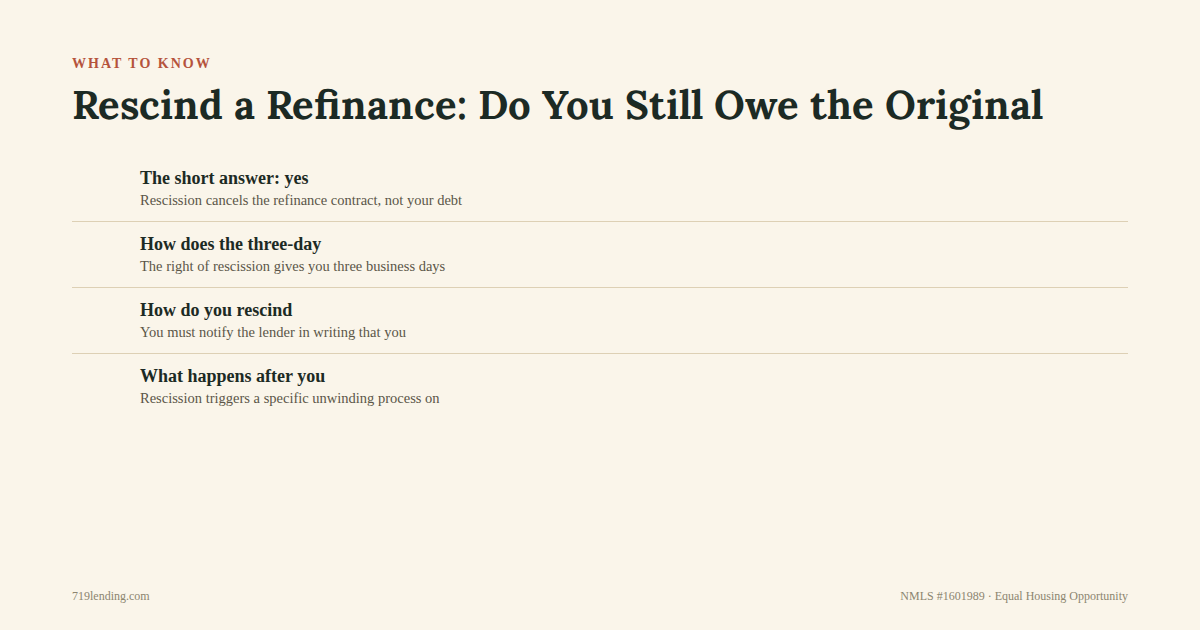
Canceling a refinance during the three-day right of rescission window unwinds the new loan, not your existing mortgage. Here is exactly what the rescission rules say, how the clock works, and what Colorado homeowners should do before and after they cancel.
Do I Have to Pay PMI Again If I Refinance My Mortgage?
Do I have to pay PMI again if I refinance my mortgage? The answer depends entirely on how much home equity you have on the day the new loan closes — not on whether you paid private mortgage insurance before. This guide explains how lenders make that call, when a refinance removes PMI, when it adds PMI back, and what Colorado borrowers should check before applying.
Here is the short version before we dig in:
- PMI applies to a conventional loan refinance when your equity is below the level the lender requires, according to the Consumer Financial Protection Bureau.
- If the refinance appraisal shows enough equity, the new conventional loan does not carry PMI at all.
- After a refinance, the “original value” used for future PMI cancellation resets to the appraised value at the time you refinanced.
- Mortgage insurance on FHA loans and VA loans follows different rules than conventional PMI.
Do you have to pay PMI again when you refinance?
A refinance replaces your existing home loan with a brand-new loan. The new lender evaluates that new loan on its own terms, including whether mortgage insurance is required.
Per the CFPB, the requirement to buy private mortgage insurance usually also applies to refinancing a conventional loan when your equity is less than the share of the home’s value that lenders require. Equity is the gap between what the home is worth and what you owe.
So the question is not “did I pay PMI before?” It is “what does my loan-to-value look like right now?” That single ratio drives the outcome, which is why the appraisal matters so much.
How lenders decide whether the new loan needs mortgage insurance

When you apply for a mortgage refinance, the lender typically orders a home appraisal to establish the property’s current market value. The lender then compares the new loan amount against that appraised value.
If the loan amount sits at or below the lender’s equity threshold, the conventional loan closes without private mortgage insurance. If the loan amount is above it, PMI is part of the deal, and the premium appears in the Projected Payments section of your Loan Estimate and Closing Disclosure.
What the appraisal changes
Your equity position can look very different today than it did at purchase. You have been paying down the mortgage balance, and the home’s market value may have moved.
Many homeowners in Colorado Springs who bought with a smaller down payment discover that the combination of principal paydown and market appreciation means the refinance appraisal shows enough equity to skip PMI entirely. Others find the opposite. The appraisal, not memory, settles it — which leads to the next question: can you refinance specifically to get rid of PMI?
Can you refinance to get rid of PMI?
Yes, refinancing to get rid of PMI is a common strategy. If the new appraised value shows your equity has crossed the lender’s threshold, the new conventional mortgage carries no PMI, and that line item disappears from the monthly mortgage payment.
But a refinance is not free. Closing costs apply to the new loan, and the interest rate on the new loan may be higher or lower than what you have now depending on the market. Whether the refinance actually helps you save money depends on the whole picture, not the PMI line alone.
Compare it against simply cancelling PMI
Before refinancing to remove PMI, check whether you can cancel PMI on the loan you already have. Federal law gives you cancellation rights on many conventional loans — covered in detail below — and cancellation does not require replacing the loan.
A refinance makes more sense when you also want something else from the new loan: a different loan term, a different rate structure, or cash out. If PMI removal is the only goal, run both paths side by side with a loan officer before committing.
When a refinance can add PMI back
The flip side is real: a refinance can put PMI back on a loan that no longer had it. That happens when the new loan pushes the loan-to-value above the lender’s threshold.
Cash-out refinances
A cash-out refinance increases the loan amount by converting home equity into cash at closing. Take out enough, and the new balance can climb past the point where the lender requires mortgage insurance again.
A soft appraisal
If the home appraises lower than expected, your equity share shrinks on paper even though nothing about the mortgage balance changed. That alone can trigger PMI on the new conventional loan.
Neither outcome is automatic — it comes down to the math on closing day. Here is how the common scenarios shake out.
PMI outcomes by refinance scenario
| Scenario at refinance | Likely PMI outcome on the new conventional loan |
|---|---|
| Equity at or above the lender’s threshold, standard rate-and-term refinance | No PMI required |
| Equity below the threshold (small original down payment, little paydown, or flat values) | PMI required, even if you paid it before |
| Cash-out refinance that raises the balance above the threshold | PMI required on the new loan |
| Currently paying PMI, but new appraisal shows equity above the threshold | New loan closes without PMI |
If PMI does apply to the new loan, you have choices in how you pay it — and they are worth comparing.
How you pay PMI on a new loan
The CFPB outlines three payment structures lenders may offer for private mortgage insurance.
Monthly premium
The most common way borrowers pay is a monthly premium added to the monthly mortgage payment. It appears on page one of the Loan Estimate and Closing Disclosure in the Projected Payments section.
Upfront premium
Sometimes borrowers pay a one-time upfront premium as a lump sum at closing, shown in section B on page two of those disclosures. One caution from the CFPB: if you pay upfront and then move or refinance again, you might not be entitled to a refund of that premium.
Both upfront and monthly
Some structures combine an upfront portion with a smaller monthly premium. Ask the lender to price the options over a few realistic timeframes so you can compare total PMI cost against how long you plan to keep the loan.
Whichever structure applies, remember what the product actually does — and does not do — for you.
What PMI protects, and what it doesn’t
Private mortgage insurance protects the lender, not you, if you stop making mortgage payments. Mortgage insurance protects the lender against loss from default; it does not protect your home. If you fall behind on payments, PMI does not stop foreclosure.
PMI is not homeowners insurance either. Homeowners insurance covers the property itself; PMI insures the lender against borrower default. Both can appear in the monthly payment, but they do entirely different jobs.
What PMI does offer is access: it can help you qualify for a home loan you might not otherwise get with a smaller down payment. That trade-off is exactly why the cancellation rules below exist.
How to remove PMI without refinancing
Federal law gives borrowers on many conventional loans the right to remove PMI once the mortgage is paid down to a specified point. These rules apply to mortgages on single-family principal residences.
Request PMI cancellation
You can request cancellation in writing on the date the principal balance is scheduled to fall to the threshold defined in federal law, measured against the home’s original value. The first eligible date appears on the PMI disclosure form you received at closing.
You can also request cancellation early if extra payments have already brought the balance down to that level. The servicer must grant the request if you have a good payment history, are current on payments, certify there is no second mortgage or other junior lien, and can show — for example, with an appraisal — that the property value hasn’t declined below the original value.
Automatic termination
Even if you never ask, the servicer must automatically terminate PMI on the date the balance is scheduled to reach a slightly lower level set by federal law, as long as you are current. Missed payments delay termination until the account is brought up to date.
The midpoint rule
The servicer must also end PMI the month after you reach the midpoint of the loan’s original amortization schedule, even if the balance hasn’t reached the automatic-termination level. Loan investors such as Fannie Mae and Freddie Mac may set their own PMI cancellation guidelines, but those cannot be less favorable to you than the federal ones.
One wrinkle matters specifically for people who have refinanced: what “original value” means afterward.
How refinancing resets your PMI cancellation clock
For cancellation purposes, “original value” generally means the contract sales price or the appraised value at purchase, whichever is lower. But if you have refinanced, the original value becomes the appraised value at the time you refinanced.
That reset cuts both ways. If Colorado Springs values rose before your refinance, the new baseline is higher, which can move your future cancel-PMI date. Track the new loan’s PMI disclosure form so you know the schedule that actually applies.
What about FHA and VA loans?
Everything above describes private mortgage insurance on conventional loans. Mortgages through the Federal Housing Administration (FHA) or the Department of Veterans Affairs (VA) have different mortgage insurance requirements, and the CFPB directs borrowers with questions about insurance on those loans to their servicer.
For the many military families around Fort Carson, Peterson, and Schriever, that distinction matters when comparing VA loans against a conventional mortgage at refinance time — the mortgage insurance math is simply governed by different rules, so compare the specific loans in front of you rather than assuming.
Your next step
Before you refinance, do three things. Pull your current balance from the servicer, get a realistic read on your home’s value, and dig out the PMI disclosure form to see when cancellation is scheduled anyway.
Then compare the paths: request PMI cancellation on the existing loan, or refinance into a new one. A quick conversation with a Colorado Springs loan officer can run both scenarios against a current appraisal estimate so you can see exactly where the equity math lands before you spend anything on closing costs.
Frequently asked questions
Does PMI automatically come back when you refinance?
No. PMI applies to a refinanced conventional loan only if your equity is below the lender’s required level at the time you refinance, per the CFPB. If the appraisal shows enough equity, the new loan has no PMI.
Can I refinance to get rid of PMI?
Yes. If the appraisal for the new loan shows your equity has crossed the lender’s threshold, the new conventional loan closes without PMI. Compare that against simply requesting PMI cancellation on your current loan, which federal law allows once the balance reaches the scheduled point.
Can a cash-out refinance trigger PMI?
It can. A cash-out refinance raises the loan amount, and if the new balance pushes the loan-to-value above the lender’s threshold, private mortgage insurance is required on the new loan even if you weren’t paying it before.
What counts as my home’s original value after a refinance?
Once you refinance, the “original value” used for PMI cancellation becomes the appraised value at the time of the refinance — not the price you originally paid. Your new PMI disclosure form shows the cancellation schedule based on that value.
Do FHA and VA loans follow the same PMI rules on a refinance?
No. Mortgage insurance on FHA and VA loans follows different requirements than conventional PMI. The CFPB directs borrowers with FHA or VA mortgage insurance questions to their loan servicer.
Can I remove PMI without refinancing at all?
Often, yes. On many conventional loans you can request PMI cancellation in writing once the balance reaches the point set by federal law, if you’re current with a good payment history, have no second mortgage, and the home’s value hasn’t declined. Servicers must also automatically terminate PMI at a scheduled point or at the loan’s midpoint.
719 Lending Inc., NMLS #1601989 · Equal Housing Opportunity
719 Lending Inc. is not affiliated with or endorsed by HUD, FHA, VA, USDA, CHFA, the CFPB, or any government agency.
Last updated: August 2026

Related Posts