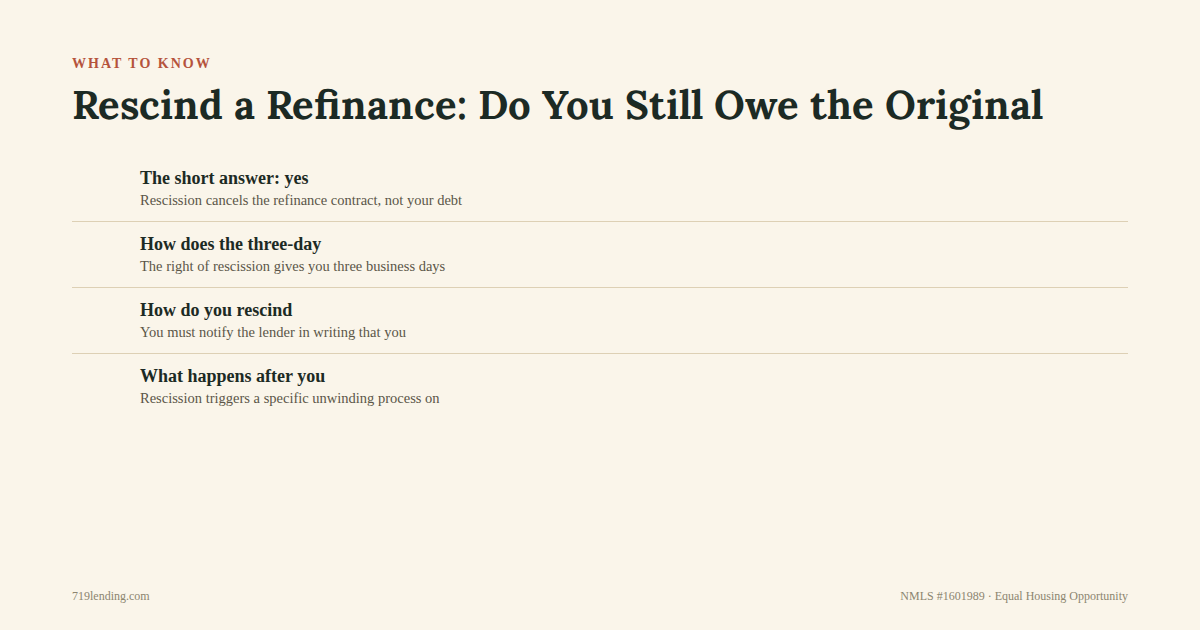
Canceling a refinance during the three-day right of rescission window unwinds the new loan, not your existing mortgage. Here is exactly what the rescission rules say, how the clock works, and what Colorado homeowners should do before and after they cancel.
How Long to Cancel a Non-Purchase Money Mortgage?
If you are asking how long you have to cancel a non-purchase money mortgage after signing, the answer under federal law is three business days for most of these loans. This guide explains the right of rescission, which loans it covers, when the three-day clock actually starts, and exactly how to cancel a loan contract the right way.
It is written for Colorado borrowers who just signed closing documents on a refinance loan or home equity loan and are having second thoughts, or who simply want to understand the cooling off period before they sign.
How long do I have to cancel a non-purchase money mortgage after signing?
You have three business days to cancel, and this right is called the right of rescission. The Consumer Financial Protection Bureau (CFPB) confirms that for most non-purchase money mortgages, you may change your mind after you sign the loan closing documents.
A non-purchase money mortgage is any mortgage loan that is not used to buy the home. Refinances and home equity loans are the classic examples.
For this rule, business days include Saturdays, but not Sundays or legal public holidays. That counting detail trips up more borrowers than anything else, so the next section lays out the key deadlines side by side.
Key deadlines at a glance
| Event | Timing |
|---|---|
| Closing Disclosure delivered before closing | At least three business days before closing |
| Right to cancel (right of rescission) | Three business days after the last trigger event |
| Deadline to deliver or mail written notice | Before midnight of the third business day |
| Lender returns money or property you paid | Within 20 calendar days of receiving your notice |
| Extended right to cancel for disclosure errors | Up to three years in certain cases |
With the timeline in view, it helps to understand what the right of rescission actually is and why the loan documents you signed include a notice about it.
What is the right of rescission?
The right of rescission is a federal right, described by the CFPB under Truth in Lending rules, that lets you cancel certain mortgage transactions after you have signed. It works like a built-in cooling off period on the loan contract.
During the three day window, you can cancel for any reason or for no reason at all. You do not need to prove the lender did anything wrong, and you do not need the lender’s permission.
Why the notice matters
At closing on a covered loan, you should receive two copies of a notice explaining your right to rescind. That notice is not boilerplate; receiving it is one of the events that starts the rescission period, as covered below.
Next, let’s pin down which mortgage loans carry this right to cancel and which do not.
Which loans come with a right to cancel?
Non-purchase money mortgages
The right of rescission applies to most non-purchase money mortgages. Again, that means mortgages not used to buy the home, and the CFPB names refinances and home equity loans as examples.
So if you refinanced an existing mortgage on your home, whether with the same lender or a different lender, or took out a second mortgage against your equity, the cooling off rule generally applies to that credit transaction.
Loans that generally do not carry rescission
By definition, a mortgage used to buy the home is a purchase money mortgage, so the right described here does not attach to purchase transactions the same way. If you just signed a purchase contract and closed on a home purchase, do not assume you have a three-day escape hatch on the mortgage.
If your situation is unusual, for example the property is not the home you live in, ask your loan officer or a real estate attorney whether the rule applies before you rely on it. Now to the question that decides most disputes: when does the clock actually start?
When does the three-day clock start?
The three trigger events

The three-day rescission period does not start until all three of the following have happened:
- You sign the credit contract, usually the promissory note.
- You receive the appropriate and accurate Truth in Lending disclosure. For most loans applied for on or after October 3, 2015, this is the Closing Disclosure form.
- You receive two copies of the notice explaining your right to rescind.
All three must occur. If any one is missing, the clock has not started, which is exactly how the extended cancellation right discussed later can arise.
How business days are counted
For rescission purposes, a business day includes Saturdays but not Sundays and not legal public holidays. So if you sign a refinance loan on a Friday and receive all required disclosures that day, Saturday counts toward the three days, Sunday does not, and federal holidays do not.
Because the counting rules are specific, mark the deadline on a calendar the day you sign your closing documents. Once you know the deadline, the next question is how to cancel correctly.
How do I actually cancel the loan?
Written notice is required
To rescind a non-purchase money mortgage, you must notify the lender in writing that you are cancelling the loan contract and exercising your right to rescind. You cannot rescind just by calling or visiting the lender or the mortgage company.
You may use the cancellation form the lender provided with your closing documents, or you may write a letter. Either way, provide written notice, and keep a copy for yourself.
The midnight deadline
Whatever form of written notice you use, make sure it is delivered or mailed before midnight of the third business day after your closing. The CFPB’s guidance treats mailing by that deadline as sufficient, so do not panic if the lender will not physically receive it until later.
Once your notice is on its way, the process shifts to what the lender owes you back.
What happens after you rescind?
Your money comes back within 20 calendar days
Within 20 calendar days after the lender receives your notice of rescission, all money or property you paid as part of the mortgage transaction must be returned to you. That is calendar days, not business days.
Your original loan does not go away
This is the part borrowers miss. Rescinding a new loan does not erase your obligation to make payments on your other loans. If you refinance and then rescind the refinance loan, you still owe the original mortgage loan and its monthly payment on the original terms.
Cancelling puts you back where you started, not ahead. There is also one scenario where the window is far longer than three days.
When can the right to cancel stretch to three years?
In some cases you may have the right to cancel the loan for up to three years. The CFPB says this can apply if the lender does not give you the Truth in Lending disclosure, which in most cases is the Closing Disclosure, or does not give you two copies of the notice of the right to cancel, or makes certain important mistakes on the Truth in Lending disclosure.
This extended rescission right is a legal remedy, not a routine option. If you think missing or defective loan documents may apply to your situation, the CFPB’s advice is direct: consult a lawyer right away.
Because so much rides on the disclosures, it is worth knowing where the official guidance lives.
What the official source says and where to read it
Everything above comes from the Consumer Financial Protection Bureau’s Ask CFPB guidance on the right of rescission for second mortgages and refinances, last reviewed in August 2024. The CFPB is the federal agency that implements and enforces federal consumer financial law for mortgage transactions.
The CFPB also recommends reviewing the Closing Disclosure, promissory note, mortgage, initial escrow disclosure, and the notice of right to cancel before closing on a refinance. The lender is required to send the Closing Disclosure at least three business days before closing, which gives you time to review the loan terms before you sign.
If you have a problem with the mortgage closing process, discuss it with the lender first. You can also submit a complaint to the CFPB online or by calling (855) 411-CFPB (2372), and the bureau will forward your complaint to the company and work to get you a response.
Now, a few notes for how this plays out for borrowers here in Colorado.
What this means for Colorado Springs borrowers
Colorado Springs is a heavily military market, and refinance decisions here often collide with PCS timelines. If you signed refinance closing documents and new orders change your plans, the three-day rescission window is one of the few clean exits, but only if you act in writing before midnight of the third business day.
Service members and veterans comparing options, including a VA loan refinance, should also remember the rescission right cancels the new loan only. The existing mortgage and its payment schedule remain fully in force.
If you are still deciding whether to sign at all, use the review window before closing. Comparing the Closing Disclosure against the Loan Estimate before you sign beats unwinding a signed loan afterward.
Your next step
If you are inside the three day window and want out: write the notice now, use the lender’s form or a letter, deliver or mail it before midnight of the third business day, and keep a copy. Then confirm the lender returns your money within 20 calendar days.
If you have not signed yet and want a second look at a refinance or home equity option before closing, the team at 719 Lending in Colorado Springs can walk through the closing documents and the rescission notice with you. Reach out to a loan officer before your closing date so you sign with confidence instead of relying on the escape hatch.
Frequently asked questions
Can I cancel a refinance after signing the closing documents?
Yes. A refinance is a non-purchase money mortgage, so you generally have a right of rescission: three business days to cancel after you sign the loan contract, receive an accurate Truth in Lending disclosure (usually the Closing Disclosure), and receive two copies of the notice explaining your right to cancel.
Do Saturdays count in the three-day right of rescission?
Yes. For the right of rescission, business days include Saturdays but not Sundays or legal public holidays. Your written notice must be delivered or mailed before midnight of the third business day after closing.
Can I cancel a mortgage used to buy a home?
The right of rescission covers most non-purchase money mortgages, meaning loans not used to buy the home, such as refinances and home equity loans. A mortgage used to purchase the home is not a non-purchase money mortgage, so do not assume a three-day cancellation right on a home purchase loan.
How do I notify the lender that I’m cancelling my loan?
You must notify the lender in writing, using the form the lender provided or your own letter. Calling or visiting the lender is not enough. Deliver or mail the written notice before midnight of the third business day and keep a copy for your records.
How long does the lender have to return my money after I rescind?
Within 20 calendar days after the lender receives your notice of rescission, all money or property you paid as part of the mortgage transaction must be returned to you.
Can I still cancel my loan after three days have passed?
Possibly. If the lender never gave you the Truth in Lending disclosure or two copies of the notice of the right to cancel, or made certain important mistakes on the disclosure, you may have the right to cancel for up to three years. The CFPB advises consulting a lawyer right away if you think this applies.
719 Lending Inc., NMLS #1601989 · Equal Housing Opportunity
719 Lending Inc. is not affiliated with or endorsed by HUD, FHA, VA, USDA, CHFA, the CFPB, or any government agency.
Last updated: September 2026

Related Posts