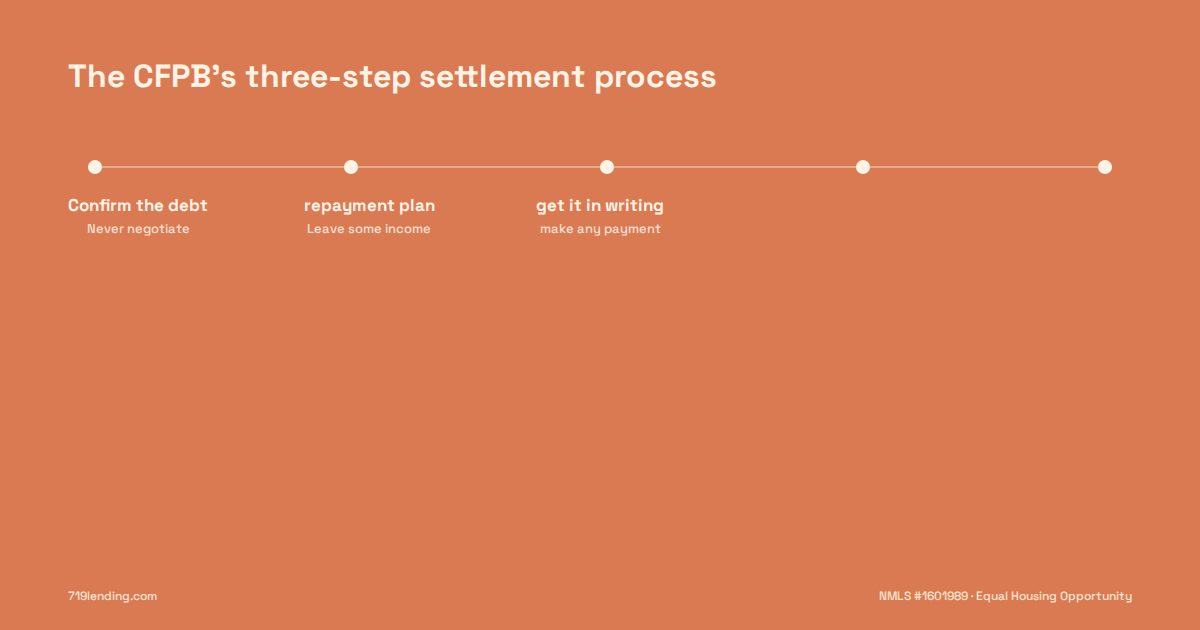
The Consumer Financial Protection Bureau says you may have more room to negotiate with a debt collector than you did with the original creditor. Here is why that is, how the three-step settlement process works, and what Colorado borrowers — especially military families — should do before making a single payment.
CFPB loan estimate explained: how to read all three pages
If you searched for “CFPB loan estimate,” you are probably holding a three-page form from a lender and wondering what it means — or wondering why you have not received one yet. This guide explains what the Loan Estimate is, when the lender must send it, and how to read every section, written for Colorado borrowers comparing mortgage loan offers.
Here are the essentials before we go page by page:
- The Loan Estimate is a standardized form created by the Consumer Financial Protection Bureau (CFPB).
- The lender must provide it within three business days of receiving your mortgage application.
- It shows the estimated interest rate, monthly payment, total closing costs, and the loan terms.
- Receiving a Loan Estimate does not mean the loan is approved or denied — it shows the terms the lender expects to offer if you move forward.
- All lenders must use the same form, which makes it easier to compare loan offers side by side.
What is a CFPB loan estimate?
A Loan Estimate is a three-page form you receive after applying for a mortgage. It tells you the important details about the mortgage loan you have requested: the loan amount, the estimated interest rate, the projected monthly payment, and total closing costs.
The Loan Estimate also covers the estimated costs of taxes and insurance, and how the interest rate and payments may change in the future. It flags special features you should know about, like a prepayment penalty or negative amortization, where the loan balance can increase even when payments are made on time.
The Consumer Financial Protection Bureau requires every lender to use the same standard form in clear language. That standardization is the whole point — it lets you line up different loan estimates and compare them item by item.
Next, let’s cover the timing rules, because they trip up a lot of borrowers.
When does the lender have to send the loan estimate?
The lender must provide a Loan Estimate within three business days of receiving your application. That deadline is set by federal rule, not by individual lender policy.
One exception: the lender is not required to provide a Loan Estimate if it denies the application before the end of the third business day after receiving it.
Does a loan estimate mean the loan is approved?
No. When you receive a Loan Estimate, the lender has not yet approved or denied the application. The form shows the loan terms the lender expects to offer if you decide to move forward.
If you do move forward, the lender will ask for additional financial information before loan approval. The Loan Estimate is the starting line of the mortgage process, not the finish.
What if you never received a loan estimate?
Contact the lender and ask whether the Loan Estimate has been sent and when. If the lender refuses to send one, consider working with another lender.
You can also submit a complaint to the CFPB online or by calling (855) 411-CFPB (2372). The CFPB forwards the complaint to the lender and works to get a response.
Now let’s walk the form itself, starting with page one.
Page one: loan terms and projected payments
Page one of the Loan Estimate is where you confirm the basics match what you discussed with the loan officer. Small errors here cause big problems later.
Check the identifying details first
Check the spelling of your name and the property address, and ask the lender to correct any inaccurate contact information. Then check the loan term, purpose, product, and loan type against what you discussed.
Confirm the loan amount is what you expected. On a purchase, the loan amount plus the down payment should equal the sale price of the home — if it doesn’t, ask the lender why. If the loan amount shifts between disclosures, there are specific reasons that happens; we break them down in our guide to why a loan amount might increase from the Loan Estimate.
Rate lock and interest rate type
The top of the form indicates whether the rate is locked. Some lenders lock the rate as part of issuing the Loan Estimate, and some do not, so confirm the rate lock status with the loan officer.
The form also shows whether the interest rate can change after closing. If the adjustable column says “YES,” the Loan Estimate includes additional information in the Projected Payments table on page one and in two extra tables at the bottom of page two.
Projected payments: principal, interest, and escrow
Monthly principal and interest are the core of the payment: principal is the amount you borrow, and interest is the lender’s charge for lending the money. The total monthly payment is typically higher because of taxes and insurance.
The Estimated Total Monthly Payment includes mortgage insurance and escrow, if applicable. Charges like property taxes and homeowners insurance can be bundled into the monthly payment and paid from an escrow account.
Look closely at Estimated Taxes, Insurance & Assessments. If any items there are not escrowed, you will pay those costs directly, often in large lump sums — make sure you know how often those payments come due.
Page one ends with costs at closing, which page two then itemizes in full.
Page two: closing costs, line by line
Closing costs — sometimes called settlement costs — are the upfront costs charged to get the loan and transfer ownership of the property. Page two splits loan costs and other costs into sections, and each section deserves a different kind of scrutiny.
Origination charges
Origination charges are upfront fees charged by the lender, and they vary from one lender to another. Common examples include application fees, origination fees, underwriting fees, processing fees, verification fees, and rate-lock fees.
Lenders itemize these differently, so don’t compare line by line — it’s the total that matters. Comparing this section across different loan estimates is how you tell whether an offer is competitive.
Services you cannot shop for
These are third-party services the lender requires and chooses, sometimes called closing services or settlement services. Because you can’t shop these separately, compare the overall total in this section against loan estimates from other lenders.
Some fees here depend on the loan product. On an FHA, VA, or USDA loan, the upfront mortgage insurance premium or funding fee appears in this section, and those fees are usually set by the government program rather than the lender. On a conventional loan with private mortgage insurance, any upfront premium typically appears here too, set by the mortgage insurance company the lender usually chooses.
Services you can shop for
The lender requires these services too, but you can shop for them separately. Along with the Loan Estimate, the lender should give you a list of approved providers for each service.
You can pick a provider from the list or look for others — just check with the lender about any provider not on the list.
Other costs: taxes, insurance, and prepaids
Other costs cover the real estate transaction itself and the costs of owning the home, including government fees, prepaid interest, and the initial escrow payment at closing.
The homeowner’s insurance premium is set by the insurance company, not the lender, and you choose the company — shop around and confirm the lender’s estimate fits your situation. Property taxes are set by the local or state government; check with the tax authority or your real estate agent to confirm the estimate is accurate for your area, whether that’s El Paso County or elsewhere in Colorado.
Points and lender credits
Points are an upfront fee paid to the lender in exchange for a lower interest rate than you would otherwise pay. If an amount appears on that line, ask whether a similar loan is available without points and how that changes the total cost of the loan.
Lender credits work in the other direction: a rebate from the lender that offsets closing costs, possibly in exchange for a higher interest rate. Ask the lender what other loan options exist and how each affects the interest rate and total cost.
Estimated cash to close
Estimated Cash to Close is the money you bring to closing, in addition to anything already paid. It includes the down payment and closing costs, minus any deposit paid to the seller, seller credits, and other adjustments.
This payment is usually made by cashier’s check or wire transfer, and the lender will need to document the source of the funds. If the estimated cash to close isn’t what you expected, ask the lender to explain the calculation.
Page three is where the comparison tools live.
Page three: comparisons, APR, and the loan officer
Page three of the Loan Estimate helps you compare offers and verify who you’re working with.
Verify the loan officer
Check that the loan officer you’ve been working with is the one listed. Most loan officers must be licensed or registered with the Nationwide Mortgage Licensing System & Registry (NMLS), and you can look them up by name or NMLS ID to see whether they’re authorized in Colorado and whether there are disciplinary actions on record.
Use the comparisons section
The Comparisons section includes the loan’s APR — the annual percentage rate, one measure of the loan’s cost that differs from the interest rate — and the Total Interest Percentage (TIP), which shows how much total interest you’d pay over the life of the loan.
Because loan costs vary across lenders and across loan products, request loan estimates for the same kind of loan from multiple lenders so the comparison is apples to apples.
Other considerations
Page three also discloses the appraisal, which the lender uses to decide the property value — it’s conducted by an independent professional appraiser, and you have a right to a copy. It notes whether the loan allows assumption, meaning a buyer could take over the loan on the same terms if you sell, and it shows the fee for a late payment.
Before comparing offers, scan the form for the risky features the CFPB specifically flags.
Red flags to look for on a loan estimate

A prepayment penalty means the lender can charge a fee if you pay off the mortgage early. The CFPB labels this feature risky — if it appears, ask the lender about other options.
A balloon payment means the final mortgage payment is a lump sum much larger than the regular monthly payments. This is also flagged as risky, and worth a direct conversation with the loan officer.
Negative amortization — the loan balance increasing even when payments are made on time — appears in the loan product description if the loan has that feature.
If the form is clean, the next step is using it the way it was designed: to compare lenders.
How to compare loan estimates from different lenders
Request multiple loan estimates from different lenders for the same loan amount, loan type, and down payment amount. Because every lender uses the identical form, the sections line up.
Compare origination charges as a total, compare the services you cannot shop for as a total, and use the APR and Total Interest Percentage on page three to compare overall cost. Then shop the services you can shop for.
For military families around Fort Carson, Peterson, and Schriever, this matters during a PCS move: collecting loan estimates from multiple lenders is how you pressure-test an offer even on a compressed timeline. A mortgage broker like 719 Lending can also gather options for comparison.
Keep every Loan Estimate you receive — you’ll want them when the Closing Disclosure arrives.
Loan estimate vs. closing disclosure
The Loan Estimate opens the mortgage process; the Closing Disclosure is the companion form you receive later, before closing, with the final figures. Comparing the Loan Estimate against the Closing Disclosure is how you catch changes before signing.
If the Closing Disclosure shows different closing costs or a different loan amount than the Loan Estimate, ask the lender to explain the change.
Not every loan gets this disclosure pair, which is worth knowing before you shop.
Which loans don’t come with a loan estimate?
You will not receive a Loan Estimate or Closing Disclosure if you are shopping for a reverse mortgage, a home equity line of credit (HELOC), a manufactured or mobile home loan not secured by real estate, or a subordinate loan through certain homebuyer assistance programs.
For those loans you should receive Truth-in-Lending disclosures instead.
Your next step
Pull out the Loan Estimate and check it in this order: name and property address, loan terms and loan amount, projected payments, total closing costs, estimated cash to close, and the risky-feature boxes. If anything looks different from what you discussed, ask why.
Then get at least one more Loan Estimate for the same loan so you have a real comparison. If you’d like a second set of eyes on a Loan Estimate — or a competing one to compare it against — the team at 719 Lending in Colorado Springs can walk through the form with you line by line.
Frequently asked questions
What is a CFPB Loan Estimate?
A Loan Estimate is a standardized three-page form from the Consumer Financial Protection Bureau that lenders must provide after you apply for a mortgage. It shows the estimated interest rate, monthly payment, total closing costs, loan terms, and any risky features like a prepayment penalty or balloon payment.
How soon must a lender send the Loan Estimate?
The lender must provide the Loan Estimate within three business days of receiving your mortgage application. The only exception is if the lender denies the application before the end of that third business day.
Does receiving a Loan Estimate mean my loan is approved?
No. The Loan Estimate shows the loan terms the lender expects to offer if you decide to move forward. The lender has not yet approved or denied the application and will ask for additional financial information before loan approval.
What should I do if I never received a Loan Estimate?
Contact the lender and ask whether it was sent and when. If the lender refuses to send one, consider working with another lender. You can also submit a complaint to the CFPB online or by calling (855) 411-CFPB (2372).
How do I compare Loan Estimates from different lenders?
Request loan estimates for the same kind of loan from multiple lenders. Compare the total origination charges, the total of services you cannot shop for, and the APR and Total Interest Percentage on page three. Because all lenders use the same form, the sections line up directly.
Which loans don’t come with a Loan Estimate?
You won’t receive a Loan Estimate or Closing Disclosure for a reverse mortgage, a HELOC, a manufactured or mobile home loan not secured by real estate, or a subordinate loan through certain homebuyer assistance programs. Those loans use Truth-in-Lending disclosures instead, and reverse mortgages also use a Good Faith Estimate and HUD-1 Settlement Statement.
719 Lending Inc., NMLS #1601989 · Equal Housing Opportunity
719 Lending Inc. is not affiliated with or endorsed by HUD, FHA, VA, USDA, CHFA, the CFPB, or any government agency.
Last updated: October 2026

Related Posts