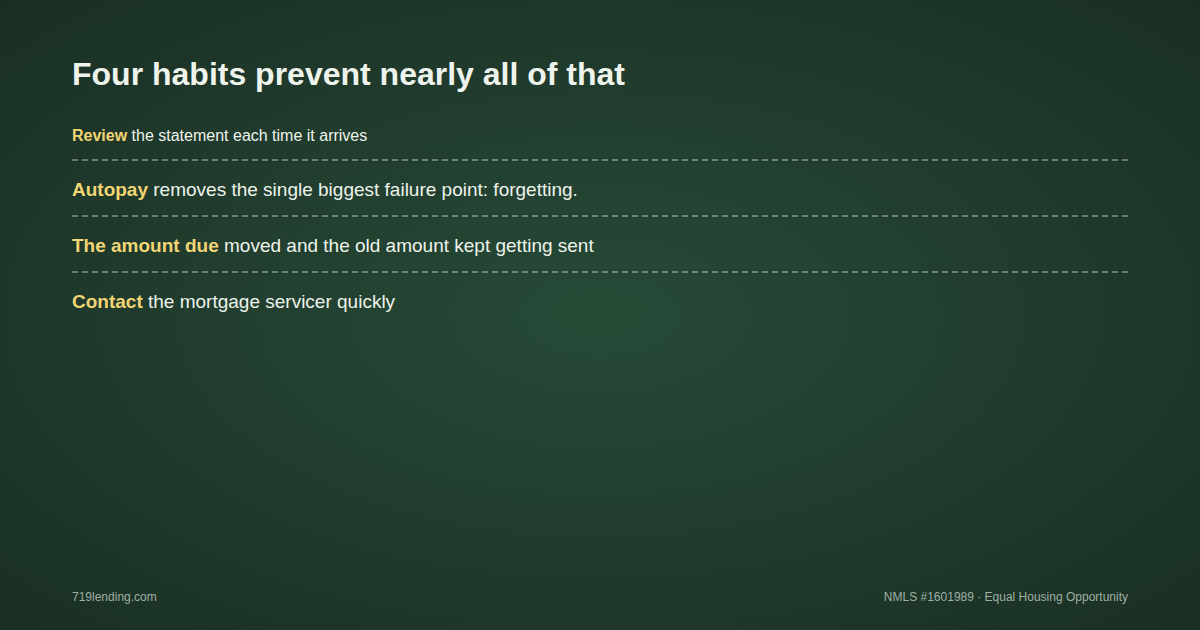
Missing a mortgage payment is almost always preventable. Here is a practical system for Colorado homeowners: read the monthly statement every time, automate the payment, understand why monthly payments change, and contact the mortgage servicer the moment something looks off.
What Happens to Your Property in Nonjudicial Foreclosure?
If you are asking what happens to my property during a nonjudicial foreclosure process, here is the plain answer: the lender moves to satisfy the mortgage debt by selling the property, without going through the court system. This guide walks Colorado homeowners — including the many military families around Colorado Springs — through each stage, from the first missed payments to the public auction, based on guidance from the Consumer Financial Protection Bureau (CFPB).

Here is the sequence at a glance:
- The borrower defaults by falling behind on mortgage payments.
- In most cases, the servicer cannot start the foreclosure process until the loan is at least 120 days delinquent.
- The lender follows a series of required written notices under the power of sale clause in the mortgage or deed of trust.
- A foreclosure sale is held at public auction, and the property goes to the highest bidder.
- State law sets the process for conveying the property to the winning bidder and any steps that follow.
The short answer: your property is sold at auction, not in court
Foreclosure is the lender’s action to satisfy the homeowner’s debt out of the sale of the collateral — the property — when the homeowner fails to make mortgage payments.
In a nonjudicial foreclosure, that happens without filing a court action. The process runs on a series of written notices required by state law, followed by a public auction of the property.
That distinction — no lawsuit, no judge upfront — is the defining feature, and it shapes everything that follows.
Judicial vs. nonjudicial foreclosure: why the difference matters
Judicial foreclosure requires the lender to file a lawsuit, and the process runs through a court where the borrower can raise defenses in front of a judge.
Nonjudicial foreclosure skips the court filing. The lender instead follows the steps spelled out in the power of sale clause and in state statutes, which generally require specific notices and procedures before any trustee’s sale or auction can happen.
Foreclosure processes differ by state, so the exact notice requirements and the path to the sale date depend on where the property sits. With the framework clear, here is how a nonjudicial foreclosure typically unfolds.
Step one: default on the mortgage payments
The foreclosure process may begin after you fall a few months behind on mortgage payments, although it can begin earlier or later depending on the situation.
Missed payments are the trigger, but default does not mean the sale is imminent. There is a built-in runway.
The 120-day rule before foreclosure proceedings start
Except in rare cases, under CFPB rules the servicer cannot start foreclosure proceedings until the loan is at least 120 days delinquent.
That window exists so borrowers can pursue options to avoid foreclosure. Don’t wait for the process to begin — reach out for help as soon as you think you might have trouble paying. The next stage is where the paperwork starts arriving.
Step two: written notices under the power of sale clause
Nonjudicial foreclosure is carried out through a series of steps, including required written notices under the power of sale clause in the mortgage or deed of trust.
State foreclosure processes require that the borrower be notified about the foreclosure proceedings, and other federal rules may also apply. Some states additionally give homeowners a right to mediation before foreclosure.
Read every notice carefully
The CFPB’s advice is direct: read your mail and any legal notices carefully, and act promptly on every notice you receive.
Each notice marks a step toward the sale date, and the deadlines in those documents control what options remain. Once the notice requirements are satisfied, the property heads to auction.
Step three: the foreclosure sale at public auction
After the required notices and procedures are completed, a public auction of the property is generally held. This is the moment the question in the headline gets answered — the property is sold.
Who bids — including your lender
Prospective buyers appear at the foreclosure sale, and the lender itself can bid. The property is sold to the highest bidder, which may be an outside buyer or the bank that holds the loan.
What happens after the highest bidder wins
Additional state laws set out the process for consummating the sale and conveying the property to the winning bidder — including when the lender is the highest bidder.
Those same state laws describe any additional steps and procedures that must follow the trustee’s sale. What those post-sale rights look like is a question worth asking a professional.
Questions for an attorney: redemption period and deficiency judgment
Because state law governs everything after the auction, two questions belong on your list for an attorney or legal services provider: whether any redemption period applies after the sale, and whether the lender can pursue a deficiency judgment for any remaining debt.
The CFPB suggests checking with your county clerk’s office or a legal services provider to find out how foreclosure works in your area. If you are facing foreclosure or have been served with legal papers, you may also need to consult an attorney.
Before any of that becomes necessary, though, there is a defined path for trying to stop the sale.
Can you stop a nonjudicial foreclosure before the sale date?
You may have options, and timing is everything. Applying for loss mitigation with your servicer is the main lever a homeowner controls.
The 37-day application deadline
Make sure the servicer receives your complete application more than 37 days before the scheduled foreclosure sale. If it arrives later than that, the servicer does not necessarily have to review it, though other rules might apply depending on the type of mortgage.
How the servicer must respond
If your complete application arrives more than 37 days before the sale, you should hear back in writing within 30 days. The servicer may offer a loss mitigation option, deny the application, or ask for more documentation.
If the servicer denies a loan modification, it must tell you exactly why. And if your complete application arrived at least 90 days before the scheduled sale, you may have a right to appeal that denial.
If you are not eligible for loss mitigation, or you decline the servicer’s offer, the foreclosure process usually resumes toward the sale. Which makes the resources below worth using early.
Help for Colorado and military borrowers
Use the CFPB’s Find a Counselor tool to get a list of counseling agencies in your area approved by the Department of Housing and Urban Development (HUD). You can also call the HOPE Hotline at (888) 995-HOPE (4673), open 24 hours a day, seven days a week.
Military members and veterans — a large share of homeowners around Colorado Springs — can call the Department of Veterans Affairs (VA) or visit the VA’s home loan website for personalized assistance. Active-duty members can also contact their local JAG legal assistance office.
The full guidance this article draws on is the CFPB’s page, How does foreclosure work?, along with its companion page on what happens after you apply to avoid foreclosure.
What to do next
If you are behind on the loan, contact your servicer and a HUD-approved counselor now — well before any sale date is set. The 37-day deadline makes early action the whole game.
If you are current but worried about affordability, talk with a loan officer at 719 Lending about where your mortgage stands and what questions to bring to your servicer. A short conversation before default beats a notice in the mail after it.
Frequently asked questions
What is the difference between judicial and nonjudicial foreclosure?
Judicial foreclosure requires the lender to file a lawsuit and go through the court system, where the borrower can raise defenses. Nonjudicial foreclosure is done without a court action, through required written notices under a power of sale clause in the mortgage or deed of trust, followed by a public auction.
How far behind on mortgage payments before foreclosure starts?
Except in rare cases, under CFPB rules a servicer cannot start the foreclosure process until the loan is at least 120 days delinquent. The time from the start of foreclosure to the actual foreclosure sale then depends on state law.
Who buys the property at a nonjudicial foreclosure sale?
The property is sold at a public auction to the highest bidder. Prospective buyers attend the sale, and the lender itself can bid — if the lender is the highest bidder, state law governs how the property is conveyed to it.
Can I stop a nonjudicial foreclosure before the sale date?
Possibly. Submit a complete loss mitigation application so your servicer receives it more than 37 days before the scheduled foreclosure sale. The servicer should respond in writing within 30 days by offering an option, denying with specific reasons, or requesting more documents.
Where can military homeowners in Colorado Springs get foreclosure help?
Military members and veterans can call the Department of Veterans Affairs or visit the VA’s home loan website for personalized assistance, and active-duty members can contact their local JAG legal assistance office. HUD-approved housing counselors and the HOPE Hotline at (888) 995-HOPE are also available.
719 Lending Inc., NMLS #1601989 · Equal Housing Opportunity
719 Lending Inc. is not affiliated with or endorsed by HUD, FHA, VA, USDA, CHFA, the CFPB, or any government agency.
Last updated: October 2026

Related Posts