Scammers mine public foreclosure records and show up claiming to be the new property owner, demanding rent or signatures. Here is exactly how to verify who really owns the home, what documents to ask for, and the warning signs that mark a foreclosure scam — with the official CFPB guidance behind every step.
What Is a Loan Estimate? What It Tells You About a Loan Offer
What is a Loan Estimate and what does it tell you about a loan offer? In short, the Loan Estimate is the standard three-page disclosure that turns a lender’s verbal quote into something you can actually verify and compare. This guide walks Colorado buyers through every section of the form, page by page, and shows what to check before you commit.
Here is what the Loan Estimate covers at a glance:
- The loan amount, loan term, loan type, and product
- The interest rate and whether it can change after closing
- Monthly principal and interest, plus estimated taxes, insurance, and assessments
- Itemized closing costs, including origination charges and third-party fees
- Estimated cash to close — what you bring to the closing table
- Risky features: prepayment penalty, balloon payment, negative amortization
What is a Loan Estimate?
A Loan Estimate is a three-page form you receive after applying for a mortgage. The lender must provide it within three business days of receiving your application.
The Loan Estimate summarizes the estimated interest rate, monthly payment, and total closing costs for the loan you requested. It also shows estimated costs of property taxes and homeowners insurance, and how the interest rate and payments may change in the future.
All lenders are required to use the same standard form. That uniformity is the point: it makes comparing mortgage loans from different lenders far easier than comparing free-form quotes.
One important nuance: receiving a Loan Estimate does not mean the loan is approved or denied. It shows the loan terms the lender expects to offer if you decide to move forward, at which point the lender will ask for additional financial information.
Next, let’s cover who actually receives this form — and who doesn’t.
Who gets a Loan Estimate — and who doesn’t
The Loan Estimate applies to most home purchase and refinance mortgages. If you’re buying a house near Fort Carson or refinancing in Monument, expect one from every lender where you apply.
Per the Consumer Financial Protection Bureau (CFPB), you will not receive a Loan Estimate or Closing Disclosure if you are shopping for a reverse mortgage, a home equity line of credit (HELOC), a manufactured or mobile home loan not secured by real estate, or a subordinate loan through certain homebuyer assistance programs. Those products come with different disclosures, such as Truth-in-Lending forms.
For everything else, the three-page form is the anchor of the entire mortgage process. Here’s what each page tells you.
Page 1: loan terms, projected payments, and costs at closing
Check the basics first
Start with the simple stuff. Check the spelling of your name and confirm the contact information is correct — even minor misspellings can cause problems later.
Then verify the loan term, purpose, product, and loan type match what you discussed with the lender. If you’re purchasing, check that the loan amount plus your down payment equals the sale price of the home. If it doesn’t, ask why.
Loan terms and rate features
Page 1 shows the interest rate and whether it can change. If the right-hand column says “YES,” the loan has an adjustable rate that can move after closing — an adjustable rate mortgage will also include extra tables in the projected payments section and on page 2.
The form also states whether the loan carries a prepayment penalty or a balloon payment, and whether the rate lock is in place. Some lenders lock the rate as part of issuing the Loan Estimate; some do not. Confirm which situation applies to you.
Projected payments
Monthly principal and interest usually make up the main components of the mortgage payment: principal is the amount you borrow, and interest is the lender’s charge for lending the money.
The estimated total monthly payment is typically higher, because it can include mortgage insurance and escrowed charges like property taxes and homeowners insurance. Make sure you’re comfortable spending that full amount on housing each month.
Watch the line for estimated taxes, insurance, and assessments that are not escrowed. Anything not escrowed you pay directly, often in large lump sums, so know how often those payments come due.
Page 1 ends with two headline figures — estimated closing costs and estimated cash to close — which page 2 breaks down in detail.
Page 2: where the closing costs live
Origination charges
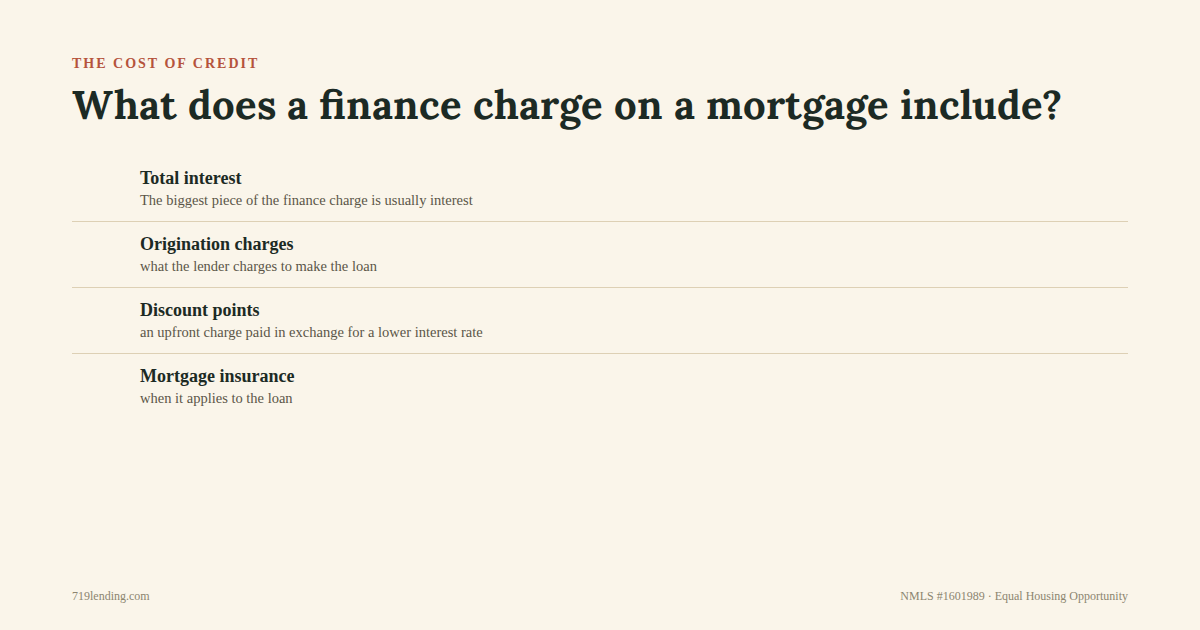
Origination charges are the upfront fees charged by the lender, and they are a core part of the loan costs. Common examples include application fees, origination fees, underwriting fees, processing fees, verification fees, and rate-lock fees.
Depending on the lender, origination charges may be more or less itemized. It’s the total that matters when comparing Loan Estimates from other lenders.
Services you cannot shop for
These are third-party services the lender requires and chooses, sometimes called closing services or settlement services. Because you can’t shop separately for these providers, compare the overall cost of this section against other Loan Estimates.
Some fees here depend on the loan type. On FHA, VA, or USDA loans, the upfront mortgage insurance premium or funding fee appears in this section, and those fees are usually set by the government program, not the lender. On a conventional loan with private mortgage insurance (PMI), any upfront premium is typically listed here, set by the mortgage insurance company.
Services you can shop for
These services are required by the lender, but you can shop for them separately. The lender should give you a list of approved providers; you can pick from the list or find your own, though you should check with the lender about any provider not on it.
Other costs and lender credits
Other costs relate to transferring the property and owning the home. The homeowners insurance premium is set by the insurance company you choose — comparison shop and confirm the lender’s estimate fits your situation. Property taxes are set by local or state government; in Colorado Springs, that means confirming the estimate against what the local tax authority actually charges for the property.
Two lines deserve special attention. Points are an upfront fee paid to the lender in exchange for a lower interest rate than you would otherwise get. Lender credits work the opposite way: the lender gives you a rebate to offset closing costs, and you may be paying a higher interest rate in exchange. In both cases, ask what other options exist and how each affects the total cost of the loan.
Estimated cash to close
Estimated cash to close is the money you bring to closing: your down payment plus closing costs, minus any deposit already paid to the seller, any seller credits, and other adjustments. It is usually paid by cashier’s check or wire transfer, and the lender will need to document the source of those funds.
If the estimated cash to close isn’t what you expected, ask the lender to explain the calculation before moving on to page 3.
Page 3: comparisons, APR, and the loan officer
Page 3 is built for comparison shopping. The APR is one measure of the loan’s cost, distinct from the note rate itself. The total interest percentage (TIP) shows how much interest you would pay over the life of the loan, which helps you compare loans directly.
Because loan costs vary across lenders and across kinds of loans, request Loan Estimates for the same loan type from each lender so the comparison is apples to apples.
Page 3 also lists the loan officer. Most loan officers must be licensed or registered with the Nationwide Mortgage Licensing System & Registry (NMLS), and you can look them up by name or NMLS ID to confirm they’re authorized in Colorado. It also states the late payment fee and whether the loan allows assumption — meaning a future buyer may be able to take over the loan on the same terms.
Beyond comparisons, page 3 works together with page 1 to flag the features you most want to catch.
Risky features the Loan Estimate flags

The Loan Estimate is designed to surface features the CFPB labels risky:
- Prepayment penalty: the lender can charge a fee if you pay off the mortgage early. If present, ask about other options.
- Balloon payment: the final payment is a lump sum much larger than the regular monthly payments.
- Negative amortization: the loan balance can increase even when payments are made on time; if present, it appears in the loan product description.
- Adjustable rate: the interest rate can change after closing, shown in additional tables on the form.
If any of these appear and you weren’t expecting them, that’s a conversation to have before you sign anything else.
How to compare two Loan Estimates
The CFPB’s guidance is direct: request Loan Estimates from multiple lenders, then compare. Because every mortgage lender uses the standard three-page form, the sections line up.
Compare total origination charges, compare the services you cannot shop for, and actually shop the services you can shop for. Check whether one offer includes points or lender credits, since those trade upfront cost against the interest rate on the loan.
Use the comparisons section on page 3 — APR and total interest percentage — to weigh the same loan across lenders. If something looks different from what you discussed, ask why. The Loan Estimate is also a negotiation tool, not just a disclosure.
One related form comes later in the process: the Closing Disclosure, which the CFPB covers alongside the Loan Estimate. Ask your loan officer how the two connect for your transaction.
Why this matters for Colorado Springs buyers
Colorado Springs is a heavily military market, and PCS moves put buyers on tight timelines. The Loan Estimate keeps the process honest under pressure: within three business days of application you have a written summary of the loan terms to review, even mid-move.
Property taxes and homeowners insurance vary by property and location, and the lender’s estimates for both are worth verifying locally — your real estate agent or the local tax authority can help confirm the numbers on the form.
The table below summarizes what to check on each page.
| Page | What it shows | What to check |
|---|---|---|
| Page 1 | Loan terms, projected payments, costs at closing | Name spelling, loan amount, rate type, prepayment penalty, balloon payment, total monthly payment |
| Page 2 | Itemized closing costs and cash to close | Origination charges, third-party services, points, lender credits, estimated cash to close |
| Page 3 | Comparisons and contact info | APR, total interest percentage, late fee, assumption, loan officer’s NMLS record |
Where to read the official source
The Consumer Financial Protection Bureau publishes an interactive Loan Estimate explainer with a sample form, plus a plain-language answer to what is a Loan Estimate and a guide to choosing a loan offer. Reviewing the sample form before your first real one arrives makes the review much easier.
What to do next
Apply with more than one lender, collect the Loan Estimates, and lay them side by side. Verify the loan amount, the rate type, the origination charges, and the estimated cash to close on each.
Then bring your questions to a loan officer. The team at 719 Lending can walk through a Loan Estimate with you line by line and explain how each section applies to your Colorado purchase or refinance.
Frequently asked questions
How long does a lender have to give me a Loan Estimate?
The lender must provide a Loan Estimate within three business days of receiving your mortgage application. It’s a standardized three-page form, so every lender’s version follows the same layout.
Does receiving a Loan Estimate mean my loan is approved?
No. When you receive a Loan Estimate, the lender has not yet approved or denied the application. The form shows the loan terms the lender expects to offer if you move forward, at which point the lender will request additional financial information.
Can I get Loan Estimates from multiple lenders?
Yes, and the CFPB recommends it. Because all lenders use the same standard form, you can compare origination charges, third-party service costs, APR, and total interest percentage side by side. Request estimates for the same kind of loan from each lender so the comparison is meaningful.
What are lender credits on a Loan Estimate?
Lender credits are a rebate from the lender that offsets closing costs, often in exchange for a higher interest rate on the loan. Points work the opposite way: an upfront fee paid in exchange for a lower rate. Ask the lender how each option changes the total cost of the loan.
What is estimated cash to close?
Estimated cash to close is the amount you bring to closing: the down payment plus closing costs, minus any deposit already paid to the seller, seller credits, and other adjustments. It’s usually paid by cashier’s check or wire transfer, and the lender must document where the funds came from.
Do all loans come with a Loan Estimate?
No. Reverse mortgages, home equity lines of credit (HELOCs), manufactured home loans not secured by real estate, and certain subordinate homebuyer-assistance loans don’t use the Loan Estimate. Those products come with Truth-in-Lending disclosures instead.
719 Lending Inc., NMLS #1601989 · Equal Housing Opportunity
719 Lending Inc. is not affiliated with or endorsed by HUD, FHA, VA, USDA, CHFA, the CFPB, or any government agency.
Last updated: September 2026

Related Posts