Scammers mine public foreclosure records and show up claiming to be the new property owner, demanding rent or signatures. Here is exactly how to verify who really owns the home, what documents to ask for, and the warning signs that mark a foreclosure scam — with the official CFPB guidance behind every step.
Legal Protections for Money Saved for Debt Settlement
What legal protections apply to money saved for debt settlement? The answer, according to the Consumer Financial Protection Bureau (CFPB), is that the money remains yours, the account holding it must be administered by an independent third party, the account must be under your control, and you can withdraw the funds at any time without penalty.
This article explains those protections in plain English. It covers how the dedicated account works, when a debt settlement company is legally allowed to charge fees, and what debt collection laws say about your rights along the way.
It is written for anyone weighing debt relief options — including Colorado Springs households juggling credit card debt, medical bills, or collection accounts, and military families whose finances get stretched around a PCS move.
Key protections at a glance

Before the deep dive, here is the short list of what federal law says about money saved for a debt settlement program:
- Ownership: Money you save up in an account for use by a debt settlement company still belongs to you.
- Independent administration: The account must be administered by an independent third party, not the settlement company itself.
- Your control: The account must be under your control.
- Withdrawal rights: You are entitled to withdraw funds held in that account at any time without penalty.
- Fee timing: A debt settlement company may be breaking the law if it charges a fee before it has settled at least one debt, you have agreed to the result, and you have made a payment to the creditor.
Those bullets come straight from CFPB guidance. The sections below unpack each one and show how they fit into the bigger picture of debt settlement.
What legal protections apply to money saved for debt settlement?
Debt settlement companies typically offer to pay off your debts with lump-sum payments that you have to save up before a settlement happens. That savings phase can last a long time, which is exactly why the law steps in.
During that phase, the money sitting in the account is not the settlement company’s money. It is yours, and the law treats it that way until a settlement is actually completed.
The money still belongs to you
Under the law, money you save up in an account for use by a debt settlement company still belongs to you. Signing up for a debt settlement program does not transfer ownership of your savings to the company.
That matters because, in practice, the CFPB warns that many debt settlement companies collect money from consumers and treat it as fees they were paid, instead of money they should be using to settle debts. The ownership rule is your legal counterweight to that behavior.
Independent third-party administration
The account where your settlement savings sit must be administered by an independent third party. The debt settlement company cannot simply hold your money in its own accounts.
Independent administration separates the company arranging settlements from the entity holding your cash. That separation makes it harder for a settlement company to quietly convert your savings into its own fees.
You can withdraw at any time without penalty
The account must be under your control, and you are entitled to withdraw funds held in that account at any time without penalty. If you change your mind about debt settlement — or if the company stops returning calls — the money is yours to take back.
With the core protections covered, the next question is when a debt settlement company is actually allowed to get paid.
When can a debt settlement company legally charge fees?
Fee timing is where many debt relief companies cross the line. Per CFPB guidance, a debt settlement company could be breaking laws if it charges you a fee before three things happen.
A successful result is reached
First, the debt settlement company must have renegotiated, settled, reduced, or otherwise changed the terms of at least one of your debts. Promising to settle debts someday is not a billable result; an actual changed debt is.
You agree to the settlement
Second, you must agree to the settlement agreement, debt management plan, or other result the company reached with your creditor or debt collector. The company cannot bind you to a deal and bill you for it without your consent.
You make a payment to the creditor
Third, you must have made at least one payment to the creditor or debt collector as a result of the agreement the debt settlement company negotiated. Only after all three conditions are met does charging a fee become legitimate.
Upfront fees are the red flag the CFPB highlights most. If a company wants money in advance to settle your debts, that is a reason to walk away — and it leads directly to why these rules exist in the first place.
Why these protections exist: how debt settlement actually works
Debt settlement companies are usually for-profit businesses that offer to arrange settlements of your debts with lenders or debt collectors for a fee. Understanding the mechanics explains why Congress and regulators focused on the savings account.
The lump-sum savings model
The typical debt settlement program asks you to stop paying your creditors and instead deposit money into a dedicated account. Once enough accumulates, the company offers a creditor or debt collector a lump sum to resolve the unpaid debt.
Because you may be saving for a long stretch before any settlement happens, a pile of consumer cash sits in one place. The legal protections exist to keep that pile in your hands, not the company’s.
Where consumers get hurt
The CFPB points out several hard truths about settlement companies. Many lenders do not negotiate with debt settlement companies at all. Many lenders and debt collectors do not negotiate a settlement amount for your individual situation — they apply standard policies about how much loan principal can be forgiven after you have missed payments for a certain amount of time.
The CFPB also notes that debt settlement companies usually cannot get better terms than you could get by negotiating with your lenders and debt collectors yourself, that they cannot guarantee how much you might save or how long the process takes, and that they cannot erase all your debts.
Knowing what the law protects is only half the picture — you also need to know what it does not protect.
What the protections do not cover
The account rules shield your savings. They do not shield you from the side effects of the debt settlement strategy itself.
Damage to your credit report
Debt settlement companies usually advise you to stop paying your creditors until a settlement is negotiated. The CFPB warns this can further damage your credit report and credit score, since accounts reported late and collections are negative items.
Growing balances and lawsuits
While you are saving instead of making debt payments, fees and interest charges can keep adding up on the underlying credit card bills and other unsecured debts. Stopping payments also leaves you open to more debt collection efforts and lawsuits from a creditor or debt collector.
Possible tax consequences on forgiven debt
Debt settlement tries to get some of your debts forgiven, and the CFPB notes that forgiven debt could mean you owe taxes on the forgiven amount. Tax treatment varies by situation, so talk with a tax professional before counting on any outcome for income taxes.
Those risks hit different households differently, which brings us to who should be paying closest attention.
Who this applies to in Colorado Springs
These protections apply to anyone saving money for use by a debt settlement company — whether the underlying balances are credit card debt, medical bills, or other household debts in collection.
In a military market like Colorado Springs, financial stress often spikes around a PCS move, a deployment, or a transition out of service. Debt relief companies market heavily to exactly these moments, so knowing the fee rules and account rules before signing is especially valuable here.
There is also a practical mortgage angle. Collections, charge-offs, and late payments on a credit report affect how a future home loan application is reviewed, so how you resolve debt today shapes what a loan officer sees tomorrow.
Before paying any company, though, it is worth knowing you can often do the negotiating yourself.
Can you negotiate with a debt collector yourself?
Yes. The CFPB lays out a straightforward approach to debt negotiation that does not require hiring anyone, and it notes you may have more room to negotiate with a debt collector than you did with the original creditor.
Confirm that you owe the debt
When a debt collector contacts you, they must give you certain validation information about the debt they say you owe, generally in writing. That information helps you figure out whether you actually owe money and explains how to dispute the debt if you do not.
If you are unsure who you owe money to or how much, you can request that the debt collector provide more information before you discuss any payment.
Calculate a realistic repayment plan
Write down your monthly take-home pay and your monthly expenses, then decide what you can realistically afford toward this debt without falling behind on other bills. Leave room for emergencies.
Decide the total you are willing to pay to settle the entire debt — as one lump sum or a series of smaller monthly payments. If you have more than one debt with a debt collector, you can direct the collector to apply your payments to a specific debt, and collectors are not allowed to apply a single payment across multiple debts you are disputing.
Make the proposal and get it in writing
Explain your financial situation and present the plan. If the debt collector agrees to a repayment or settlement plan, get the plan and the collector’s promises in writing before you make any payment — including promises to stop collection efforts and to end or forgive the debt once you complete the plan.
Working through a nonprofit credit counselor or an attorney can help with this process. Either way, the law also sets ground rules for how collectors may treat you.
Your rights under federal debt collection laws
The Fair Debt Collection Practices Act (FDCPA) is the federal law governing fair debt collection practices. Among other things, the FDCPA prohibits debt collectors from placing repeated or continuous telephone calls with the intent to harass, oppress, or abuse you.
If you believe a debt collector violated these debt collection laws, you can submit a complaint to the CFPB. Keep records of calls, letters, and any agreement a creditor or debt collector made with you.
Debt settlement is also not the only debt relief option on the table, and it helps to see the alternatives side by side.
Alternatives to a debt settlement program
The CFPB distinguishes debt settlement from several other approaches to resolving debt. Here is how they compare on mechanics.
| Option | Who provides it | How it works, per the CFPB |
|---|---|---|
| Credit counseling | Usually nonprofit organizations | Advises on money and debts; can set up a debt management plan where you make one payment and the counselor pays creditors; works to lower the overall monthly payment rather than reduce what you owe; never advises you to stop paying |
| Debt settlement | Usually for-profit settlement companies | Offers to arrange lump-sum settlements with lenders or debt collectors for a fee; usually advises stopping payments while negotiating; cannot guarantee results or erase all debts |
| Debt consolidation loan | Banks, credit unions, other lenders | You borrow to repay separate loans and make one payment over time; watch for teaser rates and longer terms that can raise the total cost |
| Bankruptcy | Legal process through the courts | An option if you simply cannot afford to pay what you owe; consult a bankruptcy attorney about how the process works |
Credit counseling and debt management plans
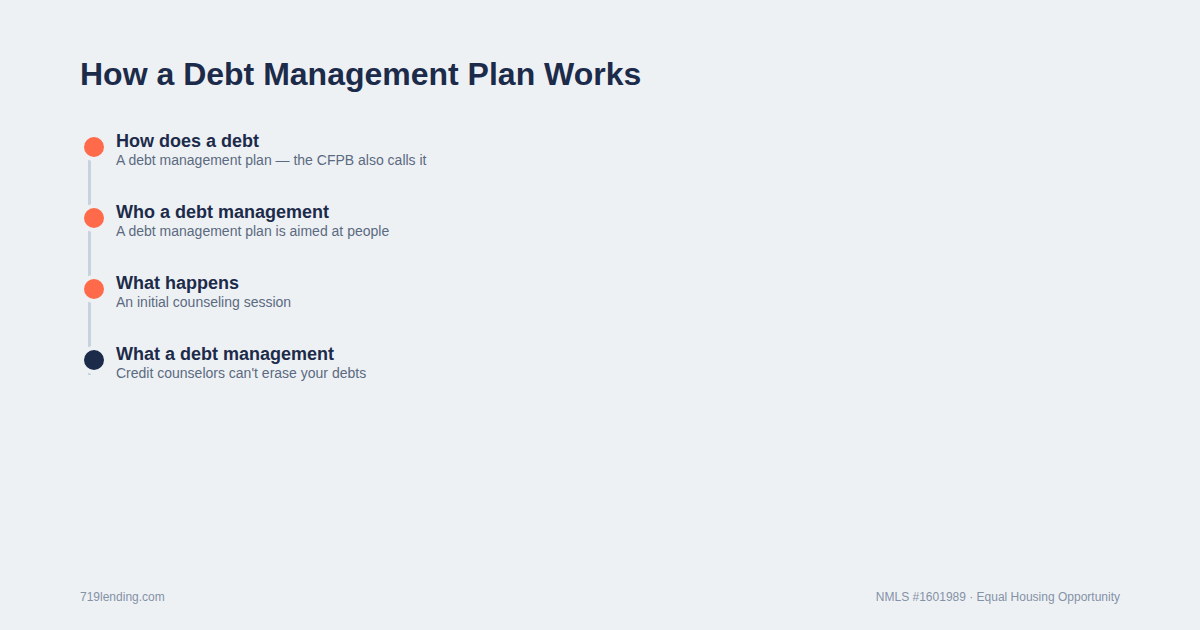
Credit counseling organizations usually offer free educational materials and an initial counseling session, and they can set up a debt management plan covering your debts. They may get creditors to lengthen repayment time or lower interest rates, and to agree not to pursue collection efforts or charge late fees while you are on the plan — but they cannot erase your debts.
Debt consolidation loans
A consolidation loan simplifies multiple debt payments into one. The CFPB cautions that a low advertised rate can be a teaser that expires, and that a lower monthly payment stretched over more time can mean paying more overall than the original debts would have cost.
Bankruptcy
If the numbers simply do not work, the CFPB says you could consider filing for bankruptcy and should consult a bankruptcy attorney to understand the legal process. Legal aid organizations and consumer law firms can also help you understand where you stand before you file bankruptcy or sign with any debt relief program.
Whatever path you lean toward, go back to the source material before you commit.
What the official source says and where to read it
The protections in this article come from the Consumer Financial Protection Bureau’s consumer guidance. Two pages are worth reading in full: the CFPB’s explainer on the difference between credit counseling, debt settlement, debt consolidation, and credit repair, and its guide to negotiating a settlement with a debt collector, both at consumerfinance.gov.
The CFPB is the federal agency that implements and enforces federal consumer financial law. Its guidance is general consumer information, not legal advice — for advice on your specific situation, talk to a debt settlement lawyer, a nonprofit credit counselor, or a bankruptcy attorney.
What to do next
If you are already saving money with a debt settlement company, verify three things today: that the account is held by an independent third party, that the account is in your control, and that you can withdraw your funds at any time without penalty. If any answer is no, that is a problem worth escalating.
If you are shopping for debt relief, refuse any upfront fee, get every promise in writing, and compare the settlement route against credit counseling, a consolidation loan, and negotiating with the debt collector yourself.
And if homeownership is on your horizon, how you resolve collections and late accounts will show up on the credit report a lender reviews. A conversation with a 719 Lending loan officer in Colorado Springs can help you understand how a debt resolution plan fits into a future mortgage application.
Frequently asked questions
Can a debt settlement company keep the money in my dedicated savings account?
No. Under federal law, money you save in an account for use by a debt settlement company still belongs to you. The account must be administered by an independent third party, must be under your control, and you can withdraw the funds at any time without penalty. The CFPB warns that some companies improperly treat these savings as fees, which is why the ownership rule exists.
When can a debt settlement company legally charge me a fee?
Only after three things happen: the company has renegotiated, settled, reduced, or otherwise changed the terms of at least one of your debts; you have agreed to the settlement or plan; and you have made at least one payment to the creditor or debt collector under that agreement. Charging fees before all three could mean the company is breaking the law.
Does debt settlement hurt your credit report?
It can. Debt settlement companies usually advise you to stop paying creditors while they negotiate, and the CFPB warns that fees and interest keep adding up, your credit is further damaged, and you are left open to more debt collection efforts and lawsuits during that time.
Do I need a debt settlement company to negotiate with a debt collector?
No. The CFPB says debt settlement companies usually cannot get better terms than you could get by negotiating with lenders and debt collectors yourself. Confirm you owe the debt, calculate a realistic repayment plan, make a proposal, and get any agreement in writing before paying. A nonprofit credit counselor or attorney can also help.
Will I owe taxes on forgiven debt from a settlement?
Possibly. The CFPB notes that getting debts forgiven could mean you owe taxes on the forgiven amount. Tax treatment varies by situation, so consult a tax professional before relying on any assumed outcome.
What can I do if a debt collector harasses me?
The Fair Debt Collection Practices Act prohibits debt collectors from placing repeated or continuous calls with the intent to harass, oppress, or abuse you. If you believe a debt collector violated the law, you can submit a complaint to the CFPB at consumerfinance.gov.
719 Lending Inc., NMLS #1601989 · Equal Housing Opportunity
719 Lending Inc. is not affiliated with or endorsed by HUD, FHA, VA, USDA, CHFA, the CFPB, or any government agency.
Last updated: October 2026

Related Posts