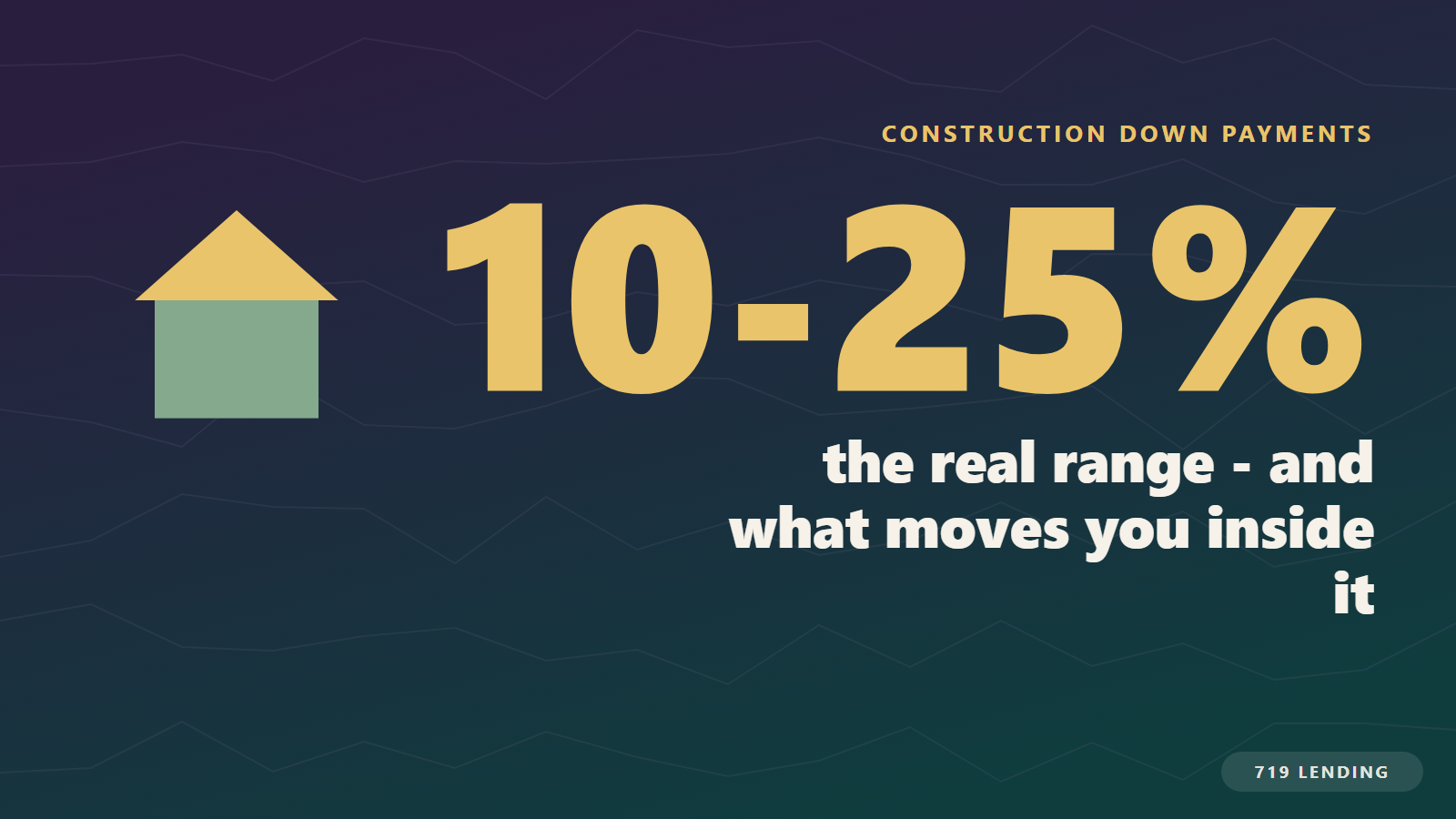
Construction loan down payments usually run higher than a standard purchase mortgage, but the land you already own can do a lot of the heavy lifting. Here is how much you actually need by loan type, and how land equity counts toward it.
One-Time Close Construction Loans Explained
Last updated: June 29, 2026 — draw-schedule shares, construction timelines, and program (conventional/FHA/VA/USDA) eligibility are general and change with the market; confirm current requirements with your broker.
A one-time close construction loan finances your land, the build, and your permanent mortgage in a single loan with one closing and one set of closing costs. You set your terms up front, the lender releases money in stages (draws) as the home is built, you pay interest only on what’s drawn, and when construction finishes the same loan converts to a standard mortgage — without a second closing.
Building from the ground up in El Paso County is having a moment. With resale inventory tight and the median home price in the Colorado Springs area hovering in the mid-$400s, more buyers are looking at vacant lots in Falcon, Monument, Black Forest, and the eastern plains and asking the same question: how do I actually pay for a house that doesn’t exist yet? This guide walks through the one-time close (also called single-close or construction-to-permanent) structure, compares it to the two-close alternative, and shows where it fits.
What is a one-time close construction loan?
It’s a single loan that covers two phases — construction and permanent financing — under one closing. Instead of taking out a short-term construction loan and then refinancing into a mortgage later, you close once, up front, before the first nail goes in. The loan funds the build in draws, then “modifies” or converts into your long-term mortgage when the home is complete and the certificate of occupancy is issued.
The appeal is mechanical: one application, one underwrite, one appraisal, and one set of closing costs. For a borrower in Colorado Springs juggling a builder contract and a moving timeline, fewer moving parts is the whole point.

How is single-close different from two-close?
With a single-close loan you sign once and the construction financing rolls into the permanent mortgage automatically. With a two-close (or two-time close) structure, you take out a standalone construction loan first, then apply separately for a permanent mortgage to pay it off when the house is done — meaning a second application, second underwrite, second appraisal, and a second round of closing costs.
The tradeoff is real and worth understanding before you commit:
| Feature | One-time close (single) | Two-time close |
|---|---|---|
| Number of closings | One | Two |
| Closing-cost sets | One | Two |
| Re-qualify after build? | Generally no | Yes — income, credit, debts re-checked |
| Rate exposure | Set up front | Permanent rate set later, at market |
| Flexibility on final loan | Lower — terms fixed early | Higher — shop the permanent loan later |
| Best when | You want certainty and fewer costs | You expect rates to drop or want to shop later |
Single-close generally wins on cost and certainty. Two-close can win if you believe rates will be meaningfully lower by the time the home is finished and you’re willing to accept that you’ll need to qualify again at that point. A broker can run both paths against your numbers — that’s exactly the kind of comparison we do at 719 Lending.
How do the draws work during construction?
You don’t get the full loan amount at closing. The lender holds the construction funds and releases them in scheduled installments called draws, tied to completed stages of the build. A typical Colorado build might run on a draw schedule like this:
| Draw | Construction stage | Typical share of funds |
|---|---|---|
| 1 | Lot / foundation poured | ~10–20% |
| 2 | Framing & roof (dried-in) | ~20–25% |
| 3 | Mechanicals — plumbing, electrical, HVAC rough-in | ~20–25% |
| 4 | Drywall, interior finishes, cabinetry | ~20–25% |
| 5 | Final — landscaping, punch list, occupancy | ~10–15% |
Before each draw is released, the lender typically sends an inspector to verify the work is actually done, and the title company may run a date-down to confirm no new contractor liens. Crucially, during construction you pay interest only on the funds drawn so far — not on the full loan. Early in the build, when only the foundation draw has hit, your monthly payment is small; it grows as more money is released. Once the home converts to permanent financing, you start making normal principal-and-interest payments.

How does conversion to a permanent mortgage happen?
When the home is complete and the local jurisdiction issues the certificate of occupancy, the construction phase ends and the loan converts. With a true one-time close, this conversion is built in — the loan “modifies” into the permanent term you set at the original closing. You don’t go through a second closing, you don’t pay a second set of closing costs, and your terms were already established up front.
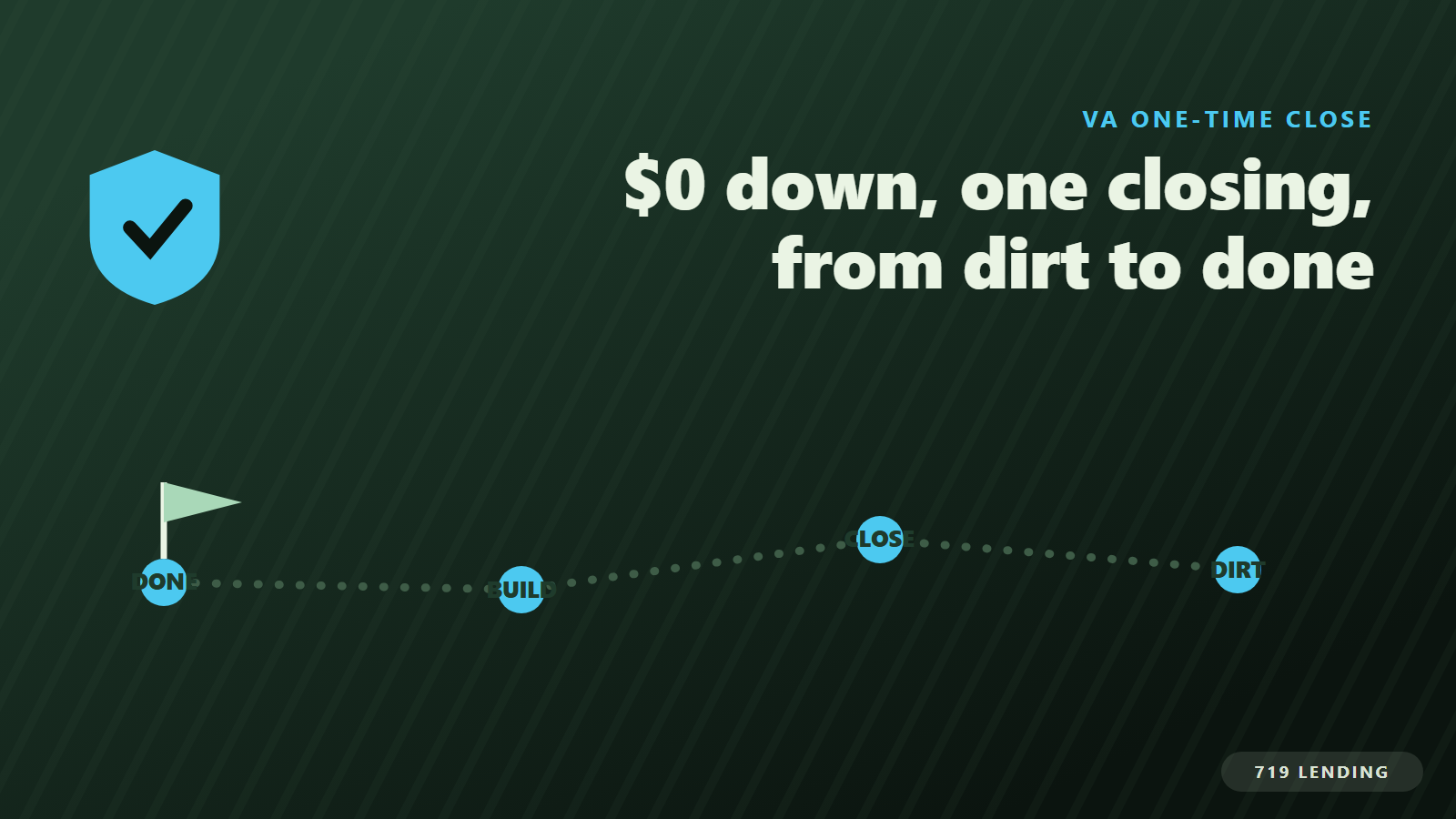
This is the structural advantage over two-close: there’s generally no point where you have to prove your income and credit all over again to a second lender. If you changed jobs, took on a car payment, or the market moved during the months of construction, you’re not re-exposed to a fresh full underwrite at the finish line. The permanent loan can be structured as conventional, FHA, VA, or USDA depending on what you qualify for — and yes, single-close construction-to-permanent programs exist under each. (If you’re a veteran building near Fort Carson, the VA one-time close keeps the $0-down, no-monthly-mortgage-insurance benefits intact through conversion.)
Who is a one-time close construction loan right for?
A one-time close fits a specific buyer profile. It’s strongest when you:
- Own or are buying a lot and have a builder under contract — Falcon, Peyton, Monument, and Black Forest see a lot of this.
- Want cost certainty and would rather not pay two sets of closing costs.
- Have a stable income and credit picture that’s unlikely to deteriorate during the 6–12 months of construction.
- Would rather not requalify or take on uncertainty about where rates land at the end of the build.
It’s a weaker fit if you’re doing a tiny DIY project, if your income is about to change dramatically, or if you strongly expect rates to fall and want to shop the permanent loan independently later. In those cases the two-close path, or a different product entirely, may serve you better.
What does it take to qualify in Colorado?
Construction lending is underwritten more conservatively than a standard purchase, because the lender is funding a home that doesn’t exist yet. Expect a closer look at your credit, your reserves, and the builder. Lenders generally want to see a licensed, vetted general contractor, a fixed-price build contract, detailed plans and specs, and an appraisal based on the finished plans (“subject-to-completion“). Down-payment and credit expectations vary by program and change with the market, so confirm current requirements with your broker rather than relying on a number you read online.
One Colorado-specific wrinkle: build timelines on the eastern plains and in the foothills can stretch because of weather, well-and-septic permitting, and contractor availability. A realistic draw schedule and a builder who hits milestones matter as much as your credit score.
Frequently asked questions
Is a one-time close cheaper than a two-time close?
Usually, yes — because you pay only one set of closing costs and close once instead of twice. The savings can run into the thousands. The two-close path can still make sense if you expect to get a meaningfully better permanent rate later, but you take on the work of qualifying again. A broker can price both for your situation.
Do I make payments during construction?
Yes, but typically interest-only on the funds drawn so far — not on the full loan amount. Your payment is small early in the build and grows as more draws are released. Full principal-and-interest payments begin once the loan converts to permanent financing.
Can I use FHA, VA, or USDA for a one-time close?
Yes. Single-close construction-to-permanent programs exist under conventional, FHA, VA, and USDA. The VA one-time close is popular with veterans near Fort Carson because it keeps the $0-down and no-monthly-mortgage-insurance benefits through conversion. Eligibility and current guidelines should be confirmed with your broker.
What happens if construction runs over budget or over schedule?
Cost overruns are generally the borrower’s responsibility unless your contract has a contingency line, which is why a fixed-price build contract and a contingency reserve matter. Significant delays can affect your rate-lock and draw schedule, so build in buffer and pick a contractor with a track record of hitting milestones.
How long does the construction phase usually last?
Most single-family builds run roughly 6–12 months, though Colorado weather, well-and-septic permitting, and contractor availability can push that. Your loan’s construction period is set at closing, so a realistic timeline agreed with your builder up front prevents surprises.
Build with a local broker who runs the numbers both ways
Deciding between single-close and two-close — and matching the permanent loan to conventional, FHA, VA, or USDA — is exactly the kind of comparison a broker should run for you before you commit to a builder. If you’re eyeing a lot in El Paso County or anywhere along the Front Range, reach out to 719 Lending and we’ll walk your specific build through both structures. You can also explore our Colorado construction loan options and our VA loan guide if you’re a veteran building near Fort Carson.
719 Lending Inc., NMLS #1601989 · Equal Housing Opportunity · This article is educational only, is not a commitment to lend, and not all applicants will qualify. 719 Lending is not affiliated with or endorsed by any government agency.

Related Posts