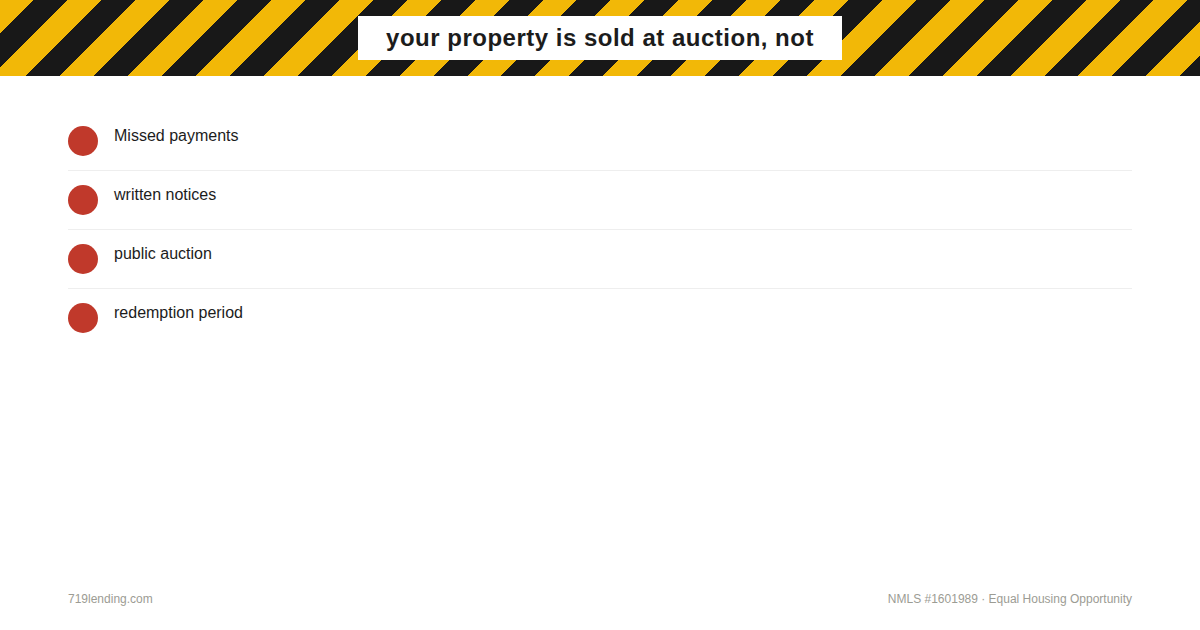
In a nonjudicial foreclosure, the lender follows a series of required written notices under the power of sale clause in your deed of trust, then sells the property at a public auction to the highest bidder — all without filing a lawsuit. Here is the step-by-step sequence, what you control, and where Colorado and military borrowers can get help.
How Much Is a Down Payment on a House? Colorado Guide
The short answer: A down payment on a house ranges from 0% to 20% of the purchase price depending on the loan type. VA and USDA loans require 0% down, FHA loans require 3.5% with a 580 credit score, and some conventional loans allow 3% down. Industry surveys show typical first-time homebuyers put down about 6% to 9%, not the often-assumed 20%.
Last updated: June 29, 2026 — down payment minimums, the $832,750 conforming limit, and the rate figures cited are general and updated periodically; confirm current numbers for your scenario.
How much is a down payment on a house? The honest answer: anywhere from $0 to 20% of the home’s purchase price, depending on the loan type you qualify for. This Colorado guide breaks down the minimum down payment for every major loan program, what buyers actually put down, and the payment assistance programs that can cover part of the cost for Colorado buyers.

Down payment minimums at a glance
Before the deep dive, here are the minimum down payment requirements by loan type. These are the figures that matter most when you’re budgeting a home purchase.
| Loan type | Minimum down payment | Key detail |
|---|---|---|
| VA loans | 0% | Eligible veterans and service members with full entitlement; no monthly mortgage insurance |
| USDA loan | 0% | 100% financing in eligible rural areas; income limits apply |
| FHA loans | 3.5% | Minimum credit score of 580; includes mortgage insurance premium |
| Conventional loans | 3% | Qualifying buyers; PMI required below 20% down |
| Jumbo loans | Varies | Loans above the $832,750 conforming limit; lenders generally require more down |
Notice what’s missing: a 20% requirement. With minimums established, let’s look at what buyers actually put down.
What is the typical down payment on a house?
Industry surveys put the typical down payment for first time homebuyers around 6% to 9% of the purchase price. Buyers overall — including repeat buyers rolling equity from a previous home — put down roughly 15%.
The 20% figure persists because putting 20% down lets you skip private mortgage insurance on conventional loans. But it has never been a requirement for loan approval, and waiting years to save 20% can cost more in rising prices than PMI would.
How many buyers put 20% down?
Far fewer than most people assume. First time homebuyers in particular rely on smaller down payments, gift funds from family, and down payment assistance to get into a first home, then build equity from there.
So how do the percentages translate into dollars? Let’s run the math.

How much is a down payment in real dollars?
Down payment amounts scale with the home’s purchase price. Here are pre-computed examples at common price points:
- 3.5% of $300,000 = $10,500 (FHA minimum)
- 3.5% of $400,000 = $14,000 (FHA minimum)
- 5% of $400,000 = $20,000 (common conventional down payment)
- 3% of $599,900 = $17,997 (conventional minimum for qualifying buyers)
- 20% of $599,900 = $119,980 (the no-PMI threshold)
The gap between 3% and 20% on the same house is enormous — nearly $102,000 at a $599,900 purchase price. That’s why your loan type matters far more than any rule of thumb.
Next, the programs that drive those minimums.
Down payment requirements by loan type
VA loans: 0% down
VA loans, backed by the Department of Veterans Affairs, require no down payment for eligible borrowers with full entitlement. In a military market like Colorado Springs — home to Fort Carson, Peterson and Schriever Space Force Bases, and the Air Force Academy — VA loans are often the strongest option on the table.
VA loans never carry monthly mortgage insurance. There is a one-time VA funding fee ranging from 0.5% (on an Interest Rate Reduction Refinance Loan, or IRRRL) to 3.3% (subsequent use, under 5% down), and many disabled veterans are exempt. With full entitlement there is no VA loan limit, which matters at Colorado prices.
USDA loans: 0% down
The USDA loan offers 100% financing for homes in eligible rural areas, with income limits. Parts of El Paso County and much of eastern Colorado qualify, so don’t rule it out before checking the map.
FHA loans: 3.5% down
FHA loans, insured by the Federal Housing Administration, allow a 3.5% minimum down payment with a minimum credit score of 580. That flexibility on credit history makes FHA loans a workhorse for first time homebuyers.
The trade-off: FHA loans carry a mortgage insurance premium (MIP) — an upfront MIP of 1.75% of the loan amount plus an annual MIP paid monthly. With less than 10% down, FHA MIP lasts the life of the loan; with 10% or more down it ends after 11 years.
Conventional loans: 3% to 5% down
Some conventional programs allow as little as 3% down for qualifying buyers, and 5% down options are widely available. Below 20% down, Fannie Mae and Freddie Mac require you to pay mortgage insurance — private mortgage insurance (PMI) — on loans they purchase on the secondary mortgage market.
PMI protects the lender if the borrower defaults, and it isn’t forever: under the Homeowners Protection Act, PMI auto-terminates at 78% loan-to-value and can be requested for removal at 80%.
Jumbo loans
Jumbo loans cover amounts above the 2026 conforming loan limit of $832,750 for El Paso County and most of Colorado (per FHFA conforming loan limits). Lenders generally require larger down payments and stronger credit on jumbo financing.
You can compare all of these loan options side by side, but credit also shapes what you’ll need — here’s how.
How does your credit score affect your down payment?
Your credit score doesn’t just determine loan approval — it shapes your minimum down payment and your interest rate. FHA’s 3.5% down option requires a 580 credit score. Conventional loans price by credit tier, and a credit score of 740 or above typically earns the best pricing tiers.
Lower credit score, different math
A lower credit score can mean a higher interest rate and more expensive PMI on conventional loans, which raises your monthly mortgage payment even at the same down payment amount. Sometimes an FHA loan beats a conventional loan for the same buyer purely because of credit pricing.
Pull your credit reports early in the loan process so a loan officer can match your profile to the right program. Credit affects cost — but so does the size of your down payment itself.
How does your down payment affect your monthly payment?
A larger down payment shrinks your loan amount, which lowers your monthly payment and the total interest paid over the life of the loan. It also buys you immediate equity and, at 20% down on a conventional loan, eliminates PMI entirely.
What PMI actually costs
PMI typically costs about 0.5% to 1.5% of the original loan amount per year. On a $300,000 loan, that’s roughly $1,500 to $4,500 annually — about $125 to $375 per month. On a $400,000 loan, roughly $2,000 to $6,000 per year, or about $167 to $500 per month.
The case for a smaller down payment
Smaller down payments get you into a home sooner and preserve cash for moving costs, repairs, and reserves. For a credit worthy buyer, a 5% down conventional loan with removable PMI often beats waiting years to save 20%. A mortgage calculator can show you both scenarios, or our team can run them for you.
The down payment isn’t the only check you’ll write, though — budget for these too.
Don’t forget closing costs and earnest money
Closing costs are separate from your down payment and cover lender fees, title insurance, appraisal, prepaid property taxes, and homeowners insurance. They commonly run about 2% to 5% of the loan amount.
Earnest money is the deposit you submit with your offer to show you’re serious. Your real estate agent will advise on a competitive amount for your market, and your earnest money is credited toward your down payment and closing costs at closing — it’s not an extra expense.
If those numbers feel steep, Colorado has real help available.
Down payment assistance programs in Colorado
Payment assistance can dramatically shrink the cash you need at closing. Colorado has some of the strongest down payment assistance programs in the country, and many first time homebuyers qualify without realizing it.
CHFA programs
The Colorado Housing and Finance Authority (CHFA) offers down payment assistance through grants and second mortgages paired with CHFA first mortgages. Income limits and homebuyer education requirements apply, and some CHFA second mortgages function like forgivable loans depending on the program terms.
metroDPA and local programs
metroDPA serves the Denver area, and local city and county payment assistance programs can sometimes be combined with state-level help. A broker who works with these programs daily can tell you quickly which ones fit your financial situation — that’s exactly what our team does for Colorado buyers, and our reviews reflect how often assistance makes the difference.
Gift funds
Most loan programs allow gift funds from family toward your down payment with a simple gift letter documenting that the money isn’t a loan. Gifts can cover part or all of the down payment amount on many programs.
Assistance covers the cash side — affordability rules cover the income side.
How much house can you afford? The income side
A common guideline is to keep housing costs near 28% of gross monthly income. Lenders also look at your overall debt to income ratio — your total monthly debts against your income — during mortgage approval.
What salary affords a $400,000 house?
There’s no single salary answer because your interest rate, down payment, property taxes, insurance, and other debts all move the number. Using the 28% guideline, work backward: estimate the full monthly payment on a $400,000 home loan with your expected down payment, then check whether it stays near 28% of your gross monthly income.
The 3-3-3 rule in real estate
The “3-3-3 rule” is an informal budgeting heuristic — versions include putting 3% or more down, keeping three months of payments in reserve, and planning to stay at least three years. It’s a sanity check, not an underwriting standard; lenders use documented income, assets, and debt to income ratio instead.
For context on borrowing costs: the 30-year fixed mortgage averaged 6.52% and the 15-year averaged 5.84% nationally in Freddie Mac’s Primary Mortgage Market Survey for the week of June 11, 2026 — down from 6.84% a year ago for the 30-year. Those are national survey averages, not offered rates, and individual rates differ based on your credit score, down payment, and loan type.
So what should you actually do next?
Next step: find your real number
The fastest way to answer “how much is a down payment on a house” for you is a quick conversation about your credit score, income, savings, and target purchase price. A mortgage loan pre-qualification maps your options across VA, FHA, USDA, and conventional loans — plus any payment assistance you qualify for — before you ever tour a home.
719 Lending is a Colorado Springs mortgage broker (NMLS #1601989) that works with first time homebuyers, military families navigating PCS moves, and move-up buyers across Colorado. Contact us or call (844) 719-5363 and we’ll show you exactly what your down payment and monthly payment would look like on a real home purchase.
Frequently asked questions
How much of a down payment do I need for a house in Colorado?
It depends on the loan type: 0% for VA and USDA loans, 3.5% for FHA loans with a 580 credit score, and as little as 3% on some conventional loans. Colorado buyers can also use CHFA down payment assistance, which offers grants and second mortgages paired with CHFA first mortgages.
How much is a 3.5% down payment on a $300,000 house?
3.5% of $300,000 is $10,500 — the FHA minimum down payment at that price. Budget separately for closing costs, which commonly run about 2% to 5% of the loan amount.
Is 20% down required to buy a house?
No. Putting 20% down avoids private mortgage insurance on conventional loans, but it has never been required. Typical first-time buyers put down around 6% to 9%, and VA and USDA loans require nothing down for eligible borrowers.
How much is PMI if I put less than 20% down?
PMI typically costs about 0.5% to 1.5% of the loan amount per year. On a $400,000 loan that’s roughly $2,000 to $6,000 annually, or about $167 to $500 per month. It auto-terminates at 78% loan-to-value and can be removed at 80%.
What salary do I need to afford a $400,000 house?
There’s no single answer — it depends on your rate, down payment, taxes, insurance, and other debts. A common guideline is keeping housing costs near 28% of gross monthly income, so estimate the full monthly payment and check it against your income.
Can family help pay my down payment?
Yes. Most loan programs allow gift funds from family with a gift letter confirming the money isn’t a loan. Gifts can cover part or all of the down payment on many programs, including FHA and conventional loans.
719 Lending Inc. is a private mortgage broker and is not affiliated with the U.S. Department of Veterans Affairs, FHA, HUD, or any government agency.
719 Lending Inc., NMLS #1601989 · Equal Housing Opportunity · This article is educational only, is not a commitment to lend, and not all applicants will qualify. Rates referenced are national survey averages, not offered rates.

Related Posts