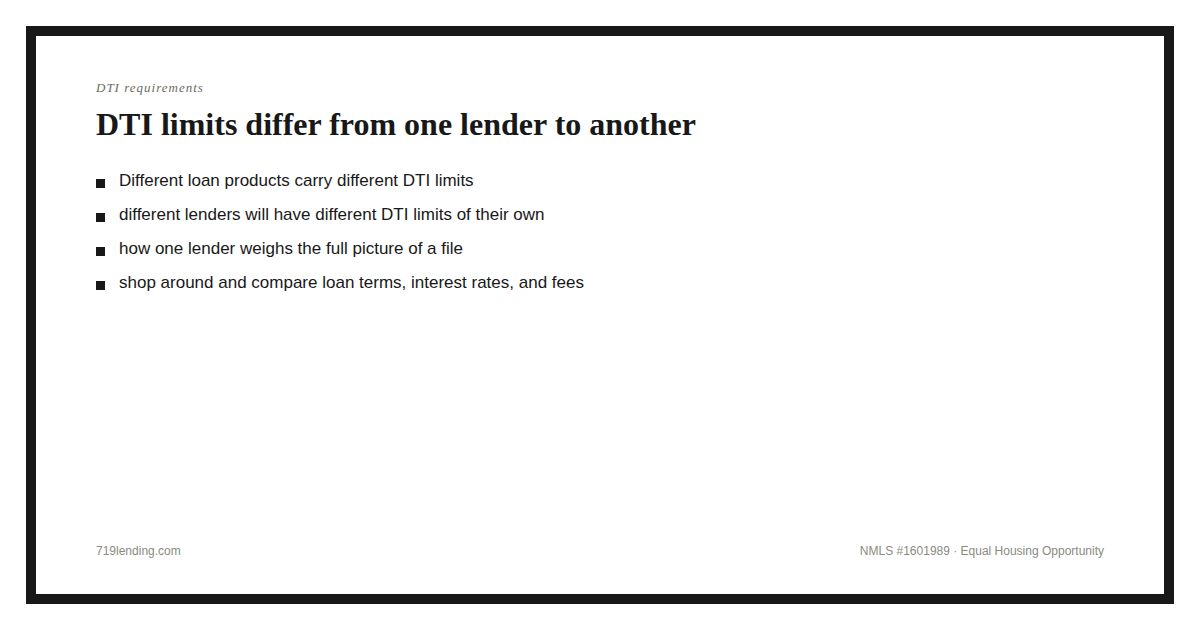
Debt-to-income ratio limits are not one universal number. The Consumer Financial Protection Bureau confirms that different loan products and different lenders have different DTI limits. Here is how that works, who decides what, and what Colorado Springs borrowers can do about it.
Can I Work With Any Loan Officer I Choose? Colorado Guide
Can I work with any loan officer I choose? Yes — the choice of loan officer belongs entirely to you, the borrower. This article explains where that right comes from, what the Colorado Housing and Finance Authority (CHFA) and the Consumer Financial Protection Bureau (CFPB) actually say about it, and how Colorado buyers — including military families around Colorado Springs — can compare loan officers and mortgage lenders before committing.
Can I work with any loan officer I choose? The direct answer
You can work with any loan officer you choose. There is no rule that assigns a borrower to a particular loan officer, mortgage broker, bank, or other financial institution.
Your real estate agent may suggest a loan officer. A builder may have a preferred lending institution. A friend may swear by their local bank. All of those are suggestions, not requirements — the decision-making process is yours.
The one practical boundary is program availability. If you want a specific loan program, the loan officer you pick must work for a lender that actually offers it. The clearest example in Colorado is CHFA, covered next.
What CHFA says about choosing a loan officer
The Colorado Housing and Finance Authority answers this exact question on its own website. In CHFA’s words: “A homebuyer may work with any loan officer working for a CHFA Participating Lender.”
CHFA loan programs are available through a statewide network of CHFA Participating Lenders. CHFA does not lend money directly to consumers — it uses approved lenders to qualify customers and make all mortgage loans.
So for CHFA programs, the freedom to choose has one condition: the loan officer must be employed by a lender in CHFA’s Participating Lender network. Within that network, any loan officer is fair game. You can read the policy yourself on CHFA’s find-a-participating-lender page.
What a CHFA loan officer actually does
Per CHFA, a loan officer working for a Participating Lender helps you determine which CHFA loan programs will work for you. They then walk you through the entire loan process, from application to closing.
That makes the loan officer your single point of contact for a CHFA loan — one more reason the choice matters. With the CHFA rule established, it helps to understand the search tools CHFA gives borrowers.
How CHFA’s loan officer filters work
CHFA publishes a searchable list of loan officers with optional filters. CHFA is explicit that the filters are a convenience only — you are not required to use any filter or any listed loan officer unless you want to.
Filtered results are based on the number of households that used a CHFA loan program with a listed loan officer in the previous calendar year or the most recent rolling twelve-month period. CHFA states that the results do not constitute an endorsement or referral, and they do not guarantee quality of service, outcomes, or results.
The Top Loan Officers filter
Gold, Silver, and Bronze statuses reflect how many CHFA loans a loan officer completed in the previous calendar year. The number of loans needed for a given status can change from year to year based on total CHFA loan production.
A high-volume loan officer has a proven track record with CHFA loan programs specifically. That can matter for first time homebuyers who want someone familiar with CHFA paperwork and process.
County, households served, and language filters
The county filter shows loan officers who helped a household purchase a home in a specific county — useful if you want someone active in the El Paso County real estate market. The households served filter highlights loan officers with experience serving certain demographic groups, though CHFA notes it does not mean they only serve that group.
The language filter shows loan officers who reported speaking languages other than English. There is also a filter for members of CHFA’s Lender Advisory Group, which helps guide the future of affordable housing in Colorado.
Filters help you narrow the field, but the bigger question for most borrowers is what kind of mortgage professional to hire in the first place.
Loan officer vs. mortgage broker: key differences

The CFPB draws a clean distinction. Mortgage loan officers often work for one specific lender, while mortgage brokers typically work with multiple lenders.
A mortgage loan officer at a single lender — a bank, one of the credit unions in town, or a mortgage banker — can offer the loan products that one financial institution carries. A mortgage broker can shop your file across many lenders, which may mean access to a wider range of loan options and loan products from different lenders through one application experience.
| Mortgage loan officer (single lender) | Mortgage broker | |
|---|---|---|
| Works for | One specific lender or financial institution | Typically works with multiple lenders |
| Loan options | That lender’s own loan products | Loan products from many lenders |
| How they’re paid | Loan-specific fee or commission, paid by you or the lender | Loan-specific fee or commission, paid by you or the lender |
| Your right to choose | Entirely yours | Entirely yours |
Neither model is automatically right for every borrower. What matters is whether the person you choose can access the loan programs you need — a CHFA program, a conventional mortgage, or something else — and can explain the loan process clearly. Either way, you should understand how that person gets paid.
How loan officers and mortgage brokers get paid
According to the CFPB, when you work with someone to get a mortgage, they are usually paid a loan-specific fee or commission. That money is paid either by you or by the lender you use.
Federal law prohibits their commission from varying based on the terms of the mortgage. In plain terms, a mortgage loan originator cannot legally be paid more for steering you into a loan with a higher interest rate or worse terms.
The forms compensation can take
Within that rule, lenders have flexibility. The CFPB notes a lender can pay a salary, a fixed amount per loan, a fixed share of the loan amount, or a combination, and can set minimums or maximums per loan.
The CFPB’s advice is direct: before you work with a loan officer or mortgage broker, make sure you understand their fees and who pays them. Ask the question early, before you submit a loan application. Compensation is one thing to verify — licensing is another.
How to vet the loan officer you pick
Choosing freely also means vetting freely. The CFPB points consumers to resources for checking whether a company or person is permitted to make or broker mortgage loans, so verifying that a licensed professional is actually licensed is a reasonable first step.
Questions worth asking any loan officer
- Which lenders or loan programs can you actually offer — one lender’s menu, or loan products from many lenders?
- How are you paid on my loan, and who pays it?
- If I’m pursuing a CHFA program, is your company a CHFA Participating Lender?
- What does the loan process look like from application through closing costs and closing day?
- How do you handle files like mine — self employed income, a shorter employment history, or a lower credit score?
A good mortgage professional answers these without flinching. Evasiveness on fees or loan options is a signal to keep shopping — which brings us to comparison shopping itself.
Shopping with more than one lender
The CFPB reminds borrowers that you can shop around for a lender and broker. Talking to more than one lender is normal, and no loan officer should make you feel locked in before you have signed anything.
Comparing different lenders side by side lets you weigh the interest rates quoted, the origination fee and other closing costs, and the loan products each can offer. Ask each for a written loan estimate of costs so you are comparing on paper, not on conversation.
What to compare beyond the rate quote
Interest rates move with market conditions, so a quote is a snapshot, not a promise. Compare the total costs, the loan programs available to you, and how well each loan officer explains the mortgage process.
Also compare fit. A borrower with a straightforward credit profile has different needs than one with a complicated file, and the right loan officer for one is not automatically right for the other. For Colorado Springs buyers, local knowledge is one more factor to weigh.
Choosing a loan officer in Colorado Springs and military markets
Colorado Springs is a heavily military market, and buyers arriving on PCS orders to Fort Carson, Peterson Space Force Base, or the Air Force Academy often start the home buying process from another state. The freedom to choose any loan officer means you are not stuck with whoever a relocation packet suggests.
You can work with a mortgage broker or loan officer based here in Colorado, at your existing bank back home, or at other financial institutions entirely. What matters is that they can offer the loan programs you want and communicate on your timeline.
For buyers exploring CHFA down payment assistance or other CHFA loan programs, the county filter on CHFA’s site can surface loan officers who closed CHFA loans in El Paso County recently. A mortgage broker like 719 Lending can also walk you through which loan options fit your situation.
Common myths about choosing a loan officer
Myth: my real estate agent’s preferred lender is mandatory. It is not. A referral can be useful, but the choice of loan officer and lending institution is yours alone.
Myth: CHFA assigns you a loan officer. CHFA states the opposite — a homebuyer may work with any loan officer who works for a CHFA Participating Lender, and the site’s filters are optional tools, not assignments.
Myth: switching loan officers mid-shopping is rude or forbidden. The CFPB explicitly tells borrowers they can shop around among lenders and brokers. Until you commit, comparing is part of the process.
Myth: a top-producer badge guarantees results. CHFA itself says its production-based statuses do not guarantee quality of service, outcomes, or results. Volume is one data point among several in your decision making process.
With the myths cleared, the path forward is short and concrete.
What to do next
First, decide whether a CHFA loan program might be part of your plan. If so, confirm any loan officer you consider works for a CHFA Participating Lender — you can verify on CHFA’s lender search.
Second, talk to more than one lender. Ask each loan officer about the loan programs they offer, how they are paid, and what the loan process and loan approval steps look like, then compare written cost estimates.
Third, pick the mortgage professional who earns it. If you are buying or refinancing in Colorado Springs or anywhere in Colorado, the team at 719 Lending is glad to be one of the conversations you have — and to answer every question above in writing.
Frequently asked questions
Can I work with any loan officer for a CHFA loan?
Yes, within CHFA’s network. CHFA states that a homebuyer may work with any loan officer working for a CHFA Participating Lender. CHFA does not lend directly to consumers; approved lenders qualify borrowers and make all CHFA mortgage loans, so the only requirement is that your loan officer’s company is a Participating Lender.
Do I have to use the lender my real estate agent recommends?
No. A recommendation from an agent, builder, or friend is only a suggestion. You can choose any loan officer or mortgage broker you want, and the CFPB confirms borrowers can shop around among lenders and brokers before committing.
What is the difference between a loan officer and a mortgage broker?
According to the CFPB, mortgage loan officers often work for one specific lender, while mortgage brokers typically work with multiple lenders. A broker can shop your file across many lenders’ loan products; a loan officer at a single lender offers that institution’s own loan options.
How does a loan officer or mortgage broker get paid?
The CFPB says they are usually paid a loan-specific fee or commission, paid either by you or by the lender. Federal law prohibits that commission from varying based on the terms of the mortgage. Before working with anyone, ask how they are paid and who pays it.
Can I talk to more than one lender at the same time?
Yes. Shopping with more than one lender is normal and encouraged by the CFPB. Comparing different lenders lets you weigh quoted interest rates, closing costs, and available loan programs before you choose who handles your loan application.
Do CHFA’s Gold, Silver, and Bronze loan officer statuses mean those officers are better?
Not necessarily. CHFA’s statuses reflect the number of CHFA loans a loan officer completed in the previous calendar year. CHFA states the results do not constitute an endorsement or referral and do not guarantee quality of service, outcomes, or results.
719 Lending Inc., NMLS #1601989 · Equal Housing Opportunity
719 Lending Inc. is not affiliated with or endorsed by HUD, FHA, VA, USDA, CHFA, the CFPB, or any government agency.
Last updated: September 2026

Related Posts