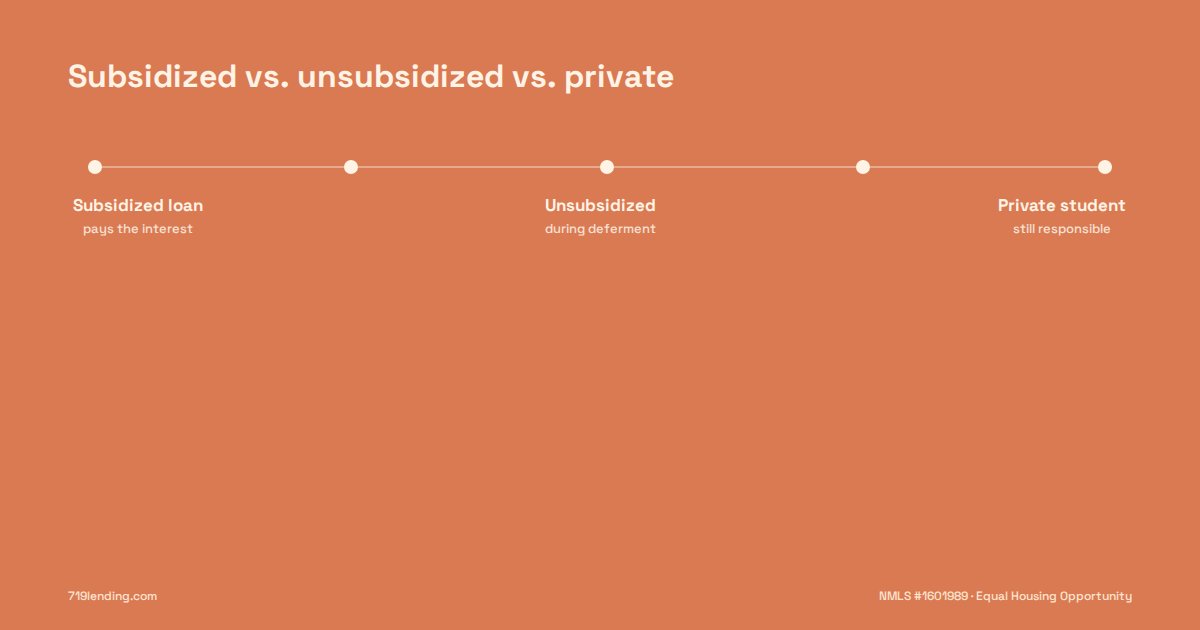
If you have a federal subsidized student loan, you do not have to pay interest on it during an approved deferment — the U.S. Department of Education covers it. Unsubsidized and private student loans work differently, and the gap matters, especially for service members around Colorado Springs weighing deferment during active duty.
Deferment vs Forbearance for Student Loans: The Difference
What is the difference between deferment and forbearance for student loans? Both options let you temporarily postpone payments when you are experiencing financial hardship, but they treat interest very differently. This guide explains both, based on Consumer Financial Protection Bureau (CFPB) guidance, for Colorado borrowers — including the many military families around Colorado Springs who juggle student loan debt alongside PCS moves and homebuying plans.
Deferment vs forbearance: the short answer
According to the CFPB, the difference between deferment and forbearance has to do with the amount of interest accrued over time.
- Deferment: postpones your loan payments without changing the terms of the loan. Interest does not accrue on subsidized federal student loans during a deferment, but it does on unsubsidized loans.
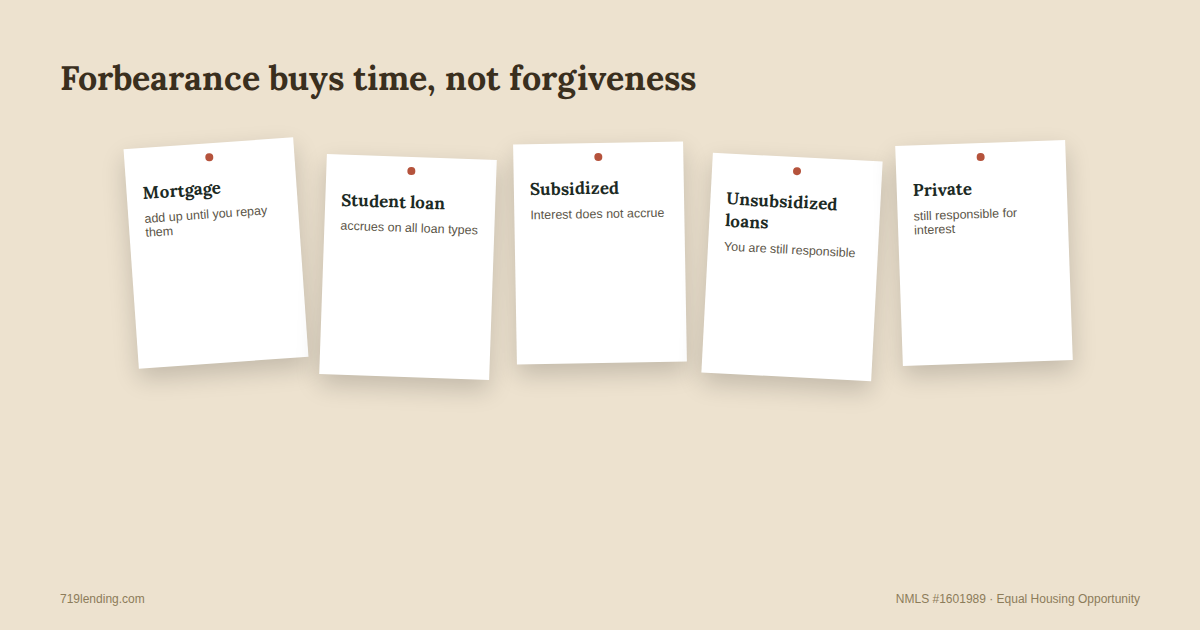
- Forbearance: pauses or reduces payments while you get back on your feet. Interest accrues on all loan types during a forbearance, including subsidized federal loans.
Neither option reduces the loan balance. Both are temporary relief, and both can make student loans more expensive over time. With that frame set, here is how each one actually works.
What is student loan deferment?
Student loan deferment postpones your monthly payments but does not change the terms of the loan. Short-term, payments are paused; long-term, the cost of the debt probably increases unless the loan qualifies for the interest benefit.
The CFPB notes that borrowers serving in the military, volunteering in the Peace Corps, or participating in a national service program may be eligible for a deferment, though other repayment options may fit better.
Subsidized vs unsubsidized loans during a deferment
If you have a subsidized federal student loan, you do not have to pay interest during the deferment period. If you have an unsubsidized loan, you remain responsible for the interest that accrues while payments are paused.
That single distinction is why deferment is usually the more borrower-friendly mechanism when subsidized loans are involved. Forbearance, covered next, offers no such carve-out.
What is student loan forbearance?
Student loan forbearance is a temporary postponement or reduction of your student loan payments because you are experiencing financial difficulty. It gives you a window to recover if you are struggling, and in some cases lenders agree to reduce the debt permanently as part of a forbearance.
How interest accrues during forbearance
You are still responsible for the interest accrued during a forbearance — on every loan type, including federal subsidized loans. You can pay that interest as it accrues, or the loan servicer may add it to the loan balance when the forbearance period ends.
One nuance from the CFPB: on federal Direct Loans, interest will not be added to the principal balance. For other federal loans not owned by the Department of Education, accrued interest may be added to the principal balance, which means you later pay interest on a larger balance.
How to request forbearance
For federal student loans, you generally apply to the loan servicer, and you can usually request forbearance over the phone. The servicer can grant it for a limited period at a time.
Critically, you must continue making payments until the servicer confirms the forbearance request is approved. Stopping early, before confirmation, is a common and avoidable mistake.
The key difference at a glance

This table summarizes the key difference between deferment and forbearance for federal student loans, per CFPB guidance.
| Feature | Deferment | Forbearance |
|---|---|---|
| Payments | Postponed | Paused or reduced |
| Interest on subsidized loans | Does not accrue | Accrues |
| Interest on unsubsidized loans | Accrues; borrower responsible | Accrues; borrower responsible |
| Loan terms | Unchanged | Unchanged; some lenders may agree to reduce debt as part of a forbearance |
| Loan balance | Not erased or reduced | Not erased or reduced |
So the choice often turns on what kinds of loans you hold — which leads to the federal versus private distinction.
Federal student loans vs private student loans
Forbearance works differently depending on whether you have federal loans or private loans.
Federal student loans
Federal student loan forbearance follows the rules above: apply through the loan servicer, keep paying until approval is confirmed, and expect interest to accrue on all loan types while payments are paused.
Private student loans
Private student loans may also offer deferment or forbearance under certain circumstances, but the terms are set by your contract and applicable laws, vary by servicer, and may not be as favorable as the federal program.
Unlike some federal student loans, with private loans you are generally still responsible for the interest that accrues during a deferment or forbearance. Many borrowers are surprised to find their student loan debt has grown once they resume repaying. Contact the private loan servicer as early as possible to explore options.
For borrowers in uniform, there are additional considerations worth knowing before pausing anything.
Deferment and forbearance during military service
Colorado Springs is home to a large military community, and deployments, training, and PCS moves are exactly the kinds of disruptions that push borrowers toward deferment or forbearance. The CFPB cautions that while loans may be eligible for either option during military service or national service like the Peace Corps, there may be better repayment options to consider.
SCRA and Perkins loan benefits
Servicemembers may be able to lower the interest rate on pre-service loans under the Servicemembers Civil Relief Act (SCRA). Peace Corps volunteers and servicemembers with a Perkins loan might be able to have the loan canceled.
Check eligibility for these benefits before consolidating any loans — consolidation could cost you that eligibility. Your student loan servicer can walk you through benefits available to borrowers engaged in public service.
Public Service Loan Forgiveness considerations
If you are pursuing Public Service Loan Forgiveness (PSLF), understand how deferment or forbearance affects your ability to receive credit toward forgiveness before you pause payments.
That concern is one reason the CFPB points public-service borrowers toward a different tool entirely.
Income-driven repayment as an alternative
For borrowers with federal Direct Loans, the CFPB highlights income-driven repayment (IDR) plans — Income-Based Repayment (IBR), Income-Contingent Repayment (ICR), Pay As You Earn (PAYE), and Saving on a Valuable Education (SAVE).
Under an IDR plan, the monthly payment is tied to income and can be very low, there may be interest benefits that keep the balance from growing due to unpaid interest, and each month enrolled counts toward loan forgiveness.
Compare that against deferment and forbearance, where months of paused payments provide temporary relief but can leave you with a larger balance. Then weigh how either path fits your bigger financial picture — including homeownership.
Why this matters if you plan to buy a home in Colorado
How paused or reduced student loan payments factor into that review depends on the loan program and your documentation, so it is worth discussing with a loan officer before you apply.
A growing loan balance from accrued interest during a forbearance period can also affect the financial situation you bring to the closing table. Handling student loans deliberately now keeps more options open when you are ready to buy near Colorado Springs or anywhere in Colorado.
Where to read the official guidance
The authoritative source on deferment and forbearance is the Consumer Financial Protection Bureau at consumerfinance.gov, including its answers on student loan forbearance, student loan deferment, and repayment options for servicemembers and national service participants.
If you have a problem with a student loan, you can submit a complaint to the CFPB online or by phone.
What to do next
Contact your student loan servicer before you decide to postpone payments. Ask whether you qualify for a deferment with the subsidized-loan interest benefit, how interest accrues under each option, whether an income-driven repayment plan fits, and — if you serve — what SCRA, Perkins, or PSLF implications apply.
And if homeownership is on your horizon, talk with a 719 Lending loan officer about how your student loan strategy fits into mortgage qualification, so the plan you pick for your loans supports the home you want to buy.
Frequently asked questions
What is the main difference between deferment and forbearance?
Interest. During a deferment, interest does not accrue on subsidized federal student loans, though it does on unsubsidized loans. During a forbearance, interest accrues on all loan types, including subsidized federal loans. Both options pause payments temporarily without erasing the loan balance.
Does interest accrue during student loan deferment?
It depends on the loan type. With a subsidized federal loan, you do not have to pay interest during deferment. With an unsubsidized loan, you remain responsible for the interest that accrues while payments are postponed.
Can I get deferment or forbearance on private student loans?
Possibly. Private student loans may offer deferment or forbearance under certain circumstances, but terms are set by your contract, vary by servicer, and may be less favorable than federal options. You are generally still responsible for interest that accrues either way, so contact the servicer early.
How do I request forbearance on federal student loans?
Apply through your federal loan servicer — usually you can do this over the phone. The servicer can grant forbearance for a limited period at a time. Keep making payments until you receive confirmation that the forbearance request has been approved.
Should servicemembers use deferment or forbearance?
The CFPB says loans may be eligible for either during military service, but better options may exist. Servicemembers may qualify for a lower interest rate on pre-service loans under the SCRA, possible Perkins loan cancellation, or income-driven repayment that counts toward Public Service Loan Forgiveness. Check eligibility before consolidating loans.
Does deferment or forbearance reduce what I owe?
No. Neither deferment nor forbearance erases or reduces the loan balance. In some cases a lender may agree to reduce debt permanently as part of a forbearance, but generally you repay the full amount, plus any interest that accrued while payments were paused.
719 Lending Inc., NMLS #1601989 · Equal Housing Opportunity
719 Lending Inc. is not affiliated with or endorsed by HUD, FHA, VA, USDA, CHFA, the CFPB, or any government agency.
Last updated: October 2026

Related Posts