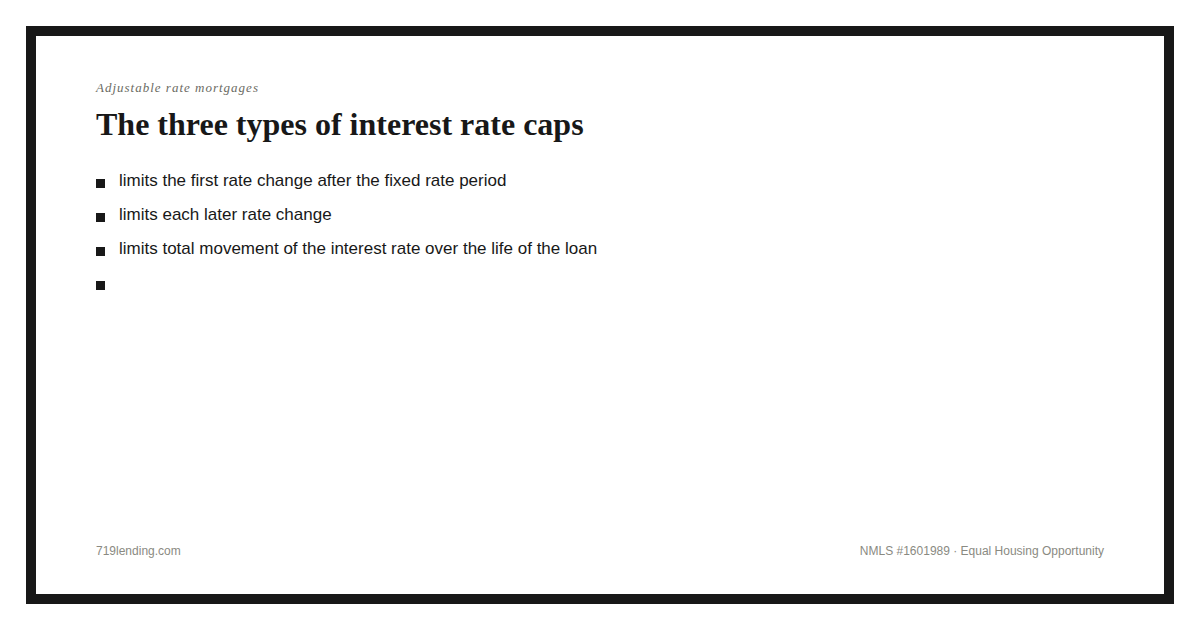
Rate caps are the built-in guardrails of an adjustable-rate mortgage. They limit how far the interest rate can move at the first adjustment, at each later adjustment, and in total over the life of the loan. Here is what each cap does, where to find them in the loan documents, and the questions to ask before you sign.
Can a Lender Require Documents Before a Loan Estimate?
Can a lender require me to submit documents before giving me a Loan Estimate? The short answer is no — a lender or mortgage broker cannot make you provide documents like a W-2, pay stub, or bank statements as a condition for giving you a Loan Estimate. This article explains what the rule actually says, what six pieces of information you do have to give, and how to use the Loan Estimate to compare lenders — whether you are buying near Fort Carson, Peterson, or anywhere else in Colorado.
Can a lender require documents before giving me a Loan Estimate?

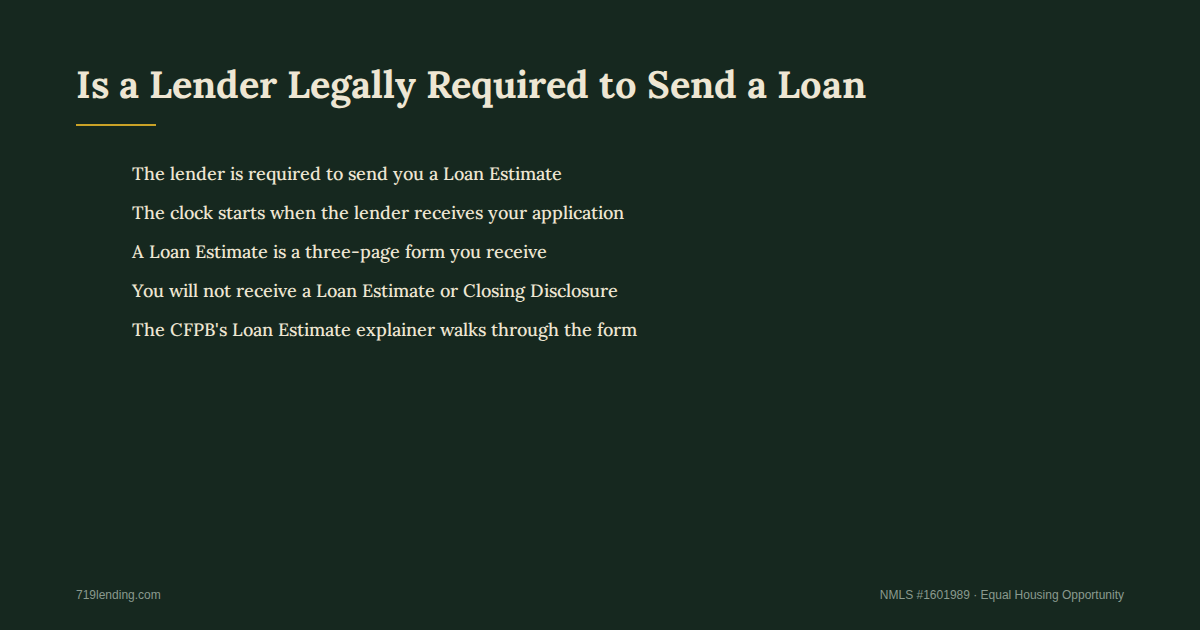
No. According to the Consumer Financial Protection Bureau, a lender or mortgage broker cannot require you to provide any documents as a condition for giving you a Loan Estimate.
To receive a Loan Estimate, you only need to submit six key pieces of information. No W-2. No pay stub. No tax returns. No signed stack of paperwork.
Once the lender has those six items, it has received a mortgage application for Loan Estimate purposes, and the clock starts. The next section covers exactly what those six items are.
The six pieces of information you actually have to provide
These are the only inputs a lender needs from you before it must issue a Loan Estimate:
| # | Information required | Why the lender needs it |
|---|---|---|
| 1 | Your name | Identifies the borrower on the loan application |
| 2 | Your income | What you state you earn — no documents required yet |
| 3 | Your Social Security number | So the lender can check your credit report |
| 4 | The property address | The home you plan to purchase or refinance |
| 5 | An estimate of the property’s value | Your good-faith estimate of the value of the property |
| 6 | The desired loan amount | How much you want to borrow |
Notice that item two is your income as you state it, not your income as documented. Verification comes later in the process.
With those six items submitted, federal law puts a deadline on the lender — which is what makes this rule useful.
When does the lender have to deliver the Loan Estimate?
The lender must provide the Loan Estimate within three business days of receiving your application — meaning those six pieces of information.
The Loan Estimate is a standardized three-page form. Every lender is required to use the same Loan Estimate form, which is exactly what makes it possible to compare loan offers side by side.
Receiving a Loan Estimate does not mean the loan is approved or denied. The Loan Estimate shows the loan terms the lender expects to offer if you decide to move forward.
So what happens if a loan officer insists on documents anyway? That is the next question.
What if a loan officer insists on a W-2 or pay stub first?
A loan officer can ask for documents — asking is allowed and often helpful. What the loan officer cannot do is refuse to issue a Loan Estimate because you have not turned documents in.
Requesting versus requiring
There is a real difference between “it would help to see your pay stub” and “I can’t give you a Loan Estimate until you send your pay stub.” The first is a request. The second conflicts with the rule the CFPB describes.
The CFPB also addresses a related tactic: a loan officer saying you cannot apply and receive a Loan Estimate until you provide a signed purchase contract. That question appears on the CFPB’s own site, and the six-item list above is the standard — a purchase contract is not on it.
Why sharing documents anyway can make sense
Although you are not required to provide documents to get a Loan Estimate, the CFPB notes it is a good idea to share what you have. The more information the lender has, the more accurate the Loan Estimate will be.
Stated income and documented income sometimes differ — especially for self-employed borrowers or service members whose pay includes allowances. Accurate inputs produce an accurate estimate, which brings us to what happens after you receive the form.
What happens after you receive a Loan Estimate?
Once you receive a Loan Estimate, the next move is yours: decide whether you want to proceed with the loan application.
Intent to proceed
After you notify the lender that you would like to proceed, the lender may then require additional information and documents to verify what you already submitted. This is the point where W-2s, pay stubs, and bank statements legitimately enter the picture.
If your verification documents show different information than what you provided, you may receive a revised Loan Estimate reflecting the corrected details.
You can keep shopping
The CFPB is explicit that you can continue to comparison shop throughout this process. Expressing intent to proceed with one lender does not lock you out of getting Loan Estimates elsewhere.
That freedom to shop is the whole point of the rule — and it deserves its own section.
Why this rule exists: comparing lenders on equal footing
The CFPB’s stated tip is that the way to get a good deal on a mortgage that fits you is to request Loan Estimates from multiple lenders and compare offers.
If lenders could demand a full document package before issuing an estimate, shopping would be slow and painful, and most borrowers would stop after one lender. The six-item standard keeps the cost of comparison low.
What to compare on the Loan Estimate form
The Loan Estimate shows important details about the mortgage loan you requested, including the estimated interest rate, the expected monthly payment, and total closing costs.
The form also shows estimated costs of property taxes and insurance, how the interest rate and payments may change in the future, and flags risky features like a prepayment penalty, a balloon payment, or negative amortization.
The CFPB’s guidance on comparing origination charges is blunt: depending on the lender, charges may be more or less itemized, and it’s the total that matters. Compare origination charges across Loan Estimates, and compare the services you cannot shop for the same way.
Also check whether a rate lock is in place — some lenders may lock the rate as part of issuing the Loan Estimate, and some may not. The form tells you.
A note on “fee sheets” and pre-approvals
An informal fee sheet, worksheet, or pre-approval letter is not an official Loan Estimate. Only the standardized Loan Estimate form carries the federal timing and content requirements described above, so compare lenders using the actual form.
There are, however, a few loan types where no Loan Estimate exists at all.
Loans that don’t come with a Loan Estimate
Per the CFPB, you will not receive a Loan Estimate or a Closing Disclosure if you are shopping for:
- A reverse mortgage
- A home equity line of credit (HELOC)
- A manufactured housing or mobile home loan not secured by real estate
- Certain loans through homebuyer assistance programs
For these kinds of loans you should receive Truth-in-Lending disclosures instead, and reverse mortgage shoppers also receive a Good Faith Estimate and a HUD-1 or HUD-1A Settlement Statement.
For a standard purchase or refinance mortgage loan, though, the Loan Estimate applies — and its counterpart arrives near closing day.
Loan Estimate vs. Closing Disclosure
The Loan Estimate arrives at the start of the process, within three business days of application, and shows the terms the lender expects to offer.
The Closing Disclosure is the companion document later in the process, before closing day, showing the final figures. If verification documents changed anything along the way, a revised Loan Estimate should have already flagged it — no surprises on the closing table is the design goal of both forms.
Everything above comes straight from the primary authority, which is worth reading yourself.
What the official source says and where to read it
The controlling guidance is from the Consumer Financial Protection Bureau, the federal agency that implements and enforces consumer financial law in the mortgage industry.
Read the CFPB’s answer directly: Can a lender make me provide documents to give me a Loan Estimate? The Bureau also publishes an interactive Loan Estimate explainer that walks through the sample form line by line, and a plain-English overview of what a Loan Estimate is.
You can also look up any loan officer by name or NMLS ID in the Nationwide Mortgage Licensing System & Registry database to confirm they are authorized to operate in Colorado.
Armed with the rule, here is how to put it to work.
Your next step
Gather the six items — name, income, Social Security number, property address, estimated property value, and desired loan amount — and give them to each lender you want to compare. Each one owes you a Loan Estimate within three business days.
For Colorado Springs borrowers, especially military families working around a PCS timeline, this means you can request Loan Estimates from multiple lenders quickly and compare them on the same standardized form before committing documents to anyone.
When you are ready, talk to a 719 Lending loan officer, provide the six pieces of information, and review the Loan Estimate together line by line before deciding whether to proceed.
Frequently asked questions
Can a lender make me provide a W-2 or pay stub to get a Loan Estimate?
No. The CFPB states a lender or mortgage broker cannot require any documents as a condition for giving you a Loan Estimate. You only need to provide six pieces of information: name, income, Social Security number, property address, an estimate of the property’s value, and the desired loan amount.
How long does a lender have to give me a Loan Estimate?
The lender must provide the Loan Estimate within three business days of receiving your application — meaning the six required pieces of information.
Do I need a signed purchase contract to receive a Loan Estimate?
A purchase contract is not one of the six items required to trigger a Loan Estimate. The CFPB addresses this exact scenario on its site; the six-item list is the standard for receiving a Loan Estimate.
When will the lender ask for my documents?
After you tell the lender you intend to proceed with the loan application. At that point the lender may require additional information and documents to verify what you submitted, and if the documents show different information, you may receive a revised Loan Estimate.
Does getting a Loan Estimate mean my loan is approved?
No. The Loan Estimate shows the loan terms the lender expects to offer if you move forward. The lender has not yet approved or denied the loan application at that stage.
Which loans don’t come with a Loan Estimate?
Reverse mortgages, home equity lines of credit (HELOCs), manufactured or mobile home loans not secured by real estate, and certain homebuyer assistance program loans. Those receive Truth-in-Lending disclosures instead.
719 Lending Inc., NMLS #1601989 · Equal Housing Opportunity
719 Lending Inc. is not affiliated with or endorsed by HUD, FHA, VA, USDA, CHFA, the CFPB, or any government agency.
Last updated: September 2026

Related Posts