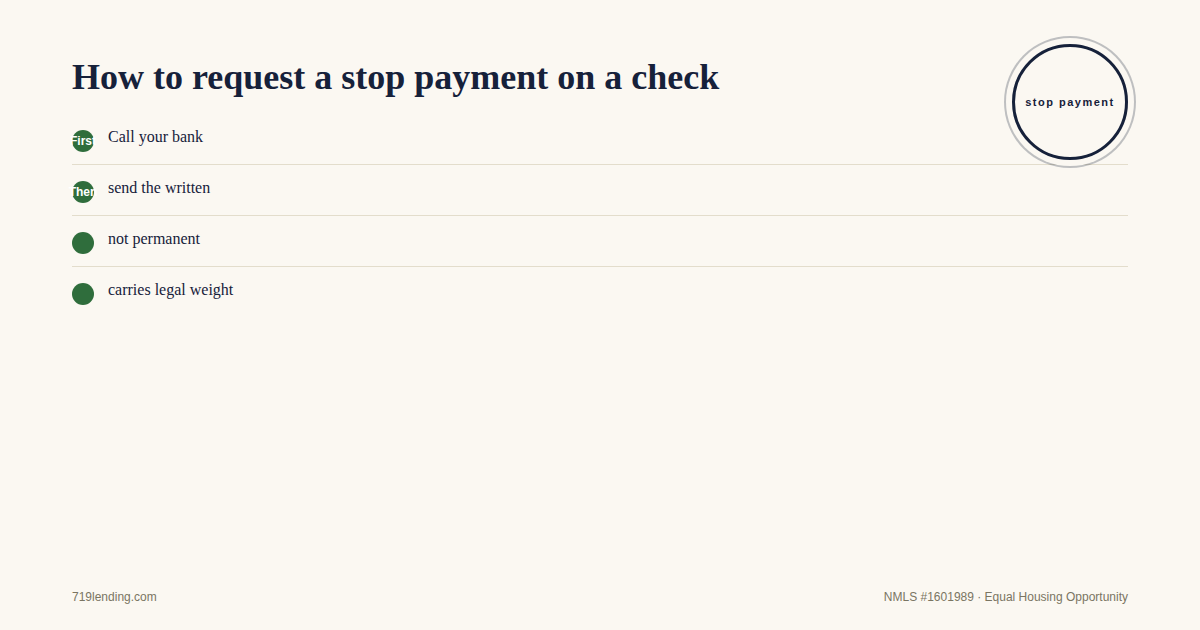
Writing a future date on a check does not stop a bank or credit union from cashing it early. The way to prevent early cashing is to notify the bank before the check arrives — and written notice lasts far longer than a phone call. Here is exactly how the process works, based on Consumer Financial Protection Bureau guidance.
What Types of Financial Institutions Offer Personal Lines of Credit?
If you are asking what types of financial institutions offer personal lines of credit, the short answer from the Consumer Financial Protection Bureau (CFPB) is banks and credit unions. This guide explains how a personal line of credit works, why those institutions usually require a checking account first, how the product compares to a credit card and a home equity line of credit, and what to confirm before you apply. It is written for Colorado borrowers, including the many military families around Colorado Springs who bank with both national banks and local credit unions.
What types of financial institutions offer personal lines of credit?
Personal lines of credit are offered by banks and credit unions. That is the answer the CFPB gives directly on its consumer education site.
Just as important: these institutions usually require that you also have a checking account with them before they extend a personal line of credit. The line of credit is typically tied to that deposit relationship.
Here are the key facts, straight from the CFPB’s guidance:
- Banks and credit unions are the institutions that offer personal lines of credit.
- A checking account at the same bank or credit union is usually required.
- A personal line of credit is unsecured — it does not require collateral.
- You have a credit limit, receive a monthly bill, and make at least a minimum payment.
- You pay interest based on your outstanding balance, and possibly a fee each time you use the account.
Before we look at banks and credit unions separately, it helps to be precise about what a personal line of credit actually is.
What is a personal line of credit?
A personal line of credit is a loan that you access from time to time rather than receiving all at once as a lump sum. It functions as a revolving credit account, similar in mechanics to a credit card.
Unlike a home equity line of credit, a personal line of credit is unsecured. There is no mortgage on your home backing it, which is a core difference from a HELOC.
How you access funds
With a personal line of credit, you access funds by writing special checks or by requesting a transfer to your checking account by phone or through an online transfer.
That built-in connection to a checking account is part of why banks and credit unions usually want the deposit relationship in place before approving the credit line.
How repayment works
Like a credit card account, a personal line of credit comes with a credit limit. You receive a monthly bill and must make at least a minimum payment.
You pay interest based on the outstanding balance, not on the full credit limit. Some institutions may also charge a fee each time you use the account, so the account agreement matters.
With the definition settled, here is how the product looks at each type of institution.
Banks that offer personal lines of credit
Banks are one of the two types of financial institutions that offer personal lines of credit. A bank customer with an established checking account is the typical applicant, since the institution usually requires that deposit relationship.
At a bank, the personal line of credit is generally linked to the checking account, which is how check-writing access and phone or online transfers into the account work.
Why a checking account usually comes first
The checking account requirement is not an arbitrary hoop. It is how the institution delivers the funds when you draw on the line, and it is also tied to the lender’s remedies if the line is not repaid, which we cover below.
If you do not already bank where you want the credit line, expect opening a checking account to be part of the application conversation. Your current bank is usually the natural first place to ask.
Credit unions follow a similar model, with one structural difference: membership.
Credit unions that offer personal lines of credit
Credit unions are the other type of financial institution that offers personal lines of credit. The same general pattern applies: the credit union will usually require that you hold a checking account with it.
Credit unions are membership organizations, so holding an account there typically means you are already a member. The personal line of credit then sits alongside your existing deposit accounts.
Credit unions and the Colorado Springs military community
The Pikes Peak region has a heavy military presence, and many service members and veterans here bank with credit unions that serve the military community. If that describes you, the institution where your checking account already lives is a logical place to ask whether an unsecured line of credit is available.
For families managing cash flow around a PCS move, knowing which of your existing institutions offers a personal line of credit — before you need one — is a practical planning step.
Whichever institution you choose, the checking account connection has a consequence worth understanding before you sign: setoff.
Why the checking account requirement matters: setoff
Setoff is a right the lender may have under your contract. If you do not pay back a personal line of credit, the bank or credit union may be able to take the money you owe directly from your checking account or any other account you have at that same institution.
That could include a savings account held at the same bank or credit union, depending on your agreement. The CFPB’s advice is blunt: read your contract before you sign it so you know what you are agreeing to.
Notably, setoff is not permitted for credit card accounts, but it is permitted for personal lines of credit. That is a real structural difference between two products that otherwise feel similar.
That comparison — line of credit versus credit card versus HELOC — deserves its own section.
How a personal line of credit compares to a credit card and a HELOC

All three products involve a credit limit and ongoing access to borrowing, but the differences matter when something goes wrong or when collateral is involved.
| Feature | Personal line of credit | Credit card | Home equity line of credit (HELOC) |
|---|---|---|---|
| Collateral | Unsecured — does not require collateral | Unsecured | Secured — backed by a mortgage on your home |
| Where offered | Banks and credit unions, usually with a checking account there | Credit card companies | Mortgage lenders and depositories |
| How you draw funds | Special checks, or phone/online transfer to checking | Card purchases | Varies by lender agreement |
| Setoff against your deposit accounts | Permitted | Not permitted | Governed by the loan contract |
| Billing | Monthly bill, minimum payment, interest on outstanding balance | Monthly bill, minimum payment | Monthly payments per the agreement |
A personal line of credit and a credit card are both unsecured revolving credit. The setoff distinction and the checking account requirement are what separate them structurally.
A HELOC, by contrast, is secured by your home. If home equity borrowing is actually what you are weighing, the team at 719 Lending’s loan options page covers mortgage-secured products in more depth.
So who actually uses an unsecured personal line of credit?
Who does a personal line of credit apply to?
A personal line of credit fits borrowers who want ongoing access to funds rather than a one-time lump sum. Because you pay interest on the outstanding balance, the account is built for borrowing money intermittently and repaying as you go.
It applies to people who already have — or are willing to open — a checking account at the bank or credit union offering the credit line, since that relationship is usually required.
Common motivations include smoothing irregular cash flow or keeping flexible access to funds for expenses that arrive unpredictably. Some borrowers also compare personal lines against personal loans when they want to consolidate debt; the right structure depends on whether you need everything up front or want revolving credit you can reuse.
Your credit history and overall credit profile will factor into the institution’s decision, so it is worth knowing where you stand before applying. Pulling your credit report ahead of time lets you correct errors first.
Wherever you land, the authoritative plain-English explanation of this product comes from a federal agency.
What the official source says and where to read it
The Consumer Financial Protection Bureau is the federal agency that publishes consumer guidance on personal lines of credit. Its Ask CFPB pages define the product, identify banks and credit unions as the institutions that offer it, and explain the consequences of nonpayment.
The CFPB describes itself as an agency that implements and enforces federal consumer financial law and works to keep markets for consumer financial products transparent, fair, and competitive. Its pages on this topic are consumer information, not legal advice.
You can read the source pages at consumerfinance.gov under “What is a Personal Line of Credit?” and “What happens if I do not pay back my Personal Line of Credit?” Both are short and worth the read before you sign anything.
The CFPB also suggests related questions worth researching — what to look for when shopping for a personal line of credit, and how to find one — which leads naturally to the questions you should ask the institution itself.
Questions to ask a bank or credit union before you apply
Because terms live in the contract, the application conversation is where you get specifics. Ask the institution:
- Is a checking account with you required, and does an existing account qualify?
- What is the credit limit you would offer, and how is it determined?
- Is the interest rate fixed or variable, and how is the annual percentage rate disclosed?
- Is there an annual fee, or a fee each time I use the account?
- How do I access funds — special checks, phone transfer, or online transfer?
- What are the setoff provisions in the contract?
- What are the credit qualifications, and will applying involve a hard credit inquiry?
Write the answers down and compare them across more than one bank or credit union. The contract language on fees and setoff is where personal lines of credit differ most from account to account.
One more topic belongs in that conversation: what happens if repayment goes wrong.
What happens if you do not pay back a personal line of credit?
According to the CFPB, your account may be suspended. The lender may also be able to exercise setoff — taking the money you owe directly from your checking account or any other account you hold at that bank or credit union.
Missing payments on a personal line of credit may also negatively impact your credit score and credit history, which could affect your ability to get credit in the future. Since payment history feeds future lending decisions, that damage can follow you into a later mortgage application.
You may also be liable for collection costs in some states. The CFPB’s core advice bears repeating: read the contract before you sign so you know exactly what you are agreeing to.
With the risks understood, here is how to move forward.
What to do next
Start with the bank or credit union where you already hold a checking account, since that relationship is usually required anyway. Ask whether an unsecured personal line of credit is available and request the fee schedule and contract terms in writing.
Read the CFPB’s pages at consumerfinance.gov before signing, paying particular attention to setoff and per-use fees.
And if the borrowing you are really contemplating is tied to a home — buying, refinancing, or tapping equity — that is mortgage territory rather than unsecured credit. The team at 719 Lending works with Colorado Springs borrowers, including active-duty and veteran families, every day. Reach out and a loan officer can walk through which structure fits your situation.
Frequently asked questions
Do banks or credit unions offer personal lines of credit?
Both. The Consumer Financial Protection Bureau states that personal lines of credit are offered by banks and credit unions, and that these institutions usually require you to also have a checking account with them.
Is a personal line of credit secured or unsecured?
A personal line of credit is unsecured. Unlike a home equity line of credit (HELOC), which is backed by a mortgage on your home, a personal line of credit does not require collateral.
Do I need a checking account to get a personal line of credit?
Usually, yes. Banks and credit unions that offer personal lines of credit typically require you to hold a checking account at the same institution, since draws are made by special checks or transfers into that account.
How is a personal line of credit different from a credit card?
Both are unsecured revolving credit with a credit limit, a monthly bill, and a minimum payment. One key legal difference: setoff — the lender taking owed money directly from your deposit accounts — is permitted for personal lines of credit but not for credit card accounts.
What happens if I don’t pay back a personal line of credit?
Your account may be suspended, and the bank or credit union may take the money you owe directly from your checking or other accounts there through setoff. Nonpayment can also hurt your credit score and history, and you may owe collection costs in some states.
How do I access funds from a personal line of credit?
You write special checks or request a transfer to your checking account by phone or online. You then pay interest on the outstanding balance, and possibly a fee each time you use the account.
719 Lending Inc., NMLS #1601989 · Equal Housing Opportunity
719 Lending Inc. is not affiliated with or endorsed by HUD, FHA, VA, USDA, CHFA, the CFPB, or any government agency.
Last updated: November 2026

Related Posts