Personal lines of credit are offered by banks and credit unions, and most require you to hold a checking account at the same institution. This guide explains how a personal line of credit works, why the checking account requirement matters, how it differs from a credit card or HELOC, and what to confirm before you sign.
Will My Bank Charge Me to Stop Payment on a Check?
Will my bank charge me to stop payment on a check? In most cases, yes — the Consumer Financial Protection Bureau (CFPB) says your bank or credit union may charge you a fee when you request to stop payment on a check, and that banks and credit unions generally charge fees for stop payment orders.
This guide explains how the stop payment process works, how long a stop payment request lasts, why stop payment fees vary between financial institutions, and how stopping a paper check differs from stopping automatic payments. It is written for everyday account holders, including the many Colorado Springs households juggling earnest money checks, movers, and deposits during a home purchase or a PCS move.
The short answer: expect a stop payment fee at most banks
When you ask your bank to stop payment on a check, you are asking the financial institution to refuse the check if someone presents it. That service usually comes with a fee.
The CFPB puts it plainly: your bank or credit union may charge you a fee when you request to stop payment on a check. It also notes that banks and credit unions generally charge fees for stop payment orders used against automatic payments.
How much the fee is, and whether it is ever waived, is a question for your specific bank — the stop payment process and the policies around it vary between financial institutions. The next section summarizes the essentials before we go deeper.
Key takeaways
- Most banks and credit unions charge a fee for a stop payment request; confirm the exact cost with your financial institution.
- Contact your bank or credit union right away — a stop payment works best before the check has been completely processed.
- Make the stop payment request in writing. In most states, a written request made before the check is completely processed means the check can’t be cashed for six months.
- In some cases the stop payment expires after one year; you can place another stop payment order when the first one expires.
- Stopping an automatic payment is a different process: you revoke the company’s authorization and notify your bank, sometimes backed by a stop payment order.
- A stop payment does not cancel what you owe. To permanently block a payment, consider closing the account and opening a new one.
With the summary in hand, it helps to understand exactly what a stop payment is and who typically needs one.
What a stop payment on a check actually is
A stop payment order is an instruction to your bank or credit union telling the financial institution not to pay a specific check or a payment to a specified company from your account.
Once the stop payment is in place and before it expires, the bank should refuse the check if someone tries to cash it. After the stop payment request expires, the bank or credit union may pay out the check if someone presents it.
Who this applies to
Anyone with a checking account who has written a paper check and now needs to cancel it: a check that was lost in the mail, a check written to a contractor who never showed up, or a duplicate payment made by mistake.
In a military town like Colorado Springs, this comes up often around moves — a deposit check mailed to a landlord before a PCS falls through, or an earnest money check that needs to be replaced after a contract changes. If you suspect check fraud or theft, telling your bank right away matters even more.
What information the bank will want
The stop payment process varies between financial institutions, so talk to someone at your bank or credit union about their specific policies. Expect to identify the specific check as precisely as you can — details like the check number, the check date, the payee, and the amount help the bank match the right item, whether you call, visit a branch, or use online banking.
Knowing what a stop payment is, the next question is how to actually place one.
How to request a stop payment on a check

The CFPB’s guidance is straightforward: contact your bank or credit union right away if you want to stop payment on a check. Speed matters because the stop payment needs to land before the check has been completely processed.
Step 1: contact your bank or credit union right away
Call your bank, use online banking if your financial institution offers a stop payment option there, or speak directly with someone at a branch. Customer service should be able to walk you through their process.
Ask two questions up front: what the stop payment fee is, and how long the stop payment order will last at that institution.
Step 2: put the stop payment request in writing
The written request is the one that carries legal weight in most states. Most states have laws that say if you make your stop payment request in writing, before the check has been completely processed, the check can’t be cashed for six months.
A phone call starts the clock; the written stop payment request secures it. Follow your bank’s suggested process for submitting it.
Step 3: keep records and watch the account
Keep close track of your requests and the dates you made them. If something goes wrong and a payment goes through after you gave your instructions, that record lets you work with the bank or credit union to refund your account.
Once the stop payment is placed, the next thing to understand is its shelf life.
How long does a stop payment last?
A stop payment is not permanent. How long it lasts varies between financial institutions, so ask yours directly.
The six-month rule in most states
Under most states’ laws, a written stop payment request made before the check is completely processed means the check can’t be cashed for six months. In some cases, the stop payment expires after one year instead.
What happens when the stop payment expires
After the stop payment request expires, the bank or credit union may pay out the check if someone presents it. If the check is still outstanding, you can make another stop payment order when the first one expires — though your bank may charge the same fee again, so ask before you renew.
If you never want that payment to go through, there is a more permanent route, covered below. First, a closer look at the fees themselves.
Why stop payment fees vary between financial institutions
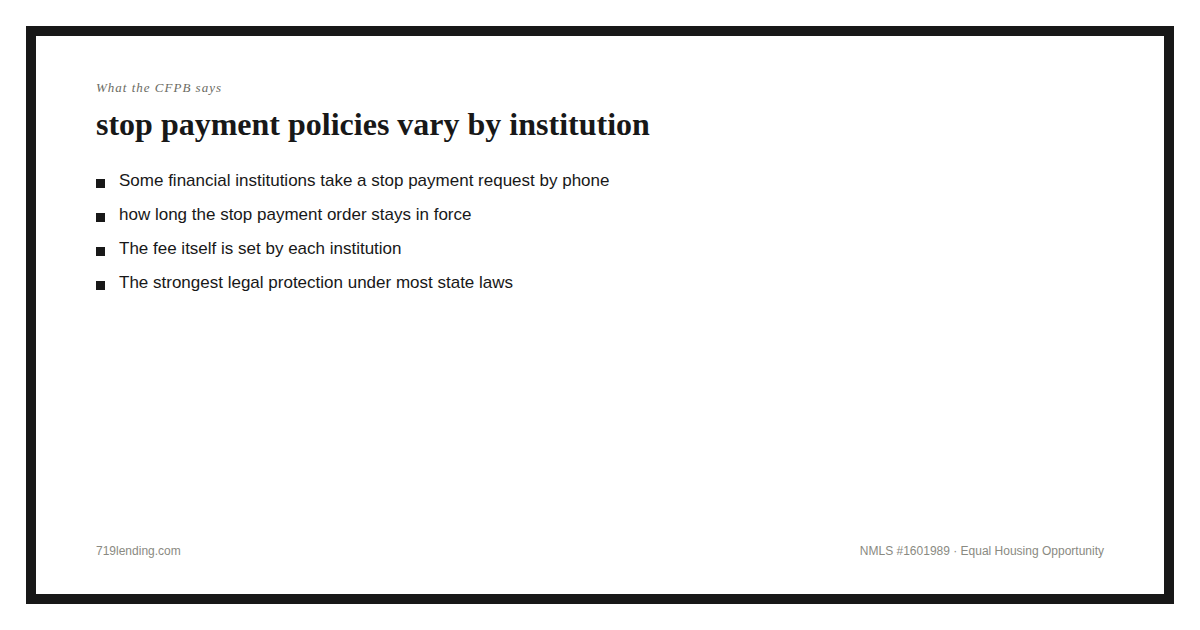
There is no single national stop payment fee. The CFPB notes that the process of stopping payment on a check varies between financial institutions, and the same is true for how long the stop payment lasts — which is why talking to someone at your own bank or credit union is the only way to know what you will pay.
Questions to ask your bank before you pay
- What is the stop payment fee on this account, and does it differ by how I submit the request — phone, branch, or online banking?
- How long does the stop payment order last here — six months, one year, or something else?
- Does the same fee apply if I renew the stop payment after it expires?
- Can one stop payment request cover multiple checks, or is each check a separate fee?
- What is the policy on cashier’s checks or other official items? Policies differ, so confirm directly rather than assuming.
Fees on paper checks are only half the story — stopping an automatic payment from your checking account follows its own process.
Stopping automatic payments is a different process
If a company pulls money from your account electronically, you are not cancelling a check — you are revoking the company’s authorization to debit the account. You have the right to stop a company from taking automatic payments from your account, even if you previously allowed them.
Call and write the company
Call the company and tell them you are taking away permission to take automatic payments out of your bank account, then follow up in writing by letter or email. Be clear whether you are cancelling the contract or subscription entirely, or only changing the payment method.
Call and write your bank or credit union
Next, call your bank or credit union and say you have revoked the company’s authorization, then follow up in writing. After both notices, any additional payments initiated by that company would be errors, and you can contact your bank for a refund.
Use a stop payment order if your bank recommends one
Some banks or credit unions might recommend you send them a stop payment order as well — an instruction not to make a payment to a specified company from your account. Banks and credit unions generally charge fees for these stop payment orders, so the same fee question applies here as with checks.
Monitor the account afterward
Tell your bank or credit union right away if you see a payment you did not allow or a payment made after you revoked authorization. Federal law gives you the right to dispute and get your money back for unauthorized transfers, as long as you tell your bank in time.
Whichever route you use, there are two things a stop payment will never do.
What a stop payment does not do
It does not cancel what you owe
Cancelling an automatic payment does not cancel the underlying debt. If you cancel an automatic payment on a loan, you still have to make payments using another method, and if you want out of an ongoing service contract — a gym, cable — you must cancel the contract with the company, not just the payment.
It is not permanent protection
Because a stop payment order expires, the CFPB notes that to permanently stop a payment from going through, you can consider closing the account and opening a new one. That is a bigger step — direct deposit, linked bills, and any savings account transfers all have to move — so weigh it against simply renewing the stop payment.
All of this comes straight from the federal consumer regulator, which is worth reading firsthand.
What the official source says and where to read it
The Consumer Financial Protection Bureau publishes plain-language answers on stop payments at consumerfinance.gov, including how to stop payment on a check and how to stop automatic payments from a bank account, with sample letters you can adapt.
The CFPB material is general consumer information, not legal advice — and because stop payment fees and timelines vary, your own bank or credit union remains the authority on its policies. Here is why this matters during a home purchase.
Why this matters when you’re buying a home in Colorado
Home purchases run on checks and transfers: earnest money, appraisal and inspection payments, and closing funds. If a check connected to your purchase goes missing or a deal changes, acting on a stop payment right away keeps your paper trail clean.
Bank activity also shows up on the documentation side of a mortgage. Keeping dated records of any stop payment request makes that conversation simple — and the team at 719 Lending in Colorado Springs can tell you how a banking change fits into your file.
What to do next
Call your bank or credit union now and ask three things: the stop payment fee, how long the stop payment lasts, and how to submit the request in writing. Then send the written request, note the date, and watch the account until you are sure the check or payment did not clear.
If the payment in question touches a home purchase or refinance, mention it to your loan officer early so the documentation is handled before underwriting asks. A quick phone call today is cheaper — in money and stress — than a cashed check you meant to cancel.
Frequently asked questions
Will my bank charge me a fee to stop payment on a check?
In most cases, yes. The Consumer Financial Protection Bureau says your bank or credit union may charge a fee when you request to stop payment on a check, and that financial institutions generally charge fees for stop payment orders. The exact fee varies by bank, so ask yours before you submit the request.
How long does a stop payment on a check last?
It varies between financial institutions. Most states have laws saying that if you make the stop payment request in writing before the check has been completely processed, the check can’t be cashed for six months. In some cases the stop payment expires after one year, and you can place another stop payment order when the first one expires.
Can my bank pay the check after the stop payment expires?
Yes. After your stop payment request expires, the bank or credit union may pay out the check if someone presents it. If the check is still outstanding, renew the stop payment — or, to permanently block the payment, consider closing the account and opening a new one.
Can I stop an automatic payment from my checking account?
Yes. You have the right to stop a company from taking automatic payments even if you previously allowed them. Call and write the company to revoke authorization, then call and write your bank or credit union. Some banks also recommend a stop payment order, which generally carries a fee.
Does stopping payment on a check cancel what I owe?
No. A stop payment blocks that specific check or debit, but it does not cancel the underlying debt or contract. If you cancel an automatic payment on a loan, you still must pay by another method, and ongoing services like a gym membership must be cancelled with the company directly.
What if the check has already been cashed?
A stop payment works when it is placed before the check has been completely processed, which is why the CFPB says to contact your bank or credit union right away. If a payment went through that you did not authorize, tell your bank immediately — federal law gives you dispute rights for unauthorized transfers if you report them in time.
719 Lending Inc., NMLS #1601989 · Equal Housing Opportunity
719 Lending Inc. is not affiliated with or endorsed by HUD, FHA, VA, USDA, CHFA, the CFPB, or any government agency.
Last updated: November 2026

Related Posts