Personal lines of credit are offered by banks and credit unions, and most require you to hold a checking account at the same institution. This guide explains how a personal line of credit works, why the checking account requirement matters, how it differs from a credit card or HELOC, and what to confirm before you sign.
How to Stop a Bank From Cashing a Post-Dated Check Early
If you want to know how to prevent your bank from cashing a post-dated check early, the answer comes down to one action: notify the bank or credit union before the check arrives, and do it in writing. This article explains why postdating a check does not protect you on its own, what the Consumer Financial Protection Bureau (CFPB) says the rules are, and the exact steps to take.
It is written for anyone who writes checks dated for a future payday — including the many Colorado Springs households managing military pay cycles, PCS move expenses, or a payment plan with a landlord or contractor.
- Banks and credit unions generally do not have to wait until the date on the check to cash it.
- State law may require the bank to wait if you notify it first.
- Written notice given a reasonable time before the check arrives is generally valid for six months.
- Oral notice alone is generally valid for only 14 days.
- If the bank cashed the check early while valid notice was in place, it may be liable to you for damages.
Can a bank cash a post-dated check before the date on the check?

Yes. According to the CFPB, banks and credit unions generally do not have to wait until the date you put on a check to cash it. Writing a future date on a check — postdating it — does not, by itself, create any obligation for the bank to hold the check.
Checks move through processing based on when they are deposited, not the date written on them. So if the check recipient deposits a post-dated check tomorrow, the bank can usually process it tomorrow, regardless of the indicated date.
That surprises a lot of check writers. The protection exists, but you have to activate it — which is what the next section covers.
How to prevent your bank from cashing a post-dated check early
The CFPB’s guidance is direct: contact your bank or credit union to hold the check before it is processed, and learn what its policies are. The strength of your protection depends on how you give that notice.
Step 1: Contact the bank before the check arrives
Timing matters. State law generally protects you if you notified the bank a reasonable time before it received the post-dated check. Notice given after the check has already been processed does not undo the payment.
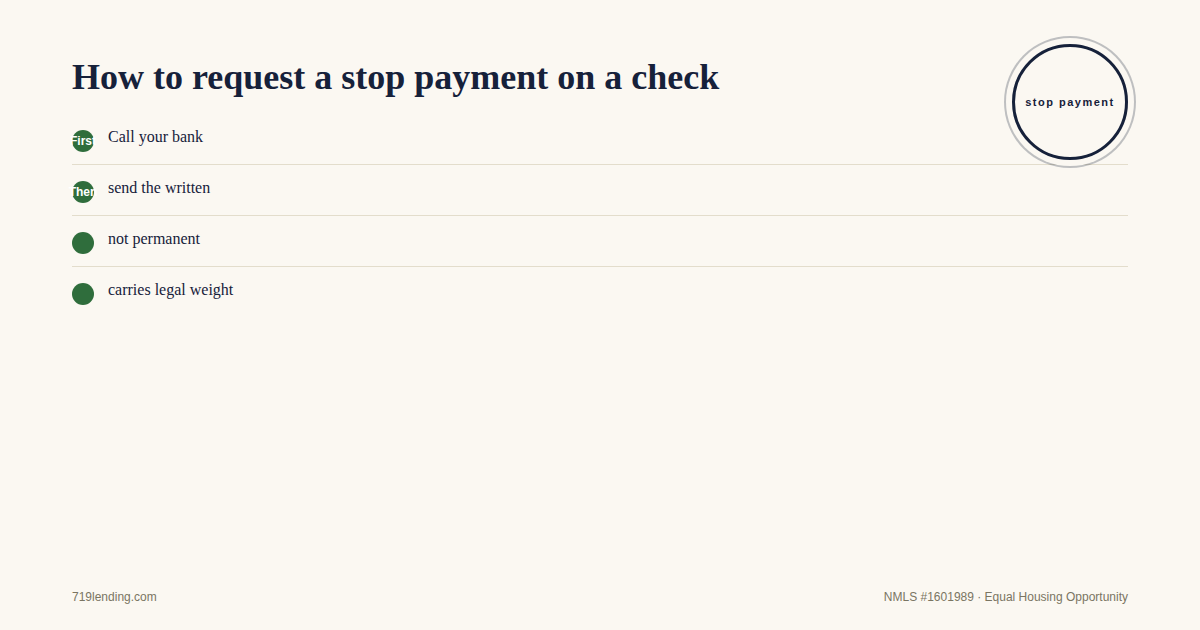
Call the number on the back of your debit card or visit a branch, identify the account, and tell the bank you have written a post-dated check that should not be cashed before the date on the check.
Step 2: Put the notice in writing
This is the step that does the real work. Generally, state law provides that if you notified your bank or credit union in writing about a post-dated check a reasonable time before it received the check, your notice is valid for six months. During that window, the bank should not cash the check before the date you wrote on it.
Include enough detail for the bank to identify the check — ask the bank what information it needs when you contact it, and keep a copy of what you send and the date you sent it.
Step 3: Confirm the bank’s specific policies
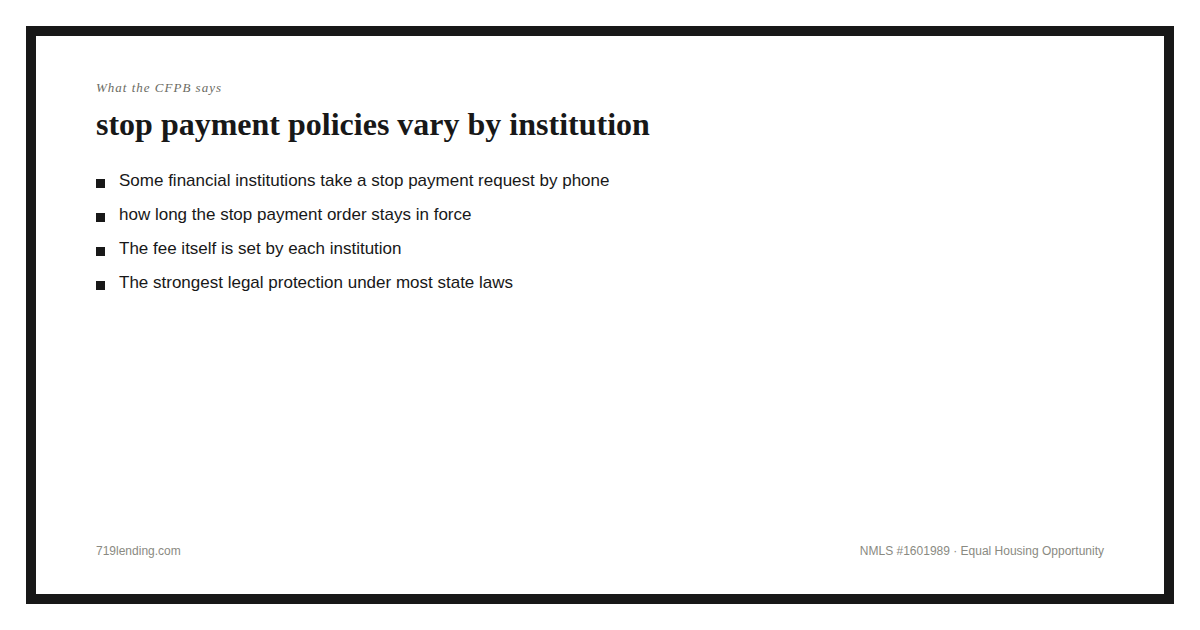
The CFPB notes that state law governs here, and banks have their own procedures for handling these requests. Ask whether the bank charges anything for the notice, how it wants the request submitted, and review your account disclosures so you know what applies to your checking account.
Once notice is in place, the key question becomes how long it lasts — and that depends entirely on the format.
Written notice vs. oral notice: how long each lasts
The difference between a phone call and a letter is the difference between roughly two weeks of protection and half a year of it.
| Type of notice | How long it is generally valid | What happens after it expires |
|---|---|---|
| Written notice, given a reasonable time before the check arrives | Six months | The bank may cash the check before the written date |
| Oral notice only, never confirmed in writing | 14 days | The bank may cash the check before the written date |
| No notice | No protection | The bank can generally cash the check at any time |
If you only gave an oral notice without confirming it in writing, the notice is only valid for 14 days. After that, the bank or credit union can cash the check before the date you wrote on it — even though you called.
The practical takeaway: call first if you need to act fast, then follow up in writing the same day. That converts a 14-day shield into a six-month one.
But what if the bank ignores a valid notice? That is where liability comes in.
What if the bank cashed the check early anyway?
If your bank or credit union cashed a check before the date you put on it while your notice was still valid, the CFPB says the bank may be liable to you for any damages.
Gather your documentation: the copy of your written notice, the date you sent it, and the records showing when the check cleared. Then raise the issue with the bank directly.
Keeping that paper trail from the start is why the written notice matters twice over — it both triggers the protection and proves the protection existed.
Of course, the cleanest outcome is never needing the dispute. That is why it helps to understand why people postdate checks in the first place, and whether another tool fits better.
Why people postdate checks — and why it is risky
Post dating a check usually comes down to cash flow. The check writer owes money now but will not have enough money in the checking account until a future date — the next paycheck, the next military pay deposit, the next client payment.
The risk is the gap between expectation and reality. The check writer assumes the check will not move until the check date. The check recipient, and the bank, are generally free to treat it like any other check.
What can go wrong
If the check is deposited early and there are insufficient funds in the account, the payment can be returned or the account can go negative. Review your account disclosures to understand what fees your bank applies in those situations.
For military families around Fort Carson, Peterson, and Schriever, this often surfaces during a PCS move — deposits, rent checks, and moving expenses all landing in the same stretch while pay timing shifts.
Who this guidance applies to
The CFPB guidance applies to consumers dealing with banks and credit unions. If you wrote the check, the notice process above is your tool. If you received a post-dated check, understand that the writer may have instructed their bank to hold it until the specified date.
If postdating keeps causing friction, there are usually cleaner ways to time a payment.
Alternatives to postdating a check
Instead of relying on a future date written on paper, consider tools that actually control timing:
- Scheduled online bill payment. You pick the send date through your bank, so the payment cannot move before you authorize it.
- A scheduled electronic payment or transfer set for the actual date the money will be in the account.
- An agreed payment plan. Talk to the person or business you owe and set a due date that matches your cash flow, rather than handing over a check and hoping.
- Moving money from a savings account into checking before the check can clear, so sufficient funds are there regardless of when it is deposited.
Each of these puts the timing in your hands instead of depending on the check recipient to wait.
One more related question comes up constantly, so it is worth answering before the wrap-up.
Can the recipient cash the check anywhere?
Not necessarily. The CFPB notes that a bank or credit union is not obligated to cash a check, and one where neither the payee nor the check writer has an account will often refuse.
Many banks will cash a check written by one of their own account holders if there is money in the account to cover it, the check is not more than six months old, the person cashing it is the payee shown on the face of the check, and they show proper ID. A fee may apply for non-customers.
If the recipient deposits the check into their own checking account instead, the funds are usually available in one or two business days.
What to do next
If you have already written a post-dated check and need the bank to wait: call the bank today, then send written notice immediately so the protection runs six months instead of 14 days. Keep copies of everything.
If you are planning payments around a home purchase in Colorado Springs — earnest money, closing funds, moving costs — talk through the timing with your lender before checks start moving. The full CFPB guidance is available at consumerfinance.gov under “Can a bank or credit union cash a post-dated check before the date on the check?”
Frequently asked questions
Can a bank legally cash a postdated check before the date on it?
Yes. The Consumer Financial Protection Bureau says banks and credit unions generally do not have to wait until the date you put on a check to cash it. However, state law may require the bank to wait if you notify it about the post-dated check before it is received.
How long does a notice to hold a post-dated check last?
Generally, written notice given a reasonable time before the bank receives the check is valid for six months. An oral notice that is never confirmed in writing is only valid for 14 days, after which the bank can cash the check before the date written on it.
What happens if my bank cashed a postdated check early while my notice was valid?
According to the CFPB, if a bank or credit union cashed a check before the date you put on it while your notice was still valid, it may be liable to you for any damages. Keep a copy of your written notice and the records showing when the check cleared, then raise the issue with the bank.
Is postdating a check enough to stop it from being cashed?
No. Writing a future date on a check does not by itself stop a bank from processing it. The check recipient can deposit it at any time, and the bank can generally cash it unless you have given the bank valid notice to hold it until the check date.
Can someone cash my post-dated check at any bank?
Not always. A bank or credit union is not obligated to cash a check, and one where neither the payee nor the check writer has an account will often refuse. Many banks will cash a check for the named payee with proper ID if the account has money to cover it and the check is not more than six months old.
What should I do instead of postdating a check?
Consider scheduling an online bill payment or electronic transfer for the actual date the money will be in your account, agreeing on a payment plan with a due date that fits your cash flow, or moving funds from a savings account so sufficient funds are available whenever the check is deposited.
719 Lending Inc., NMLS #1601989 · Equal Housing Opportunity
719 Lending Inc. is not affiliated with or endorsed by HUD, FHA, VA, USDA, CHFA, the CFPB, or any government agency.
Last updated: November 2026

Related Posts