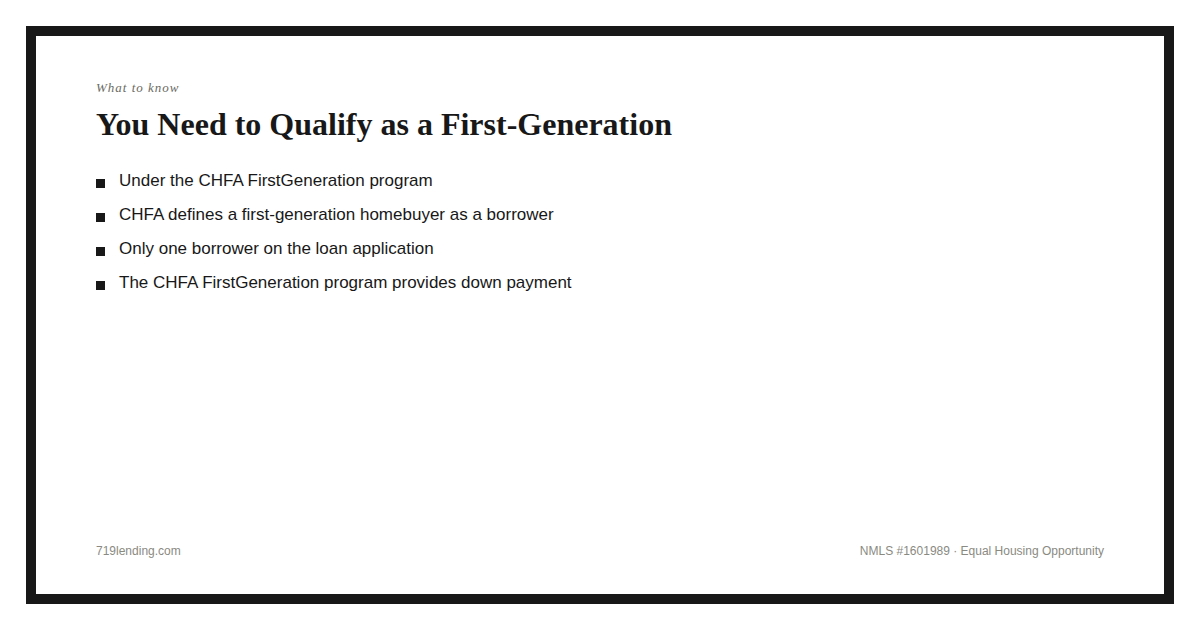
Wondering what proof you need to show you qualify as a first-generation homebuyer? For Colorado's CHFA FirstGeneration program, the answer is simpler than most people expect: a signed affidavit provided by your lender. Here's exactly how the definition works, who counts, and what happens after you sign.
What Does Financial Health Mean in Homebuying?
What does financial health mean in the context of homebuying? In plain terms, it is the current state of your finances — your credit, your debt, your savings, your income, and your investments — viewed through the lens of getting and keeping a mortgage.
That definition comes straight from the Colorado Housing and Finance Authority (CHFA), the state agency that has helped Coloradans become homeowners through education and down payment assistance. This article unpacks each piece for Colorado buyers, including the military families who make up so much of the Colorado Springs market.
The five working parts of financial health:
- Credit — your credit report and credit score
- Debt — what you owe and what it costs each month
- Savings — down payment funds, closing costs, and an emergency fund
- Income — what comes in, and how steady it is
- Investments — the longer-term assets behind your net worth
What does financial health mean in the context of homebuying?

CHFA describes financial health as the current state of your finances, such as your credit, debt, savings, income, and investments. It is a snapshot, not a grade — a clear picture of where your personal finances stand today.
In homebuying, that snapshot matters twice. First, lenders assess your creditworthiness before approving a home loan. Second, you have to carry the house after closing — the mortgage payment plus everything else.
Being financially healthy for homebuying means both tests come back favorable: you can qualify, and you can comfortably afford the home over time. The next section breaks down each of the five elements.
The five key elements of financial health, one at a time
Credit
Your credit report tells lenders how you have handled borrowed money. CHFA’s homebuyer education materials emphasize that understanding how lenders assess creditworthiness is part of understanding loan approval itself.
Pulling your own credit report before house hunting lets you spot errors and see the picture a lender will see. A good credit score is built over time through consistent on-time payments, so starting early helps.
Debt
Debt is the counterweight to income. Student debt, auto loans, credit cards, and obligations like child support all compete with a future mortgage payment for the same dollars.
Too much debt relative to income — what the industry calls the debt to income ratio — can limit how much house a lender will approve. Paying debt down, and avoiding taking on new debt before closing, strengthens this piece.
Savings
Savings cover the upfront costs of buying: the down payment, closing costs, and moving expenses. They also cover life after closing — an emergency fund for unexpected expenses keeps one surprise repair from becoming a crisis.
Building savings is also where help exists. CHFA offers down payment assistance to eligible Colorado buyers, which many households pair with their own savings. You can review CHFA down payment assistance options with a loan officer to see what applies to your situation.
Income
Income is what makes a mortgage payment sustainable. Lenders look at what you earn and how reliably you earn it when deciding what you qualify for.
Investments
Investments and other assets round out your overall financial health and net worth. They show reserves beyond your checking account and support your long term financial goals after you become a homeowner.
Together, these five elements answer the real question behind financial health: can you buy, and can you keep, this home? Here is who should be running that check.
Who should check their financial health before buying?
Anyone thinking about home buying benefits from a financial health check — first-time buyers especially, since CHFA’s programs are built around helping Coloradans at different stages of life become homeowners.
In Colorado Springs, military families face an extra wrinkle: PCS moves compress the timeline. Checking credit, debt, savings, and income months before orders arrive means you are ready to act when the window opens.
Repeat buyers and refinancers should run the same check. Financial health is not a one-time milestone; it shifts as your spending, debt, and savings shift. Next: how lenders actually use it.
How does financial health shape the mortgage you qualify for?
Lenders translate your financial health into a lending decision. Your credit report, income, existing debt, and savings all feed into whether a home loan is approved and on what terms.
| Element | What it influences in a mortgage |
|---|---|
| Credit | How lenders assess creditworthiness |
| Debt | How much payment you can take on alongside existing obligations |
| Savings | Down payment size and closing costs |
| Income | What payment is sustainable month to month |
| Investments | Reserves and overall net worth behind the loan |
Down payment and private mortgage insurance
Savings determine the down payment, and the down payment can determine whether private mortgage insurance (PMI) applies. CHFA notes that PMI is a type of mortgage insurance that may be required on conventional loans when the down payment falls below a threshold share of the purchase price — a loan officer can confirm where that line sits for your loan.
Qualifying is only half the story, though. The other half is what the house costs to keep — covered next.
What ongoing costs does financial health need to cover?
CHFA’s homebuyer education returns to this theme repeatedly: before you buy, prepare for the ongoing expenses of homeownership beyond the mortgage payment.
Taxes, insurance, and maintenance
Property taxes and homeowners insurance are recurring costs, often collected through an escrow account alongside the monthly payment. Maintenance costs come on top — and they arrive on the house’s schedule, not yours.
Why the emergency fund matters
An emergency fund absorbs unexpected expenses without derailing the budget. Poor financial health often shows up here first: a household that qualifies on paper but has no cushion is one furnace failure from missed payments.
Knowing the true costs of ownership helps you decide what you can comfortably afford — which is exactly where the official resources come in.
What do the official sources say, and where can you read them?
CHFA publishes Your Road Home, a free enews for prospective homebuyers covering financial health, PMI, ongoing costs, and down payment assistance. CHFA has also partnered with Zogo, a gamified financial education app that rewards users for completing short lessons.
The Consumer Financial Protection Bureau offers free mortgage tools for every stage, from first shopping to trouble paying, and explains how to find a HUD-approved housing counseling agency for one-on-one help.
With those resources in hand, the remaining question is what to actually do this month.
How do you improve financial health before house hunting?
Start with a budget. Knowing your starting point — what comes in, what goes out — gives you the clear picture financial experts recommend as the first step.
Then work the five elements: review your credit report, pay down debt, save money toward the down payment and an emergency fund, document your income, and avoid taking on new obligations while you prepare.
Tie it to your financial goals. Financial wellness before homebuying is not about perfection; it is about knowing where you stand and closing the specific gaps between today and loan approval.
Your next step
CHFA’s own advice is a good one to end on: speaking with a mortgage loan professional is a great way to learn about the loan types and down payment assistance options available once you are ready to buy.
Reach out to 719 Lending in Colorado Springs, or start with our first-time buyer resources to see how your financial health lines up with a plan to buy.
Frequently asked questions
What are the key elements of financial health for homebuyers?
Per the Colorado Housing and Finance Authority, financial health is the current state of your finances: your credit, debt, savings, income, and investments. For homebuying, each element affects either qualifying for a mortgage or affording the home afterward.
How do lenders check my financial health?
Lenders assess creditworthiness as part of the loan approval process. They review your credit report, income, existing debt, and savings to decide whether to approve the loan and on what terms.
Does financial health affect how much house I can comfortably afford?
Yes. Beyond qualifying, your budget has to carry ongoing expenses like property taxes, homeowners insurance, and maintenance. Reviewing those costs before buying — as CHFA’s homebuyer education recommends — shows what payment fits your finances.
Where can I get free help reviewing my finances before buying a home?
CHFA’s Your Road Home enews and its Zogo financial education app cover homebuying basics, and the Consumer Financial Protection Bureau explains how to find a HUD-approved housing counseling agency for one-on-one guidance.
Do I need a large down payment to be financially healthy enough to buy?
Not necessarily. Savings are one of five elements, and down payment assistance programs like CHFA’s exist for eligible Colorado buyers. A loan officer can walk through which options apply to your situation.
719 Lending Inc., NMLS #1601989 · Equal Housing Opportunity
719 Lending Inc. is not affiliated with or endorsed by HUD, FHA, VA, USDA, CHFA, the CFPB, or any government agency.
Last updated: October 2026

Related Posts