Seen ads for a VA IRRRL enhancement program? Here is what that phrase actually refers to, how the VA Interest Rate Reduction Refinance Loan works, who is eligible, and how Colorado Springs veterans can tell a legitimate streamline refinance from a misleading offer.
What Are the Current VA IRRRL Rates? A Colorado Guide
If you searched for what are the current VA IRRRL rates, here is the honest answer up front: there is no official rate to quote. The VA backs the Interest Rate Reduction Refinance Loan, but it does not set or publish the interest rate on any loan. This guide explains how VA IRRRL rates actually get set, who is eligible for the VA IRRRL program, and how Colorado veterans can compare offers without getting misled.
Key points before the deep dive:
- The VA guarantees the loan; private lenders set VA IRRRL pricing, and terms and fees vary by lender.
- An IRRRL replaces an existing VA-backed loan with a new loan under different terms.
- The purpose, per VA guidelines, is to lower the monthly payment or move from an adjustable or variable interest rate to a fixed rate.
- Closing costs and the VA funding fee affect whether a refinance is worth it, so compare total loan costs, not just the rate.
What are the current VA IRRRL rates?

The current VA IRRRL rates are whatever individual lenders are quoting today, because the VA home loan program works through private banks, mortgage companies, and credit unions — not directly through the VA.
That means VA IRRRL rates change daily, and two lenders can quote the same borrower differently on the same afternoon. The VA itself explicitly tells borrowers that terms and fees may vary, and to contact several lenders to check out their options.
So the real question is not what the rate is, but how it gets set — which is where we go next.
Why there is no single VA IRRRL rate
Lenders set the terms, not the VA
The Department of Veterans Affairs guarantees VA-backed loans, which is part of why the program can offer different terms than a traditional loan. But the interest rate on a VA streamline refinance is set by the lender making the loan.
Each lender prices based on its own costs, capacity, and risk appetite. That is why shopping matters more on a VA IRRRL than almost any other step in the process.
What moves interest rates day to day
None of that is specific to the VA IRRRL program, but it explains why a quote from last month tells you little about today. A rate lock is what converts a quote into a commitment, and a loan officer can walk you through when to lock.
Market pricing only matters if you qualify, so let’s cover eligibility.
Who is eligible for a VA IRRRL?
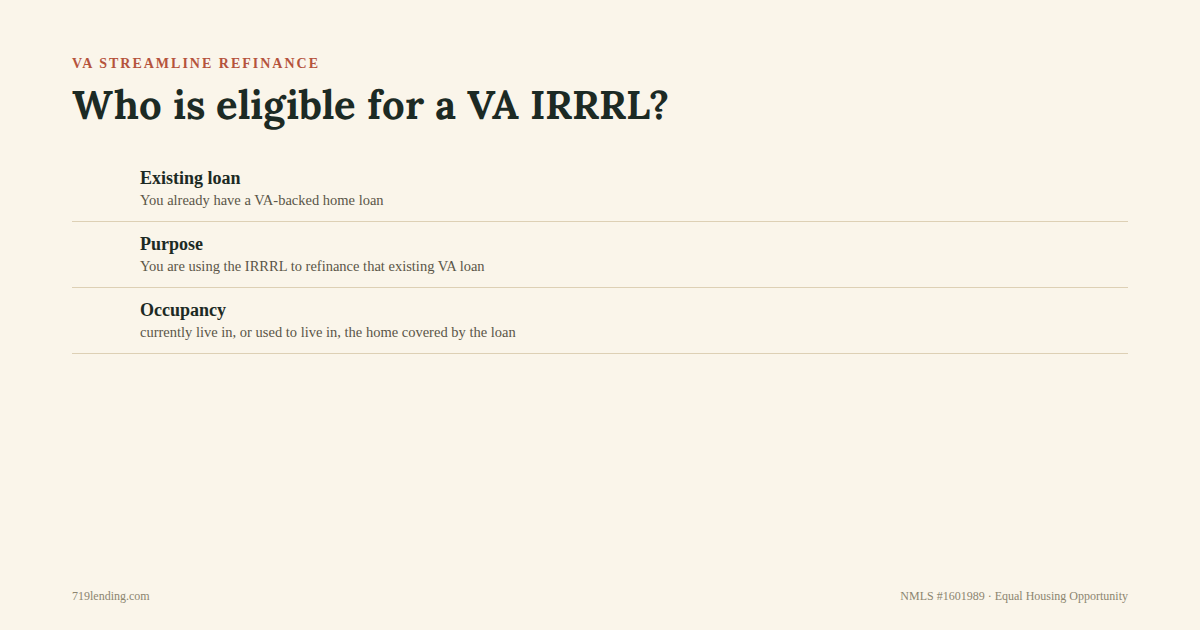
VA IRRRL eligibility is narrower than people expect. Per the VA, all of the following must be true:
- You already have an existing VA-backed home loan.
- You are using the IRRRL to refinance that existing VA loan.
- You can certify that you currently live in, or used to live in, the home covered by the loan.
That last point matters in a military town like Colorado Springs. A PCS move does not automatically disqualify you — the VA allows certification of prior occupancy, which helps service members who kept a home near Fort Carson, Peterson, or the Air Force Academy after orders took them elsewhere.
One more rule from the VA: if there is a second mortgage on the home, the holder of that second mortgage must agree to make the new VA-backed loan the first mortgage.
Eligibility is the gate; the next question is what the loan actually accomplishes.
What a VA streamline refinance is designed to do
Lower the monthly payment
The VA interest rate reduction refinance loan — often called a streamline refinance — exists to lower monthly mortgage payments by replacing the existing loan with a new loan at a lower interest rate.
Lower payment is the core use case, and it is why the program’s formal name is the Interest Rate Reduction Refinance Loan.
Move from an adjustable rate mortgage to a fixed rate
The second sanctioned purpose is stability: moving from a loan with an adjustable or variable interest rate — one that changes over time — to a fixed rate mortgage, where the interest rate stays the same over the life of the loan.
Even if the payment does not drop immediately, trading an adjustable rate mortgage for a fixed rate loan can make mortgage payments predictable.
What the IRRRL is not
The VA IRRRL is a rate-and-term tool for an existing VA loan. It is not designed to pull cash out of the home — if cash out is the goal, that is a different conversation to have with a loan officer about which loan program fits.
Purpose settled, the next piece is cost, because a streamline refinance is not free.
Closing costs and the VA funding fee
Closing costs on a refinance can add up to thousands of dollars, and the VA tells borrowers to keep them squarely in mind.
You may also need to pay the VA funding fee — a one-time fee that helps lower the cost of the VA loan program for taxpayers, since the program does not require down payments or monthly mortgage insurance. Your lender will also charge interest on the loan in addition to closing fees.
How IRRRL closing costs can be handled
With a VA IRRRL, the VA allows two ways to avoid paying costs out of pocket at closing:
- Include the closing costs in the new loan amount, so nothing is due up front.
- Take the new loan at an interest rate high enough that the lender pays the costs.
Both approaches have trade-offs — rolling costs in raises the loan amount, and lender-paid costs mean a higher interest rate on the new loan. Neither is wrong; they are different ways to pay for the same thing.
The break-even check
The VA suggests a simple test before refinancing: divide the total closing costs by the expected monthly savings. That tells you how long it takes the refinance to pay for itself.
If you expect to sell or PCS before that break-even point, the math deserves a harder look. Costs understood, the next skill is comparing offers.
How to compare VA IRRRL rates between lenders
Because terms and fees vary by lender, the only way to find the current VA IRRRL rates that apply to your loan is to collect quotes from several lenders — ideally on the same day, since pricing moves.
Compare the full picture: the interest rate, any discount points, the closing costs, and the resulting monthly payment. A lower quoted rate paired with heavy loan costs can be a worse deal than a slightly higher rate with lean costs.
Watch for misleading refinance offers
The VA specifically warns VA loan holders to be careful with refinance offers. Claims that you can skip payments, or promises of very low interest rates or other terms that sound too good to be true, may be signs of a misleading offer.
Military communities like Colorado Springs see a lot of this mail. Put any offer in front of a licensed loan officer before acting on it.
Once you have compared quotes, the application itself is straightforward.
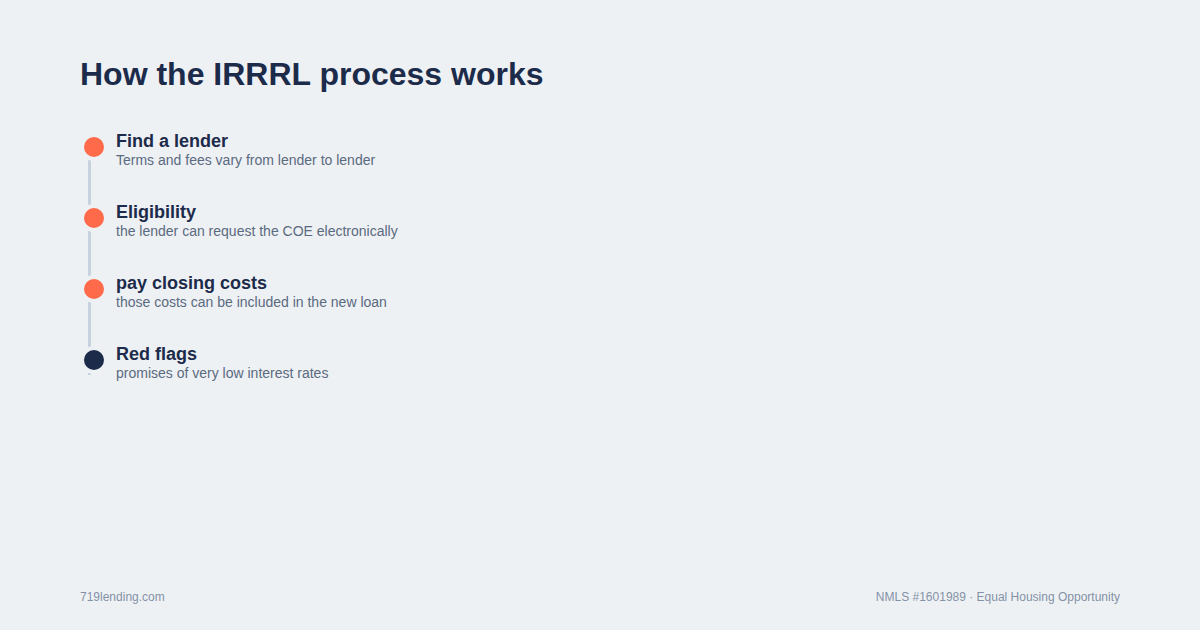
How to get a VA IRRRL, step by step
The VA lays out a short process for the IRRRL refinance:
- Find a lender. You go through a private bank, mortgage company, or credit union — not directly through the VA.
- Provide your Certificate of Eligibility. If you have the COE used on the original VA loan, it shows the prior use of entitlement. If not, the lender can request the COE electronically through the VA Home Loan program portal.
- Follow the lender’s closing process and settle the closing costs — out of pocket, rolled into the new loan, or covered through the rate, as described above.
Documentation requirements beyond the COE are set by the lender, so ask up front what the file will need.
The Colorado Springs angle
That means many local homeowners already hold an existing VA loan — the one hard prerequisite for a VA streamline refinance. It also means plenty of homeowners who bought here, PCSed away, and still qualify under the prior-occupancy rule.
Next step
Stop hunting for a posted VA IRRRL rate — it does not exist. Instead, gather a recent mortgage statement, locate the Certificate of Eligibility if you have it, and request a written quote from a few lenders, including a local one.
A 719 Lending loan officer in Colorado Springs can pull the COE through the VA portal if needed, price the VA IRRRL on your specific loan, and run the break-even math with you so the decision is based on numbers, not a mailer.
Frequently asked questions
Does the VA set IRRRL interest rates?
No. The VA backs the loan but you get an IRRRL through a private bank, mortgage company, or credit union, and each lender sets its own terms and fees. The VA itself advises contacting several lenders to compare options.
Who qualifies for a VA IRRRL?
Per the VA, you must already have a VA-backed home loan, use the IRRRL to refinance that existing loan, and certify that you currently live in or used to live in the home. If a second mortgage exists, its holder must agree to put the new VA loan in first position.
Do I have to pay IRRRL closing costs out of pocket?
Not necessarily. The VA allows you to include the closing costs in the new loan, or to take an interest rate high enough that the lender pays the costs. You may also need to pay the one-time VA funding fee, which can be handled the same ways.
Is an IRRRL worth it if I might PCS soon?
Run the VA’s suggested break-even test: divide total closing costs by the expected monthly savings to see how long the refinance takes to pay for itself. If a PCS move is likely before that point, discuss the timing with a loan officer first.
Can a VA IRRRL change an adjustable rate to a fixed rate?
Yes. One of the two stated purposes of the IRRRL is moving from a loan with an adjustable or variable interest rate to a fixed rate, making monthly payments more stable. The other purpose is lowering the payment through a lower interest rate.
How are misleading IRRRL offers spotted?
The VA warns that claims you can skip payments, or promises of very low interest rates or terms that sound too good to be true, may signal a misleading refinance offer. Have any mailer reviewed by a licensed loan officer before signing anything.
719 Lending Inc., NMLS #1601989 · Equal Housing Opportunity
719 Lending Inc. is not affiliated with or endorsed by HUD, FHA, VA, USDA, CHFA, the CFPB, or any government agency.
Last updated: October 2026

Related Posts