Seen ads for a VA IRRRL enhancement program? Here is what that phrase actually refers to, how the VA Interest Rate Reduction Refinance Loan works, who is eligible, and how Colorado Springs veterans can tell a legitimate streamline refinance from a misleading offer.
What Is the VA IRRRL Enhancement Program? Plain-English Guide
If you’re asking what is the VA IRRRL enhancement program, the short answer is that it isn’t an official program at all. The phrase shows up in refinance mailers and online ads, and it almost always refers to the real thing: the Interest Rate Reduction Refinance Loan, or VA IRRRL, offered through the Department of Veterans Affairs home loan program.
This guide is for veterans, active duty service members, and surviving spouses in Colorado who currently have a VA loan and want to understand what the VA IRRRL actually does, who is eligible, and how to separate a legitimate VA streamline refinance offer from a misleading one.
Here are the key facts up front:
- There is no separate VA program called the “IRRRL enhancement program” — the official product is the Interest Rate Reduction Refinance Loan.
- The VA IRRRL is often called a VA streamline refinance.
- It refinances an existing VA-backed home loan into a new VA loan.
- Its purpose is to lower the monthly mortgage payment or make payments more stable by moving from an adjustable rate mortgage to a fixed rate mortgage.
- You apply through a private lender — a bank, mortgage company, or credit union — not directly through the Department of Veterans Affairs.
What is the VA IRRRL enhancement program?

The “VA IRRRL enhancement program” is marketing shorthand, not a product name you will find on VA.gov. Lenders and lead-generation companies attach words like “enhancement,” “relief,” or “benefit update” to refinance mailers to make a standard offer sound new or time-limited.
The underlying loan those mailers point to is the Interest Rate Reduction Refinance Loan — the VA IRRRL. That is a real, long-standing VA refinance option for borrowers who already have a VA-backed home loan.
The official name and what it means
The Department of Veterans Affairs calls this product the Interest Rate Reduction Refinance Loan. The name describes the job: refinancing lets you replace the current loan with a new loan under different terms, with the goal of reducing the monthly payment or stabilizing it.
Why mailers use the word “enhancement”
Refinance marketing competes hard for veterans’ attention, especially in military markets like Colorado Springs. “Enhancement program” implies something extra was added to the veteran’s benefit. In reality, the rules of the VA IRRRL come from the VA, and any lender offering a VA streamline refinance is working within the same program framework.
With the name question settled, the next step is understanding how the actual VA IRRRL works.
How a VA IRRRL (VA streamline refinance) works
The VA IRRRL replaces an existing VA-backed home loan with a new VA loan. You keep the VA loan structure — you are simply swapping the current loan for a new one with different terms.
Two main jobs the loan performs
According to the VA, an IRRRL may help you lower the monthly mortgage payment by getting a lower interest rate, or make monthly payments more stable by moving from a loan with an adjustable or variable interest rate to one that is fixed for the life of the loan.
That second use matters for anyone holding a VA adjustable rate mortgage. An adjustable rate changes over time; a fixed rate stays the same over the life of the loan, which makes the principal-and-interest portion of the payment predictable.
Why it’s called a streamline refinance
The VA itself notes the IRRRL is “often called a streamline refinance.” The idea is a simpler path for a borrower who has already been through the VA loan process once. Your lender walks you through the specific documentation its process requires.
Loan amount and limits
On a no-down-payment loan, the VA says you can borrow up to the Fannie Mae/Freddie Mac conforming loan limit in most areas — and more in some high-cost counties. The limit is set by the agencies and changes over time, so your loan officer confirms the current figure for your county. You can borrow more than the limit if you choose to make a down payment.
Next: who actually qualifies to use the VA IRRRL.
Who is eligible for a VA IRRRL?
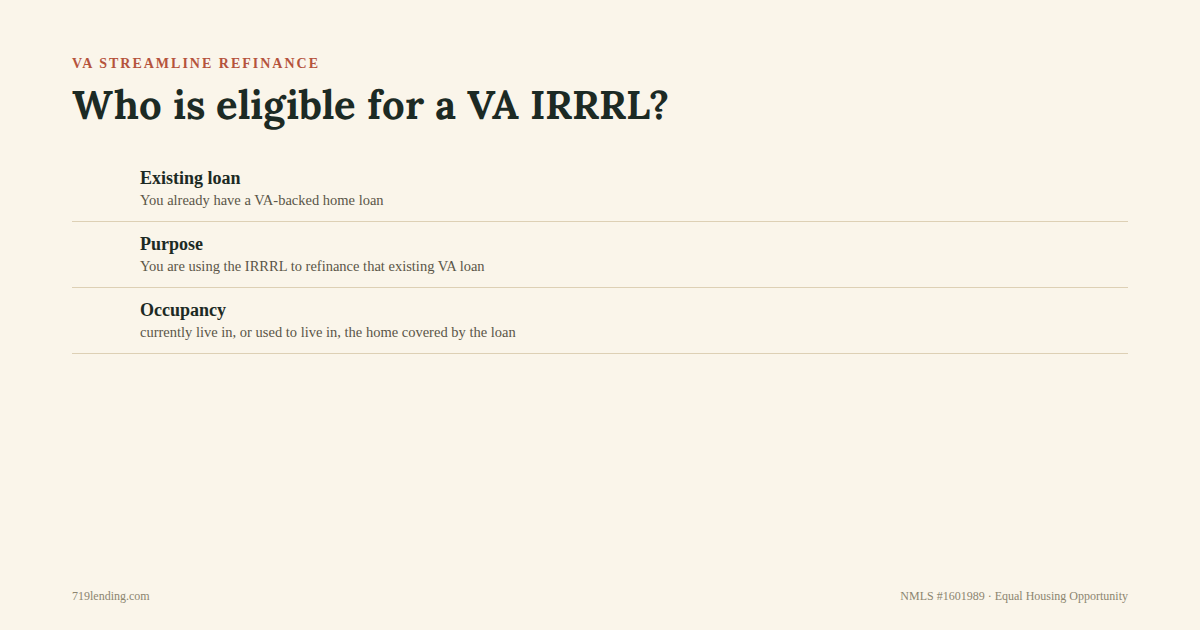
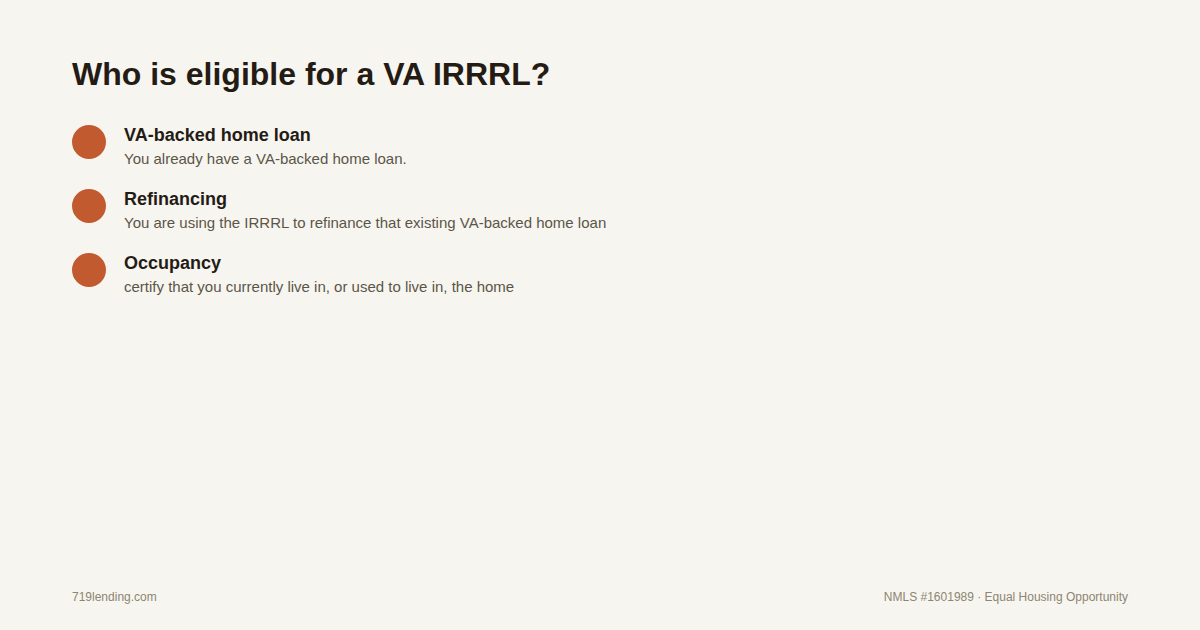
Eligibility for the VA IRRRL is narrower than for a purchase loan, because the program exists specifically to refinance an existing VA loan. The VA lists these requirements, and all of them must be true:
| Requirement | What it means in practice |
|---|---|
| You already have a VA-backed home loan | The IRRRL is only for borrowers with a current VA loan — it is not a way to convert a non-VA mortgage into a VA loan. |
| You’re using the IRRRL to refinance that existing VA-backed loan | The new loan replaces the original VA loan on the same property. |
| You can certify you currently live in, or used to live in, the home | The home does not have to be your current primary residence, as long as you can certify prior occupancy. |
The occupancy certification
Note the “used to live in” language. For a military family that bought in Colorado Springs with a VA home loan and then received PCS orders, the IRRRL can still be an option on that home — the certification covers past occupancy, not just current occupancy.
If there’s a second mortgage on the home
If you have a second mortgage on the property, the VA requires the holder of that second mortgage to agree to make the new VA-backed loan the first mortgage. Your lender coordinates that subordination as part of the refinance process.
Eligibility is the gate; costs are the math. That’s the next piece.
Closing costs and the VA funding fee
Every refinance comes with closing costs, and the VA cautions that they can add up to thousands of dollars. Understanding where those costs sit in the new loan is the core of deciding whether a VA streamline refinance makes sense.
The VA funding fee
You may need to pay the VA funding fee on an IRRRL. The VA describes it as a one-time fee that helps lower the cost of the loan program for taxpayers, since the VA home loan program doesn’t require down payments or monthly mortgage insurance. Your loan officer confirms the fee that applies to your situation and whether any exemption applies.
Three ways the costs can be handled
With an IRRRL, the VA notes you have options for covering closing costs:
- Pay them up front at closing.
- Include the costs in the new loan balance so nothing is due out of pocket at closing.
- Accept an interest rate high enough that the lender pays the costs on your behalf.
Each path trades one thing for another. Rolling costs into the loan raises the loan amount; lender-paid costs raise the interest rate on the loan. Neither is free — the question is which structure fits your timeline in the home.
The break-even check the VA recommends
Before you decide to refinance, the VA suggests a simple test: divide the closing costs by how much you expect to save every month. The result is how long you’d need to keep the loan for the savings to cover the costs. If a PCS move could take you out of the house before that point, that changes the math.
Cost math is also where misleading offers hide, which brings us to the warning signs.
How to spot a misleading “enhancement” offer
The VA specifically warns borrowers with a VA home loan to be careful when considering refinance offers. Claims that you can skip payments, or promises of very low interest rates or other terms that sound too good to be true, may be signs of a misleading offer.
Red flags in IRRRL marketing
- Official-looking mailers implying the lender is the VA or a government agency — the VA IRRRL is always closed through a private lender, never directly through the VA.
- “Enhancement,” “update,” or “expiring benefit” language suggesting a new program exists when it doesn’t.
- Pressure to act before you’ve compared the new loan terms against the current VA loan.
What a legitimate conversation looks like
The VA’s own guidance is to contact several lenders, because terms and fees may vary. A legitimate loan officer will walk through the closing costs, the new loan balance, and the monthly savings — and will tell you plainly if the numbers don’t work. That comparison is something our refinance team does in writing, so you can check the math yourself.
If the offer passes the smell test, the application process itself is straightforward.
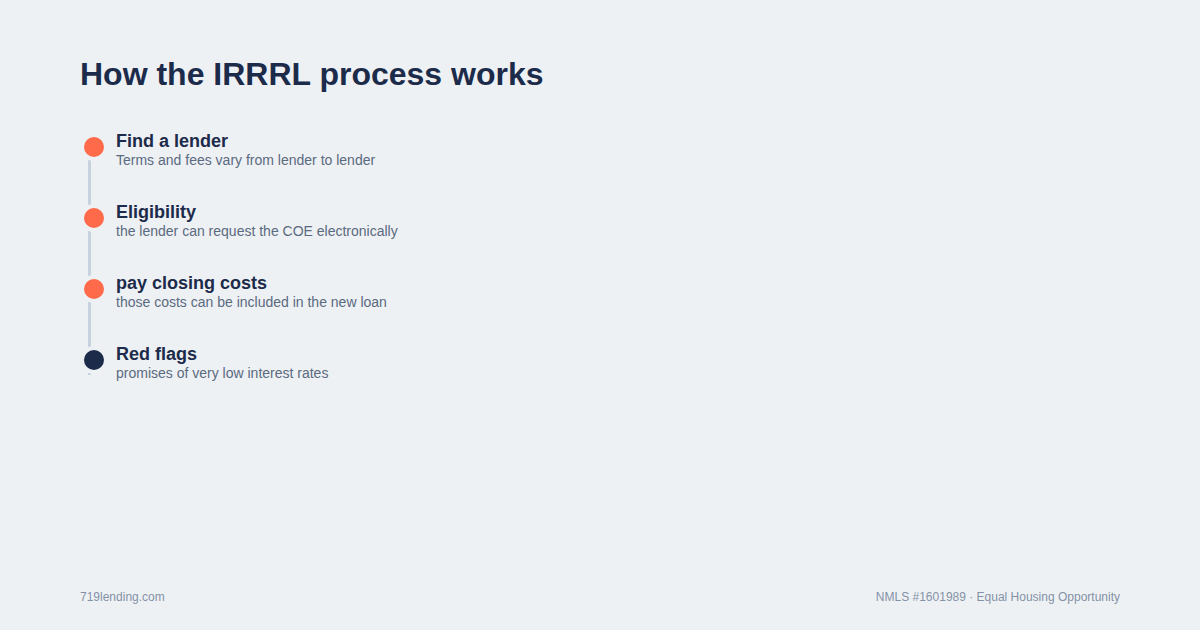
How to get a VA IRRRL, step by step
Step 1: Choose a lender
You’ll go through a private bank, mortgage company, or credit union — not directly through the VA. Because terms and fees vary by lender, the VA recommends contacting several to compare options. A Colorado-based broker like 719 Lending works with multiple investors on VA refinance loans.
Step 2: Provide your Certificate of Eligibility
If you still have the Certificate of Eligibility (COE) used for the original VA loan, give it to your lender to show prior use of your entitlement. If you don’t have it, your lender can request the COE electronically through the VA Home Loan program portal — you don’t need to track down old paperwork yourself.
Step 3: Follow the lender’s closing process
From there, you follow the lender’s process for closing on the IRRRL and settle the closing costs — up front, rolled into the loan, or lender-paid, as discussed above. The lender also charges interest on the new loan, so the full terms come together at closing.
For military borrowers along the Front Range, there’s one more local wrinkle worth covering.
Why the VA IRRRL comes up so often in Colorado Springs
Colorado Springs is home to Fort Carson, Peterson Space Force Base, Schriever Space Force Base, and the Air Force Academy, so a large share of local homeowners carry an existing VA loan. That makes this market a heavy target for IRRRL “enhancement” mailers.
It also means many local homeowners genuinely fit the program: they bought with a VA home loan, they can certify occupancy, and a payment that moves with BAH budgeting benefits from the stability of a fixed rate. The prior-occupancy rule also helps families who kept a Colorado Springs home after PCS orders.
The takeaway for local veterans: evaluate the loan, not the mailer.
Next steps
If a “VA IRRRL enhancement program” offer landed in your mailbox, treat it as a prompt to review the current VA loan — not as a program you need to sign up for before it disappears.
Pull out the current mortgage statement, note the interest rate and remaining balance, and talk with a VA-experienced loan officer about whether a VA streamline refinance pencils out. You can reach the 719 Lending team for a no-pressure review of the numbers, including the funding fee, closing costs, and the break-even timeline the VA recommends you calculate before deciding.
Frequently asked questions
Is the VA IRRRL enhancement program a real government program?
No. There is no official VA program by that name. The phrase is marketing language used in refinance mailers. The real product is the Interest Rate Reduction Refinance Loan (IRRRL), often called a VA streamline refinance, which refinances an existing VA-backed home loan into a new VA loan.
Who is eligible for a VA IRRRL?
Per the VA, you must already have a VA-backed home loan, use the IRRRL to refinance that existing VA loan, and certify that you currently live in or used to live in the home. If there’s a second mortgage, its holder must agree to make the new VA loan the first mortgage.
Do I have to pay closing costs on a VA streamline refinance?
Closing costs apply, and the VA notes they can add up to thousands of dollars. With an IRRRL you can pay them up front, include them in the new loan balance, or take an interest rate high enough that the lender covers the costs. The VA suggests dividing closing costs by expected monthly savings to check whether the refinance is worth it.
Can I use a VA IRRRL on a home I no longer live in after a PCS move?
Possibly. The VA’s occupancy requirement is that you certify you currently live in or used to live in the home covered by the loan, so prior occupancy can satisfy the rule. Confirm the details of your situation with your lender.
Do I apply for an IRRRL through the VA directly?
No. You get an IRRRL through a private bank, mortgage company, or credit union, not directly through the Department of Veterans Affairs. Terms and fees vary by lender, so the VA recommends contacting several lenders to compare options.
719 Lending Inc., NMLS #1601989 · Equal Housing Opportunity
719 Lending Inc. is not affiliated with or endorsed by HUD, FHA, VA, USDA, CHFA, the CFPB, or any government agency.
Last updated: October 2026

Related Posts