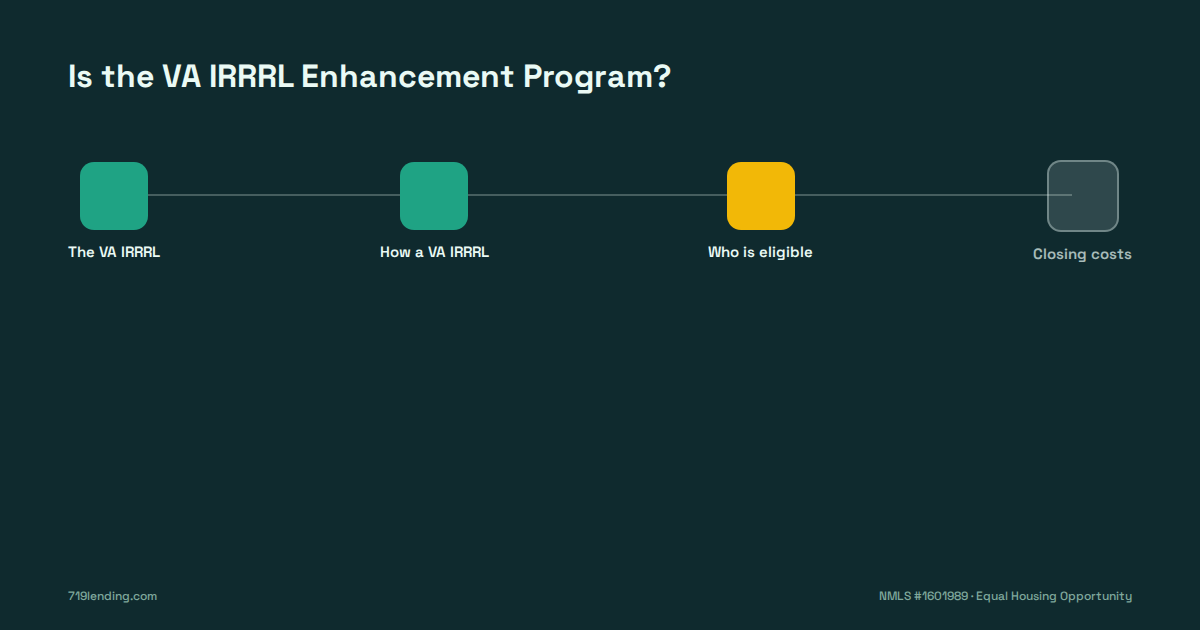
Seen a mailer about a "VA IRRRL enhancement program"? There is no separate enhancement program. The real product is the VA Interest Rate Reduction Refinance Loan (IRRRL), the VA streamline refinance for borrowers with an existing VA loan. This guide explains what the IRRRL actually is, who is eligible, how closing costs and the VA funding fee work, and how to tell a legitimate offer from a misleading one.
What Is the VA IRRRL Enhancement Program? Explained
If you are asking what is the VA IRRRL enhancement program, here is the straight answer: it is a marketing label, not a separate government program. The actual program behind the ads is the VA Interest Rate Reduction Refinance Loan, or IRRRL, often called a VA streamline refinance.
This guide explains what the IRRRL actually is, who qualifies, what it costs, and how Colorado Springs veterans and active duty service members can separate the real program from the advertising wrapper around it.
What is the VA IRRRL enhancement program?
The phrase “VA IRRRL enhancement program” shows up in mailers, online ads, and phone pitches aimed at veterans with an existing VA loan. The Department of Veterans Affairs does not use that name.
The underlying product is the Interest Rate Reduction Refinance Loan. The VA describes it as a refinance for borrowers who already have a VA-backed home loan and want to reduce monthly mortgage payments or make those payments more stable.
So when an ad promises an “enhancement,” it is almost always describing the standard VA IRRRL. The rules, the eligibility, and the mechanics are the same program the VA publishes on its own site.
Knowing that, the real question becomes how the IRRRL itself works — which is where we go next.
Quick facts about the VA IRRRL
- The IRRRL refinances an existing VA-backed home loan into a new VA loan with different terms.
- It is often called a streamline refinance or VA streamline.
- Its two stated purposes: get a lower interest rate to reduce monthly payments, or move from an adjustable or variable interest rate to a fixed rate.
- You must certify that you currently live in, or used to live in, the home covered by the loan.
- Closing costs apply, and the VA allows you to include them in the new loan rather than paying up front.
- You get the loan through a private lender — a bank, mortgage company, or credit union — not directly through the VA.
With the basics on the table, let’s walk through how the refinance actually functions.
How the VA IRRRL works
Refinancing replaces the current loan with a new loan under different terms. The IRRRL is the VA’s version of that for borrowers who already hold a VA mortgage.
Lowering monthly payments
The first use of an IRRRL is reducing the monthly mortgage payment by refinancing into a lower interest rate. Whether that pencils out depends on where mortgage rates sit when you apply versus the rate on the existing VA loan.
Because the interest rate on the loan drives the payment, the IRRRL only makes sense when the new terms genuinely improve on the old ones. A loan officer can run the comparison for you.
Moving from an adjustable rate to a fixed rate
The second use is stability. The VA allows an IRRRL to move a borrower from an adjustable or variable interest rate — one that changes over time — to a fixed rate that stays the same for the life of the loan.
Even if the payment does not drop, a fixed rate mortgage can make monthly payments predictable, which matters for military families budgeting around BAH and future PCS moves.
Next: who is actually allowed to use the program.
Who is eligible for a VA IRRRL?

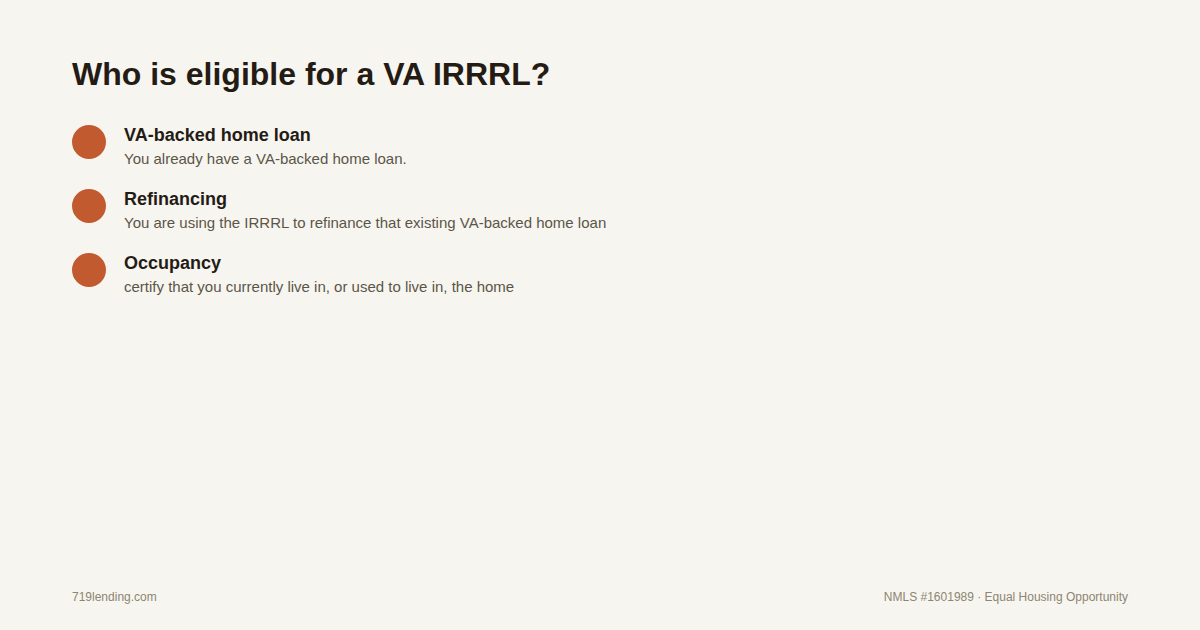
The VA sets out three conditions, and all of them must be true.
| Requirement | What the VA says |
|---|---|
| Existing loan | You already have a VA-backed home loan |
| Purpose | You are using the IRRRL to refinance that existing VA loan |
| Occupancy | You can certify that you currently live in, or used to live in, the home covered by the loan |
The occupancy rule and PCS moves
Notice the occupancy wording: “currently live in or used to live in.” That matters in a military market like Colorado Springs, where PCS orders routinely move families away from a home they bought near Fort Carson, Peterson, or Schriever.
A veteran who kept the house after a PCS and now rents it out may still be able to use an IRRRL on the existing VA mortgage, because past occupancy counts under the VA’s rule.
Second mortgages
If there is a second mortgage on the home, the VA requires the holder of that second lien to agree that the new VA loan becomes the first mortgage. Your lender coordinates that step.
Eligibility is only half the picture — the costs deserve the same scrutiny.
What does a VA streamline refinance cost?
Closing costs on a refinance loan can add up to thousands of dollars, and the VA tells borrowers to weigh them directly against the expected savings.
The VA’s break-even test
The VA’s own guidance is simple: divide the closing costs by the amount you expect to save every month to see whether the refinance is worth it. That gives you the number of months it takes for monthly savings to recover the cost of the transaction.
If you plan to sell or PCS before that break-even point, the math may not work, no matter how good the ad sounded.
The VA funding fee
You may need to pay the VA funding fee on an IRRRL. The VA describes it as a one-time fee that helps lower the cost of the loan program for taxpayers, since the VA home loan program does not require down payments or monthly mortgage insurance.
The lender will also charge interest on the loan in addition to closing fees. Ask the loan officer to itemize everything before you commit.
Rolling costs into the new loan
With an IRRRL, the VA allows you to include closing costs in the new loan so you do not pay them up front. Alternatively, the loan can be made at an interest rate high enough that the lender pays the costs.
Both paths have trade-offs: financing costs raises the loan balance, and a lender-paid structure means a higher rate. Understanding which trade-off you are accepting leads directly into the next topic — spotting offers that hide it.
How to spot a misleading “enhancement” offer
The VA specifically warns veterans to be careful when considering home loan refinance offers. Claims that you can skip payments, or promises of very low interest rates or other terms that sound too good to be true, may be signs of a misleading offer.
Branded names like “enhancement program” are often part of that packaging. A few checks keep you grounded:
- Ask the sender to name the actual program. If it is a legitimate VA IRRRL, they should say so plainly.
- Get the full closing costs in writing and run the VA’s break-even math yourself.
- Contact several lenders. The VA notes that terms and fees vary, so comparing VA loan options across lenders is part of the process the VA itself recommends.
- Remember that the VA — a federal agency — does not originate IRRRLs itself; private lenders do. Anyone implying they are the VA is misrepresenting themselves.
Once you are confident the offer is a genuine IRRRL, the application process is straightforward.
How do you get a VA IRRRL?
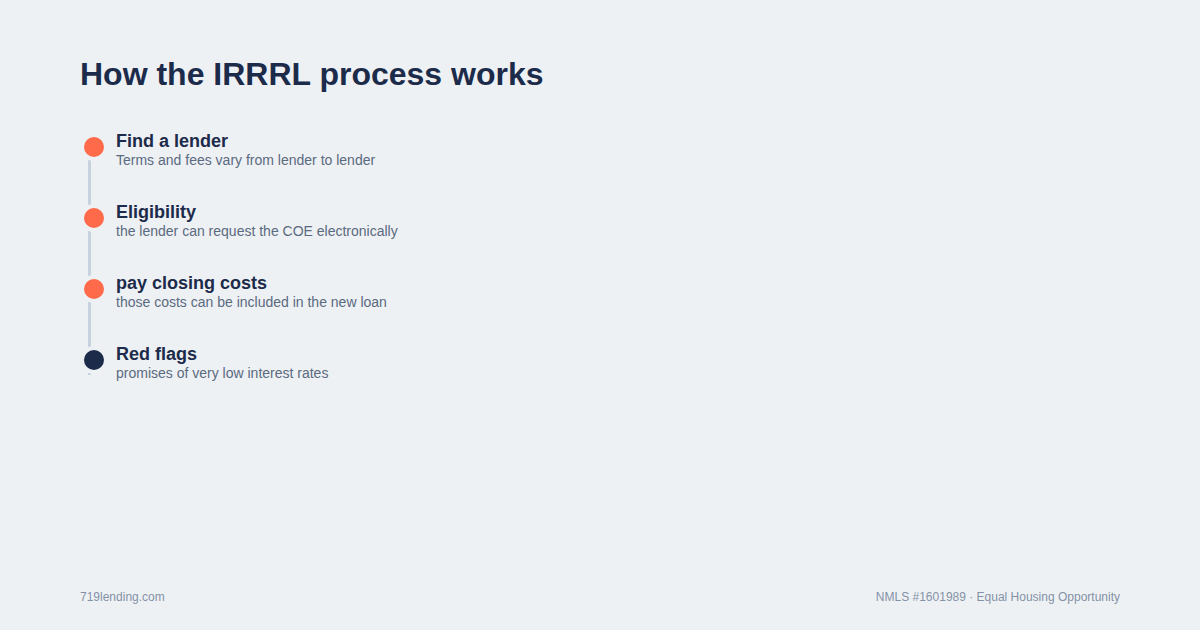
Step one: choose a lender
You go through a private bank, mortgage company, or credit union — not directly through the Department of Veterans Affairs. A local refinance review with a Colorado Springs broker can put several lender options side by side.
Step two: provide your Certificate of Eligibility
If you still have the Certificate of Eligibility (COE) used for the original VA loan, give it to the lender to show prior use of your entitlement. If you do not have it, the lender can request the COE electronically through the VA Home Loan program portal.
Step three: close and settle the costs
Follow the lender’s process for closing on the IRRRL and pay the closing costs — or roll them into the new loan as described above. From there, the new loan simply replaces the old one.
One related question comes up constantly, so let’s address it before wrapping up.
Is an IRRRL the same as a VA cash out refinance?
No. The IRRRL exists to change the terms of an existing VA loan — a lower interest rate or a switch to a fixed rate.
If pulling equity out of the home is the goal, tell the loan officer up front so they point you at the right program rather than forcing the goal into an IRRRL.
What to do next
If you hold an existing VA loan on a home in Colorado Springs — or anywhere in Colorado — the next step is a simple comparison: the terms on the current loan versus what an IRRRL could offer today, with closing costs laid out next to the expected monthly savings.
719 Lending is a Colorado Springs mortgage broker in a community full of veterans and active duty service members. Reach out to a loan officer, have your COE or loan paperwork handy, and get the break-even math in writing before you sign anything with “enhancement” in the headline.
Frequently asked questions
Is the VA IRRRL enhancement program real?
The underlying program is real — it is the VA Interest Rate Reduction Refinance Loan (IRRRL). “Enhancement program” is a marketing name advertisers attach to it; the Department of Veterans Affairs does not use that term.
Who qualifies for a VA IRRRL?
Per the VA, you must already have a VA-backed home loan, use the IRRRL to refinance that existing VA loan, and certify that you currently live in or used to live in the home covered by the loan.
Do I have to pay closing costs on a VA streamline refinance?
Closing costs apply and can add up to thousands of dollars. With an IRRRL you can include those costs in the new loan instead of paying up front, or the loan can be structured at a higher interest rate so the lender pays the costs.
Can I use an IRRRL if I no longer live in the home after a PCS move?
Possibly. The VA’s occupancy rule says you must certify that you currently live in or used to live in the home, so prior occupancy can satisfy the requirement. Confirm your situation with your lender.
Do I need a new Certificate of Eligibility for an IRRRL?
If you have the COE from your original VA loan, give it to your lender to show prior use of your entitlement. If you don’t have it, the lender can request it electronically through the VA Home Loan program portal.
Does the VA issue IRRRLs directly?
No. You get an IRRRL through a private bank, mortgage company, or credit union — not directly through the VA. Terms and fees vary by lender, so the VA recommends contacting several lenders to compare options.
719 Lending Inc., NMLS #1601989 · Equal Housing Opportunity
719 Lending Inc. is not affiliated with or endorsed by HUD, FHA, VA, USDA, CHFA, the CFPB, or any government agency.
Last updated: October 2026

Related Posts