Seen ads for a VA IRRRL enhancement program? Here is what that phrase actually refers to, how the VA Interest Rate Reduction Refinance Loan works, who is eligible, and how Colorado Springs veterans can tell a legitimate streamline refinance from a misleading offer.
Is the VA IRRRL Program Legit? What Veterans Should Know
If you are asking “is the VA IRRRL program legit,” the short answer is yes — the Interest Rate Reduction Refinance Loan is a real refinance program backed by the Department of Veterans Affairs. This article explains what the IRRRL actually is, who qualifies, how the process works through a private lender, and how to separate the genuine program from the misleading mailers that imitate it. It is written for Colorado veterans and active duty service members who already hold a VA home loan.
Is the VA IRRRL program legit?
The VA IRRRL is a legitimate, government-backed refinance program. It is documented directly on the official Veterans Affairs IRRRL page, which spells out eligibility, purpose, and process.
The program is often called a “streamline” refinance. Its stated purpose is simple: lower a monthly mortgage payment through a lower interest rate, or make payments more stable by moving from an adjustable rate to a fixed rate.
So why the doubt? Because the IRRRL is heavily marketed, and some of that marketing is misleading. The program is real; some of the mail about it is not honest.
Next, it helps to understand exactly what this refinance does.
What is an interest rate reduction refinance loan?
An Interest Rate Reduction Refinance Loan replaces an existing VA-backed home loan with a new loan under different terms. Refinancing, in plain terms, means swapping the current mortgage for a new one.
According to the VA, an IRRRL may help a borrower in two ways. It can lower the monthly payment by securing a lower interest rate, or it can convert an adjustable or variable interest rate — one that changes over time — into a fixed rate that stays the same for the life of the loan.
Why the fixed rate option matters
A fixed rate mortgage removes the uncertainty of a payment that can move. For a household budgeting around military pay and BAH, converting an adjustable loan into a fixed rate mortgage makes the monthly payment predictable.
That brings us to who can actually use the IRRRL program.
Who is eligible for a VA IRRRL?

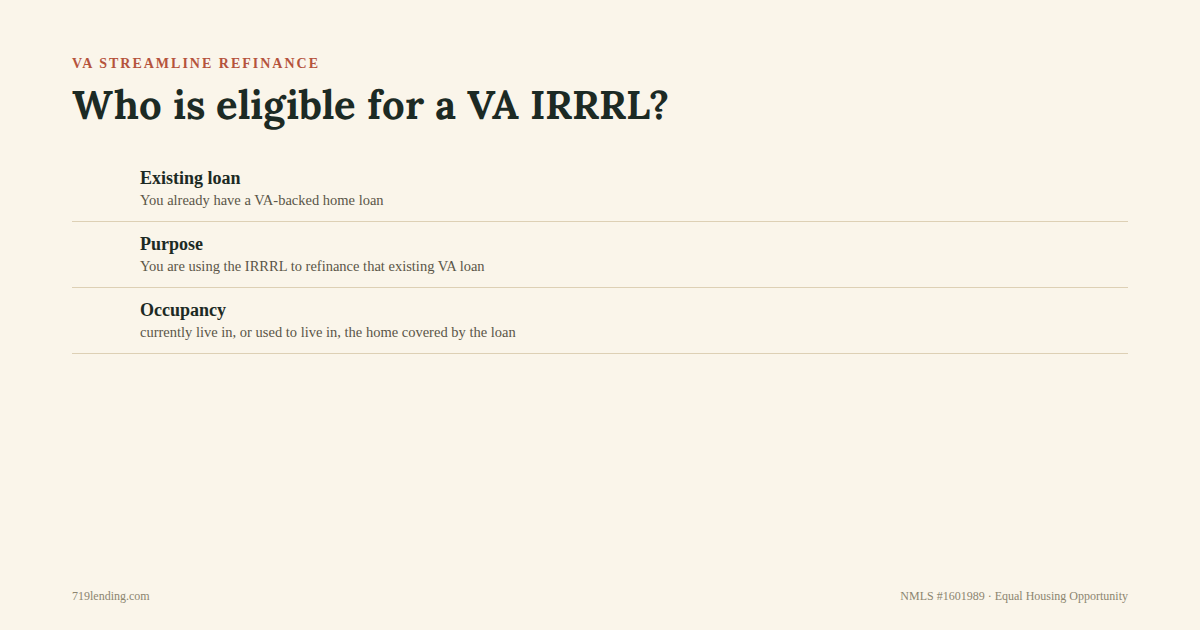
The VA sets three requirements, and all of them must be true:
- You already have a VA-backed home loan.
- You are using the IRRRL to refinance that existing VA-backed home loan.
- You can certify that you currently live in, or used to live in, the home covered by the loan.
Note the third point: unlike many refinance products, the VA allows a borrower who used to live in the home to qualify. That matters in Colorado Springs, where PCS moves from Fort Carson, Peterson, or Schriever can turn a former residence into a rental before the owner ever planned on it.
One more rule from the VA: if there is a second mortgage on the home, that lender must agree to make the new VA-backed loan the first mortgage.
If you meet those conditions, the next question is why the offers you receive sound so aggressive.
Why the IRRRL feels too good to be true
The VA itself warns borrowers to be careful with home loan refinance offers. Claims that you can skip payments, or promises of very low interest rates and other terms that sound too good to be true, may be signs of a misleading offer.
Veterans with a VA home loan are a heavily targeted audience.
The program is real; the mailer may not be honest
Here is the distinction that answers the “legit” question. The IRRRL program is a genuine Veterans Affairs benefit. A specific offer from a specific company is only as trustworthy as that company.
Verify any offer against the official VA home loans site, and talk to a lender you choose rather than one that chose you.
Understanding how the process actually works makes the fakes easier to spot.
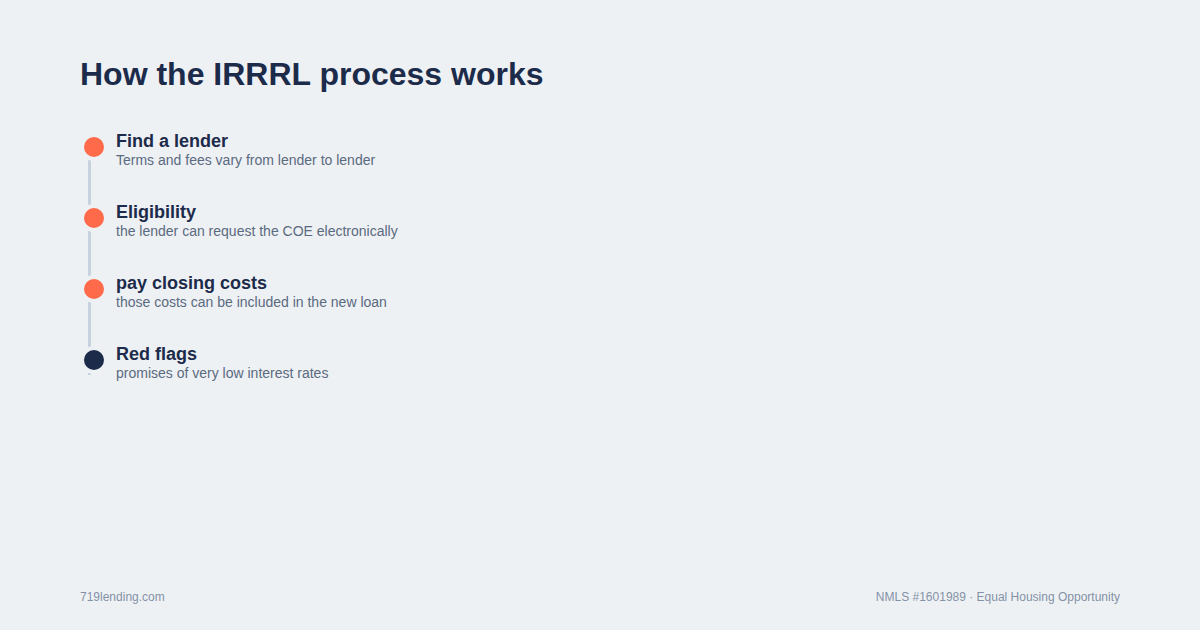
How the VA IRRRL process actually works
The VA does not issue IRRRLs directly. You go through a private bank, mortgage company, or credit union — a lender like 719 Lending here in Colorado Springs.
Step one: find a lender and compare
Because terms and fees vary, the VA advises contacting multiple lenders to check out the options. Comparing offers from more than one lender is the practical way to confirm you are seeing competitive terms rather than one company’s marketing.
Step two: provide the Certificate of Eligibility
If you still have the Certificate of Eligibility (COE) used for the original VA loan, bring it to the lender to show prior use of entitlement. If you do not have it, the lender can request the COE electronically through the VA Home Loan program portal.
Step three: close and handle closing costs
You follow the lender’s process for closing on the IRRRL and pay the closing costs. The lender charges interest on the new loan in addition to closing fees, and a VA funding fee may apply — more on that next.
What about closing costs and the VA funding fee?
Closing costs are the part of an IRRRL most worth scrutinizing. The VA cautions that they can add up, and recommends a simple test: divide the closing costs by the expected monthly savings to see how long it takes the refinance to pay for itself.
The VA funding fee is a one-time charge that helps lower the cost of the VA home loan program for taxpayers, since the program does not require down payments or monthly private mortgage insurance. Ask the lender whether any exemption applies in your situation.
Two ways to handle the costs
With an IRRRL, the VA allows two approaches so you do not have to pay everything up front. You can include the costs in the new loan balance, or the loan can be made at an interest rate high enough that the lender pays the costs.
Both are legitimate structures — but both have trade-offs, which is exactly why you want the math spelled out before you commit. The Consumer Financial Protection Bureau publishes a home loan toolkit that walks through refinance decisions in plain language.
It is also worth knowing how the IRRRL fits among other refinance paths.
How the IRRRL compares to other refinance options
The IRRRL is one of several VA refinance paths; a VA cash-out refinance is a separate option, and conventional loans offer refinancing outside the VA system entirely. The IRRRL is specifically for replacing an existing VA loan with the goal of a lower payment or a stable fixed rate — it is a rate and term tool, not a cash tool.
Which path fits depends on the current loan, the goal, and the numbers a loan officer runs for your specific situation. Whether a home appraisal is required, and what documentation the lender needs, are questions to confirm during that conversation.
Summary of the program at a glance:
| Question | Answer per the VA |
|---|---|
| Is it a real program? | Yes — documented on VA.gov |
| Who issues the loan? | A private lender, not the VA directly |
| Purpose | Lower the interest rate or move to a fixed rate |
| Occupancy | Current or former occupancy of the home qualifies |
| Costs | Closing costs apply; a VA funding fee may apply |
Your next step
If you have a VA home loan in Colorado and want to know whether an IRRRL makes sense, get a written breakdown of the closing costs and the expected monthly savings, then do the division the VA recommends.
719 Lending is a Colorado Springs mortgage broker that works with veterans and active duty service members every day. Bring us the refinance mailer you got — we will tell you straight whether the real IRRRL program beats it.
Frequently asked questions
Is the VA IRRRL a government program or a lender product?
The IRRRL is an official refinance program backed by the Department of Veterans Affairs, but the VA does not issue the loans directly. You get an IRRRL through a private bank, mortgage company, or credit union, and terms and fees vary by lender.
Do I have to live in the home to get an IRRRL?
No. The VA requires you to certify that you currently live in or used to live in the home covered by the loan. Former occupancy — common after a PCS move — can still qualify.
Are there closing costs on a VA IRRRL?
Yes. Closing costs apply, and a VA funding fee may apply as well. The VA allows you to include these costs in the new loan or have the lender cover them in exchange for a higher interest rate on the loan.
How do I know if an IRRRL offer is a scam?
The VA warns that offers promising skipped payments or terms that sound too good to be true may be misleading. Verify any offer against VA.gov, and compare terms from multiple lenders before committing.
Can I get an IRRRL if I never had a VA loan?
No. The IRRRL is only for refinancing an existing VA-backed home loan. Borrowers without a VA loan would need a different refinance option, which a loan officer can walk through.
719 Lending Inc., NMLS #1601989 · Equal Housing Opportunity
719 Lending Inc. is not affiliated with or endorsed by HUD, FHA, VA, USDA, CHFA, the CFPB, or any government agency.
Last updated: October 2026

Related Posts