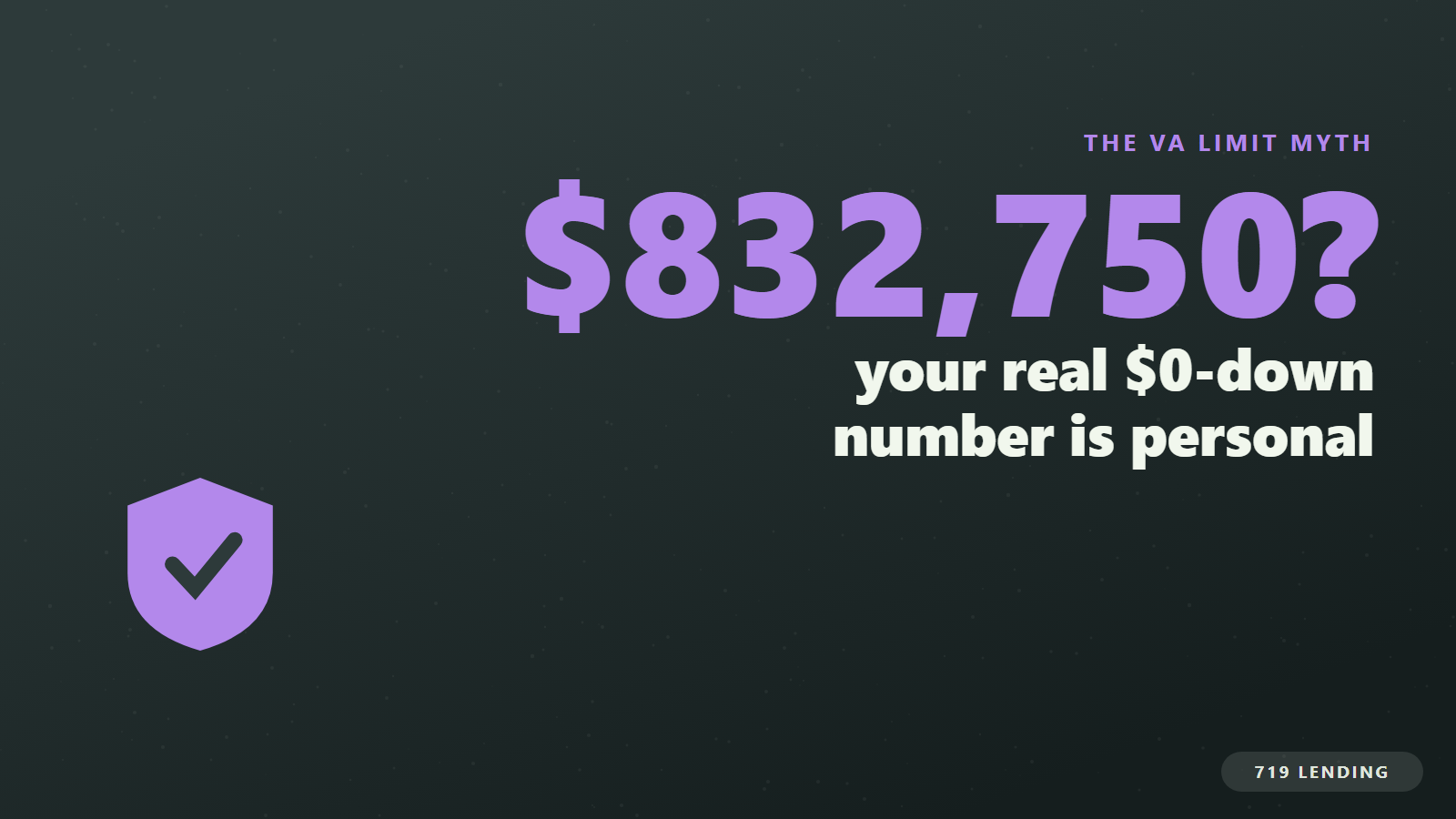
On a VA loan, your military income is more than base pay. BAH and BAS are tax-free allowances a lender can gross up — which quietly raises the income you qualify on. Here's which pay counts, and the charts to prove it.
Demystifying the VA Loan Funding Fee (2025 Guide)
VA Funding Fee: A Clear, Accurate Explanation for Colorado Springs Veterans
If you’re a veteran, active-duty service member, National Guard member, or eligible surviving spouse in Colorado Springs, the VA home loan is one of the most powerful homeownership benefits available. Eligibility for a VA loan is based on military service, including service in the National Guard.
At 719 Lending Inc., one question comes up more than almost any other:
“If I’m buying a $450,000 home, why is the VA adding thousands of dollars to my loan?”
That additional amount is called the VA loan funding fee. While it can look confusing at first, it’s not a hidden charge — and in most cases, it’s far outweighed by the long-term advantages of using a VA loan. The VA does not directly offer VA loans; instead, it works with approved lenders who offer VA loans, with the VA providing insurance to reduce lender risk and enable features like no down payment and competitive rates.
This 2025 guide explains exactly what the VA funding fee is, how much it costs, who is exempt, and why VA loans remain one of the best mortgageoptions for Colorado Springs veterans. The VA funding fee helps protect the benefits of the VA loan program without imposing additional costs on taxpayers.
What Is the VA Funding Fee — and Why Does It Exist?
The VA funding fee is a one-time charge paid directly to the Department of Veterans Affairs. It is not paid to your lender and it is not a penalty.
Its purpose is to:
-
Help fund and sustain the VA home loan program
-
Reduce reliance on taxpayer funding
-
Allow the VA to continue offering $0 down loans with no monthly mortgage insurance (PMI)
-
Offset the costs of the VA guarantee for lenders in case a borrower defaults on a VA-backed loan
Because the VA guarantees a portion of every VA loan, lenders take on less risk — which is why VA borrowers benefit from:
-
No down payment requirement
-
No PMI
-
Competitive interest rates
-
Flexible underwriting standards
The VA funding fee is a necessary and standardized funding fee cost associated with obtaining a VA-backed loan.
The funding fee acts as insurance for that guarantee. The VA funding fee is a one-time fee paid to the Department of Veterans Affairs and is typically included in the closing costs.
How Is the VA Funding Fee Paid?
You can pay the funding fee upfront at closing or roll it into your loan amount. Most borrowers do not pay the fee out of pocket. The funding fee can be:
-
Financed into the loan, or
-
Paid upfront at closing,
-
Paid by the seller as part of allowed seller concessions (up to 4%)
Most Veterans choose to roll the VA funding fee into their loan rather than pay the VA funding fee at closing, avoiding any upfront cost. Rolling the VA funding fee into the loan amount means you will pay interest on that amount over time, and it increases your loan balance, as with other financed funding fees. Choosing to pay the VA funding fee upfront can save you money on interest over the life of the loan. Unlike mortgage insurance, the VA funding fee is paid entirely upfront and does not have an ongoing monthly component, though financing it results in a higher monthly payment than paying it at closing.
2025 VA Funding Fee Rates (Current & Accurate)
The VA funding fee cost is a percentage of the loan amount and varies depending on whether it’s your first time using a VA loan and the size of your down payment. VA funding fee percentages vary based on:
-
Loan type
-
First-time vs. repeat VA loan use
-
Down payment amount (for purchases only)
-
Exemption status
The VA funding fee differs from mortgage insurance on a conventional mortgage. With a conventional mortgage, borrowers who put down less than 20% typically pay private mortgage insurance (PMI) until they reach 20% equity, resulting in ongoing monthly payments. In contrast, the VA funding fee is usually paid upfront and does not require ongoing payments. Additionally, VA loans do not require mortgage insurance, which can make them more affordable than other loan types that do require it.
The following rates apply to loans closed in 2025.
VA Purchase & Construction Loans (2025)
First-Time VA Loan UseFor a VA purchase or construction loan, the VA funding fee ranges from 0.5% to 3.3%, depending on the loan type, whether this is your first or subsequent VA loan, and your down payment amount; a 5% down payment reduces the funding fee to 1.5%.
-
Less than 5% down: 2.15%
-
5%–9.99% down: 1.50%
-
10% or more down: 1.25%
Subsequent (Repeat) VA Loan UseIf you are using your VA loan benefit again for a purchase or construction loan, the funding fee is typically higher. For most subsequent VA purchase loans with no down payment, the funding fee is 3.30%.
-
Less than 5% down: 3.30%
-
5%–9.99% down: 1.50%
-
10% or more down: 1.25%
The funding fee for a VA Cash-Out refinance is similar to that of a VA purchase loan, except borrowers cannot lower the fee by making a down payment.
**Important technical note:**Down payment thresholds are not rounded. A down payment of 4.99% does NOT qualify for the 5% tier.
VA Cash-Out Refinance Loans (2025)
-
First use: 2.15%
-
Subsequent use: 3.30%
These rates apply to VA refinance loans, including both VA cash-out refinance and VA IRRRL (Interest Rate Reduction Refinance Loan) options. For VA refinance loans, the funding fee for a VA IRRRL is 0.5%, regardless of service history or prior usage. The VA cash-out refinance funding fee is 2.15% for first use and 3.3% for subsequent use, similar to a VA purchase loan. These funding fees increase total borrowing costs and can be financed into the new loan amount.
Reduced funding fee rates based on equity or loan-to-value do not apply to VA cash-out refinances, though a lender’s loan to value ratio limits can still affect qualification.
VA IRRRL (Streamline Refinance) — 2025
-
0.50% for all borrowers, regardless of prior VA loan use
This reduced fee applies specifically to the VA IRRRL, also known as the VA streamline refinance. The VA streamline refinance funding fee is set at 0.5% for all borrowers, reflecting prior successful participation in the VA loan program.
Real Colorado Springs Example (2025)
Purchase Price: $450,000 First-Time VA Loan Use
For a first-time VA loan user with no down payment, the typical VA funding fee cost is 2.15% of the loan amount. In this example, the funding fee amount is $9,675. If financed, those funding fee costs increase the total loan balance and can raise the monthly payment over time.
Scenario 1: $0 Down
-
Funding fee: 2.15% = $9,675
-
Final loan amount: $459,675
Scenario 2: 5% Down ($22,500)
-
Base loan amount: $427,500
-
Funding fee: 1.50% = $6,412.50
-
Final loan amount: $433,912.50
A modest down payment can reduce the funding fee — but it is not required to use a VA loan.
Who Is Exempt From the VA Funding Fee?
Approximately one-third of VA loan borrowers are exempt from the VA loan funding fee. Many veterans qualify for a VA funding fee exemption and do not pay the fee at all.
You are generally exempt if you:
-
Receive VA compensation for service connected disabilities
-
Receive retirement pay instead of VA disability compensation and provide the appropriate documentation to establish eligibility for exemption
-
Are a surviving spouse eligible for a VA loan (including deaths in service or from service-connected causes)
-
Are the surviving spouse of a veteran receiving Dependency and Indemnity Compensation (DIC)
-
Are an active-duty Purple Heart recipient (documentation must be provided before closing)
-
Have a pre-discharge disability rating issued prior to loan closing
Exemptions from the VA loan funding fee may apply to individuals receiving VA disability compensation, surviving spouses, and Purple Heart recipients. A Purple Heart recipient is exempt from paying the VA Funding Fee. To determine funding fee exemptions, lenders typically look at the Certificate of Eligibility or a Verification of VA Benefits. The VA, not the lender, makes the official funding fee exemption determination based on documents such as the Certificate of Eligibility.
Pending Disability Claims — Critical Distinction
-
Veterans with a pending disability claim at the time of closing must have the VA loan funding fee collected by the lender—meaning they will pay the VA funding fee at closing—unless exemption status is confirmed. If the claim is approved after closing, refund eligibility can depend on when the VA disability rating becomes effective relative to the loan closing date. Additionally, if compensation is awarded after closing with an effective date before the loan closing date, a borrower who had to pay the VA funding fee may be entitled to a refund of the VA Funding Fee.
-
Active-duty borrowers without a proposed or memo rating are not eligible for a refund after closing
Your Certificate of Eligibility (COE) determines exemption status. At 719 Lending Inc., we verify this early in the process, but if exemption status is missing initially, you may need updated VA documentation to correct it.
The VA Loan Closing Process in Colorado Springs
Navigating the VA loan closing process in Colorado Springs is a journey with several key steps, each designed to help you secure your new home with confidence. From your initial application to the final signatures at closing, understanding how the VA funding fee fits into the process can help you make informed decisions and maximize your VA loan benefit.
After you apply for a VA loan and get pre-approved, you’ll work with your lender to find the right home and make an offer. Once your offer is accepted, the closing process begins. At this stage, you’ll encounter the VA funding fee—a one-time charge that helps keep the VA loan program strong for future veterans, whether they use it for a purchase or a cash out refinance. This funding fee is typically paid at closing, and you have the option to pay it upfront or roll it into your total loan amount, depending on your financial goals, such as buying a home or completing a cash out refinance. Unlike FHA loans, VA loans do not require ongoing monthly mortgage insurance premiums.
The amount you’ll pay for the VA funding fee depends on several factors, including your down payment, whether you’re using your VA loan entitlement for the first time or as a repeat user, and your military status. The funding fee amount also varies by loan type—such as a purchase or a cash out refinance—first-time versus subsequent use, down payment, and exemption status. For most borrowers, whether pursuing a purchase or a cash out refinance, the funding fee ranges from 1.25% to 3.3% of the loan amount. For example, if you’re a first-time VA loan user with no down payment, your funding fee will be 2.15% of the loan amount. If you’re using your VA loan benefit again without a down payment, the fee increases to 3.3%.
It’s important to remember that the VA funding fee is just one part of your total closing costs. Other expenses may include lender fees, appraisal fees, credit report fees, and property taxes. While the VA allows sellers to contribute up to 4% of the home’s value toward your closing costs—including the funding fee—this is negotiable and not guaranteed. Working with a knowledgeable VA lender can help you understand which costs you’ll be responsible for and how to structure your offer to maximize seller concessions.
To move smoothly through the VA loan closing process, you’ll need to provide key documents such as your DD Form 214, Certificate of Eligibility, and proof of income. Your lender will coordinate the appraisal, review your credit report, and finalize your loan terms. Once your loan is approved, you’ll review and sign the final documents, and the lender will disburse the funds—making you the official owner of your new home.
When it comes time to pay the VA funding fee, you can choose to pay it upfront at closing or finance it into your loan, spreading the cost over your monthly mortgage payments. Financing the fee increases your loan balance and may raise your monthly cost compared with paying it at closing. Be sure to review your closing disclosure carefully and ask your lender any questions you have about the funding fee or other closing costs.
Some borrowers may qualify for VA funding fee exemptions, such as those receiving VA compensation for a service connected disability or surviving spouses receiving Dependency and Indemnity Compensation. If you’re awarded VA compensation for a service-related disability after closing and have already paid the funding fee, you may be eligible for a refund. Your lender can help you determine your eligibility and guide you through the process.
The VA loan program offers powerful benefits—like no down payment, competitive interest rates, and lower monthly mortgage payments—but it’s essential to understand all costs involved, including the funding fee. By working with a local VA loan expert and staying informed, you can confidently navigate the closing process and achieve your dream of homeownership in Colorado Springs.
Why VA Loans Still Offer Unmatched Value in Colorado Springs
Even when the funding fee applies, VA loans often produce significant long-term savings. Mortgage lenders play a key role in the VA loan process, including collecting and processing the VA funding fee directly with the Department of Veterans Affairs. To obtain a VA loan, borrowers must first get a Certificate of Eligibility (COE), which confirms their eligibility for the loan and any exemptions from the funding fee.
Key VA Loan Advantages
-
VA home loans with $0 upfront payment — even at higher price points with full entitlement
-
No Monthly PMI — often saving hundreds per month versus FHA or conventional loans, and those savings can be especially meaningful because FHA loans typically include upfront and ongoing mortgage insurance costs
-
Lower Interest Rates — typically below conventional market rates
-
Seller Concessions Up to 4% — can cover closing costs and the funding fee
-
Flexible Credit Guidelines — designed for real-world veteran scenarios
In many cases, the monthly savings from no PMI and lower rates offset the funding fee within just a few years.
Your Colorado Springs VA Loan Experts — 719 Lending Inc.
VA loans are powerful — but only when structured correctly.
At 719 Lending Inc., we specialize in VA lending for Colorado Springs and Southern Colorado veterans. We focus on:
-
Clear, upfront explanations
-
Accurate 2025 funding fee calculations
-
Exemption verification
-
Competitive pricing without fluff
Whether you’re purchasing your first home or refinancing with an IRRRL, we make sure you understand exactly how your VA benefits are working for you.
You earned this benefit. We help you use it correctly.
For additional assistance or clarification regarding your VA loan benefits, veterans can also contact the VA Regional Loan Center.
SEO Keyphrase
VA Loan Funding Fee Colorado Springs
Meta Description
Understand the 2025 VA loan funding fee, current rates, exemptions, and real examples for Colorado Springs veterans. Learn why VA loans remain one of the best home-buying options available.
Excerpt
The VA loan funding fee is a one-time charge that helps sustain the VA loan program. While it can increase the loan amount, many veterans are exempt — and the long-term savings from no PMI, no upfront payment, and lower interest rates often outweigh the cost. Learn how the 2025 VA funding fee works for Colorado Springs homebuyers.
Understanding funding fees on VA-backed home financing
The va funding fee is a one-time charge that helps keep the benefit program self-sustaining for future service members and veterans. Because this single payment funding fee replaces mortgage insurance, eligible borrowers avoid the recurring insurance premiums common with other financing programs. Think of it as a built-in contribution to the program rather than an ongoing expense.
Paying the fee upfront versus financing it
Borrowers can generally choose to pay the charge in cash at closing or roll it into the loan balance and spread it across the life of the financing. Veterans receiving benefits for a service connected disability are often exempt from the charge altogether. If you finance it, the amount owed will exceed the purchase price portion you originally borrowed, so weigh both approaches carefully.
719 Lending Inc., NMLS #1601989 · Equal Housing Opportunity · This article is educational only, is not a commitment to lend, and not all applicants will qualify. Rates referenced are national survey averages, not offered rates.

Related Posts