TRID falls under two federal laws: the Truth in Lending Act and the Real Estate Settlement Procedures Act. Here is what the TILA RESPA Integrated Disclosure rule is, who enforces it, and what the Loan Estimate and Closing Disclosure mean for Colorado borrowers.
What Types of Bills Can I Set Up Automatic Payments For?
If you’re wondering what types of bills you can set up automatic payments for, the short answer is: almost any recurring bill. The Consumer Financial Protection Bureau (CFPB) specifically lists utility bills, credit card bills, childcare fees, gym fees, car payments, and even a mortgage as bills that work with automatic debit.
This guide is for Colorado borrowers — especially the military families around Colorado Springs who juggle recurring bills through moves and deployments — and it covers how automatic bill payments work, what to check before you authorize one, and how to shut one off.
Here are the bill types the CFPB names as candidates for automatic payments:
- Utility bills
- Credit card bills
- Childcare fees
- Gym fees
- Car payments
- Mortgage payments
What types of bills can I set up automatic payments for?
Automatic payments work for nearly any recurring expense where a company bills you on a schedule. If a business invoices you monthly, there’s a good chance it offers an auto pay option.
Household and utility bills
Utility bills are the classic example, because the amount changes each month. Automatic bill payment systems handle this by letting you authorize payments that vary in amount within a specified range rather than a single fixed figure.
Phone bills and other household recurring bills typically follow the same pattern. You give the service provider your checking account or debit card details once, and the bill is paid automatically on each cycle.
Loans, credit cards, and the mortgage
Car payments and credit card payments are common autopay candidates because timely payments matter so much on credit accounts. Missing a due date on a loan can trigger late fees, and automated payments remove the chance of simply forgetting.
A mortgage can also go on automatic payments. The CFPB notes that some lenders offer an interest-rate reduction on loans for paying by automatic debit — ask any lender you’re considering whether that applies and how it’s documented.
One important right to know: a company cannot require you to repay a loan by automatic debit from your checking account as a condition for giving you the loan, unless the loan is an overdraft line of credit.
Memberships, subscriptions, and family expenses
Gym fees and childcare fees round out the CFPB’s list. Subscription services generally run on the same recurring-payment machinery: an authorization, a payment schedule, and a withdrawal from the payment account you designated.
Next, it helps to understand what actually happens behind the scenes when a bill is paid automatically.
How do automatic payments from a bank account work?
To set up automatic payments, you give a company your checking account or debit card information and authorize them to electronically withdraw money from that account on a recurring basis. That authorization — not your bank — is what drives the withdrawals.
The company must give you a copy of the terms of the payment authorization, laid out in a clear and understandable way. Keep that copy for your records.
Fixed amounts vs. amounts that vary
You can set up automatic debit payments to pay the same amount each time, which fits bills like a gym membership. Or you can allow payments that vary within a specified range, which fits a utility bill that changes month to month.
Either way, the payment schedule and the amount rules come from the authorization you signed. Monitor the account to make sure the amount and timing of the transfers match what you agreed to.
Advance notice when the amount changes
The company must let you know before a scheduled payment if that payment will be different from the authorized amount or range, or from the amount of the most recent payment. That notice is your chance to make sure there’s enough money in the account.
That brings up a key distinction many people miss: autopay through a company is not the same as bill-pay through your bank.
Automatic payments vs. recurring bill-pay from the bank

Automatic payments work differently than the recurring bill-pay feature offered by a bank or credit union. The difference comes down to who you give permission to.
| Feature | Automatic payments (autopay) | Recurring bill-pay |
|---|---|---|
| Who you authorize | The billing company | Your bank or credit union |
| Who moves the money | The company takes the payment from the bank account | The bank sends the payment to the company |
| Who you contact to change it | The company first, then the bank | The bank or credit union |
In recurring bill-pay, you give permission to the bank or credit union to send payments to the company. With automatic payments, you give permission to the company to take the payments from the bank account.
Both get recurring bills paid on time, but they put control in different hands. Knowing which one you’re using matters most when you later want to stop payments.
Before signing any authorization, though, run through a short checklist.
Before you set up automatic bill payments
Setting up automatic bill payment is easy; unwinding a bad arrangement is harder. The CFPB recommends a few checks before you hand over account details.
Verify the company first
Before agreeing to let any company automatically take money out of a bank account, make sure the company is legitimate. Never give bank account or debit card information to a company you’re at all unsure about.
Consider using a different payment method until you’re sure you’re happy with the company or service. You can always switch to automated payments later.
Know your rights on loan repayment
Be wary of a company that pressures you to repay by automatic debit. Outside of an overdraft line of credit, autopay cannot be a condition of getting a loan.
If a lender pushes hard on this point, treat it as a signal to look closer at the whole arrangement.
Review and keep the authorization terms
Make sure you understand how much and how often money is taken out of the account. Review the payment details, keep a copy of the authorization, and check billing statements and bank statements regularly against what you agreed to.
Even a well-set-up autopay can go wrong if the account runs low — which is the biggest practical risk.
Watch out for overdraft and nonsufficient funds fees
Automatic payments can help you avoid late fees on recurring bills. But if you forget to track the account balance and it’s too low when a payment is due, you might have to pay overdraft or nonsufficient funds fees.
Both the bank and the billing company might charge a fee when there isn’t enough in the account, and those fees can add up quickly.
The fix is simple but requires discipline: pay close attention to the account balance and upcoming automatic payments, and make sure sufficient funds will be there on each scheduled date. Reviewing accounts regularly also helps you catch any transfer that doesn’t match the authorization.
If you ever decide an autopay no longer serves you, federal rules give you a clear exit.
How to stop automatic payments from a bank account
You have the right to stop a company from taking automatic payments from your account, even if you previously allowed them. Maybe you’re canceling a membership, or just switching to a different payment method.
Contact the company, then the bank or credit union
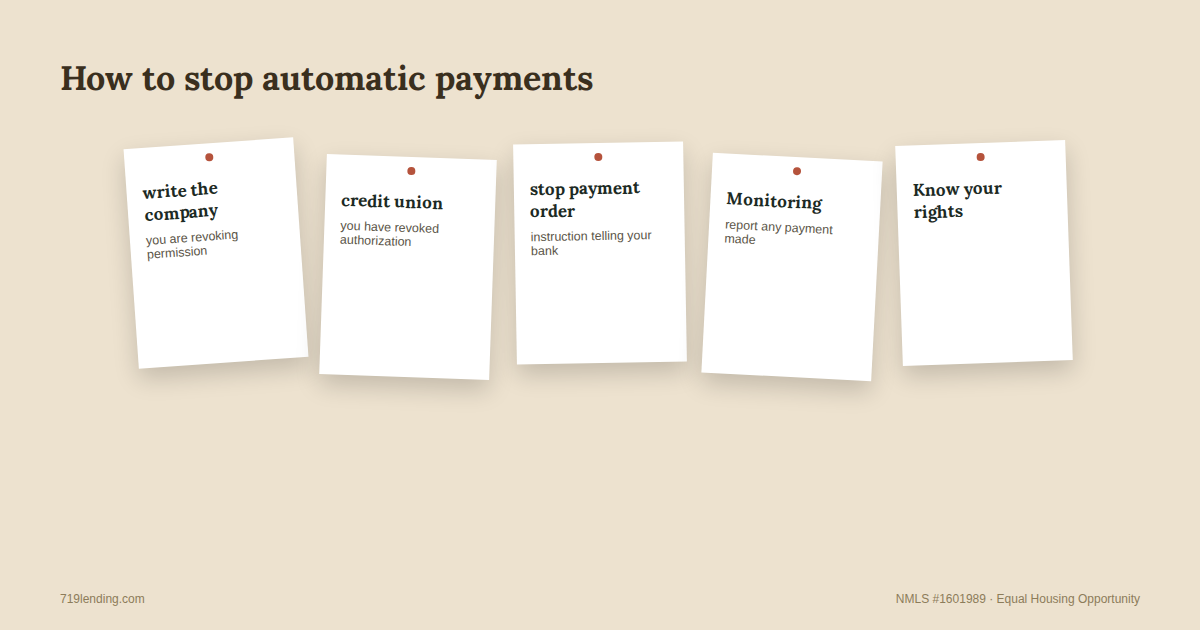
Call the company and say you’re revoking permission for automatic payments, then follow up in writing by letter or email. Make clear whether you’re canceling the underlying contract or only changing how you pay.
Next, call the bank or credit union and say you’ve revoked the company’s authorization, and follow up in writing there too. After both notices, any additional payments initiated by that company would be errors, and you can contact the bank for a refund.
Stop payment orders and monitoring
Some financial institutions may recommend a stop payment order — an instruction telling the bank not to pay a specified company from the account. Banks and credit unions generally charge fees for stop payment orders, so ask before you file one.
Keep close track of every request and date. Federal law gives you the right to dispute and recover unauthorized transfers, as long as you tell the bank in time.
Cancelling autopay does not cancel what you owe
Stopping an automatic payment stops the withdrawal — it does not erase the obligation. To end a service contract, like cable or a gym, cancel the contract with the company in addition to revoking the autopay.
If you cancel an automatic payment on a loan, you still have to make payments on the loan using another payment method. The mortgage, car payment, or credit card bill is still due on its due dates.
Autopay and military life in Colorado Springs
For service members around Fort Carson, Peterson, and Schriever, recurring bills don’t pause for a PCS move or a deployment. Automatic bill payments on fixed recurring expenses can keep accounts current while mail and schedules are in flux.
The same cautions apply, though: track the account balance through the move, and update or revoke authorizations for services you’re leaving behind, in writing, with both the company and the bank.
What to do next
Start with the recurring bills that carry the biggest penalty for a missed due date — loans, credit cards, and the mortgage — and ask each billing company what autopay options it offers.
Read the authorization terms, keep a copy, and set a habit of reviewing bank and credit card statements regularly. The CFPB’s pages on how automatic payments work and how to stop them are the authoritative references, and they include sample letters you can use.
If you’re setting up housing payments in the Pikes Peak region and want to talk through how a mortgage payment actually gets collected each month, the team at 719 Lending can walk you through it.
Frequently asked questions
Can I set up automatic payments for a mortgage?
Yes. The CFPB lists a mortgage among the bills that can be paid by automatic debit, alongside utility bills, credit card bills, childcare fees, gym fees, and car payments. Some lenders offer an interest-rate reduction on loans for paying by automatic debit — ask the lender whether that applies and get it in writing.
Can a lender require me to use automatic payments?
No. A company cannot require you to repay a loan by automatic debit from your checking account as a condition for giving you the loan, unless the loan is an overdraft line of credit. Be wary of any company that pressures you to repay by automatic debit.
What happens if there isn’t enough money in my account when autopay runs?
You might be charged overdraft or nonsufficient funds fees, and both the bank and the billing company may each charge a fee. Those fees can add up quickly, so track the account balance and upcoming automatic payments to make sure sufficient funds are available on each scheduled date.
How do I stop automatic payments from my bank account?
Call the company to revoke your authorization, then follow up in writing. Next, notify the bank or credit union by phone and in writing. The bank may also suggest a stop payment order, which generally carries a fee. After you revoke authorization, any further payments by that company are errors you can dispute for a refund.
Is autopay the same as my bank’s bill-pay feature?
No. With automatic payments, you give the company permission to take money from your bank account. With recurring bill-pay, you give the bank or credit union permission to send payments to the company. The money moves either way, but who controls the payment — and who you contact to change it — differs.
If I cancel an automatic payment, do I still owe the bill?
Yes. Canceling the autopay only stops the withdrawal, not the debt or the contract. Cancel the underlying service contract with the company if that’s your goal, and if the autopay was on a loan, keep making payments by another payment method.
719 Lending Inc., NMLS #1601989 · Equal Housing Opportunity
719 Lending Inc. is not affiliated with or endorsed by HUD, FHA, VA, USDA, CHFA, the CFPB, or any government agency.
Last updated: October 2026

Related Posts