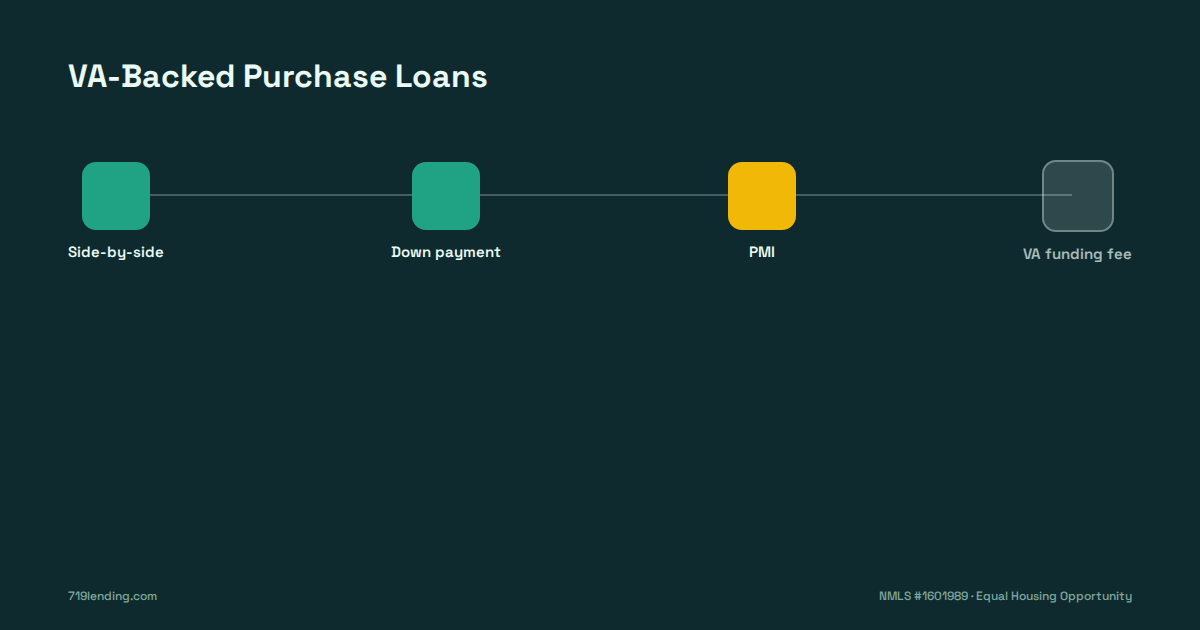
A VA-backed purchase loan and a conventional loan both come from a private lender, but the VA guaranty changes the rules on down payment, mortgage insurance, the funding fee, and prepayment. Here is the point-by-point comparison for Colorado buyers, especially military families around Colorado Springs.
What Is an IRRRL and What Might It Help Me Accomplish?
What is an IRRRL and what might it help me accomplish? An IRRRL is the Department of Veterans Affairs’ Interest Rate Reduction Refinance Loan, a VA streamline refinance available only to homeowners who already have a VA-backed home loan. This guide explains what the VA IRRRL is, what it can and cannot do, who is eligible, how the process works, and what it costs.
It is written for Colorado veterans, active-duty service members, and surviving spouses who currently hold a VA loan, including the large military homeowner population around Colorado Springs.
The short version: key facts about the VA IRRRL

- An IRRRL replaces an existing VA-backed home loan with a new VA loan under different terms.
- Its two stated purposes are a lower monthly mortgage payment through a lower interest rate, or more stable payments by moving from an adjustable rate to a fixed rate.
- You must already have a VA loan; the IRRRL refinances that existing VA loan, not a non-VA loan.
- You must certify that you currently live in, or used to live in, the home covered by the loan.
- You get the IRRRL through a private mortgage lender, credit union, or bank — not directly through the VA.
- A one-time VA funding fee may apply, and closing costs can often be included in the new loan.
With those basics in place, here is how the program actually works.
What is a VA IRRRL?
The Interest Rate Reduction Refinance Loan is one of the VA-backed loan programs the Department of Veterans Affairs offers alongside its purchase loan, its cash-out refinance loan, and the Native American Direct Loan. Refinancing lets you replace the current loan with a new loan under different terms, and the IRRRL is the VA’s version of that for homeowners who already hold a VA loan.
Why it’s called a streamline refinance
The VA itself describes the IRRRL as a “streamline” refinance. The name reflects the program’s narrow purpose: it exists specifically to reduce the monthly mortgage payment or make payments more stable, not to pull cash out of the home.
Because the new loan replaces an existing VA loan the government already stands behind, the streamline refinance is designed as a simpler path than starting a brand-new loan application from scratch. Terms and documentation requirements can still vary by lender, so ask each lender exactly what its loan process requires.
How VA backing works on the new loan
With a VA-backed home loan, the Department of Veterans Affairs guarantees a portion of the loan you get from a private lender. If the loan ever went into foreclosure, that guaranty allows the lender to recover some or all of its losses.
Less risk for the lender is the reason VA loans can carry different terms than loans without that backing. Lenders follow VA standards when making these loans, and they may also add their own standards, such as credit requirements or an updated appraisal.
That is the structure. Now the more important question: what can it do for you?
What might an IRRRL help me accomplish?
The VA lists two things an IRRRL may help you do. Everything else about the program flows from these two goals.
Lower the monthly mortgage payment
The first purpose of the VA streamline refinance is to lower the monthly payment by getting a lower interest rate on the new loan. If interest rates have moved down since you closed the original VA loan, or your situation has changed in a way that qualifies you for better pricing, an IRRRL is the VA’s mechanism for capturing that difference.
A lower interest rate applied to the loan balance means less interest accruing each month, which is how the lower monthly payment happens. Whether the math works in your specific case depends on the rate available to you, the remaining loan balance, the new loan term, and the closing costs — which is why the VA tells borrowers to run a break-even calculation before committing.
Make monthly payments more stable
The second purpose is stability. If the current VA loan has an adjustable or variable interest rate — one that changes over time — a VA IRRRL can move you into a fixed rate loan, where the interest rate stays the same for the life of the loan.
With a fixed rate mortgage, the principal-and-interest portion of the payment stops moving when the market moves. For a household budgeting around military pay and allowances, trading an adjustable rate mortgage for a fixed rate can make the housing line item predictable for as long as you hold the loan.
Notice what is not on this list: taking cash out. That distinction matters, and we cover it below. First, eligibility.
Who is eligible for a VA IRRRL?
The VA sets out the eligibility requirements plainly, and all of them must be true at the same time.
The three core requirements
- You already have a VA-backed home loan.
- You are using the IRRRL to refinance that existing VA loan.
- You can certify that you currently live in, or used to live in, the home covered by the loan.
The second requirement is the one that surprises people. A VA streamline refinance only refinances a current VA loan — it is not a route for moving a non-VA loan into the VA loan program. Homeowners with other loan types who want VA financing should talk with a lender about which VA refinance options, if any, fit their situation.
The occupancy certification and PCS moves
The occupancy language is notably flexible: “currently live in or used to live in.” That wording matters for military families who bought a home near Fort Carson, Peterson Space Force Base, or Schriever, then received PCS orders and moved away while keeping the house.
Because prior occupancy counts, a homeowner who converted the property after a PCS move may still be able to use a VA IRRRL on that loan. Confirm the certification details with the lender when you apply.
If you have a second mortgage
One more rule from the VA: if there is a second mortgage on the home, the holder of that second mortgage must agree to make the new VA-backed loan the first mortgage. That agreement is arranged during the loan process, and the lender coordinates it.
If you check those boxes, the next question is how the process actually unfolds.
How does a VA streamline refinance work, step by step?
You do not apply to the VA for an IRRRL. The Department of Veterans Affairs backs the loan, but a private bank, mortgage company, or credit union makes it.
Step one: choose a lender
The VA’s own guidance is to contact several lenders, because terms and fees may vary from one to the next. A Colorado-based mortgage broker such as 719 Lending’s VA loan team can walk through how a streamline refinance would apply to your existing VA loan and what documentation the lender will need.
Ask each lender what its credit underwriting package looks like for an IRRRL — what income verification, credit report, or appraisal steps it applies. The VA allows lenders to set additional standards beyond the VA’s own, so requirements are not identical everywhere.
Step two: provide the Certificate of Eligibility
If you still have the Certificate of Eligibility (COE) you used for the original VA loan, give it to the lender to show the prior use of the VA loan entitlement. If you do not have it, the lender can request the COE electronically through the VA Home Loan program portal.
Either way, you do not have to chase the document down yourself before starting the conversation.
Step three: close and settle the costs
From there, you follow the lender’s process for closing on the new loan and pay the closing costs. The VA funding fee may be due at this stage, along with the lender’s fees and interest on the new loan.
The IRRRL gives you options for handling those costs, covered next.
What does a VA IRRRL cost?
A streamline refinance is not free, and the VA is direct about that. Two categories of cost matter: the VA funding fee and ordinary closing costs.
The VA funding fee
The VA funding fee is a one-time fee on the loan. The VA explains its purpose: it helps lower the cost of the VA loan program to U.S. taxpayers, since VA loans do not require down payments or monthly mortgage insurance the way some other financing structures do.
Whether the funding fee applies to you, and what it amounts to on your transaction, is something the lender confirms and discloses before closing. Tax treatment of any loan cost varies by situation, so direct those questions to a tax professional.
Closing costs on a streamline refinance
Beyond the funding fee, the new loan carries closing costs like any refinance loan — lender charges plus interest on the loan going forward. The VA cautions borrowers to keep these costs firmly in mind, because they add up.
The VA’s suggested test is simple: divide the total closing costs by the expected monthly savings. The result is the number of months it takes to break even, and if you plan to sell or refinance again before that point, the transaction may not pay for itself.
Three ways to handle the out-of-pocket costs
- Pay the closing costs upfront at the closing table.
- Include the costs in the new loan, so nothing is due out of pocket at closing — the trade-off is a larger loan balance.
- Accept an interest rate on the new loan high enough that the lender pays the costs on your behalf.
Each structure changes the break-even math, so run the numbers under each option before choosing. That leads to the bigger judgment call: is the refinance worth doing at all?
How do I know if a VA streamline refinance is worth it?
The IRRRL is a tool, not an automatic win. The VA itself tells borrowers to make sure they understand what they are getting into, even though the lender can advise on the costs and benefits of the transaction.
Questions to work through with the lender
- How much lower would the monthly payment be, and how many months of that savings does it take to recover the closing costs?
- How does the new loan term compare with the remaining term on the current loan?
- If the costs are rolled into the loan, what does the new loan balance look like?
- If the goal is stability rather than savings, what does moving from the adjustable rate to a fixed rate do to the payment?
- Does the refinance produce a genuine, documented benefit under the lender’s guidelines?
A refinance that trims the payment but restarts a long loan term can cost more interest over the full life of the loan. There is no universal answer — only your break-even math and your plans for the home. For a deeper look at when refinancing makes sense generally, see our refinance overview.
One more piece of due diligence the VA specifically flags: watch for misleading offers.
Watch out for misleading refinance offers
The VA warns homeowners with VA loans to be careful when weighing refinance solicitations. VA borrowers are heavily marketed to, and Colorado Springs mailboxes see plenty of it.
According to the VA, claims that you can skip payments, or promises of very low interest rates or other terms that sound too good to be true, may be signs of a misleading offer. If a mailer implies it comes from the government or pressures you to act immediately, slow down.
Compare any offer against written terms from at least one other mortgage lender, and read the closing cost disclosures line by line. A legitimate VA streamline refinance survives scrutiny; a misleading one depends on you not looking closely. Next, a common question: how large can the new loan be?
How much can you borrow with an IRRRL?
On a no-down-payment VA loan, the VA says you can borrow up to the Fannie Mae/Freddie Mac conforming loan limit that applies in most areas, and more in some high-cost counties. Those limits are published by the agencies and updated over time, so the lender confirms the current figure for your county when you apply.
You can borrow above that level if you choose to make a down payment. How this interacts with your VA loan entitlement is worth reviewing with the lender, and the VA publishes its own guidance on entitlement and limits.
Borrowing capacity is one distinction between VA refinance options; purpose is the bigger one.
VA IRRRL vs. VA cash-out refinance
The Department of Veterans Affairs backs two refinance loans, and they exist for different jobs.
| Question | VA IRRRL (streamline refinance) | VA cash-out refinance |
|---|---|---|
| What is it for? | Lowering the monthly payment or moving from an adjustable rate to a fixed rate | Taking cash out of home equity to pay off debt, pay for school, or cover other needs |
| What loan does it replace? | An existing VA-backed home loan only | A current home loan, per VA eligibility rules for that program |
| Who makes the loan? | A private lender, with VA backing | A private lender, with VA backing |
If the goal is cash in hand rather than a lower or steadier payment, the IRRRL is not the vehicle — the VA points those borrowers to its cash-out refinance loan instead, with its own eligibility rules to review. If the goal is strictly payment reduction or rate stability on an existing VA loan, the streamline refinance is the program built for it.
Why the IRRRL matters in Colorado Springs
That means an unusually large share of local homeowners hold the one prerequisite an IRRRL demands: an existing VA loan.
It also means PCS turnover is constant. The IRRRL’s occupancy language — currently live in or used to live in the home — is written in a way that can accommodate owners who kept a Colorado property after orders took them elsewhere.
And because household budgets here often revolve around military pay, the program’s second purpose — converting an adjustable rate mortgage into a fixed rate mortgage for payment stability — is a practical fit for families who want the mortgage payment to hold still between duty stations.
What to do next
Start by confirming the basics: you have a VA-backed home loan, and you either live in the property now or lived in it before. If both are true, the VA IRRRL is on the table.
Then gather what you know about the current loan — the interest rate, the remaining balance, the remaining term — and get written terms from more than one lender, as the VA recommends. Ask each one to show the break-even math with the closing costs handled upfront, rolled into the loan, and lender-paid.
If you want to walk through it with a local team, reach out to 719 Lending in Colorado Springs. Bring the current mortgage statement and, if you have it, the original Certificate of Eligibility; if not, the lender can pull the COE through the VA’s portal. For the official program rules, read the VA’s own IRRRL page at VA.gov — it is short, plainly written, and the authority on everything above.
Frequently asked questions
What does IRRRL stand for?
IRRRL stands for Interest Rate Reduction Refinance Loan. It is a VA-backed refinance, often called a VA streamline refinance, that replaces an existing VA home loan with a new loan intended to lower the monthly payment or make payments more stable.
Can I use a VA IRRRL if I don’t currently have a VA loan?
No. The VA requires that you already have a VA-backed home loan and that the IRRRL is used to refinance that existing VA loan. Homeowners with other loan types should ask a lender which refinance options fit their situation instead.
Do I have to live in the home to get a VA streamline refinance?
Not necessarily. The VA requires you to certify that you currently live in the home or used to live in it. That prior-occupancy option can matter for military homeowners who kept a property after a PCS move.
Does a VA IRRRL have closing costs?
Yes. The new loan carries closing costs plus a possible one-time VA funding fee. The VA says you can pay these upfront, include them in the new loan balance, or take an interest rate high enough that the lender pays the costs.
How do I know if an IRRRL is worth it?
Use the VA’s own test: divide the total closing costs by the expected monthly savings to find how many months it takes to break even. If you plan to keep the loan past that point, the refinance may make sense; if not, it may not.
Can I take cash out with a VA IRRRL?
No. The IRRRL exists to lower the monthly payment or move from an adjustable rate to a fixed rate. Borrowers who want to tap home equity for debt payoff, school, or other needs would look at the VA cash-out refinance loan instead.
719 Lending Inc., NMLS #1601989 · Equal Housing Opportunity
719 Lending Inc. is not affiliated with or endorsed by HUD, FHA, VA, USDA, CHFA, the CFPB, or any government agency.
Last updated: September 2026

Related Posts