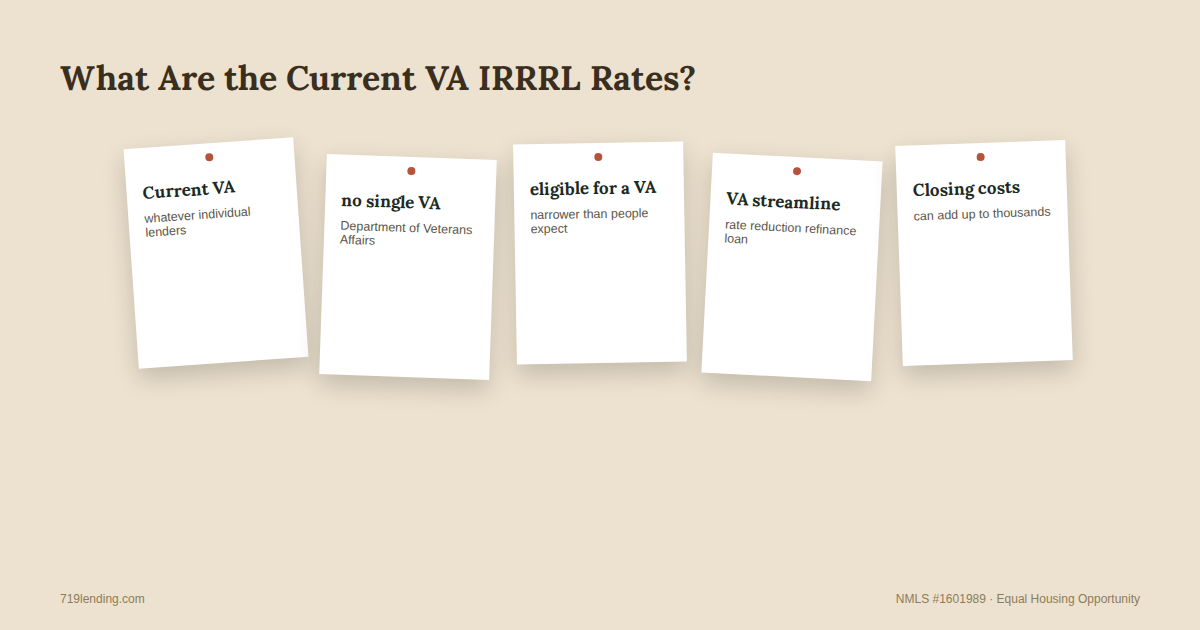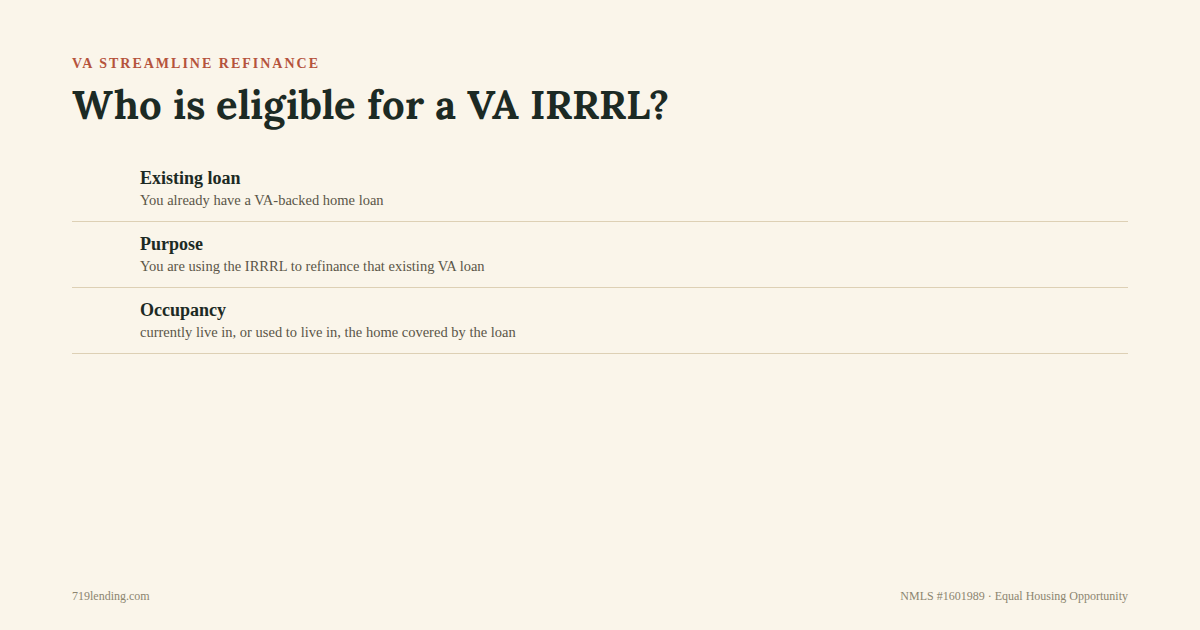
The VA does not publish an IRRRL rate. Private lenders set VA streamline refinance pricing, and it moves with the market and the borrower's profile. Here is how the VA IRRRL works, who qualifies, and how Colorado Springs veterans can compare quotes the right way.
VA Direct Loan vs. VA-Backed Loan: What’s the Difference?
If you’re asking what the difference is between a VA direct loan and a VA-backed loan, here’s the plain-English answer: the difference is who actually lends you the money. This guide explains both structures, walks through each VA home loan type, and lays out the next steps for Veterans and service members in Colorado Springs and across Colorado.
Here’s the quick summary before we go deep:
- VA direct loan: the Department of Veterans Affairs serves as your mortgage lender, and you work directly with the VA to apply for and manage the loan. Today this means the Native American Direct Loan (NADL) program.
- VA-backed loan: a private lender — a bank, mortgage company, or credit union — makes the loan, and the VA guarantees a portion of it.
- Three VA-backed loan types: the purchase loan, the Interest Rate Reduction Refinance Loan (IRRRL), and the cash-out refinance loan.
- Where they work: only within the U.S. and its territories, including Puerto Rico and the Northern Mariana Islands.
What is the difference between a VA direct loan and a VA-backed loan?
A VA direct loan is a mortgage where the Department of Veterans Affairs itself is the lender. You apply with the VA, and you manage the loan with the VA.
A VA-backed loan is a mortgage from a private lender that the VA guarantees, or stands behind, in part. If a VA-backed home loan goes into foreclosure, the guaranty allows the lender to recover some or all of their losses.
The short version
Direct means the government is the lender. Backed means a private lender is the lender and the government shares the risk. Both are VA home loan programs, and both require a Certificate of Eligibility, but the borrower experience is different because the counterparty is different.
Next, let’s look at how the direct side actually works — and why most Veterans will never use it.
How does a VA direct home loan work?
With a VA direct home loan, the VA serves as your mortgage lender. That means the application, the underwriting relationship, and the ongoing loan management all run through the Department of Veterans Affairs rather than a private bank, mortgage company, or credit union.
Here is the part that surprises many borrowers: the VA direct home loan is not a general-purpose option open to every Veteran. It exists as one specific program.
The Native American Direct Loan (NADL)
The Native American Direct Loan (NADL) is the VA’s direct home loan program. The VA states that the NADL program often has better terms than a home loan from a private lender.
The NADL can be used to buy, build, or improve a home on federal trust land. Because the VA is the lender, the borrower works with the VA from application through repayment.
Who the NADL is for
The NADL program serves Native American Veterans and Veterans married to a Native American. Eligibility for the program is something you confirm directly with the VA, and the VA’s own site is the authoritative place to start that check.
If you don’t fit the NADL profile, the VA-backed side of the house is where your VA home loan benefit lives — so let’s break that down.
How does a VA-backed home loan work?
With a VA-backed home loan, you get the loan from a private lender, and the VA guarantees a portion of it. The private lender can be a bank, a mortgage company, or a credit union.
The guaranty matters because of what it does to risk. If the VA-backed home loan goes into foreclosure, the guaranty allows the lender to recover some or all of their losses.
What the VA guaranty does
Because there’s less risk for the lender, the lender is more likely to give you the loan under better terms, according to the VA. The VA also reports that the large majority of VA-backed home loans are made without a down payment.
That no-down-payment feature is a defining characteristic of the VA loan program, and it’s a direct result of the guaranty structure rather than a lender promotion.
What lenders can still require
Lenders follow VA standards when making VA-backed home loans, but they may also require you to meet additional standards before approving the loan. The VA gives two examples: having a high enough credit score and getting an updated home appraisal, which is an expert’s estimate of the value of the home.
In practice this means two Veterans with identical VA loan eligibility can have different experiences at different lenders, because each lender layers its own standards on top of the VA’s. With the structure clear, here are the three VA-backed loan types you can actually apply for.
What are the three VA-backed loan types?
The VA offers home loan programs to help you buy, build, or improve a home, or refinance a current home loan. Alongside the direct NADL, there are three VA-backed loan types.
VA-backed purchase loan
The VA-backed purchase loan is for buying a home. Per the VA, eligible borrowers may get better terms than with a private-lender loan that has no VA guaranty behind it.
Purchase loans are where most Colorado Springs Veterans start, whether it’s a first home near Fort Carson or a move-up purchase on the north side. If you’re weighing a purchase, you can explore VA loan options with 719 Lending to see how the program applies to your situation.
Interest Rate Reduction Refinance Loan (IRRRL)
The Interest Rate Reduction Refinance Loan (IRRRL) is for borrowers who already have an existing VA-backed home loan. The VA describes the IRRRL as a way to help reduce monthly payments or make them more stable.
Because the IRRRL requires an active VA loan to begin with, it’s a benefit that follows you after your first VA purchase — something worth remembering years down the road, especially in a market where the interest rate environment shifts over time.
VA-backed cash-out refinance loan
The VA-backed cash-out refinance loan is for taking cash out of home equity. The VA lists paying off debt, paying for school, or taking care of other needs as uses.
Colorado homeowners who have built home equity can look at a refinance through this route; whether it fits depends on the goals for the money and the terms available at the time.

Now let’s put the direct and backed structures side by side.
VA direct loan vs. VA-backed loan: side-by-side comparison
| Feature | VA direct loan | VA-backed loan |
|---|---|---|
| Who lends the money | The Department of Veterans Affairs | A private lender (bank, mortgage company, or credit union) |
| The VA’s role | Your mortgage lender — you apply and manage the loan with the VA | Guarantees a portion of the loan; the guaranty covers lender losses in a foreclosure |
| Current program(s) | Native American Direct Loan (NADL) | Purchase loan, IRRRL, cash-out refinance loan |
| Who it serves | Native American Veterans and Veterans married to a Native American, for homes on federal trust land | Eligible Veterans and borrowers who obtain a Certificate of Eligibility and meet lender standards |
| Whose standards apply | The VA’s | VA standards plus any additional lender standards, such as credit score or an updated appraisal |
The table covers structure — but geography matters too, so here’s where these loans can and cannot be used.
Where can you use a VA home loan?
You can use these VA home loan programs to buy a home or refinance a home loan only within the U.S. and its territories, including Puerto Rico and the Northern Mariana Islands.
For the NADL specifically, the property must be on federal trust land, since the program exists to help Native American Veterans buy, build, or improve a home there.
For military families, this comes up during overseas assignments: the benefit travels with you, but the property it finances has to be inside the U.S. and its territories. Before any property enters the picture, though, there’s one document every VA borrower needs.
Why the Certificate of Eligibility comes first
The VA directs borrowers to find out if they can get a Certificate of Eligibility for a loan that meets their needs. The Certificate of Eligibility is the document that confirms you qualify for the VA home loan benefit.
Whether you’re pursuing the NADL directly through the VA or a VA-backed purchase loan through a private lender, the Certificate of Eligibility is the starting point. A loan officer can help you understand how to obtain it and what your service history means for VA loan eligibility.
With the paperwork question answered, here’s why all of this matters so much in this particular corner of Colorado.
What this means for Colorado Springs borrowers
Colorado Springs is one of the most military-dense housing markets in the country, home to Fort Carson, Peterson Space Force Base, Schriever Space Force Base, and the U.S. Air Force Academy. VA home loans are a fixture of this market for a reason.
PCS moves and timing
PCS orders compress home-buying timelines. Understanding upfront that a VA-backed purchase loan comes from a private lender — not from the VA itself — helps you plan the sequence: Certificate of Eligibility, lender application, appraisal, closing.
Because lenders may apply their own standards on top of the VA’s, getting your credit report and documentation organized before orders drop puts you in a stronger position when the clock starts.
Working with a lender on a VA-backed loan
Since the VA-backed structure runs through private lenders, your choice of lender shapes the experience. As a Colorado Springs mortgage broker, 719 Lending works with military borrowers on VA purchase loans and VA refinance options; you can reach out to the team with questions about your situation.
Even with the structure clear, a few misconceptions come up constantly — worth clearing before you apply.
Common points of confusion
“VA direct loan” doesn’t describe most VA loans
Many borrowers assume every VA loan comes directly from the government. In reality, the direct structure applies to the NADL program, while the purchase loan, the IRRRL, and the cash-out refinance loan are all VA-backed loans funded by private lenders.
It’s also easy to confuse the term with federal Direct Loans on the student side — those are student loans made directly by the U.S. Department of Education, a completely separate program from anything the Department of Veterans Affairs offers for housing.
The guaranty is not an approval
The VA guaranty protects the lender against losses; it is not a promise that any individual application will be approved. Lenders follow VA standards and may require additional ones, so approval always depends on your full financial picture.
No down payment doesn’t mean no costs
The VA reports that the large majority of VA-backed home loans are made without a down payment. That is a statement about the down payment specifically — closing costs and other loan charges are a separate conversation to have with your loan officer, who can walk through a full estimate for your scenario.
That leads naturally to the short list of items worth confirming before you commit.
Questions to confirm with your loan officer
Some details vary by borrower, by program, and by the point in time you apply, so confirm them rather than assuming:
- What the lender’s own standards are — credit score expectations, appraisal requirements, and documentation.
- How an existing VA loan affects your options, including whether an IRRRL fits your goals.
- How the numbers compare against other loan types you may be considering, such as conventional loans or an FHA loan, based on the actual terms available to you at the time.
For the program rules themselves, go straight to the source: the VA’s official page on VA home loan types covers the direct loan, the three VA-backed loans, and how to check eligibility. The VA also notes there is help available with VA-backed loans and home repairs for those affected by a natural disaster.
Your next step
Start with the Certificate of Eligibility, then decide which structure fits: the NADL if you’re a Native American Veteran or married to one and buying, building, or improving a home on federal trust land, or a VA-backed loan through a private lender for a purchase or refinance anywhere in the U.S. and its territories.
If you’re in Colorado Springs or anywhere in Colorado, start an application with 719 Lending or call to talk through your VA home loan benefit with a loan officer who works with military borrowers every day. Tax treatment of any loan costs varies, so direct those questions to a tax professional.
Frequently asked questions
Is a VA loan a direct loan from the government?
Usually not. Most VA loans are VA-backed loans, meaning a private lender — a bank, mortgage company, or credit union — funds the loan and the VA guarantees a portion of it. The only VA direct home loan, where the VA itself is the lender, is the Native American Direct Loan (NADL) program.
Who qualifies for a VA direct loan (NADL)?
The Native American Direct Loan program serves Native American Veterans and Veterans married to a Native American who want to buy, build, or improve a home on federal trust land. Eligibility is confirmed directly with the Department of Veterans Affairs.
Do VA-backed loans require a down payment?
The VA reports that the large majority of VA-backed home loans are made without a down payment. Lenders follow VA standards but may add their own requirements, such as a high enough credit score or an updated home appraisal, so confirm specifics with your lender.
What are the three types of VA-backed loans?
The three VA-backed loan types are the purchase loan for buying a home, the Interest Rate Reduction Refinance Loan (IRRRL) for borrowers with an existing VA-backed loan who want to reduce or stabilize monthly payments, and the cash-out refinance loan for taking cash out of home equity.
Can I use a VA home loan to buy a home outside the United States?
No. VA home loan programs can be used to buy a home or refinance a home loan only within the U.S. and its territories, including Puerto Rico and the Northern Mariana Islands.
What is a Certificate of Eligibility for a VA loan?
The Certificate of Eligibility is the document that confirms you qualify for the VA home loan benefit. The VA directs borrowers to obtain it as a first step, whether they’re pursuing the direct NADL or a VA-backed loan through a private lender.
719 Lending Inc., NMLS #1601989 · Equal Housing Opportunity
719 Lending Inc. is not affiliated with or endorsed by HUD, FHA, VA, USDA, CHFA, the CFPB, or any government agency.
Last updated: September 2026

Related Posts