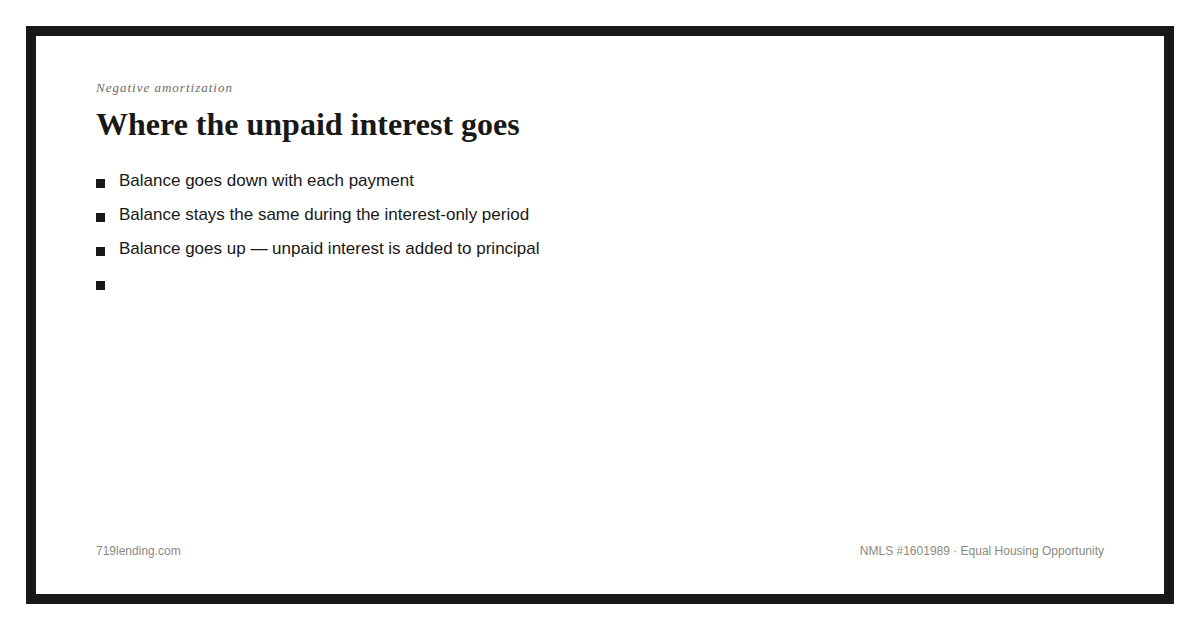
Negative amortization means the loan balance goes up instead of down, because the payment is not large enough to cover the interest. The unpaid interest gets added to the amount you borrowed, and you can end up paying interest on interest. Here is how the mechanism works, why it matters for Colorado homeowners, and how to avoid it.
A key risk of a negative amortization loan, explained
What is a key risk of taking out a negative amortization loan? The key risk is that the amount you owe goes up over time instead of down, so you can end up owing more on the mortgage than the home is worth. This article explains how negative amortization occurs, why a growing loan balance is dangerous, what the Consumer Financial Protection Bureau says about it, and what Colorado borrowers — including military families around Colorado Springs — can do about it.
Here is the short version before we go deeper:
- Negative amortization means the loan balance increases even when you make payments, because the payment does not cover the interest owed.
- The unpaid interest gets added to the principal balance, and you then pay interest on that interest.
- Eventually the minimum payment period ends and you must make higher monthly payments that cover both the interest and the principal — often called payment shock.
- If the balance grows past the home’s value, selling becomes difficult and foreclosure risk rises if you run into trouble making the mortgage payment.
The key risk: owing more than the home is worth

The Consumer Financial Protection Bureau is direct about this. A negative amortization loan can be risky because you can end up owing more on the mortgage than the home is worth.
That matters because the sale of the home is the natural exit for most borrowers. If the loan balance exceeds the likely sales price, the proceeds will not be enough to pay what you owe.
A borrower who cannot sell and cannot afford the higher monthly payments that eventually arrive is boxed in. The CFPB notes this can put you at risk of foreclosure if you run into trouble making the mortgage payments.
To understand why the balance grows, it helps to see how a normal amortization schedule works first.
What negative amortization means in plain English
Amortization means paying off a loan with regular payments so that the amount you owe goes down with each payment. Each loan payment covers the interest owed that month plus at least some principal.
How a normal amortization schedule works
In an amortizing loan, a percentage of each monthly payment is applied to the principal and to the interest. The chart showing how each payment splits between principal and interest is called an amortization schedule.
Early in the mortgage term, a greater percentage of the fixed monthly payment generally goes toward interest. Toward the end, a greater percentage goes toward principal, so the principal balance decreases slowly at first and then more quickly.
The longer the loan terms stretch, the lower the monthly payments, but the more total interest you pay over the life of the loan. Even so, with a normally amortizing loan the balance always moves in one direction: down.
How negative amortization reverses that
Negative amortization means that even when you pay, the amount you owe still goes up, because you are not paying enough to cover the interest. The lender may offer a minimum payment option that is less than the interest accruing each month.
The unpaid interest gets added to the amount you borrowed, and the outstanding balance increases. Instead of the amortization schedule working for you, it works against you.
Next, the mechanics of exactly how that growing loan balance compounds.
How the loan balance grows when payments don’t cover the interest
Negative amortization occurs any time the scheduled payments are less than the interest owed for the period. The shortfall does not disappear — it becomes deferred interest that is capitalized into the principal loan balance.
Interest on interest: why deferred interest compounds
The CFPB’s warning is to try to avoid paying interest on interest. Certain loans have payment options that let you pay only a portion of the interest you owe each month.
If you only pay some of the interest, the amount you do not pay may get added to the principal balance. You then end up paying interest not only on the money you borrowed, but on the interest you were charged for borrowing it.
This dramatically increases the amount of debt you have and the total cost of the loan. The deferred interest snowballs quietly, month after month, while the low minimum payment makes everything feel fine.
Payment shock when full payments begin
Negative amortization does not last forever. Usually, after a period of time, you will have to start making payments that cover both the interest and the principal.
Those payments will be higher — and they are calculated on a loan balance that is now larger than what you originally borrowed. Borrowers call this payment shock.
A household budget built around the low minimum payment can be badly strained when the full mortgage payment arrives. That is exactly when the growing loan balance turns from an abstraction into a crisis.
Why a growing loan balance makes the home harder to sell
Selling the home normally pays off the mortgage balance from the sale proceeds. When negative amortization has pushed the balance above the home’s value, the CFPB points out that the sales price won’t be enough to pay what you owe.
That leaves the homeowner with hard choices: bring cash to closing, negotiate with the lender, or stay in a loan with higher monthly payments they may not be able to afford.
Compare that with a fully amortizing fixed rate mortgage, where timely payments reduce the remaining principal balance every single month. Fixed rate mortgages build an equity cushion by design; a negative amortization loan erodes it by design.
| Payment structure | What each payment covers | What happens to the loan balance |
|---|---|---|
| Fully amortizing payment | All of the interest owed plus some principal | Balance goes down with every payment |
| Interest-only payments | The interest owed, but no principal | Balance stays where it started |
| Negative amortization minimum payment | Less than the interest owed | Unpaid interest is added and the balance goes up |
With the mechanics clear, the next question is who actually faces this risk.
Who this risk applies to
Negative amortization risk applies to anyone offered a loan with a minimum payment option, a payment cap, or any structure where scheduled payments can be less than the interest owed.
Military homeowners and PCS moves in Colorado Springs
The sell-the-home risk hits military families especially hard. Around Fort Carson, Peterson Space Force Base, and Schriever, a PCS move can force a sale on the military’s timeline, not the market’s.
A service member who owes more than the home is worth cannot simply list the house and move on orders. The shortfall follows them, at exactly the moment BAH and the household budget are being reworked for a new duty station.
Buyers stretching to qualify on the minimum payment
The low minimum payment is the sales pitch. Buyers stretching their debt-to-income ratio may be tempted to qualify based on a payment that does not cover the interest.
That trade works only if the full, higher payment is affordable later — and if the home’s value outruns the growing loan balance. Neither is guaranteed, which is why federal regulators flag the structure.
What the official source says and where to read it
The Consumer Financial Protection Bureau publishes a plain-language explainer, “What is negative amortization?”, in its Ask CFPB library. It defines the mechanism, explains how unpaid interest gets added to the amount borrowed, and names the key risk: owing more on the mortgage than the home is worth, making the house harder to sell and raising foreclosure risk.
The CFPB’s practical tip is worth repeating: to keep your debt from growing, try to pay down all of the interest and at least some of the principal you owe. Reading the CFPB page directly is a good habit before signing any unusual loan terms.
So how do you put that advice into practice?
How to avoid negative amortization
The most reliable way to avoid negative amortization is to make payments that cover the full interest owed plus some principal every month. If a loan’s minimum payment allows less than that, treat the minimum as a trap, not a feature.
Questions to ask before you sign
Ask the mortgage lender or mortgage broker these questions in writing:
- Can any scheduled payment on this loan be less than the interest owed?
- Is this a fixed interest rate loan, or an adjustable rate mortgage where the payment and the interest can move separately?
- Is there a payment cap, and can the loan balance increase if interest rates move while the cap holds the payment down?
- When do fully amortizing payments begin, and how much higher could they be?
- Does the loan estimate show the balance ever rising on the amortization schedule?
If a product is marketed with flexible or graduated payment mortgages language, ask specifically whether deferred interest is possible. A straight answer to that one question tells you most of what you need to know. Our mortgage basics guides cover more of the vocabulary you will see on loan paperwork.
If you already have a loan with a rising balance
If you are already watching the principal balance climb, pay more than the minimum whenever you can — enough to cover the interest portion plus some principal. That stops the compounding.
Refinancing into a fully amortizing loan is another path. Eligible veterans and service members can look at a VA-backed cash-out refinance loan, which the Department of Veterans Affairs describes as a way to replace the current loan with a new one under different terms, including refinancing a non-VA loan into a VA-backed loan.
That route runs through a private lender, requires a Certificate of Eligibility, and involves a lender-ordered appraisal plus closing costs, which the VA notes can add up. A refinance review can compare the current loan’s trajectory against a fully amortizing replacement.
Next steps for Colorado borrowers
Before you sign anything, get the amortization schedule and confirm the balance never rises. If you are shopping now, compare any payment-option product against a fully amortizing fixed rate alternative side by side.
719 Lending is a mortgage broker in Colorado Springs, and walking a borrower through an amortization schedule is routine work. Talk with a 719 Lending loan officer about the loan terms you have been offered, and bring the paperwork — the answer is in the schedule, not the sales pitch.
Frequently asked questions
What is a key risk of taking out a negative amortization loan?
The key risk is that the loan balance grows even as you make payments, because unpaid interest is added to the principal. You can end up owing more on the mortgage than the home is worth, which makes the home harder to sell and raises the risk of foreclosure if you have trouble making payments.
Why does the balance go up on a negative amortization loan?
Negative amortization occurs when the scheduled payment is less than the interest owed for the month. The unpaid interest is added to the amount you borrowed, so the principal balance increases and you begin paying interest on that interest.
What is payment shock on a negative amortization loan?
After the minimum-payment period ends, you must start making payments that cover both the interest and the principal. Those payments are higher, and they are calculated on a balance that has grown larger than the original loan amount.
How can I avoid negative amortization?
Pay all of the interest owed plus at least some principal every month, and ask the lender in writing whether any scheduled payment on the loan can be less than the interest owed. Review the amortization schedule and confirm the balance goes down with every payment.
Can I refinance out of a negative amortization loan?
Refinancing into a fully amortizing loan is one option. Eligible veterans and service members can consider a VA-backed cash-out refinance loan, which replaces the current loan with a new one under different terms through a private lender; it requires a Certificate of Eligibility and involves an appraisal and closing costs.
Why is negative amortization risky for military families?
A PCS move can force a sale on the military’s timeline. If the loan balance has grown past the home’s value, the sales price will not be enough to pay off the mortgage, leaving the service member to cover the shortfall while relocating.
719 Lending Inc., NMLS #1601989 · Equal Housing Opportunity
719 Lending Inc. is not affiliated with or endorsed by HUD, FHA, VA, USDA, CHFA, the CFPB, or any government agency.
Last updated: October 2026

Related Posts