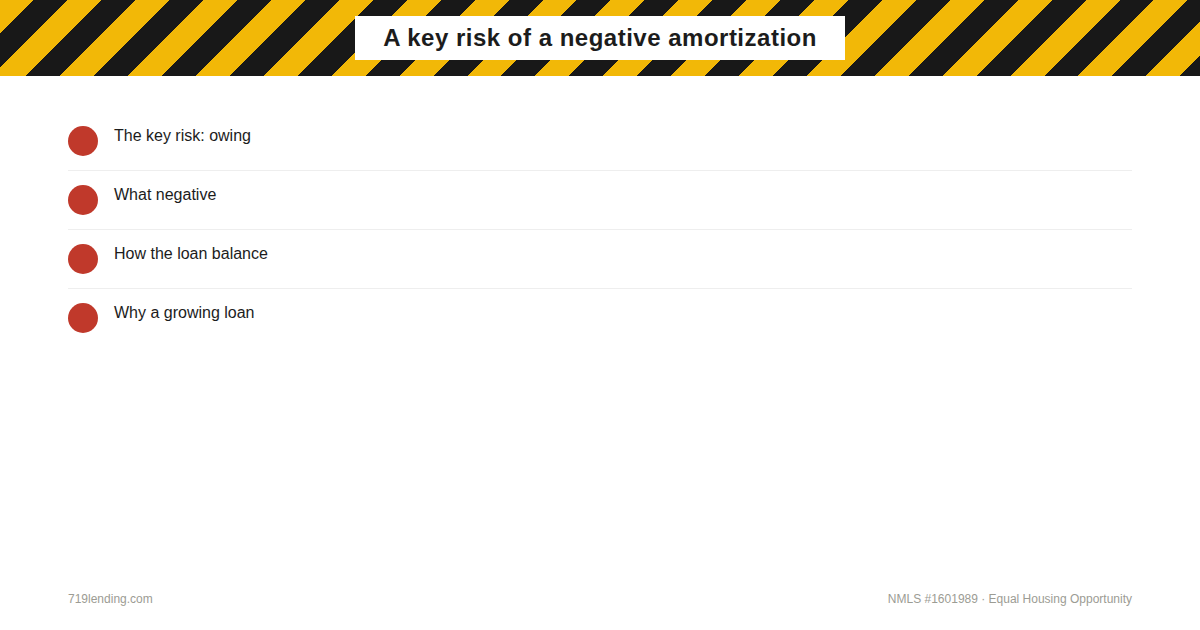
Negative amortization means the amount you owe goes up even when you make payments, because the minimum payment does not cover the interest. The key risk: you can end up owing more on the mortgage than the home is worth, which makes the house harder to sell and raises the risk of foreclosure if you hit trouble.
What Does Negative Amortization Mean? Plain-English Guide
What does negative amortization mean? In plain English, negative amortization means the amount you owe on a loan increases over time even though you are making payments, because the payments are not large enough to cover the interest being charged.
This guide is for Colorado borrowers who saw the term on a loan disclosure, in an online mortgage article, or in a question from a lender and want a straight answer. We cover how amortization normally works, how negative amortization happens, why it is risky, and how to avoid it.
Here are the key points up front:
- Amortization means paying off a loan with regular payments so the balance goes down with each payment.
- Negative amortization is the opposite: the balance of the loan goes up because the payment does not cover the interest owed.
- The unpaid interest gets added to the amount you borrowed, so you pay interest on interest.
- Eventually you must start making higher payments that cover principal and interest.
- A negative amortization loan can leave you owing more than the home is worth.
What does negative amortization mean, exactly?

Negative amortization means that even when you pay, the amount you owe still goes up, because you are not paying enough to cover the interest. That is the definition the Consumer Financial Protection Bureau (CFPB) uses, and it is the one that matters.
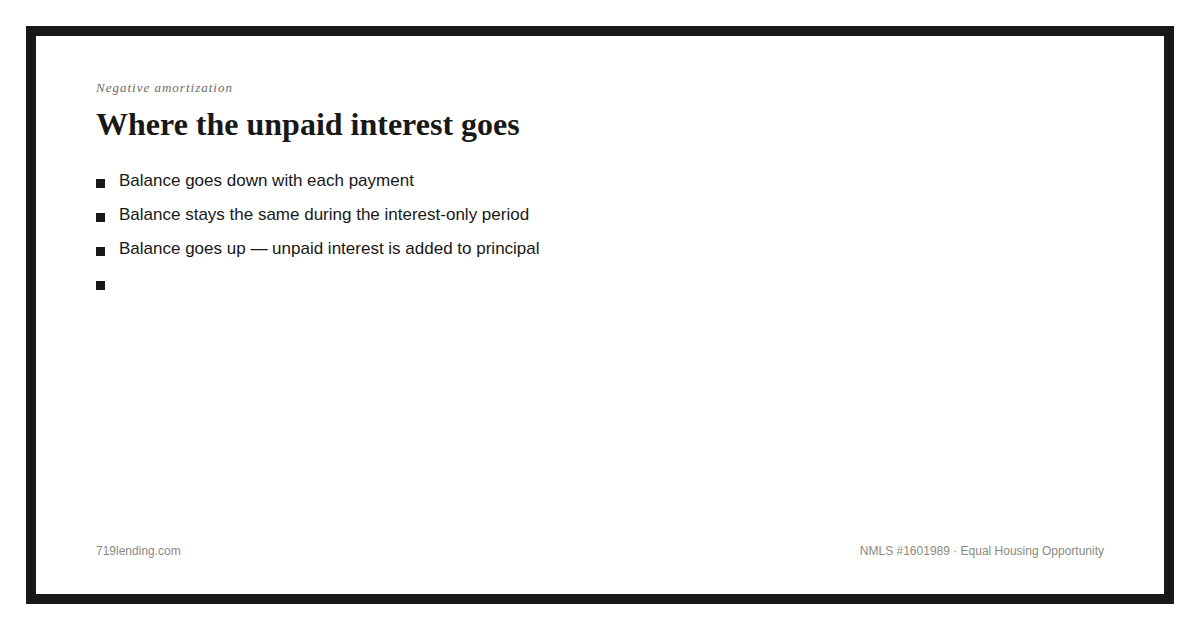
Some lenders offer the choice to make a minimum payment that does not cover the interest you owe each month. When the borrower makes that minimum payment, the unpaid interest gets added to the principal balance, and the mortgage balance grows.
So instead of the loan shrinking with every mortgage payment, the loan grows. That is why the word “negative” is in the name. Next, it helps to see what normal amortization looks like.
How a normally amortizing loan works
Amortization means paying off a loan with regular payments, structured so that the amount you owe goes down with each payment. Each monthly payment covers all of the interest that accrued since the last payment, plus a piece of the principal.
Self-amortizing payments
A loan built this way is often called self-amortizing. Make every scheduled payment on a self-amortizing loan and the principal loan balance reaches zero by the end of the loan term, with no lump sum left over.
Most fixed rate mortgages written today work exactly this way: the monthly payments are set so the balance steadily declines. Negative amortization flips that math on its head, which is what we cover next.
How negative amortization happens
Negative amortization happens when the payment the borrower makes is smaller than the interest owed for that period. The shortfall does not disappear. The lender adds the unpaid interest to the outstanding balance of the loan.
The minimum payment trap
Certain loans have payment options that let you pay only a portion of the interest you owe each month. The minimum payment option can make the monthly payments lower in the short run, which is exactly why it tempts borrowers in a tight month.
But if you only pay some of the interest, the amount you do not pay may get added to the principal balance. Every month you choose that option, the mortgage balance climbs a little higher.
Interest on interest
Once unpaid interest is rolled into the principal, you end up paying not only interest on the money you borrowed, but interest on the interest you were charged for borrowing it. The CFPB warns that this dramatically increases the amount of debt you have and the total cost of the loan.
You may also see this described as deferred interest: interest that was owed, not paid, and deferred into the loan balance to be paid later with more interest on top. However it is labeled, the mechanism is the same, and it leads directly to the biggest risk of these loans.
Why is a negative amortization loan risky?
A negative amortization loan carries two distinct risks: the payments eventually jump, and the debt can outgrow the home’s value.
Payment shock when the real payments begin
Usually, after a period of time, the borrower has to start making payments that cover principal and interest. Those payments will be higher than the minimum payment the borrower got used to.
That jump is often called payment shock. A household budget built around the low minimum payment can be strained when the required mortgage payment resets higher, and the higher balance that accumulated makes the problem worse.
Owing more than the home is worth
Because the loan balance grows instead of shrinks, you can end up owing more on the mortgage than the home is worth. That makes it harder to sell the house, because the sales price will not be enough to pay what you owe.
The CFPB notes this can put you at risk of foreclosure if you run into trouble making the mortgage payments. Knowing who tends to encounter these structures helps you spot them before signing.
Who does negative amortization apply to?
Negative amortization is not a feature of the standard self-amortizing mortgage most Colorado buyers use. It shows up with specific loan structures and specific payment choices.
Borrowers offered flexible payment options
If a lender offers a choice of payment options each month — and one of those options is a minimum payment that does not cover the interest owed — negative amortization is on the table.
Why it matters in a military market
Colorado Springs is a heavily military market, and PCS moves mean many local homeowners sell on a timeline they do not fully control. A growing loan balance is a particular problem when orders arrive and the home must sell for enough to pay off the mortgage.
A service member who made minimum payments on a negatively amortizing loan could face a sale price that does not clear the balance of the loan. That is one more reason to understand the payment structure before closing — and it leads straight to the question of avoidance.
How to avoid negative amortization
The CFPB’s advice is direct: try to avoid paying interest on interest. To keep your debt from growing, pay down all of the interest and at least some of the principal you owe each month.
Practical steps for borrowers:
- Ask whether the loan is self-amortizing — whether regular payments always cover the interest owed plus some principal.
- If a loan offers multiple payment options, ask what happens to the balance when you choose the lowest one.
- Read the loan disclosures for the words “negative amortization” or “deferred interest” before you sign.
- If you already have a loan that can negatively amortize, pay at least the full interest owed whenever possible, and ask a lender whether a refinance into a fully amortizing loan fits your situation.
If anything in the paperwork is unclear, go to the source document regulators publish, covered next.
What the official source says
The authoritative plain-language explanation comes from the Consumer Financial Protection Bureau, the federal agency that implements and enforces federal consumer financial law. You can read it directly at the CFPB’s page, What is negative amortization?.
The CFPB’s core points: amortization means the amount you owe goes down with each payment; negative amortization means the amount you owe goes up even when you pay; unpaid interest gets added to what you borrowed; and higher principal-and-interest payments come later.
The CFPB also answers related questions, such as what a balloon payment is and when one is allowed. With the definition settled, here is what to do with it.
Next steps for Colorado borrowers
If you are shopping for a mortgage along the Front Range, ask every lender one simple question: can the loan balance ever go up while I am making the scheduled payments? On a standard self-amortizing loan, the answer should be no.
If you already hold a loan with flexible payment options, pull the most recent statement and compare the payment you make to the interest charged. If the payment is smaller, the loan is negatively amortizing and the balance is growing.
The team at 719 Lending in Colorado Springs can walk through a loan’s amortization schedule with you, line by line, whether you are buying near one of the local installations or reviewing an existing mortgage. Reach out to a loan officer with the statement or loan estimate in hand, and get a clear read on exactly where every payment goes.
Frequently asked questions
What does negative amortization mean in simple terms?
Negative amortization means the loan balance goes up even when you make payments, because the payment is not large enough to cover the interest owed. The unpaid interest gets added to the principal balance, so the debt grows instead of shrinks.
How is negative amortization different from regular amortization?
Regular amortization means paying off a loan with regular payments so the amount you owe goes down with each payment. Negative amortization is the reverse: the payment falls short of the interest, the shortfall is added to the balance, and the amount owed increases.
Why is a negative amortization loan risky?
Two reasons, per the Consumer Financial Protection Bureau. First, after a period of time you must start making higher payments that cover principal and interest. Second, you can end up owing more than the home is worth, which makes it harder to sell and can put you at risk of foreclosure if you struggle to pay.
How do I avoid negative amortization?
Pay down all of the interest owed each month and at least some of the principal. If a loan offers a minimum payment option that covers only part of the interest, avoid relying on it, because the unpaid interest gets added to the balance and you end up paying interest on interest.
Can my mortgage balance go up even if I never miss a payment?
Yes, if the loan allows payments smaller than the interest owed. Making every scheduled minimum payment on such a loan still lets unpaid interest roll into the principal balance, so the mortgage balance can climb while you stay current.
Does negative amortization affect selling a home during a PCS move?
It can. If the loan balance has grown through negative amortization, the sales price may not be enough to pay off what you owe. That matters in military markets like Colorado Springs, where PCS orders can force a sale on a short timeline.
719 Lending Inc., NMLS #1601989 · Equal Housing Opportunity
719 Lending Inc. is not affiliated with or endorsed by HUD, FHA, VA, USDA, CHFA, the CFPB, or any government agency.
Last updated: October 2026

Related Posts