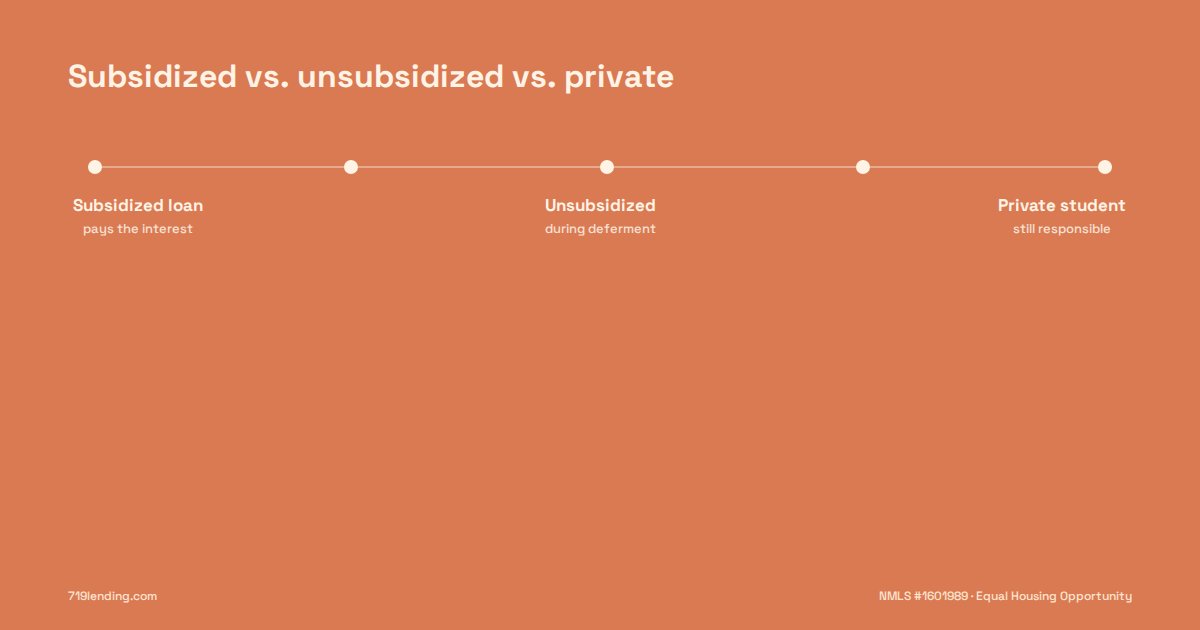
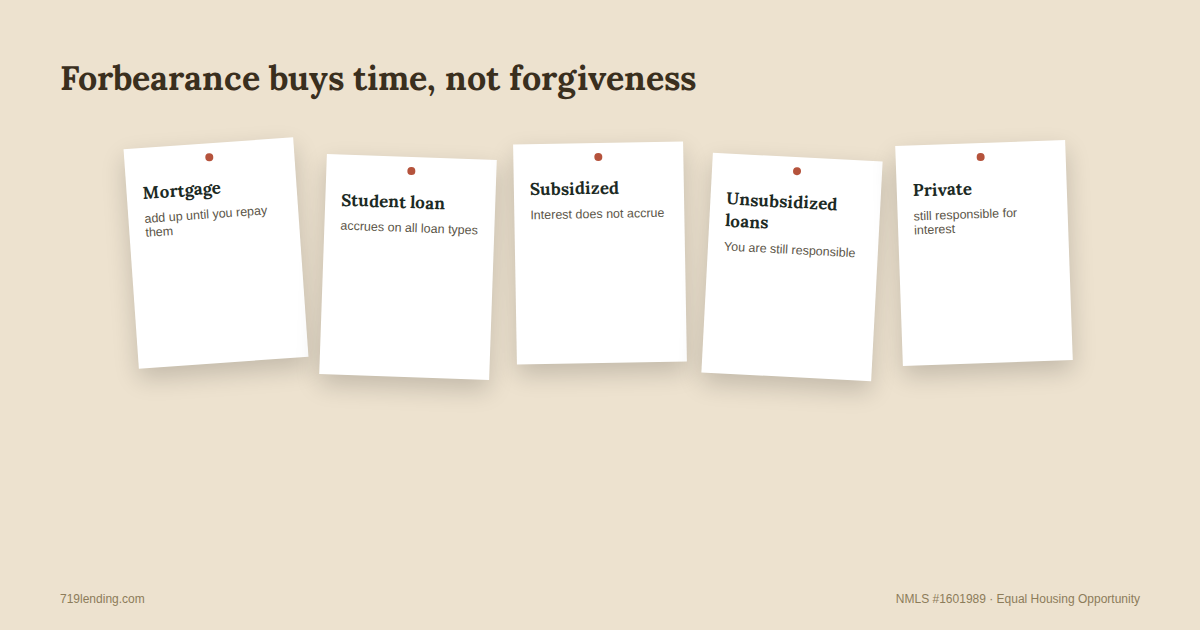
If you have a federal subsidized student loan, you do not have to pay interest on it during an approved deferment — the U.S. Department of Education covers it. Unsubsidized and private student loans work differently, and the gap matters, especially for service members around Colorado Springs weighing deferment during active duty.
How to Repay Paused Mortgage Payments After Forbearance
If you are asking what the different ways are to repay paused mortgage payments after forbearance ends, the answer comes down to three basic structures: a lump sum when payments restart, repayment at the end of the mortgage, or a repayment plan spread across future monthly payments. This guide walks through each one, what to consider, and what to ask your mortgage servicer — written for Colorado homeowners, including the many military families around Colorado Springs who use forbearance during a PCS move, deployment gap, or other financial hardship.
One thing up front: mortgage forbearance does not erase or decrease what you owe. It is a temporary pause or reduction, and every missed or reduced payment has to be repaid later. The question is only how and when.
What are the different ways I can repay paused mortgage payments after forbearance ends?
The Consumer Financial Protection Bureau (CFPB) describes three general repayment structures that servicers use once a forbearance period ends.
- Lump sum: paused payments are repaid all at once, in one lump sum, when regular payments restart.
- End of the mortgage: missed payments are repaid at the end of the loan, either by adding payments after the original loan term or through a new loan that comes due later.
- Repayment plan during the loan term: the reduced or missed amounts are spread out over a set number of months, added on top of the regular mortgage payment, so monthly payments increase temporarily.
Which repayment option you actually get depends on your servicer, your loan, and your situation. The CFPB is direct about this: forbearance is complicated, and there is no one-size-fits-all answer. With the map in place, here is how each option works in practice.
Repayment options at a glance
| Repayment option | How it works | What to consider |
|---|---|---|
| Lump sum after forbearance ends | Payments stop for a set number of months, then the whole missed amount is repaid at once when payments restart | A big bill comes due at one time; interest on the paused amounts could keep adding up until repaid |
| Repay at the end of the mortgage | Missed payments are added as extra payments after the original loan term, or repaid through a new loan | The mortgage could extend past its original term; a new loan must be paid back all at once when the mortgage term ends |
| Repayment plan during the loan term | The reduced amounts are spread over a set number of months and added to the monthly payment | The monthly payment increases during that repayment period; interest on reduced amounts could keep accruing |

Now the detail on each, starting with the option that surprises the most people.
Option 1: Repay everything in one lump sum when payments restart
Under a lump sum structure, the servicer lets you stop making mortgage payments for a specified number of months. When the forbearance period ends and payments restart, you pay the whole missed amount back at once.
What to consider with a lump sum payment
The obvious issue is that you owe a big bill that comes due at one time. If the financial hardship that put you into forbearance has not fully resolved, a lump sum payment can be hard to manage right as regular payments are also restarting.
The CFPB also flags that interest on the paused amounts could continue to add up until you repay them. That is worth confirming in writing before you agree to any forbearance plan.
If a lump sum is not realistic for your financial situation, that is exactly the conversation to have with the mortgage servicer — which leads to the second structure.
Option 2: Repay the missed payments at the end of the mortgage
Under this structure, the servicer pauses payments for a specified number of months, and the missed mortgage payments are repaid at the end of the loan rather than when payments restart. The CFPB describes two ways this happens.
Adding payments after the original loan term
The missed payments can be added at the end of the mortgage loan. The practical effect is that the mortgage could extend longer than its original term — you keep making the regular mortgage payment now, and the paused months are tacked on at the back.
Repaying through a new loan
Alternatively, the missed payments can be repaid through a new loan. The key consideration the CFPB highlights: at the end of the mortgage term, that new loan has to be paid back all at once.
Either way, interest on the missed amounts could continue to add up until you repay them, so ask the servicer to spell out exactly how interest accrues on the deferred balance.
For homeowners who can resume the regular monthly payments but cannot come up with a lump sum, this end-of-loan structure is worth asking about by name. The third structure sits in between.
Option 3: A repayment plan spread across the loan term
A repayment plan applies when the servicer let you make reduced mortgage payments for a specified number of months rather than pausing them entirely. When that time is up, you repay the difference by increasing the monthly payment for a set period.
How the repayment plan works
The amount of the reduction is spread out over a specified number of months and added to the regular mortgage payment during those months. Once the spread-out amounts are repaid, the payment returns to its normal level.
What to consider with a repayment plan
The monthly payment increases during the repayment period, so you need enough room in the budget to handle a payment that is temporarily higher than normal. And as with the other structures, interest on any reduced amounts could continue to add up until you repay them.
Before you commit to any of these three paths, there is a short list of questions that determines whether the plan actually fits your budget.
Questions to ask the mortgage servicer before you agree
The CFPB’s advice is to explain your situation to the mortgage servicer and keep asking questions until you understand three things clearly.
- The amount you must pay, and for how long payments are paused or reduced
- How interest accrues during that time
- When and how you pay back the paused or reduced amounts
Get the answers in a written forbearance agreement or written plan description whenever possible. If anything in the paperwork is unclear, ask again — the options depend on many factors, and assumptions are where borrowers get hurt.
Timing matters too. Some mortgage servicers require that forbearance or hardship assistance be requested within a specified amount of time after a disaster or other qualifying event, so call as soon as trouble paying the mortgage appears likely.
Your monthly mortgage statement is a useful tool during this process, and it deserves its own note.
Use the mortgage statement to stay on track
A monthly mortgage statement includes customer service contact information for the mortgage servicer, the amount due, the due date, the interest rate on the loan, fees and charges, and — if the loan is delinquent for more than a certain number of days — information about past-due payments, late fees, and how much it takes to bring the loan current.
Review the statement each time it arrives, especially during and after a forbearance period. That is how you spot a misapplied payment or an unexpected late payment entry quickly.
If you receive a coupon book instead of a statement, it might only show contact information, account information, and the amount due; you may need to contact the servicer to request an explanation of the amount due or past payment history. You can also send a written request for information.
Reading the statement is one thing; decoding the vocabulary servicers use is another.
Terms you may hear from the servicer
In these conversations you may hear labels like payment deferral, partial claim, deferred balance, or loan modification.
Do not assume any of those terms means what you think it means. Ask the servicer to explain exactly how their specific program handles the paused amounts, whether it changes the loan balance, the loan term, or the monthly payment, and what a partial claim or payment deferral would mean for your particular mortgage loan. The label matters far less than the mechanics: when the money is due, how interest accrues, and what happens to the principal balance.
Beyond the servicer, there are independent resources built for exactly this situation.
Where to find free help with forbearance decisions
Housing counselors certified by the U.S. Department of Housing and Urban Development (HUD) can discuss options with you if you are having trouble paying the mortgage. They are a neutral resource, separate from the servicer.
If you have a reverse mortgage, contact a HUD-approved reverse mortgage housing counseling agency or default counseling agency. Homeowners exploring that product later can read more in our reverse mortgage overview.
If you are facing foreclosure proceedings or have been served with legal papers, resources may be available through your local bar association or legal aid.
And if you are a servicemember — a large share of homeowners in the Colorado Springs area, given the concentration of military installations here — the CFPB specifically points servicemembers to their local Legal Assistance Office. That is a benefit worth using before signing anything you do not fully understand.
Help is available; the last piece is knowing what to do about the loan itself once you are back on stable footing.
Exiting forbearance in Colorado: the bigger picture
Mortgage forbearance exists for temporary hardship — a natural disaster, unexpected medical costs, a job loss. For military families, an income disruption around a PCS move can create the same squeeze. The goal of any repayment option is the same: bring the loan current and get back to regular monthly payments you can sustain.
Once you have resumed payments and rebuilt some stability, it can be worth reviewing the mortgage itself. Depending on your situation and the loan, restructuring through a refinance is one path some homeowners eventually explore — though whether it makes sense depends on the loan terms, closing costs, and your longer-term plans, which is a conversation for a licensed loan officer, not a blog post.
Keep an eye on your credit report during and after forbearance as well, and ask the servicer how the forbearance plan and each repayment option will be reported to the credit bureaus before you agree. How the arrangement is reported can affect a credit score, so get that answer in writing rather than assuming.
That leaves one final question: what should you actually do today?
What to do next
If you are in forbearance now or heading toward the end of a forbearance period, call the mortgage servicer using the contact information on the monthly statement. Ask which repayment options are available for your loan, how interest is accruing on the missed payments, and exactly when and how repayment starts.
If you want a neutral second opinion, find a HUD-certified housing counselor. And if you are a Colorado homeowner thinking through what comes after — rebuilding, restructuring, or planning the next purchase — the team at 719 Lending is happy to talk through your options. Reach out to 719 Lending and bring your servicer paperwork with you; the details in that agreement drive everything.
Frequently asked questions
Do I have to repay all my missed mortgage payments at once after forbearance?
Not necessarily. A lump sum is one option, but servicers may also let you repay missed payments at the end of the mortgage — by extending the loan term or through a new loan — or spread the repayment over a set number of months with a temporarily higher monthly payment. Ask your servicer which options apply to your loan.
Does mortgage forbearance erase what I owe?
No. Forbearance does not erase or decrease the amount you owe on the mortgage. It temporarily pauses or reduces payments, and you must repay any missed or reduced amounts later under whichever repayment option your servicer offers.
Does interest keep adding up during forbearance?
It can. The CFPB notes that interest on paused or reduced amounts could continue to accrue until you repay them, under all three repayment structures. Ask your mortgage servicer exactly how interest accrues during the forbearance period and get the answer in writing.
What is a repayment plan after forbearance?
A repayment plan spreads the reduced or missed amounts over a specified number of months and adds them to your regular mortgage payment. Your monthly payment increases during that repayment period, then returns to normal once the paused amounts are repaid.
How do I request mortgage forbearance or hardship help?
Call your mortgage servicer immediately, explain your situation, and ask what forbearance or hardship options are available. Some servicers require that assistance be requested within a specified time after a disaster or other qualifying event, so do not wait.
Where can I get free help deciding how to repay after forbearance?
HUD-certified housing counselors can discuss your options at no cost. If you are facing foreclosure or legal papers, your local bar association or legal aid may help. Servicemembers — including those stationed around Colorado Springs — can contact their local Legal Assistance Office.
719 Lending Inc., NMLS #1601989 · Equal Housing Opportunity
719 Lending Inc. is not affiliated with or endorsed by HUD, FHA, VA, USDA, CHFA, the CFPB, or any government agency.
Last updated: September 2026

Related Posts