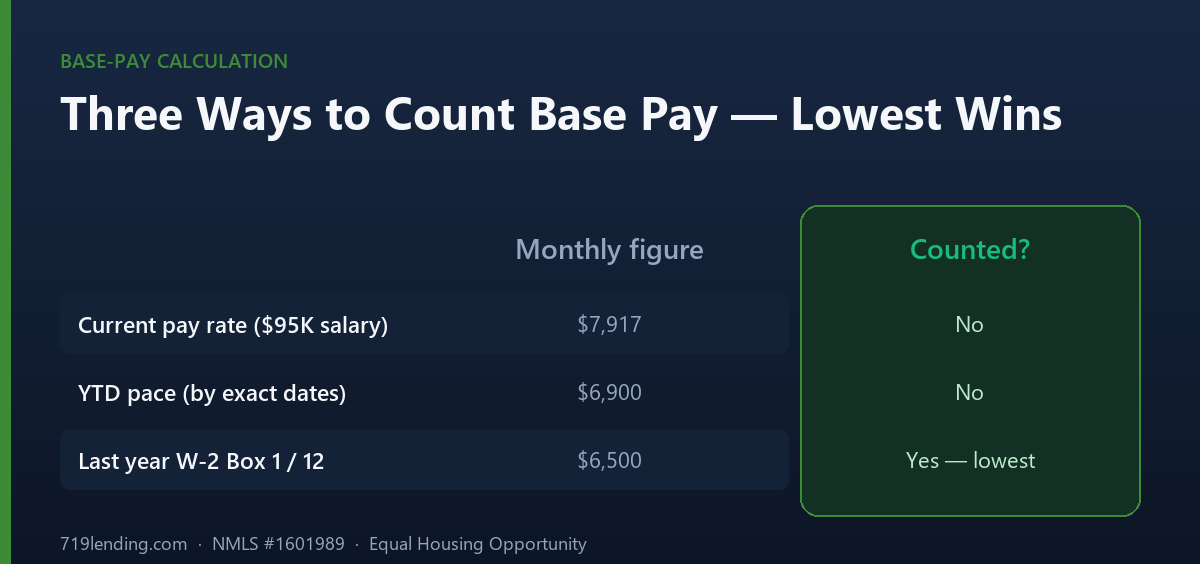
Underwriters rarely count your full salary. The lowest-of-three base-pay rule, one-year bonus haircuts, and 2106 write-offs can turn a $95K salary into $78K of qualifying income. Here's the math — and a calculator that runs it for you.
Gross-up income calculator: turn your tax-free dollars into qualifying income
Last updated: June 30, 2026 — gross-up percentages reflect current Fannie Mae, FHA (HUD Handbook 4000.1 / Mortgagee Letter 2023-17), VA, and USDA agency rules; confirm current guidance with your loan officer.
Tax-free income can count for more than its face value on a mortgage application. Because money like Social Security or VA disability is not taxed, lenders are allowed to “gross up” it before calculating your debt-to-income ratio. Depending on your loan program, $2,000/mo tax-free can count as $2,300 to $2,500 in qualifying income. Our gross-up income calculator applies the exact agency rule and shows the math.
What does “grossing up” income actually mean?
Grossing up means an underwriter credits you with more qualifying income than the dollar amount you actually receive, because that income is not taxed. The logic: someone with $4,344/mo in tax-free Social Security has the same spending power as someone earning meaningfully more in a taxable paycheck, so the agencies let lenders add a percentage on top before calculating your debt-to-income (DTI) ratio.
This applies only to genuinely non-taxable income: Social Security and SSI, VA and other disability benefits, child support, Section 8 housing assistance, and military BAH/BAS allowances. You enter your monthly non-taxable income, your loan program, and whether you can document the tax treatment, and the tool returns your grossed-up monthly and annual figure, the dollars added, the percentage applied, and a plain-English note on which rule fired.
One honest caveat the calculator states up front: grossing up adds zero to your bank account. It changes the DTI number on your application, not your real cash flow. It can be the difference between qualifying and not, but it does not make your monthly budget any bigger.

Why does the gross-up percentage change by loan program?
Because each agency writes its own rule. This is exactly where generic online calculators go wrong: they apply one flat percentage to everything. Our tool encodes five distinct, real agency rules and tells you which one applies to your scenario.
| Scenario | Gross-up applied | Proof of tax treatment? |
|---|---|---|
| Conventional / VA / USDA with documentation | Flat 25% | Yes |
| FHA with documentation | Greater of 15% or your documented tax rate | Yes |
| FHA, no proof (safe harbor) | 15% | No |
| Conventional Social Security, no proof | 3.75% effective (25% on a 15% slice) | No |
| Fannie exception: child support / Section 8 | Full 25% | No |
That conventional “no proof” line is subtle and worth calling out. For Social Security without documentation, the convention is to treat 15% of the benefit as taxable and gross up the remaining portion, which works out to roughly a 3.75% effective bump rather than a flat 25%. The calculator does that math for you so you are not surprised at the application stage. Want to see your own number? Run your numbers in the gross-up calculator.
What is the FHA rule most calculators get wrong?
Here is the differentiator. Many online gross-up calculators cap FHA at a flat 15%. That is outdated. Under HUD Mortgagee Letter 2023-17 and Handbook 4000.1, when you can document your actual tax treatment, FHA uses the greater of 15% or your documented tax rate.
So if your real effective tax rate would have been 22%, FHA lets you gross up at 22%, not the flat 15% the old calculators show. That is a materially larger income credit, and on a tight DTI it can matter. Our tool surfaces a documented tax-rate field only for the FHA-with-proof path, and it floors that input at 15% so you can never accidentally land below the safe harbor.
If you cannot document the rate, FHA falls back to the 15% safe harbor automatically. Either way, the calculator picks the more favorable outcome the rules allow and shows a “why this number” citation paragraph so you and your loan officer are working from the same page.

How much could grossing up add to my qualifying income?
It depends on your income type and program, but the swing is real. Consider a borrower with $4,344/mo in tax-free income on a conventional, VA, or USDA loan with documentation, which gets the full 25%:
| Item | Amount (example) |
|---|---|
| Documented monthly income | $4,344 |
| Gross-up applied | 25% |
| Qualifying monthly income | $5,430 |
| Dollars added per month | +$1,086 |
| Added per year | +$13,032 |
These figures are an illustration, not a quote, and your actual result will depend on your file. The tool also draws a two-bar “documented vs qualifying” visual so you can see the gap at a glance, and it produces a branded PDF you can hand to a real estate agent or keep for your file. The bottom-line message it returns reads like: “your $X tax-free counts as $Y, an N% boost without earning more.”
What if my income does not qualify for a gross-up?
Then the calculator says so plainly and offers coaching instead of a misleading number. Not every income type or program combination earns a gross-up, and inflating the figure only sets up a denial later. The honest path is to know your real qualifying number before you write an offer, then structure around it.
This is one of nine free tools on our Calculate hub. If gross-up alone does not get your DTI where it needs to be, the seller-concession and buydown calculators can help you lower the payment side of the ratio instead.
Run your own numbers
If any part of your income is tax-free, it is worth seeing what it is really worth on a mortgage application. The rules are program-specific, the FHA math has changed, and the difference can be over a thousand dollars a month in qualifying power. Try the gross-up income calculator, then bring the PDF to a 719 Lending loan officer to confirm which rule applies to your file.
719 Lending Inc., NMLS #1601989 · Equal Housing Opportunity · This article is educational only, is not a commitment to lend, and not all applicants will qualify. 719 Lending is not affiliated with or endorsed by any government agency. Calculator results are estimates only.
Frequently asked questions
Does grossing up my income give me more money to spend? No. Grossing up only changes the income figure used to calculate your debt-to-income ratio for mortgage qualifying. It adds nothing to your bank account or monthly budget; it simply reflects that tax-free income has more buying power than the same amount of taxable income.
What income can be grossed up? Only genuinely non-taxable income, such as Social Security and SSI, VA and other disability benefits, child support, Section 8 housing assistance, and military BAH/BAS allowances. Taxable wages and most self-employment income cannot be grossed up.
Why does FHA sometimes allow more than 15%? Under HUD Mortgagee Letter 2023-17 and Handbook 4000.1, FHA uses the greater of 15% or your documented tax rate when you can prove the tax treatment of your income. If your real effective rate would have been 22%, FHA can gross up at 22%. Many older calculators incorrectly cap FHA at a flat 15%.
How much can a gross-up add to my qualifying income? It varies by program and income type. As an example, on a conventional, VA, or USDA loan with documentation, the full 25% gross-up turns $4,344/mo of tax-free income into $5,430/mo of qualifying income, an added $1,086 per month. These are illustrative figures, not a quote, and your result depends on your file.
Will every loan program gross up my income the same way? No. Each agency writes its own rule. The calculator encodes five distinct rules, including a flat 25% for documented conventional, VA, and USDA loans, the FHA greater-of rule, an FHA 15% safe harbor with no proof, a roughly 3.75% effective bump for undocumented conventional Social Security, and a full 25% Fannie exception for child support and Section 8.

Related Posts