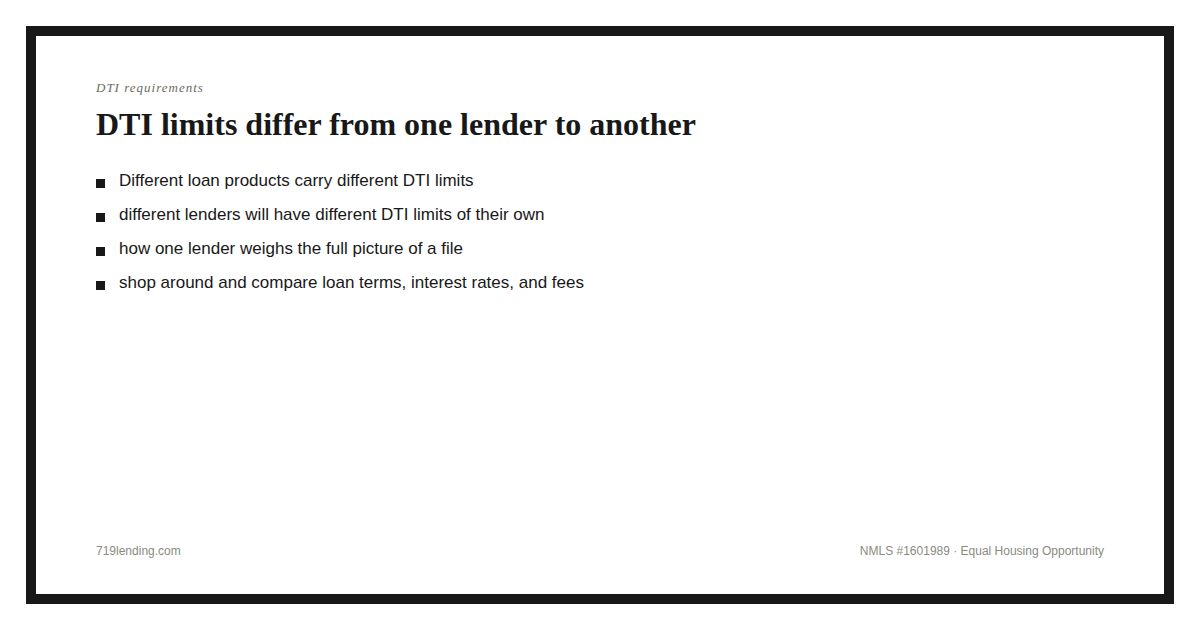
Debt-to-income ratio limits are not one universal number. The Consumer Financial Protection Bureau confirms that different loan products and different lenders have different DTI limits. Here is how that works, who decides what, and what Colorado Springs borrowers can do about it.
When Did I First Become Eligible to Request PMI Cancellation?
If you are searching for where to find information about when you first became eligible to request PMI cancellation, there is one specific document with the answer: the PMI disclosure form you received along with your mortgage at closing. This guide explains where that date lives, what the federal rules say, and how Colorado homeowners can act on it.
Here is the quick version before we go deeper:
- The first date you can request PMI cancellation should appear on your PMI disclosure form from closing.
- If you cannot find the disclosure form, contact your loan servicer and ask for the date.
- You can request early PMI cancellation if extra payments have already brought the principal balance down to the required share of the home’s original value.
- Separate from any request, your servicer must automatically terminate PMI once the loan balance is scheduled to reach a slightly lower share of original value, as long as you are current on payments.
- The Consumer Financial Protection Bureau (CFPB) publishes the plain-English official explanation of these rights.
The short answer: check your PMI disclosure form

When you closed on a conventional loan with private mortgage insurance, your lender gave you a PMI disclosure form. That form should show the first date you can ask your servicer to cancel PMI.
That date is tied to your original amortization schedule. It is the date the principal balance of your mortgage loan is scheduled to fall to the share of the home’s original value at which federal rules give you the right to request cancellation.
What the PMI disclosure form tells you
The disclosure translates the amortization schedule into a calendar date. It assumes you make only the regular monthly payments, with no extra principal along the way.
That matters because the printed date is the latest you would become request-eligible on schedule. Extra payments can move your real eligibility earlier, which we cover below.
Can’t find the form? Ask your servicer
Closing packets get lost in moves, and in a military town like Colorado Springs, a PCS move or two can scatter paperwork. If the PMI disclosure form is gone, contact your loan servicer.
The servicer is the company you send monthly mortgage payments to, and it can confirm the first date you were eligible to request PMI cancellation. Recent mortgage statements will show the servicer’s contact information.
Once you know where the date comes from, the next question is whether these rules even apply to your loan.
Who these PMI cancellation rules apply to
The federal PMI cancellation rights described here apply to mortgages on single-family principal residences that closed on or after July 29, 1999. In practice, that covers most conventional mortgage loans with borrower-paid private mortgage insurance.
Private mortgage insurance is coverage you may be required to buy when you take out a conventional loan with a lower down payment than the threshold that avoids PMI. The requirement can also apply when refinancing a conventional loan if your equity is below that same threshold.
A key point: PMI protects the lender
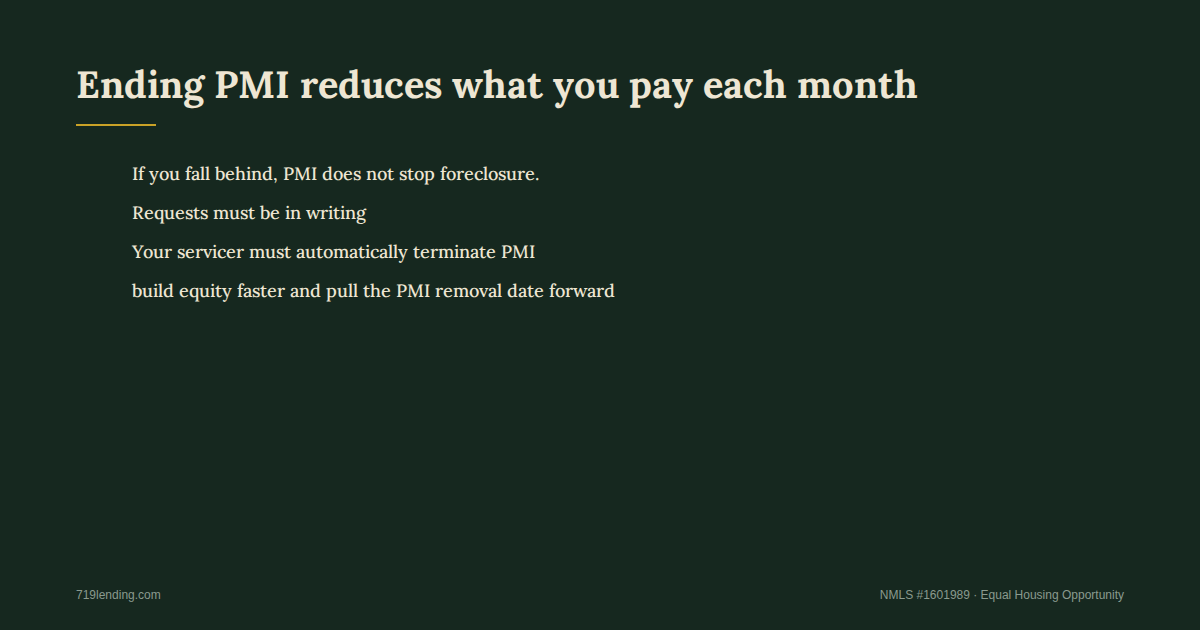
PMI protects the lender, not you, if you stop making payments on the loan. If you fall behind on mortgage payments, PMI does not shield you from foreclosure.
That is exactly why removing it once you no longer need it is worth the paperwork: canceling PMI reduces your monthly costs without changing anything else about the mortgage loan.
Loans with different rules
Mortgages through the Federal Housing Administration (FHA) or the Department of Veterans Affairs (VA) have different requirements. If you have questions about mortgage insurance on FHA loans or VA loans, the CFPB’s guidance is to contact your servicer directly.
Different rules also apply if the lender is paying for your mortgage insurance rather than you. Lender-paid arrangements do not follow the borrower-requested cancellation process described here.
With coverage sorted out, the next piece is the definition everything hinges on: original value.
What “original value” means for PMI cancellation
Every PMI cancellation trigger is measured against the original value of your home, not what Zillow says today. Getting this definition right is how you know whether the loan balance has actually reached the request threshold.
For purchase loans
On a purchase, original value generally means the contract sales price or the appraised value at the time you bought the home, whichever is lower. In a market that has appreciated, like much of Colorado, this number is often well below the current property value.
For refinanced loans
If you have refinanced, original value resets. It becomes the appraised value at the time of the refinance, and the PMI cancellation clock is measured against that number instead.
Now that the yardstick is clear, here are the three distinct ways PMI ends.
The three ways to remove PMI from a conventional loan
Federal rules create three separate paths to remove PMI. One requires action from you; the other two happen automatically if you are current on payments.
| Path | Trigger | What you must do |
|---|---|---|
| Borrower-requested cancellation | Loan balance reaches the request threshold of original value, on schedule or through extra payments | Request in writing; meet the servicer’s criteria |
| Automatic termination | Loan balance is scheduled to reach a slightly lower share of original value | Nothing, but you must be current on payments |
| Final termination at midpoint | You reach the midpoint of the original amortization schedule | Nothing, but you must be current on payments |
Borrower-requested cancellation
You have the right to ask your servicer to cancel PMI on the date the principal balance is scheduled to fall to the required share of the home’s original value. That is the date printed on your PMI disclosure form.
This path is the earliest of the three, but it only happens if you send a cancellation request. The servicer will not do it for you at this stage.
Automatic termination
Even if you never ask, your servicer must automatically terminate PMI on the date the principal balance is scheduled to reach a lower share of the original value. For automatic termination to occur on that date, you need to be current on your monthly payments.
If you are behind, PMI is not terminated until shortly after your payments are brought up to date. Automatic PMI termination is the safety net; the written request is how you stop paying sooner.
Final termination at the loan midpoint
There is one more backstop. Your lender or servicer must end PMI the month after you reach the midpoint of the loan’s original amortization schedule, even if the principal balance has not reached the automatic termination threshold.
The midpoint is halfway through the original full loan term. This final termination rule matters most for loans with an interest-only period, principal forbearance, or a balloon payment, where the balance pays down more slowly. You must be current on monthly payments for this termination to occur as well.
Knowing the scheduled dates is half the picture; many homeowners can act before those dates arrive.
Can I request PMI cancellation earlier than the scheduled date?
Yes. You can ask to cancel PMI ahead of the date on your disclosure form if you have made additional payments that reduce the principal balance to the required share of the home’s original value.
Extra payments accelerate the amortization schedule. If you have been rounding up payments or applying lump sums to principal, your real eligibility date may already have passed even though the printed date has not.
What your servicer will check on a cancellation request
Your servicer is legally required to grant a request to cancel PMI as long as you meet these criteria:
- You make the request in writing.
- You have a good payment history and are current on your payments.
- You can certify there are no junior liens, such as a second mortgage, on the home.
- You can provide evidence, such as an appraisal, that the property value has not declined below the original value of the home.
That last item catches people. If the current property value has fallen below original value, you may not be able to cancel PMI on schedule, even with a good payment history.
Loans backed by Fannie Mae or Freddie Mac
Loan investors, including Fannie Mae and Freddie Mac, often create their own PMI cancellation guidelines. Those investor guidelines cannot be less favorable to the borrower than the federal rules described above.
If your loan is backed by one of these investors, ask your servicer which PMI cancellation guidelines apply, since the investor’s version may give you an additional path.
All of this comes from one authoritative source, which is worth reading yourself.
What the official source says and where to read it
The Consumer Financial Protection Bureau publishes the definitive plain-English answer at consumerfinance.gov, in its Ask CFPB article on when you can remove private mortgage insurance (PMI) from a loan.
The CFPB page confirms that the first date you can make a cancellation request should appear on your PMI disclosure form, and that your servicer is the fallback if the form is missing. It also lays out the automatic termination and midpoint rules summarized above.
The CFPB notes that some lenders and servicers may allow removal of PMI under their own standards, beyond the legal minimums. That is another reason a direct conversation with the servicer is worth having.
With the rules and the source in hand, here is how to turn them into a lower monthly mortgage payment.
What to do next: a step-by-step plan to remove PMI
Follow this sequence and you will either have a firm eligibility date or a cancellation request in motion.
Step 1: Locate your eligibility date
Pull the PMI disclosure form from your closing packet. If it is missing, call or write your servicer and ask for the first date you were eligible to request PMI cancellation.
Step 2: Compare the schedule to reality
Check your current loan balance on a recent statement. If extra payments have pushed the balance down faster than the original amortization schedule assumed, you may be request-eligible now.
Step 3: Submit the request in writing
Send a written cancellation request to your servicer. Be ready to certify that there are no junior liens and to provide evidence, such as an appraisal, that the value of the property has not declined below original value.
Step 4: Confirm the outcome
Once PMI is removed, verify on the next statements that the mortgage insurance line is gone and the monthly mortgage payment has dropped. Remember that property taxes and homeowners insurance in your escrow are separate and continue as usual.
If the numbers do not line up, or if you are weighing a refinance that would reset original value, a conversation with a 719 Lending loan officer in Colorado Springs can help you map the options on a conventional loan before you commit to anything. Whether you request early PMI cancellation or wait for automatic termination, the eligibility date is yours to find, and now you know exactly where it lives.
Frequently asked questions
Where is my PMI cancellation eligibility date listed?
On the PMI disclosure form you received along with your mortgage at closing. It shows the first date you can request PMI cancellation based on the original amortization schedule. If you can’t find the form, contact your loan servicer and ask for the date.
Can I cancel PMI before the date on my disclosure form?
Yes. If additional payments have reduced the principal balance to the required share of the home’s original value ahead of schedule, you can request early PMI cancellation. The request must be in writing, and you’ll need a good payment history, no junior liens, and evidence the property value hasn’t declined.
Does PMI ever come off automatically without a request?
Yes. Your servicer must automatically terminate PMI on the date the principal balance is scheduled to reach a set lower share of the home’s original value, provided you are current on payments. There is also a final termination the month after you reach the midpoint of the original loan term.
Do these PMI cancellation rules apply to FHA or VA loans?
No. Mortgages through the Federal Housing Administration or the Department of Veterans Affairs have different requirements. For questions about mortgage insurance on an FHA or VA loan, contact your servicer directly.
What counts as the home’s original value for PMI removal?
For a purchase, it’s generally the contract sales price or the appraised value at the time you bought the home, whichever is lower. If you have refinanced, original value is the appraised value at the time of the refinance.
What if my home’s value has dropped since I bought it?
If you can’t show that the property value hasn’t declined below the original value, you may not be able to cancel PMI on schedule. Servicers can require evidence, such as an appraisal, before granting a cancellation request.
719 Lending Inc., NMLS #1601989 · Equal Housing Opportunity
719 Lending Inc. is not affiliated with or endorsed by HUD, FHA, VA, USDA, CHFA, the CFPB, or any government agency.
Last updated: September 2026

Related Posts