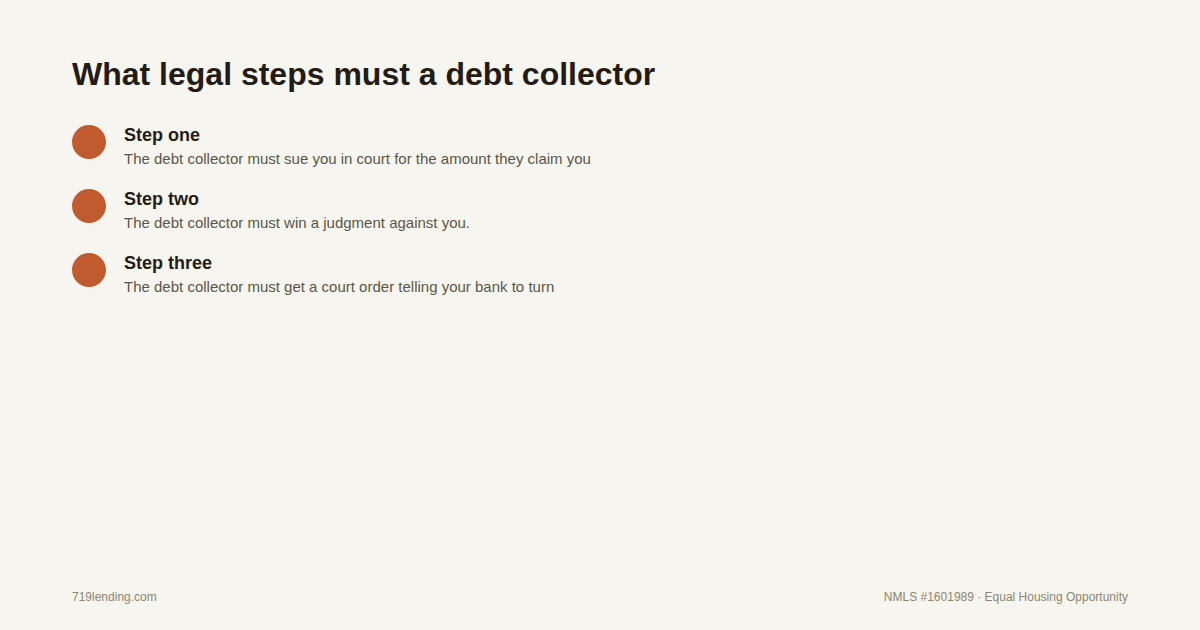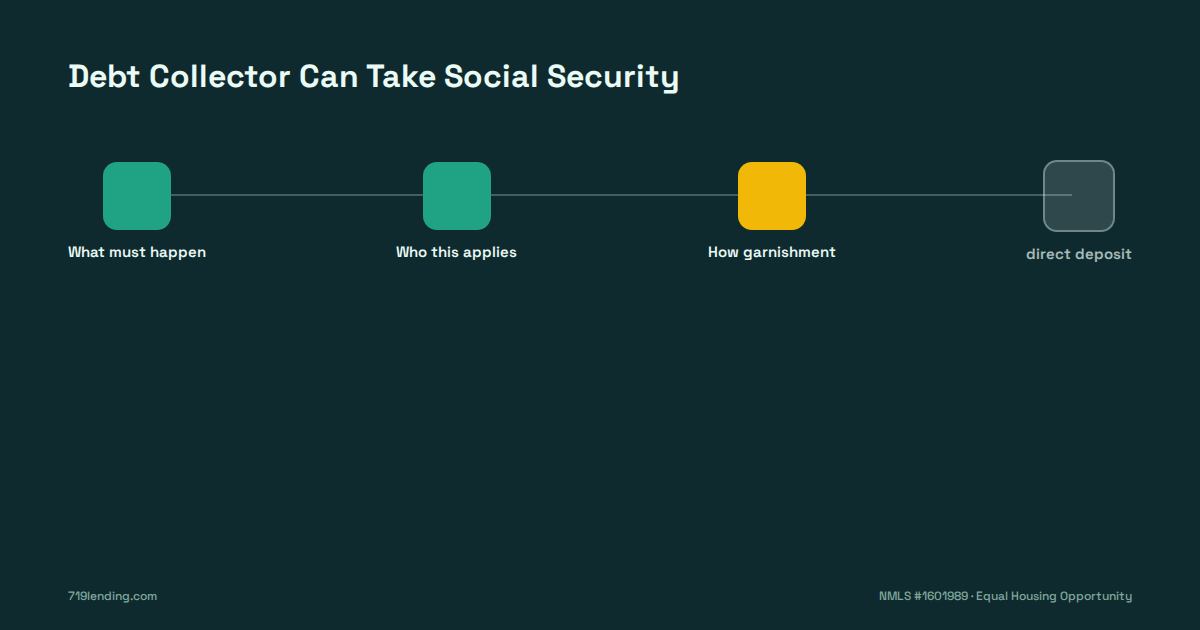
Before a debt collector can touch your Social Security or VA benefits, federal law requires a specific legal sequence: a lawsuit, a court judgment, and a garnishment order sent to your bank. Here is each step, which federal benefits are protected, and what to do if your bank account is frozen — with guidance for Colorado Springs veterans and retirees.
Can a Surviving Spouse Get a VA Loan? Eligibility Explained
Can a surviving spouse get a VA loan? Yes — the VA home loan benefit extends to eligible surviving spouses in situations the Department of Veterans Affairs spells out on its eligibility page. This guide explains exactly who qualifies, how the Certificate of Eligibility (COE) works, and what a surviving spouse in Colorado Springs should do next.
The rules here come straight from the Department of Veterans Affairs and the Consumer Financial Protection Bureau, so you can rely on them when you talk to a lender.
Can a surviving spouse get a VA loan? The short answer

A surviving spouse may be able to get a COE for a VA-backed home loan if at least one of these is true, according to the Department of Veterans Affairs:
- You’re eligible for or currently receiving certain types of VA Dependency and Indemnity Compensation (DIC), or
- You’re the spouse of an active-duty service member who is missing in action (MIA) or being held as a prisoner of war (POW).
If one of those describes your situation, the VA home loan guaranty program is open to you the same way it is open to veterans and service members who meet the service requirements. The COE is the document that proves it to a lender.
| Question | What the VA says |
|---|---|
| Can a surviving spouse get a VA loan? | Yes, if eligible through DIC or as the spouse of a service member who is MIA or a POW |
| What proves eligibility? | A Certificate of Eligibility (COE) issued by the VA |
| Who sets credit and income standards? | Both the VA and the lender |
| Is a down payment required? | No, as long as the sales price isn’t higher than the home’s appraised value |
| Is private mortgage insurance required? | No — VA-backed loans do not require PMI or MIP |
With the short answer established, it helps to understand each eligibility path in detail.
Who counts as an eligible surviving spouse
The Department of Veterans Affairs recognizes two paths for a surviving spouse to receive a COE for the VA home loan program. Each one has a distinct trigger.
Path one: Dependency and Indemnity Compensation (DIC)
Dependency and Indemnity Compensation is a VA benefit connected to a veteran’s death. The home loan eligibility rule says you may get a COE if you’re eligible for or currently receiving certain types of DIC.
Notice the wording: eligible for or currently receiving. A surviving spouse who has not yet applied for DIC, but who would qualify, may still have a path to VA loan eligibility — the VA reviews the records and makes the determination.
Because DIC itself has its own rules, the cleanest move is to let the VA confirm your status rather than assume you’re out. You can apply for the COE and the VA will review your situation.
Path two: spouse of a service member who is MIA or a POW
The second path applies while the service member is still living but unaccounted for. If your spouse is an active-duty service member who is missing in action or being held as a prisoner of war, you may be able to get a COE.
This path matters in a military community like Colorado Springs, where families connected to Fort Carson, Peterson Space Force Base, Schriever Space Force Base, and the Air Force Academy sometimes face exactly these circumstances.
Both paths lead to the same next step: requesting the Certificate of Eligibility.
How does a surviving spouse get a Certificate of Eligibility (COE)?
The Certificate of Eligibility (COE) is the document that shows a lender you qualify for the VA home loan benefit. Every VA-backed purchase loan starts here.
Requesting the COE
The VA allows you to request a COE online, or you can ask your lender to submit an online application for you. A mortgage broker like 719 Lending’s VA loan team handles this step routinely for Colorado borrowers.
If your records are incomplete or your situation is unusual, you can still apply — the VA states it will review service records to determine whether a COE can be issued.
What if the VA has questions about eligibility?
The Department of Veterans Affairs runs a Loan Guaranty support portal where you can submit eligibility questions online, and the VA Loan Guaranty Service answers phone questions on weekdays. Your loan officer can also help you frame the question correctly before you submit it.
Once the COE is in hand, the loan itself works much like any other mortgage application — with a few features specific to VA loans.
What a VA home loan offers an eligible surviving spouse
The VA-backed purchase loan is designed to help eligible borrowers buy, build, or improve a home, and the Department of Veterans Affairs lists several defining features.
No down payment in most cases
A VA-backed purchase loan often requires no down payment, as long as the sales price isn’t higher than the home’s appraised value. The appraised value is the value set for the home after an expert reviews the property.
If you want to borrow above the no-down-payment threshold tied to the conforming loan limit, you can — by making a down payment. The applicable limit changes over time, so your loan officer confirms the current one for your county.
No private mortgage insurance
VA-backed loans do not require private mortgage insurance (PMI) or mortgage insurance premiums (MIP). PMI is insurance that protects the lender if you can’t repay the loan, and MIP is what the Federal Housing Administration requires on an FHA loan — neither applies to a VA home loan.
Other features the VA lists
The VA also notes that lenders offer competitive interest rates on VA-backed purchase loans, that closing costs may be fewer and may be paid by the seller, and that there is no penalty fee for paying the loan off early.
One cost to ask about is the VA funding fee — a one-time fee the VA says helps lower the cost of the loan program for taxpayers. Whether and how it applies in your specific situation is something to confirm with your loan officer and the VA before closing.
Those are the features. Next: what you can actually do with the loan.
What can a surviving spouse use the VA loan for?
According to the Department of Veterans Affairs, a VA-backed purchase loan can be used to:
- Buy a single-family home or a condo in a VA-approved project
- Buy a home and improve it
- Buy a manufactured home or lot
- Build a new home
- Make energy-efficient changes, like adding solar power
You must live in the home you’re buying with the loan — the VA home loan program is built around the primary residence, not investment property.
You can also assume an existing VA loan, meaning the buyer takes over the seller’s loan instead of opening a new mortgage. In a market like Colorado Springs with frequent PCS moves, assumptions of an existing VA loan do come up, and a loan officer can walk you through whether one makes sense for you.
Knowing the uses is half the picture; the other half is qualifying with the lender.
Applying on your own: credit, income, and occupancy
VA loan eligibility through the COE is only step one. To get financing, the VA says you must meet credit, income, and occupancy requirements from both the VA and your lender.
You do not automatically need a co-signer
The Consumer Financial Protection Bureau is clear on this: a lender generally cannot require another person’s signature for individual credit if you qualify on your own for the amount and terms requested. A surviving spouse applying alone is applying as an individual borrower.
There are exceptions — joint applications, or state-law requirements around securing the property as collateral — but “you must bring a co-signer” is not a blanket rule.
What the lender reviews
Expect the lender to pull a credit report, document income, and calculate a debt-to-income ratio, alongside the standard homeownership costs of property taxes and homeowners insurance. The loan application process for a surviving spouse looks like the process for any other VA borrower once the COE is issued.
A pre-qualification conversation before you shop tells you where you stand on all of those pieces. And if you already hold a VA loan, there are refinance paths worth knowing about too.
What if there’s already an existing VA loan on the home?
The Department of Veterans Affairs lists refinance options for borrowers with an existing VA loan.
Interest Rate Reduction Refinance Loan (IRRRL)
The Interest Rate Reduction Refinance Loan (IRRRL) is a VA-backed refinance designed to help reduce the monthly payment or make it more stable. If you have an existing VA loan, you can find out whether you qualify for an IRRRL refinance.
Cash-out refinance
The VA also backs a cash-out refinance for borrowers who want to take cash out of home equity to pay off debt, pay for school, or take care of other needs. A VA cash-out refinance replaces the existing loan with a new one.
Eligibility questions about either option run through the same COE framework, which brings up one more topic: reusing the benefit.
Can the VA loan benefit be used more than once?
Yes. The VA allows entitlement used on a prior loan to be restored in defined situations: you sold the home and paid the loan in full, a qualified veteran-transferee assumed the loan and substituted their entitlement, or you repaid the prior loan in full without selling the home (that last one can only be done once).
Entitlement restoration can be requested online, through your lender, or by filing VA Form 26-1880, the Request for a Certificate of Eligibility. Even without full restoration, remaining entitlement may be available to buy or refinance another home.
With the rules covered, here is the practical path forward.
Next steps for a surviving spouse in Colorado
If you believe you qualify as a surviving spouse — through DIC eligibility or as the spouse of a service member who is MIA or a POW — the sequence is straightforward.
First, request the COE, or ask a lender to submit the application for you. Second, go through pre-qualification so you know what the lender’s credit and income review looks like for you. Third, shop with confidence, knowing the occupancy requirement means the home will be your primary residence.
719 Lending is a Colorado Springs mortgage broker in one of the most military-connected markets in the country, and helping eligible surviving spouses navigate the VA home loan process is familiar ground. Reach out to a 719 Lending loan officer to start the COE request and get a clear read on your VA loan eligibility.
Frequently asked questions
Can a surviving spouse get a VA loan without the veteran?
Yes. The VA issues a Certificate of Eligibility directly to an eligible surviving spouse — either someone eligible for or receiving certain types of VA Dependency and Indemnity Compensation (DIC), or the spouse of an active-duty service member who is missing in action or a prisoner of war. The surviving spouse then applies for the loan in their own name.
Does a surviving spouse need to receive DIC to qualify for a VA home loan?
Not necessarily. The VA’s rule covers spouses who are eligible for or currently receiving certain types of DIC. If you haven’t applied for DIC but may qualify, you can still apply for a COE and the VA will review your records and make the determination.
How does a surviving spouse get a Certificate of Eligibility (COE)?
You can request a COE online through the VA, or ask your lender to submit the online application for you. If the VA needs more information, it reviews the records and determines whether you qualify. A mortgage broker can handle the submission as part of your loan application.
Does a surviving spouse pay a down payment or PMI on a VA loan?
According to the Department of Veterans Affairs, VA-backed purchase loans often require no down payment as long as the sales price isn’t higher than the home’s appraised value, and they never require private mortgage insurance (PMI) or mortgage insurance premiums (MIP).
Can a surviving spouse refinance an existing VA loan?
The VA backs two refinance options for existing VA loans: the Interest Rate Reduction Refinance Loan (IRRRL), designed to reduce the monthly payment or make it more stable, and the cash-out refinance, which lets a borrower take cash out of home equity. Eligibility runs through the same COE framework.
Does a surviving spouse have to live in the home purchased with a VA loan?
Yes. The VA requires that you live in the home you’re buying with a VA-backed purchase loan. The program is built around primary residences, and occupancy is one of the requirements alongside the credit and income standards set by the VA and the lender.
719 Lending Inc., NMLS #1601989 · Equal Housing Opportunity
719 Lending Inc. is not affiliated with or endorsed by HUD, FHA, VA, USDA, CHFA, the CFPB, or any government agency.
Last updated: November 2026

Related Posts