Many surviving spouses of veterans can use the VA home loan benefit. This guide explains exactly who qualifies, how the Certificate of Eligibility works for a surviving spouse, what a VA-backed home loan offers, and the concrete steps to take next — written for Colorado Springs families.
Steps a Debt Collector Must Take Before Garnishing Benefits
If you are asking what legal steps a debt collector must complete before they can take your Social Security or VA benefits, the short answer is: a lawsuit, a court judgment, and then a garnishment order delivered to your bank or credit union. A debt collector cannot simply reach into your bank account because you have an unpaid debt.
This guide walks through each step in that sequence, which federal benefits are protected, how the two-month direct deposit protection works, and what to do if your account is frozen. It is written for Colorado borrowers — especially the many veterans, retirees, and military families in Colorado Springs living on Social Security income or VA benefits.
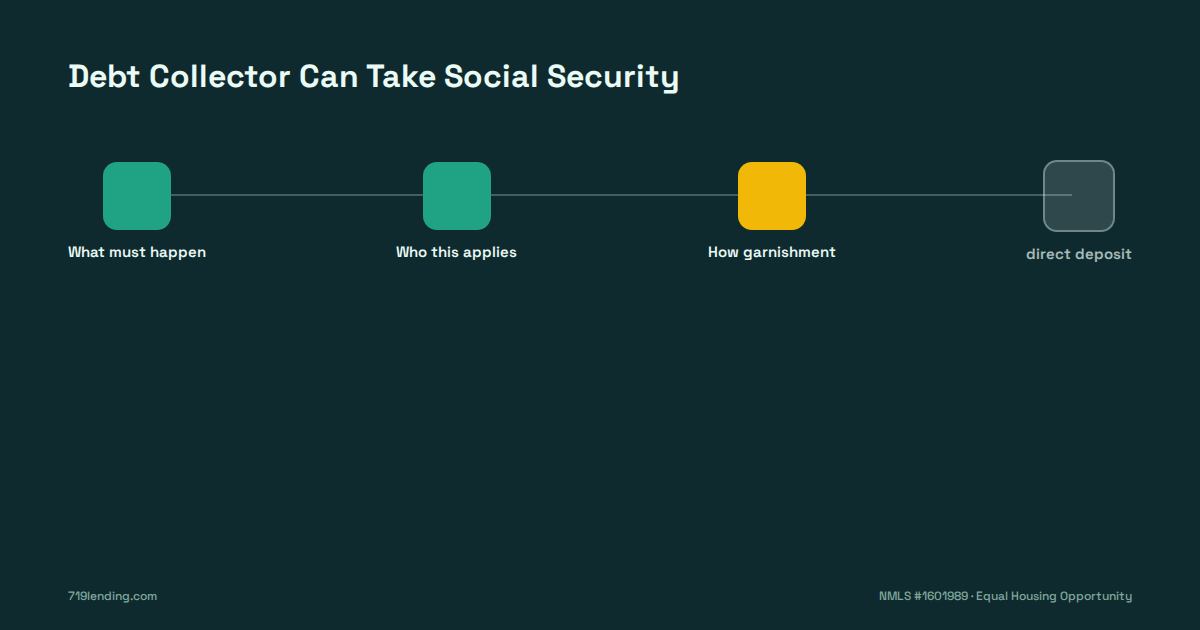
Here is the sequence at a glance, based on guidance from the Consumer Financial Protection Bureau (CFPB):
- Step one: The debt collector must sue you in court for the amount they claim you owe.
- Step two: The debt collector must win a judgment against you.
- Step three: The debt collector must get a court order telling your bank to turn over money — this is garnishment.
- Your protection: Federal benefits received by direct deposit are legally protected, and your bank must preserve two months’ worth of directly deposited benefits.
What legal steps must a debt collector complete before taking Social Security or VA benefits?

A debt collector pursuing credit card debt, medical bills, or another unpaid debt must work through the court system before any money leaves your bank account. Each step gives you a chance to respond and assert your rights.
Step one: the debt collector must sue you
The debt collector files a lawsuit against you for the amount they claim you owe. You will be served with court papers that state a deadline to respond.
A lawsuit is not a judgment. Until a court rules, the debt collector has no legal power over your bank account.
Step two: the debt collector must win a judgment
If the debt collector proves the debt is valid — or if you never respond and the court enters a default judgment — the court issues a judgment for the amount owed. A judgment can also include lawful additional fees for collection costs, interest, and attorney fees as allowed by the judgment.
A court judgment gives debt collectors much stronger tools: depending on your state law, they may be able to garnish wages, place a lien against your property, or move to freeze funds in your bank account.
Step three: the debt collector must get a garnishment order
Even with a judgment, the debt collector needs one more thing: a court order telling your bank or credit union to turn over money from your account or prepaid card. That court order is what the law calls garnishment.
Only when your bank receives that order does any freeze or turnover happen — and even then, federal law protects directly deposited federal benefits. The next section covers exactly which benefits qualify.
Which federal benefits are protected from debt collectors?
According to the CFPB, money you receive by direct deposit from the following federal government programs is protected from garnishment by private creditors:
- Social Security benefits
- Supplemental Security Income (SSI) benefits
- Veterans benefits
- Civil service and federal retirement and disability benefits
- Servicemember pay
- Military annuities and survivor benefits
- Federal student aid
- Railroad retirement benefits
- Financial assistance from the Federal Emergency Management Agency (FEMA)
For the Colorado Springs community, that list covers a lot of households: VA benefits, servicemember pay, military annuities, and survivor benefits are all on it. The key condition for the automatic protection, though, is how the money arrives — which brings us to direct deposit.
Why does direct deposit matter so much?
The key to making sure your federal benefits are legally protected from being frozen or garnished is direct deposit. You can sign up anytime to have federal benefits directly deposited to your bank account or loaded onto a prepaid card.
The two-month protection at your bank
When your bank receives a court order to garnish money in your account, the bank must look at your account history to see whether you received federal benefits by direct deposit in the last two months. Two months’ worth of benefits are protected and remain in the account for you to use.
So if your Social Security benefits arrive by direct deposit every month, your bank’s own records prove the money’s source, and the bank must give you access to that two-month amount for monthly bills and cash withdrawals.
What happens if you deposit paper checks instead
If you receive Social Security or VA benefits by check and then deposit the check into your bank account, the bank does not have to protect two months’ worth of benefits automatically. Your entire account balance could be frozen.
In that situation, you would need to go to court to prove the money comes from protected federal benefits and should not be garnished. That is a stressful position for anyone on a fixed income, which is why the CFPB points to direct deposit as the safeguard.
Money above two months’ worth of benefits
The debt collector is permitted to garnish money in your account that is over two months’ worth of benefits. If your account holds more than that, the bank can garnish or freeze the extra amount, and the bank is allowed to charge a processing fee for the garnishment in that situation.
However, if the extra money is also exempt under federal law or state law, you may be able to go to court to have it released. Protection is strongest for the two-month cushion — but there are also situations where benefits can be garnished regardless, covered next.
Can Social Security or VA benefits ever be garnished anyway?
The protections above apply to private creditors — collection agencies and credit card companies chasing consumer debt. Debts owed to the federal government play by different rules.
Government debts and support obligations
Social Security and Social Security Disability Insurance (SSDI) can sometimes be garnished to pay money you owe to the government, such as back taxes or federal student loans, and money you owe for child support or spousal support.
So unpaid federal taxes or defaulted federal student loans are a different category of government debt than ordinary credit card debt, and the usual shield does not fully apply to them.
Benefits protected even from government debt
Some benefits, such as Supplemental Security Income (SSI), are protected from garnishment even to pay a government debt or child or spousal support. If your household mixes income types — Social Security income, SSI, VA benefits, servicemember pay — the source of each deposit matters when a court decides what can be taken.
Knowing the exceptions helps, but the most important moment is when the lawsuit itself arrives. Here is how to handle it.
What should I do if a debt collector sues me?
If you are sued for an unpaid debt, respond to the lawsuit — personally or through a lawyer — by the date specified in the court papers. Responding does not mean you agree that you owe the debt or that the amount is valid.
Why responding protects you
When you respond, the debt collector has to prove to the court that the debt is valid. You may also be able to work out a settlement or other resolution before the court ever rules.
If you do not respond, the court can enter a default judgment against you for the amount claimed plus allowable fees. Refusing to accept delivery or service of the lawsuit does not help — the court can treat that as ignoring a properly served lawsuit.
When a debt collector cannot sue or threaten to sue
Under the Fair Debt Collection Practices Act (FDCPA), a debt collector cannot use the threat of a lawsuit to collect debt if they do not actually intend to file one. They also cannot sue or threaten to sue once the statute of limitations — the limitations period for filing a lawsuit to collect a debt — has expired.
If a collector crosses those lines, you can submit a complaint with the CFPB. And if the process has already reached your bank account, you still have options.
What if my bank account is already frozen or garnished?
If your bank garnishes or freezes money in your account, you must be sent a notice of garnishment. The notice explains the court procedures for claiming exemptions from garnishment and getting your money released.
Tell the judge where the money came from
A judge decides whether your money should be turned over to the debt collector based on factors such as the source of your income and any federal or state exemptions. It is very important for the judge to know the money comes from Social Security, SSI, VA, or other federal or state benefits before that decision is made.
Notify the court, the bank, and the person or business garnishing your account immediately in writing, and seek help from a lawyer.
Use the CFPB’s sample letter
The CFPB publishes a sample letter telling a debt collector that your Social Security or VA benefits are protected from garnishment. You can modify the sample letter to fit your situation — for example, to identify payments protected under federal or state law.
Fighting a garnishment is one path. Negotiating before things reach a courtroom is another.
Can I negotiate with the debt collector instead?
Yes. The CFPB outlines a three-step approach to negotiating a settlement with a debt collector, and you may have more room to negotiate with a collector than you did with the original creditor.
Confirm you actually owe the debt
Debt collectors must give you validation information about the debt, generally in writing, either when they first contact you or within five days of first communicating with you. That information helps you confirm the debt and explains how to dispute it if you believe you do not owe it.
Build a realistic repayment plan
Review your take-home pay and monthly expenses, decide what you can genuinely afford as a monthly payment, and leave room for emergencies. A non-profit credit counselor can help you build a budget and work with collectors, and the CFPB warns against companies that charge money in advance to settle debts for you.
Get every promise in writing
If you reach a repayment or settlement plan, get the agreement and the debt collector’s promises in writing before you make any payment — including promises to stop collection efforts or forgive the debt once the plan is complete. If you have multiple debts with one collector, you can direct how payments are applied, and collectors cannot apply a single payment across multiple debts you are disputing.
Whether you negotiate or fight, having a professional in your corner helps — and Colorado has resources for that.
Where can Colorado Springs residents get legal help?
You may qualify for free legal help through a local legal services program or an attorney referral program. Look for an attorney with experience in the Fair Debt Collection Practices Act and debt collection issues; some offer free services or reduced fees.
If you are a servicemember in the Colorado Springs area, consult your local JAG office, use the JAG Legal Assistance Office locator, or ask your installation’s financial readiness office for information. The Eldercare Locator connects older Americans and caregivers with trustworthy local support, including free legal aid for many older adults.
If you are sorting out past debt while planning to buy or refinance, that history is part of the conversation.
Your next step
If a debt collector is threatening your Social Security or VA benefits, do three things now: switch any benefit payments to direct deposit, respond in writing to any lawsuit or garnishment notice by the stated deadline, and read the CFPB’s guidance on responding to a debt collection lawsuit.
Remember the legal sequence: no lawsuit, no judgment, no court order — no garnishment. Knowing those steps, and acting at each one, is how you keep protected federal benefits in your bank account where they belong.
Frequently asked questions
Can a debt collector take my Social Security without going to court?
No. A debt collector must first sue you and win a judgment for the amount you owe, then obtain a court order — a garnishment — telling your bank or credit union to turn over money from your account. Without those legal steps, a private debt collector cannot take Social Security benefits.
Are VA benefits protected from garnishment?
Yes, when received by direct deposit. The CFPB lists veterans benefits among the federal benefits protected from garnishment, alongside Social Security, SSI, servicemember pay, military annuities and survivor benefits, federal retirement benefits, federal student aid, railroad retirement benefits, and FEMA assistance.
How much of my benefits does my bank have to protect automatically?
When your bank receives a garnishment order, it must review your account history for federal benefits received by direct deposit in the last two months. Two months’ worth of directly deposited benefits are protected and remain available to you. This automatic protection does not apply to benefits deposited by paper check.
Can Social Security be garnished for child support or back taxes?
Sometimes. Social Security and Social Security Disability Insurance (SSDI) can be garnished to pay money owed to the government, such as back taxes or federal student loans, and for child support or spousal support. Supplemental Security Income (SSI) is protected from garnishment even for government debts and support obligations.
What happens if I ignore a lawsuit from a debt collector?
The court can enter a default judgment against you for the amount claimed plus allowable collection costs, interest, and attorney fees. A judgment gives the collector much stronger tools, including the ability — depending on state law — to garnish wages, place a lien on property, or move to freeze your bank account.
What should I do if my bank account was frozen for benefits I received by check?
You must be sent a notice of garnishment explaining how to claim exemptions. Notify the court, the bank, and the garnishing party immediately in writing that the money comes from protected federal benefits, use the CFPB’s sample letter, and seek help from a lawyer or free legal aid program.
719 Lending Inc., NMLS #1601989 · Equal Housing Opportunity
719 Lending Inc. is not affiliated with or endorsed by HUD, FHA, VA, USDA, CHFA, the CFPB, or any government agency.
Last updated: November 2026

Related Posts